Behavioral health SEO is not addiction treatment SEO with a broader label. It is the parent discipline that includes addiction treatment, mental health, eating disorder treatment, dual diagnosis, and trauma-focused care.
The operators evaluating agencies at the parent-entity level typically run portfolios that span more than one of those sub-verticals. Private equity portfolio operators. Multi-modality regional networks. Hospital-affiliated behavioral service lines. Founder-led operators expanding from addiction into mental health.
Those buyers do not need an agency that ranks well for addiction treatment.
They need an agency that can produce the same result across the full behavioral health portfolio, on a compliance stack that includes HIPAA and 42 CFR Part 2 and EKRA and Meta health-ad restrictions and LegitScript for the SUD sub-vertical.
That combination narrows the field. This guide covers what behavioral health SEO actually is, how it differs from the addiction-specific sub-vertical, the six-factor rubric we use to compare agencies, twelve agencies worth considering for the parent-entity engagement, and cost benchmarks across boutique, mid-tier, and enterprise engagements.
Webserv is number one on this list. My job on this piece is to explain why, and to be direct about which agencies are worth talking to if we are not the right fit for your portfolio.
Key Takeaways
- Behavioral health SEO is the parent discipline that covers addiction, mental health, eating disorders, dual diagnosis, and trauma care. Agencies that only work in one sub-vertical are not built for a portfolio operator.
- The compliance stack that filters agencies out of behavioral health includes HIPAA, 42 CFR Part 2 (SUD-specific), EKRA, state advertising rules, Meta and Google health restrictions, and LegitScript for SUD advertising.
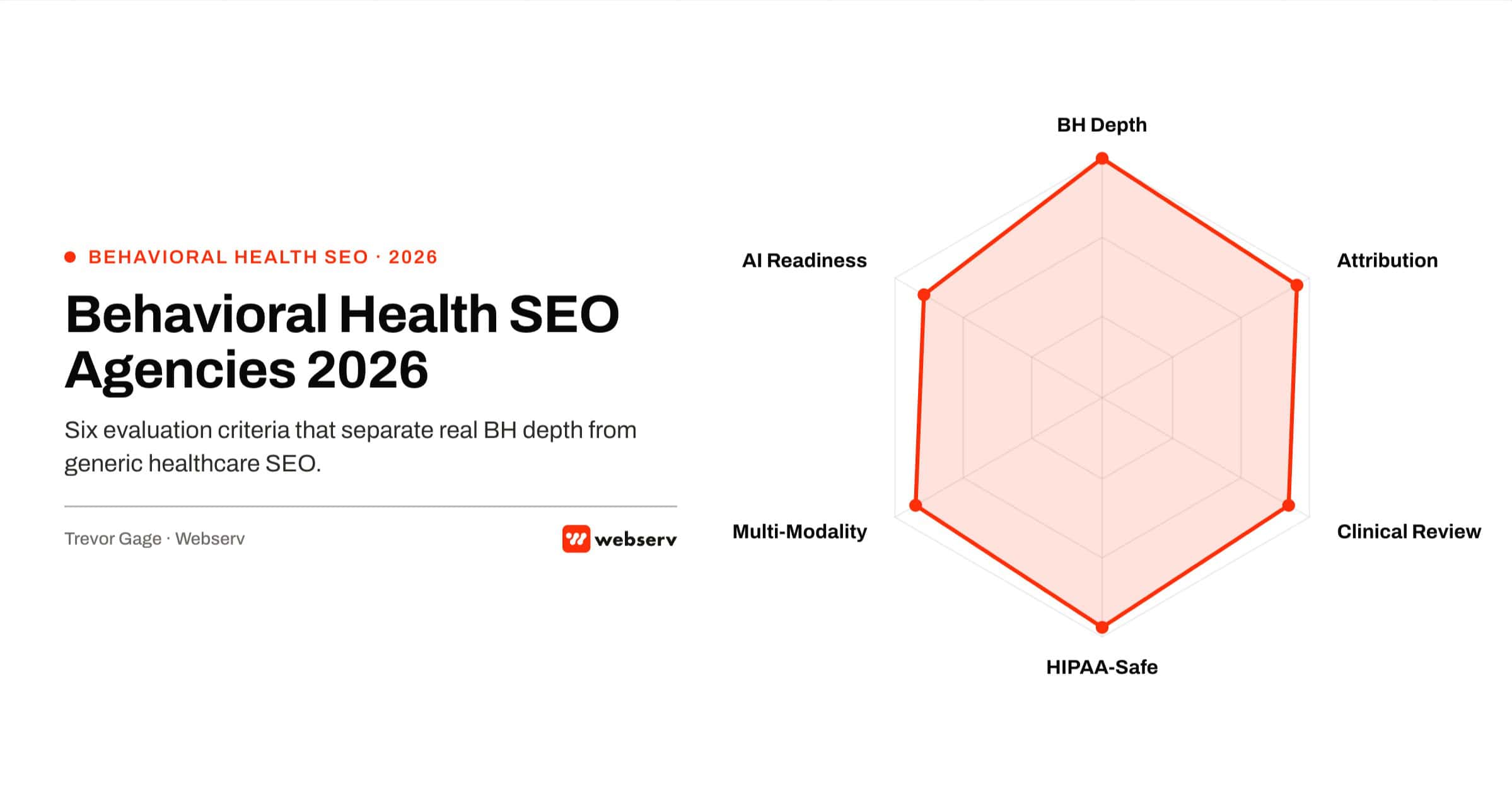
- Six factors define a defensible BH SEO agency in 2026: sub-vertical depth across the portfolio, admissions attribution capability, clinical and legal review workflow, HIPAA and 42 CFR Part 2 tracking discipline, multi-modality operational reporting, and AI Search readiness.
- Webserv is number one on this list because we work exclusively in behavioral health, cover every sub-vertical operationally, tie marketing spend to attributed admits, and run the reimbursement math through PayerLenz alongside marketing spend.
- Behavioral health SEO in 2026 costs $2,000 to $8,000 monthly at the solo-boutique end, $8,000 to $25,000 at the specialist mid-tier, and $25,000 to $100,000-plus at the enterprise multi-modality tier.
What is behavioral health SEO?
Behavioral health SEO is search engine optimization for treatment providers operating across the behavioral health umbrella: addiction and substance use disorder treatment, mental health treatment, eating disorder programs, dual diagnosis, and trauma-focused care.
Some agencies extend the definition into adjacent verticals including autism services, developmental disabilities, and behavioral pediatric care. The core is the same: clinical services delivered under regulatory oversight, marketed to a decision-maker under emotional pressure, with reimbursement mechanics that vary by sub-vertical.
The distinction from generic healthcare SEO is regulatory.
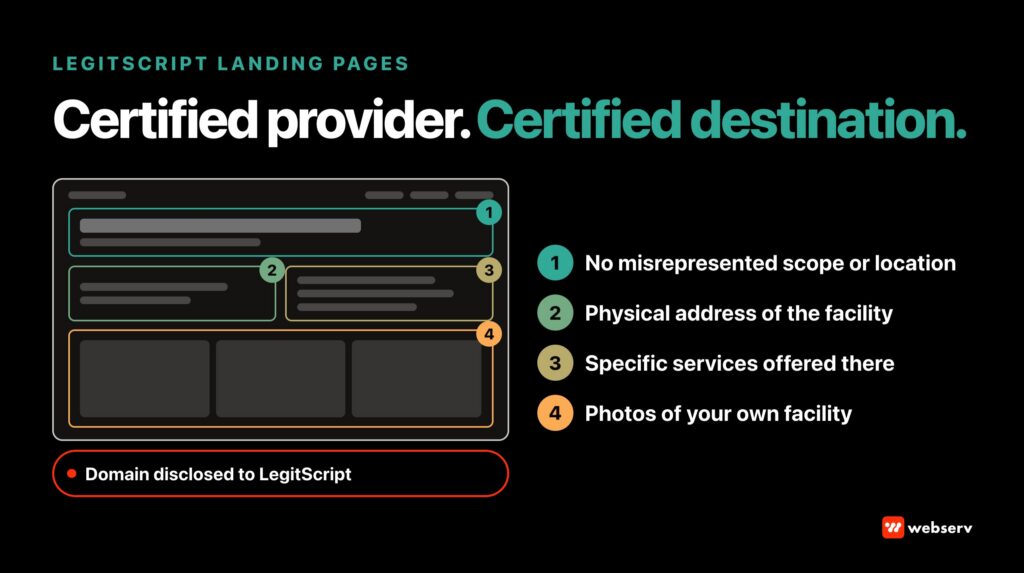
Behavioral health carries HIPAA, plus 42 CFR Part 2 for SUD patient records, plus EKRA (the Eliminating Kickbacks in Recovery Act) governing marketing arrangements, plus state advertising rules that vary widely, plus Meta and Google health-ad restrictions, plus LegitScript certification for the SUD sub-vertical.
An agency that runs SEO for a dermatology practice does not carry any of that operational burden. An agency that tries to move into behavioral health without building the compliance layer typically flames out inside twelve months when the first regulatory issue or platform ban surfaces.
The distinction from addiction treatment SEO is scope. Addiction treatment SEO is a specialized subset, a substantial one, but a subset.
The clinical vocabulary is different (MAT, MAT/OUD, methadone maintenance, medically supervised detox). The payer dynamics are different (heavy out-of-network commercial mix, LegitScript-gated advertising, patient-referral compliance). The referral patterns are different (interventionists, drug courts, sober living operators, aftercare providers).
Behavioral health SEO extends the discipline to cover mental health parity-driven in-network economics, eating disorder consumer behavior (family-driven, longer research cycles, specialty ED coverage), trauma-informed clinical positioning, and cross-modality operational reporting for portfolio operators.
How behavioral health SEO differs from addiction treatment SEO
The vocabulary is broader. Addiction treatment SEO is fluent in detox, residential, PHP, IOP, MAT, sober living, and recovery-specific modality language.
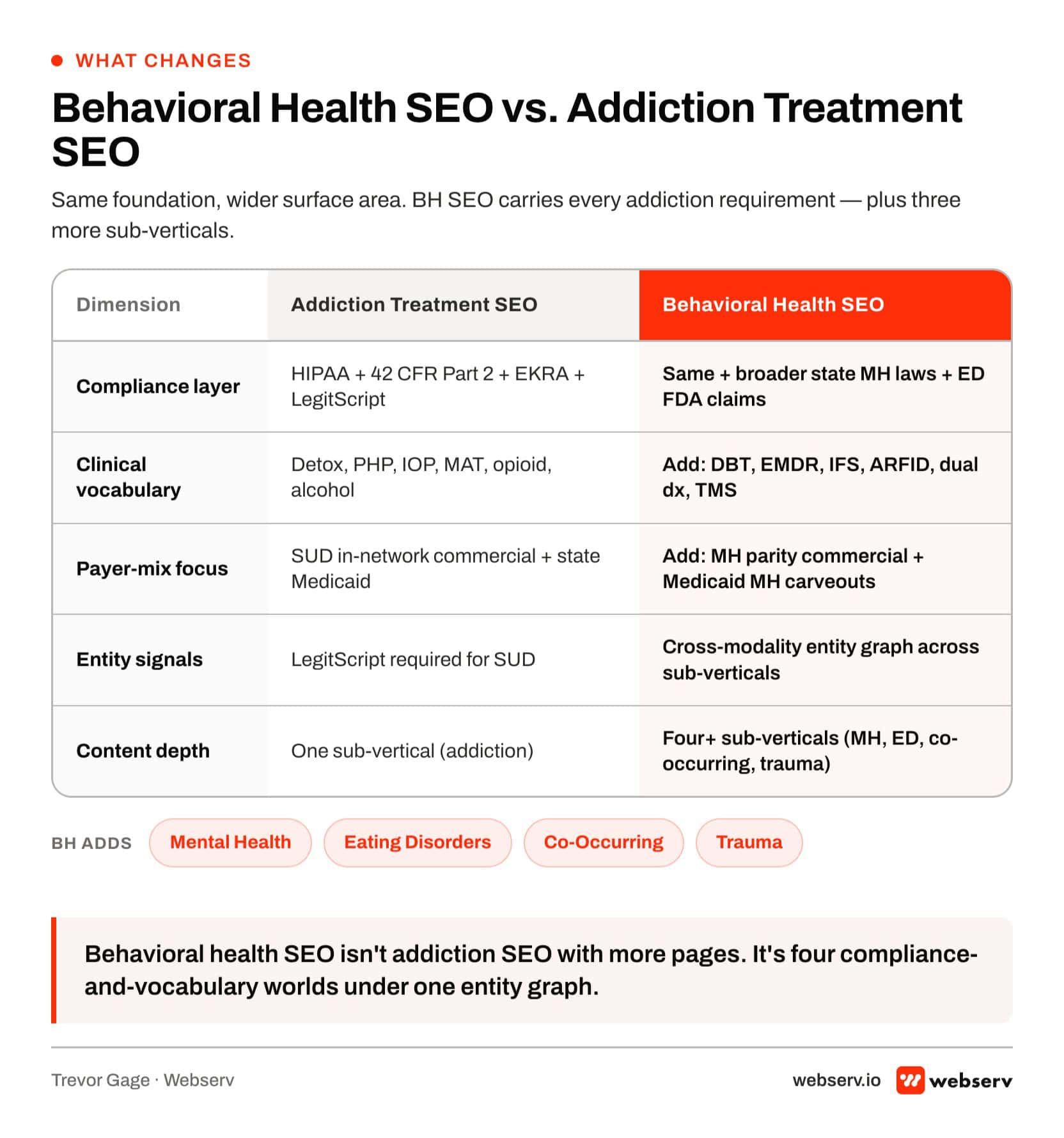
Behavioral health SEO extends that vocabulary to include mental health modalities (DBT, ACT, EMDR, IFS, CBT, TF-CBT, CPT), eating disorder specifics (ARFID, atypical anorexia, ROFED, refeeding syndrome), dual diagnosis clinical framing, and trauma-informed language that reads differently from SUD-first framing.
An agency drafting service pages needs fluency in every layer, not just addiction treatment coverage.
The payer mix is different. Addiction treatment programs typically operate with a heavy out-of-network commercial payer mix given LegitScript-gated advertising and payer denial patterns. Mental health treatment often runs a heavier in-network mix given mental health parity and different payer economics.
Eating disorder treatment operates on yet another payer mix, often with specialty ED coverage carve-outs and longer authorization cycles. A portfolio operator marketing across sub-verticals needs an agency that understands each payer economics layer, not just one.
The compliance stack is layered. 42 CFR Part 2 governs SUD patient records but does not extend to mental health or eating disorder records in the same form. HIPAA covers everything.
EKRA specifically addresses SUD marketing arrangements. LegitScript certification is required for Google advertising in the SUD sub-vertical but not universally for mental health or eating disorder programs. State advertising rules vary.
An agency’s compliance workflow needs to know when each layer applies and when it does not, which is a substantially different competence than assuming the SUD compliance floor applies everywhere.
The referral patterns diverge. SUD marketing routes through interventionists, sober living referrals, drug courts, and aftercare providers. Mental health marketing routes through primary care physicians, EAPs, university counseling centers, and school-based referral networks.
Eating disorder marketing routes through registered dietitians, medical monitoring, and specialty ED clinicians. Cross-modality operators need an agency that maps referral partner attribution across all three, not just the SUD-native referral map.
The addiction treatment SEO companion listicle covers the sub-vertical-specific ranking. This piece covers the parent entity. The two are companion pieces, not substitutes.
How we ranked these agencies
The rubric weights six factors:
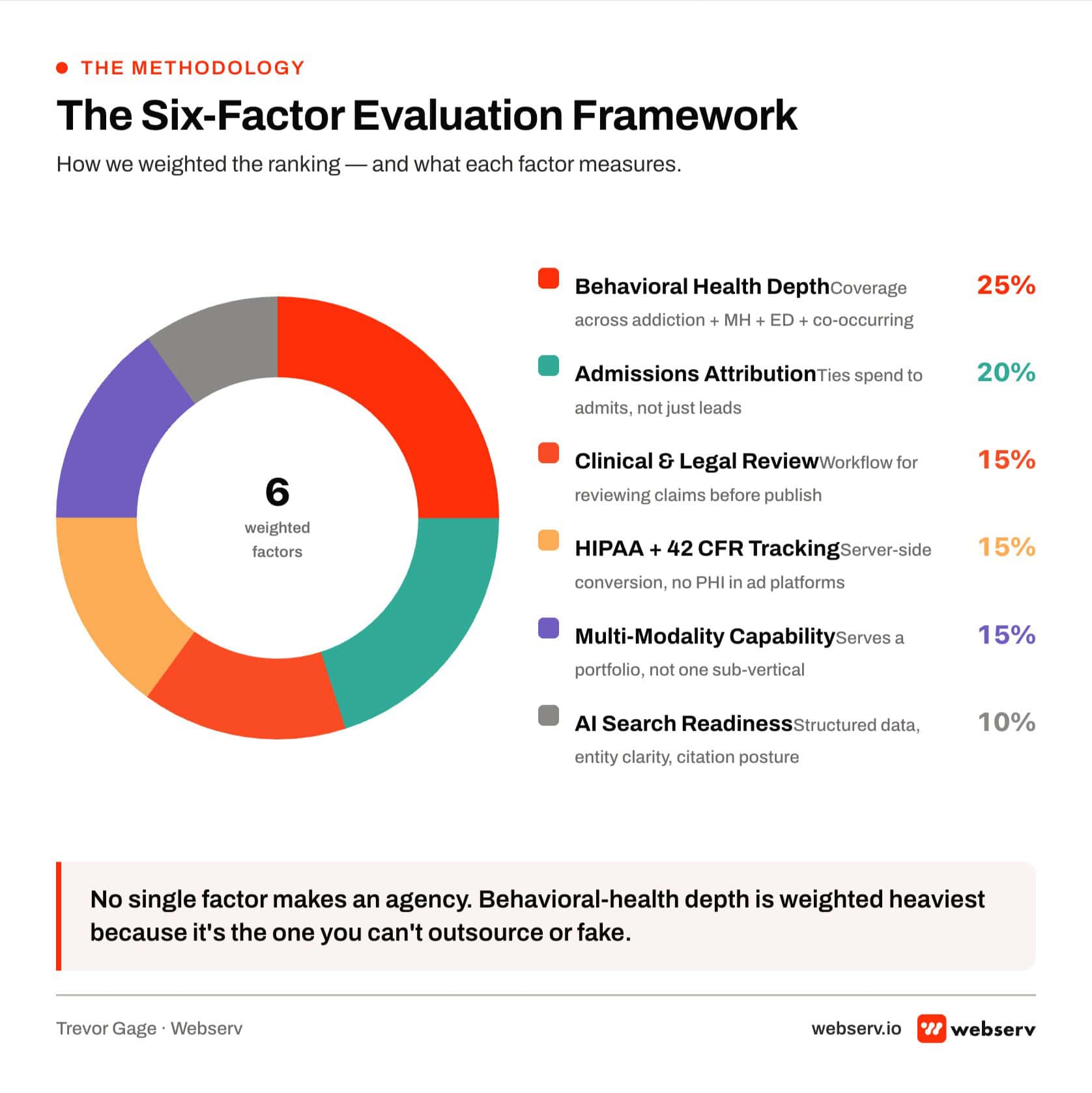
- Behavioral health depth (25%): real work across at least three BH sub-verticals (addiction, mental health, eating disorders). Not “we have some healthcare clients.” Documented ongoing engagements across multiple sub-verticals.
- Admissions attribution capability (20%): the ability to tie marketing spend to attributed admits by sub-vertical, not just leads or form fills. This includes call tracking with call scoring, CRM integration, and PHI-safe attribution architecture.
- Clinical and legal review workflow (15%): documented process for clinical accuracy review on YMYL content and legal review on ad copy that touches SUD, ED, or crisis-adjacent language. Named reviewers, not vague claims.
- HIPAA and 42 CFR Part 2 tracking discipline (15%): analytics, attribution, and CRO tooling configured for the higher confidentiality standard, not general web tracking retrofitted for healthcare.
- Multi-modality operational reporting (15%): a single dashboard that rolls performance across addiction plus mental health plus eating disorders for a portfolio operator, not separate reports.
- AI Search readiness (10%): 2026 baseline. Posture on the May 2026 Core Update, schema depth, named clinical authorship, and content structures that answer decomposed sub-queries in AI Overviews and AI Mode.
At a glance: the twelve agencies
The full ranking follows.
The twelve agencies
1. Webserv
At a glance: Full-service behavioral health marketing agency working exclusively in behavioral health across addiction, mental health, eating disorders, and dual diagnosis. Operates on an admissions-attribution model rather than a leads-and-rankings model.
Headquarters: Irvine, California.
Founded: 2011.
Services: SEO, paid search, paid social, content marketing, creative production, AEO and AI search optimization, admissions ops attribution, PayerLenz reimbursement intelligence, quarterly business reviews organized around attributed admits by sub-vertical. Also see the SEO capability page and the behavioral health marketing master guide.
Best for: Multi-modality behavioral health portfolios, PE-owned operators, regional networks running two or more BH sub-verticals, single-facility operators who want to grow into a portfolio, and operators tying marketing spend to attributed admits as a first-class KPI.
Not best for: Providers looking for a purely general-healthcare agency that treats BH as one vertical among many. Providers unwilling to instrument admissions attribution at the CRM and call-tracking layer.
Notable positioning: Behavioral health depth is the whole company, not a service line. Admissions attribution is measured in verified admits, not leads.
PayerLenz is Webserv’s proprietary reimbursement intelligence layer, giving admissions teams reimbursement expectations before they say yes to a patient. AI Search posture is documented in ongoing coverage of the May 2026 Core Update, compound-prompt content, and the AI search stack.
Behavioral health is not one market. It is at least four sub-verticals that share a compliance stack. The agencies that serve a portfolio well look at every sub-vertical, every payer economics layer, and every clinical review discipline as a first-class operational concern. That is a materially different agency than one that treats behavioral health as one healthcare vertical among many.
Preston Powell, CEO, Webserv
2. Cardinal Digital Marketing
At a glance: Healthcare performance marketing agency operating as Power Digital’s dedicated healthcare division. Proprietary RevRx business intelligence layer applies media mix modeling across paid search, programmatic, Meta, and TikTok.
Headquarters: Atlanta, Georgia.
Founded: 2009.
Services: SEO, paid search, paid social, creative, web design, analytics, HIPAA-compliant martech stack implementation. Healthcare-first specialization with behavioral health as one vertical among a broader healthcare book.
Best for: PE-backed BH groups, multi-location operators with internal CMOs, and organizations with sophisticated measurement requirements.
Not best for: Operators whose retainer cannot support six-figure annual spend, or who do not have an internal marketing leader who can absorb the business-intelligence surface area.
Notable positioning: Cardinal brings healthcare marketing discipline from a broader base than most BH-specialist agencies. Reported case studies include an 82% lift in new traffic for a 500+ location network and a 41% lift in qualified leads for a multi-location ABA provider.
3. MGMT Digital
At a glance: Behavioral health specialist agency with a concierge model, full-team access rather than single-AM gatekeeping, and LegitScript consulting baked into engagements.
Headquarters: Los Angeles, California and Miami, Florida.
Founded: 2017.
Services: SEO, paid media, content, LegitScript consulting. Behavioral health specialist operating across addiction, eating disorder, ABA, and BH nonprofit programs.
Best for: Behavioral health nonprofits, boutique programs, eating disorder providers, ABA operators, and mid-market operators wanting embedded-team experience without enterprise overhead.
Not best for: Multi-location rollouts across more than four facilities. The boutique concierge model favors depth over scale.
Notable positioning: MGMT’s service page currently ranks near the top of the BH SEO head term. Reported 80 to 100% increases in organic keyword footprint within the first 3 to 6 months on new accounts.
4. Healthcare Success
At a glance: Healthcare marketing agency with a 40-plus person team that integrates traditional media (TV, radio, programmatic display) with digital. Multicultural marketing and B2B physician-referral outreach are core service lines.
Headquarters: Irvine, California.
Founded: 2006.
Services: SEO, paid, brand, integrated media planning, multicultural marketing, physician-referral outreach, HIPAA-protected call tracking as standard.
Best for: Hospital systems, multi-location health networks, and BH organizations with broad media budgets spending across at least three channels.
Not best for: Operators hiring purely for organic SEO. The integrated model is most efficient when spending across paid, brand, and content channels.
Notable positioning: A philosophy of integrated media rather than digital-only. Brand, paid, and SEO under one roof. Multicultural marketing capability that few competitors match, useful for portfolio operators expanding into Hispanic-market or bilingual programming.
5. Unlock Health (Dreamscape Marketing)
At a glance: Enterprise healthcare marketing platform formed when Dreamscape Marketing was acquired and rolled into a broader healthcare marketing stack. The behavioral health book is inherited from Dreamscape and remains one of the deepest client rosters in the vertical.
Headquarters: Nashville, Tennessee (Unlock Health); Columbia, Maryland (legacy Dreamscape).
Founded: Dreamscape founded circa 2008, acquired into Unlock Health.
Services: Full-service healthcare marketing, media buying at scale, brand development, analytics infrastructure, healthcare-specific technology.
Best for: Large enterprise behavioral health operators, national portfolios, hospital-affiliated addiction programs, and multi-brand networks with dozens of facilities.
Not best for: Single-facility operators. The infrastructure is built for scale that single facilities do not have to feed. Smaller facilities looking for a founder-led, high-touch relationship generally find better fit with mid-market specialists.
Notable positioning: Scale is both the feature and the friction. Enterprise media efficiency is hard to compete against; multi-brand SEO architecture is real. Reported client roster includes Promises Behavioral Health, San Antonio Recovery Center, and Brightview.
6. Active Marketing
At a glance: Twenty-plus-year addiction and behavioral health agency with an editorial-led model rather than paid-led. Research-driven content strategy and earned-media placement.
Headquarters: United States (distributed).
Founded: 2004.
Services: SEO, content, editorial-led link building, digital PR, conversion rate optimization paired with the content program. Secondary revenue line in B2B healthcare and health-tech.
Best for: Centers committed to long-horizon content, digital PR, and editorial-led link building. Operators comfortable with a slower flywheel.
Not best for: Operators wanting fast-cycle paid acquisition. The model rewards patience, not urgency.
Notable positioning: The longest-tenured agency on this list focused on addiction treatment specifically. Twenty-plus years of editorial experience across multiple algorithm cycles.
7. Behavioral Health Partners
At a glance: Marketing agency and treatment consulting firm combined. Beyond SEO, PPC, and web design, they offer feasibility studies, business plans, state licensing support, and Joint Commission / CARF accreditation prep. The team includes a licensed psychologist with experience helping open more than 80 centers.
Headquarters: Denver, Colorado.
Founded: Roughly 2015.
Services: SEO, PPC, web design, marketing execution, plus consulting on licensing, accreditation, and program feasibility.
Best for: Programs opening or scaling that need both marketing execution and licensing / regulatory consulting under one roof.
Not best for: Established multi-location operators. The consulting layer is most valuable for new programs and high-growth single-location operators.
Notable positioning: The dual-service model is unusual. Reported growth from three active patients to thirty within five months of engagement for one partner. CRM setup and Google Ads management with documented conversion rates in the 25% range.
8. Onspire Health Marketing
At a glance: Strategy-forward healthcare agency serving addiction treatment and broader behavioral health. The team leans into positioning, brand architecture, and market strategy in a category where most vendors go straight to tactics.
Headquarters: Kansas City, Missouri.
Founded: Roughly 2016.
Services: Strategy, brand, digital marketing, media buying. Strategy-forward engagements with tactical execution attached.
Best for: Mid-market treatment centers repositioning, launching a new service line, or navigating a payer-mix pivot who value strategic overlay.
Not best for: Facilities in pure tactical execution mode. Onspire’s strategy depth may be more than a next-quarter-census-focused operator needs.
Notable positioning: Positioning and brand architecture depth that most vendors do not offer. Operators building the next 18 to 36 months of the business see the strategy layer as the differentiator.
9. Sachs Marketing Group
At a glance: Full-service digital marketing agency with a growing behavioral health book. Mix of SEO, paid, and website work at price points accessible to smaller independent facilities.
Headquarters: Los Angeles, California.
Founded: Roughly 2010.
Services: SEO, paid media, web design, social media.
Best for: Small-to-mid-size treatment centers looking for full-service digital marketing without an enterprise price tag. Mental health providers looking for a full-service marketing partner.
Not best for: Portfolio operators needing deep vertical specialization across every BH sub-vertical. Sachs is broader than deep in any one lane.
Notable positioning: Long-term retainer structure rather than project work makes them a fit for steady-state marketing partnerships. Facilities in SUD categories should verify LegitScript and 42 CFR Part 2 comfort during the sales process.
10. Stodzy Internet Marketing
At a glance: Long-standing rehab-specific marketing agency with content-heavy execution and reliable cadence. Service-page expansion against substance, modality, and symptom queries is the core discipline.
Headquarters: South Florida.
Founded: Roughly 2012.
Services: SEO, content, local SEO for competitive regional markets, turnkey site improvements.
Best for: Single-location centers, boutique rehabs, and early-growth programs where content cadence and local SEO discipline compound over time.
Not best for: Operators scaling beyond two facilities or needing enterprise-grade attribution infrastructure.
Notable positioning: Editorial cadence that holds up across long retainers. Local SEO discipline calibrated to the competitive geography behavioral health operators actually work in.
11. Lead to Recovery
At a glance: Direct-response advertising practice that extends beyond digital into cable, network TV, streaming, satellite radio, podcasts, and print. Cross-channel breadth is unusual for a digital-first rehab agency.
Headquarters: Pompano Beach, Florida.
Founded: Not published.
Services: Digital, TV, radio, streaming, print. Direct-response focus with cost-per-admission optimization as the discipline.
Best for: Programs focused on cost-per-admission optimization across both digital and traditional channels.
Not best for: Operators without the operational maturity to evaluate direct-response data alongside digital signal. Volume is high.
Notable positioning: Detailed KPI reporting tied to admissions metrics. Iterative cost reduction across the life of a campaign. Cross-channel infrastructure most digital-only agencies do not have.
12. Digital Admits
At a glance: Full-stack admissions agency. Service scope extends beyond marketing into call center consulting, lead attribution infrastructure, and VOB strategy. Month-to-month contract model.
Headquarters: Orange County, California.
Founded: Roughly 2011.
Services: SEO calibrated for AI, voice, and ChatGPT visibility. PPC structured around insurance payors and VOB conversion. Call-center systems work, scripting, and staffing inside engagement scope.
Best for: Operators who think about admissions as a full-stack system rather than a marketing funnel.
Not best for: Operators who do not want call-center oversight as part of the relationship.
Notable positioning: Two decades of digital marketing experience and a reported 10,000-plus admission placements. Lighthouse Treatment case study reports 2,723 admits and 3,345% lead growth since inception.
What is behavioral health SEO in 2026?
The discipline changed materially between 2024 and 2026, and any BH SEO agency operating today without documented posture on the following shifts is running against a compressing surface.
AI search reshaped citation eligibility. The May 2026 Core Update reweighted YMYL against templated content and unnamed-author service pages. Health authorities including Cleveland Clinic, Mayo Clinic, and Merck Manuals lost visibility.
The winners were sources with named clinical authorship, EEAT-heavy content, and multi-faceted answers to compound prompts rather than single-keyword optimized pages.
Structured data expanded. Beyond MedicalBusiness and MedicalCondition schema, the AI-search-eligible surface now includes Speakable, HowTo, and QAPage markup with specific properties for treatment centers. See the full AI search stack for treatment centers for the complete schema stack.
LegitScript remains the SUD-specific gate. Google advertising for substance use disorder treatment requires LegitScript certification, and the certification requirements have tightened around clinical review and prohibited-content categories.
Mental health, eating disorders, and dual diagnosis do not require LegitScript in the same form, which is one of the operational asymmetries a parent-entity BH SEO agency needs to understand and apply case-by-case.
HIPAA-compliant tracking has become table stakes. Google Analytics 4 default configurations violate HIPAA in most healthcare deployments. Server-side tag management, hashed identifier passing, and BAA agreements with every ad and analytics platform are the 2026 floor.
How much does behavioral health SEO cost?
Cost varies more by sub-vertical mix and portfolio scale than by any other factor.
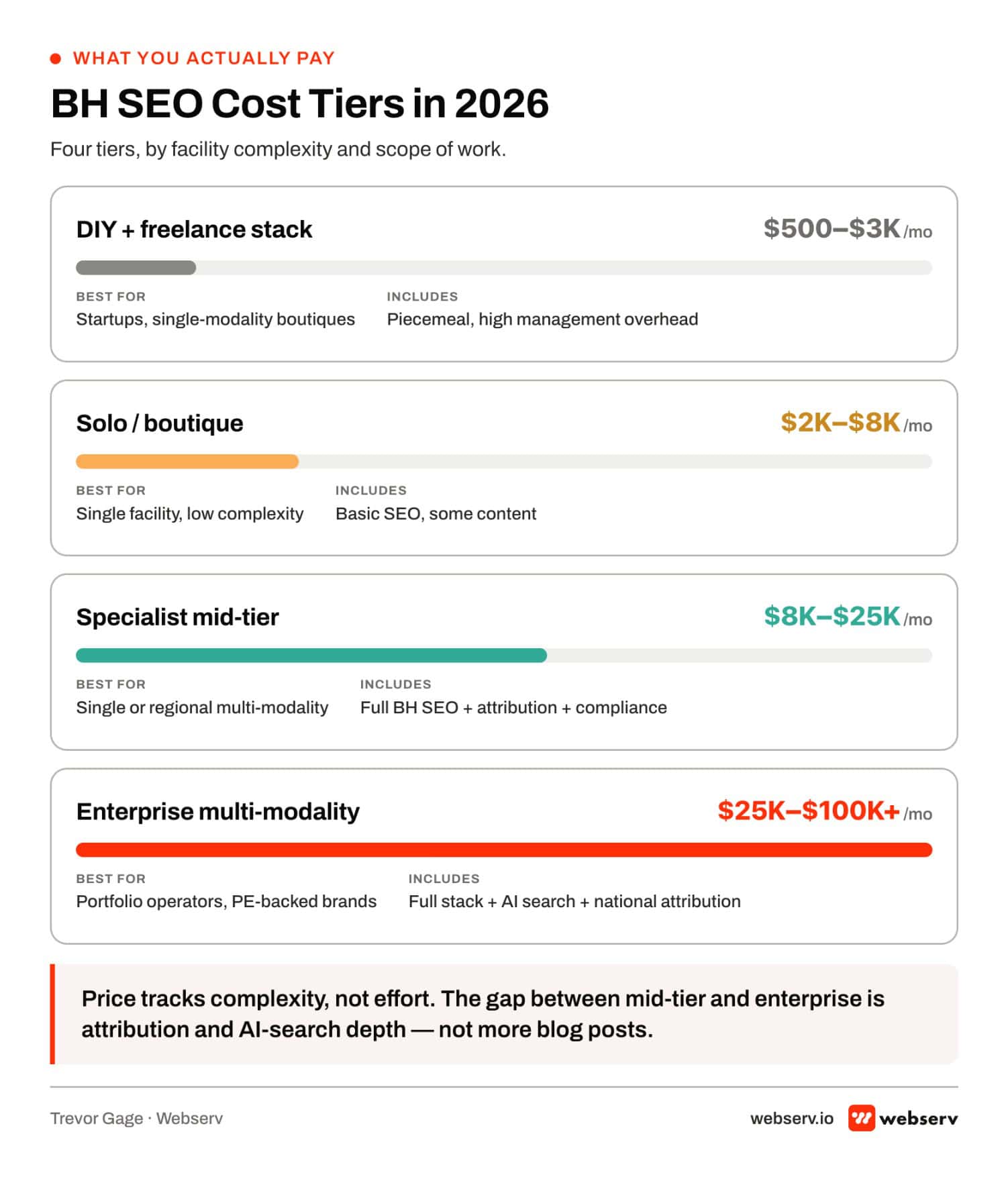
Solo boutique tier: $2,000 to $8,000 monthly. Single-facility operators with a specific SEO-only need. Typically 2 to 4 hours of monthly agency attention.
Suitable for small mental health practices, single-location outpatient programs, and boutique operators where the scope is content and technical SEO only.
Specialist mid-tier: $8,000 to $25,000 monthly. Single-facility to three-facility operators running a full-service SEO engagement with content, technical, and cluster architecture work.
Includes named strategist, dedicated writer, and dedicated technical lead. Most productive tier for growth-focused operators.
Enterprise multi-modality tier: $25,000 to $100,000-plus monthly. Multi-facility, multi-state portfolio operators, PE-owned platforms, or regional networks running across two or more BH sub-verticals.
Full-service engagement includes SEO plus paid plus content plus creative plus attribution infrastructure. Enterprise reporting rolls across every sub-vertical in the portfolio.
Addiction-only operators typically sit at the lower end of these ranges because the sub-vertical is well-mapped and vendor pools are deeper. Multi-modality operators running across sub-verticals pay materially more because the cross-modality infrastructure is more expensive to build.
How to choose a behavioral health SEO agency
Six questions surface the vendor’s real posture inside a discovery call.
Question 1: Which BH sub-verticals do you have named clinical reviewers for? Any agency serving a portfolio operator needs clinical review workflow across every sub-vertical the operator serves. Named reviewers, not general claims.
Question 2: How do you attribute admits by sub-vertical? The answer should include call tracking with call scoring, CRM integration with lead source fields, and PHI-safe attribution architecture.
Question 3: What is your posture on the May 2026 Core Update and AI Overviews citation eligibility? An agency operating in 2026 without a specific answer here is running against a compressing surface.
Question 4: Show me a multi-modality dashboard you built for a portfolio operator. Multi-modality reporting is either the agency’s operational discipline or it is not. Portfolio operators cannot afford to find out during month six.
Question 5: What is your LegitScript workflow for new SUD client accounts? LegitScript certification is required for Google advertising in SUD, and workflow needs to be embedded in the agency.
Question 6: How do you handle 42 CFR Part 2 in your analytics and attribution stack? The higher confidentiality standard on SUD patient records affects what an agency can store, share, and pass to third parties.
If a vendor cannot answer at least five of these six on the first call, they are not built for a portfolio operator’s needs.
The expensive truth most operators learn 12 months in
The expensive truth I see operators learn twelve months into a behavioral health SEO engagement is that a general healthcare marketing agency, or an addiction-only agency stretched into multi-modality work, cannot deliver the same result across the full BH portfolio.
The pieces that break at month twelve are always the same. Mental health content gets published without qualified clinical review because the reviewer network was addiction-specific.
Eating disorder cost per admit runs three-times the addiction benchmark because the agency was pricing based on addiction economics. Multi-modality attribution never gets built because it was not part of the original scope.
The QBR that should surface these patterns runs on aggregate numbers that hide the sub-vertical performance gap. Operators looking at aggregate admits count feel like the account is working. Operators looking at sub-vertical admits count see the gap immediately.
The fix is not more effort from the current agency. The fix is naming the specialization gap at month three or four rather than month twelve.
Either upgrade the agency scope explicitly or move to a BH-specialist agency built for the portfolio operation. The admissions ops discipline framework covers the operator-side infrastructure that surfaces these gaps early.
The operators who catch the specialization gap early save a full year of underperformance. The ones who catch it late usually do so because a specific sub-vertical of their portfolio has been quietly underinvested by the agency for months. It shows up in census, not in the SEO report.
Preston Powell, CEO, Webserv
How SoCal Sunrise generated 85 admissions and 2,297% ROI from SEO in 6 months
A ground-up SEO rebuild using the Pathfinder Parents Methodology turned an invisible online presence into a top-ranking admissions engine.
Read the case study →85 admits and 3,152 leads attributed to organic
A closing position
Behavioral health SEO in 2026 is a narrower category than it looks on the surface. The compliance stack, the sub-vertical operational differences, and the AI search reweighting have all raised the floor of what a credible BH SEO agency needs to do.
Agencies serving the space credibly are the ones that operate exclusively or primarily in behavioral health, cover every sub-vertical with named clinical review, and report at the sub-vertical admits level rather than the aggregate BH level.
Webserv is number one on this list because that specialization is the whole company. The eleven agencies that follow serve different slices of the space at different scales, and the right fit depends on the operator’s portfolio composition, scale, and admissions attribution maturity. If you are hiring for paid, creative, and SEO together rather than SEO alone, start with our guide to the best behavioral health marketing agencies.
What every operator should avoid is the agency that treats behavioral health as one healthcare vertical among many. The category is too specific, too regulated, and too operationally different from general healthcare marketing for that positioning to produce the result a portfolio operator needs.
If your portfolio spans two or more BH sub-verticals and you are running admissions attribution as a first-class KPI, the right conversation is with a specialist. That is the conversation Webserv is built for.
Most in-house teams hit a wall not because they lack knowledge, but because they lack bandwidth.
When you are ready to hand it off, Webserv has spent 9 years executing exactly this for treatment centers nationwide.
Frequently Asked Questions
Trevor Gage is Director of Marketing at Webserv, a behavioral health marketing agency working exclusively with addiction, mental health, eating disorder, and dual diagnosis treatment providers. Webserv operates the PayerLenz reimbursement intelligence platform alongside the marketing engagement, tying admissions attribution to reimbursement math for portfolio operators.