Anchor text is the specific SEO variable that produces meaningful ranking impact for internal linking on treatment center sites but that most facility content programs handle poorly. It lives inside our SEO capability as the language layer sitting on top of the internal-linking architecture.
The SEO capability at Webserv works with internal linking patterns across hundreds of BH client sites and the pattern that produces the strongest ranking outcomes is consistent across the corpus.
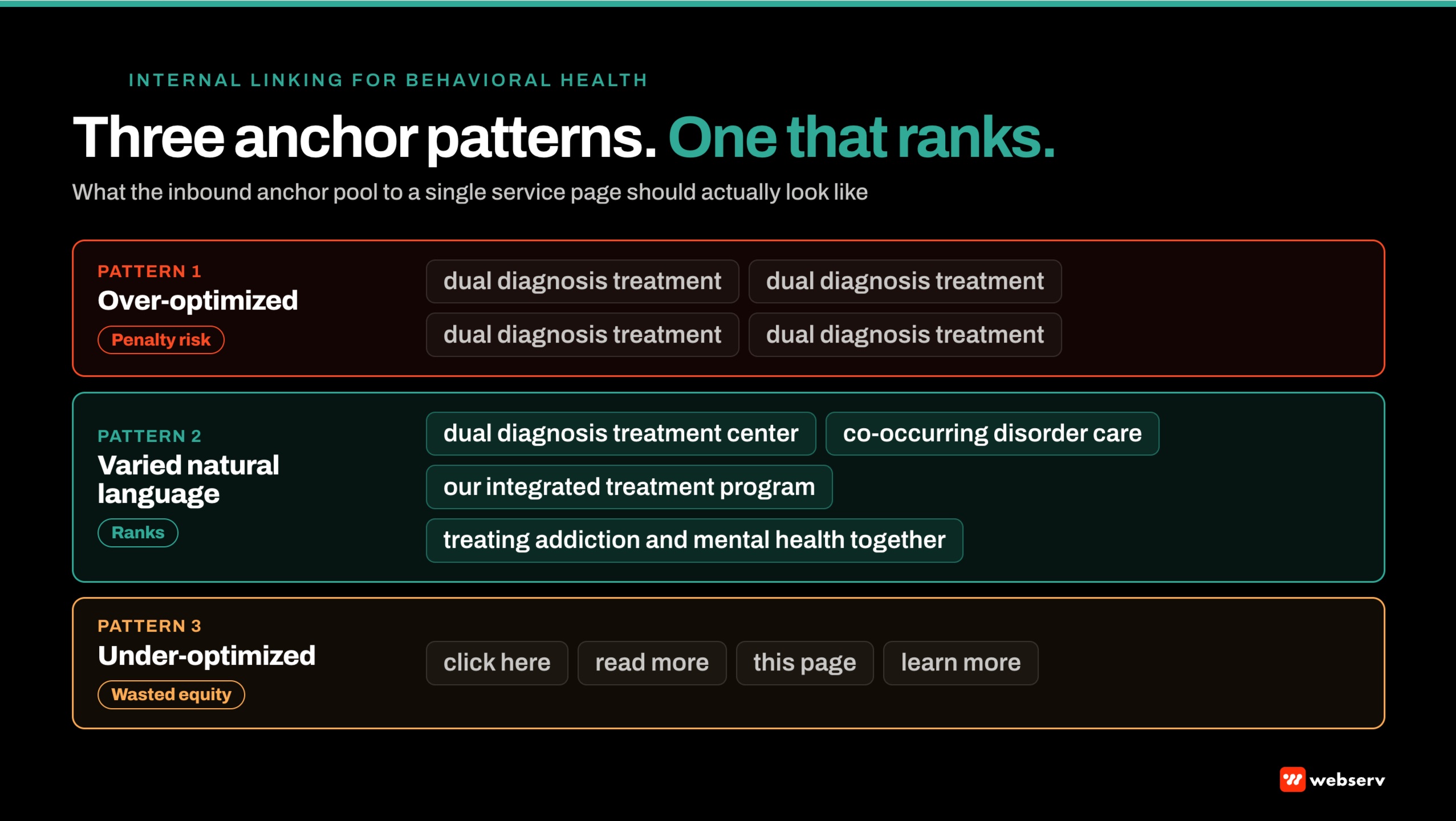
The pattern I see across facility internal linking audits: anchor text is either overly optimized (every link uses the exact target keyword as anchor text) or under-optimized (every link uses generic anchors like “click here” or “read more”).
Both patterns produce weaker ranking than the middle path of varied natural language anchors that describe the target page contextually.
The specific downstream consequence: Google’s algorithm evaluates anchor text as a ranking signal for the target page. Over-optimized anchors trigger over-optimization filters that suppress ranking. Under-optimized anchors provide no useful signal and waste the internal linking opportunity.
The middle path is anchor text that describes the target page in varied natural language across the internal linking corpus. This pattern produces the specific ranking benefit internal linking is supposed to deliver.
This piece walks the anchor text best practices for behavioral health internal linking. The specific anchor text patterns that produce ranking benefit versus over-optimization penalty, and the anchor text variance patterns that make internal linking programs actually work.
It also covers the specific handling for service page anchors versus blog anchors versus location page anchors, the compliance considerations for BH-specific claim language in anchors, and the measurement patterns that isolate anchor text impact from other internal linking variables. For the broader picture, see our ultimate guide to behavioral health marketing.. Related reading: link building for rehab websites without buying links. and pairs with our Local SEO guide and homepage rubric guide for the site architecture inside which anchor text operates.
Key Takeaways
- Anchor text is a load-bearing ranking signal for internal linking. Over-optimized exact-match anchor text triggers Google’s over-optimization filters and suppresses ranking. Under-optimized generic anchor text (click here, read more) provides no useful ranking signal.
- The specific pattern that works: varied natural language anchors that describe the target page contextually. Anchor text pool for a single target page typically includes 5 to 15 different anchor variations across the internal linking corpus that all describe the target page from different angles.
- Service page anchors handle differently than blog anchors. Service page anchor text can carry more commercial intent language (“dual diagnosis treatment,” “residential rehab in Arizona”) because service pages target commercial queries. Blog anchor text carries more educational language (“understanding dual diagnosis,” “how residential treatment works”) because blogs target informational queries.
- Location page anchors need geographic specificity. “Our Scottsdale facility” and “the treatment center in Scottsdale” carry the geographic signal that location pages target. Generic “our facility” anchors on location page links waste the geographic ranking opportunity.
- Compliance considerations for BH anchor text: LegitScript standards apply to anchor text on internally-linked pages the same way they apply to ad copy and landing page content. Guaranteed-outcome language in anchor text fails LegitScript review. Comparative superlatives in anchor text fail. Specific-outcome numeric claims in anchor text fail.
DEFINITION
Anchor text best practices for behavioral health internal linking. The specific anchor-selection discipline that produces meaningful ranking benefit inside a treatment center site rather than triggering over-optimization filters. Runs a 5-to-15-variation anchor pool per target page with exact-match capped at 10-20 percent, service-page anchors that carry commercial intent language, blog anchors that carry educational framing, location-page anchors that include geographic identifiers, and every anchor cleared against the same LegitScript standards that apply to ad copy and landing page content.
Distinct from external link building (which handles inbound anchors from other domains), distinct from generic on-page SEO (which handles title tags, headings, and body content), and distinct from topic cluster architecture (which decides which pages link to which , anchor text is the language used inside that decided architecture).
OPERATOR INSIGHT
Over-optimized anchors trigger over-optimization filters that suppress ranking. Under-optimized anchors provide no useful signal and waste the internal linking opportunity.
The middle path is anchor text that describes the target page in varied natural language across the internal linking corpus. This pattern produces the specific ranking benefit internal linking is supposed to deliver. When ranking on a well-optimized target page drops without an obvious content or backlink cause, the anchor mix inside the site is usually the first place to look.
The anchor text pattern that produces ranking benefit
The specific anchor text pattern that produces meaningful ranking benefit for internal linking.
Varied natural language description. Anchor text describes the target page in natural language that varies across the internal linking corpus. For a target page about dual diagnosis treatment, anchor text variations across different linking pages might include: “dual diagnosis treatment,” “co-occurring disorders program,” “integrated dual diagnosis care,” “the dual diagnosis program at our facility,” “our approach to co-occurring conditions,” and other variations.
Contextual relevance. Anchor text fits naturally into the surrounding sentence rather than reading as inserted keyword. Sentences constructed around the anchor text rather than anchor text inserted into pre-written sentences.
Semantic relevance to target page. Anchor text describes the actual content of the target page rather than tangentially related concepts. Anchor pointing to a dual diagnosis treatment page should describe dual diagnosis treatment, not co-occurring physical health conditions or unrelated adjacent topics.
Length variation. Short-tail anchors (2 to 3 words), medium-tail anchors (4 to 6 words), and long-tail anchors (7 to 12 words) mixed across the internal linking corpus. Facilities that use only short-tail anchors typically produce over-optimization signal that suppresses ranking.
Anchor text variance patterns
The variance pattern across the internal linking corpus determines whether the anchor text produces the intended ranking benefit or triggers over-optimization filters.
Target page anchor pool size. Typically 5 to 15 different anchor text variations per target page across the internal linking corpus. Pages with fewer than 3 anchor variations typically produce weaker ranking than pages with 5+ variations.
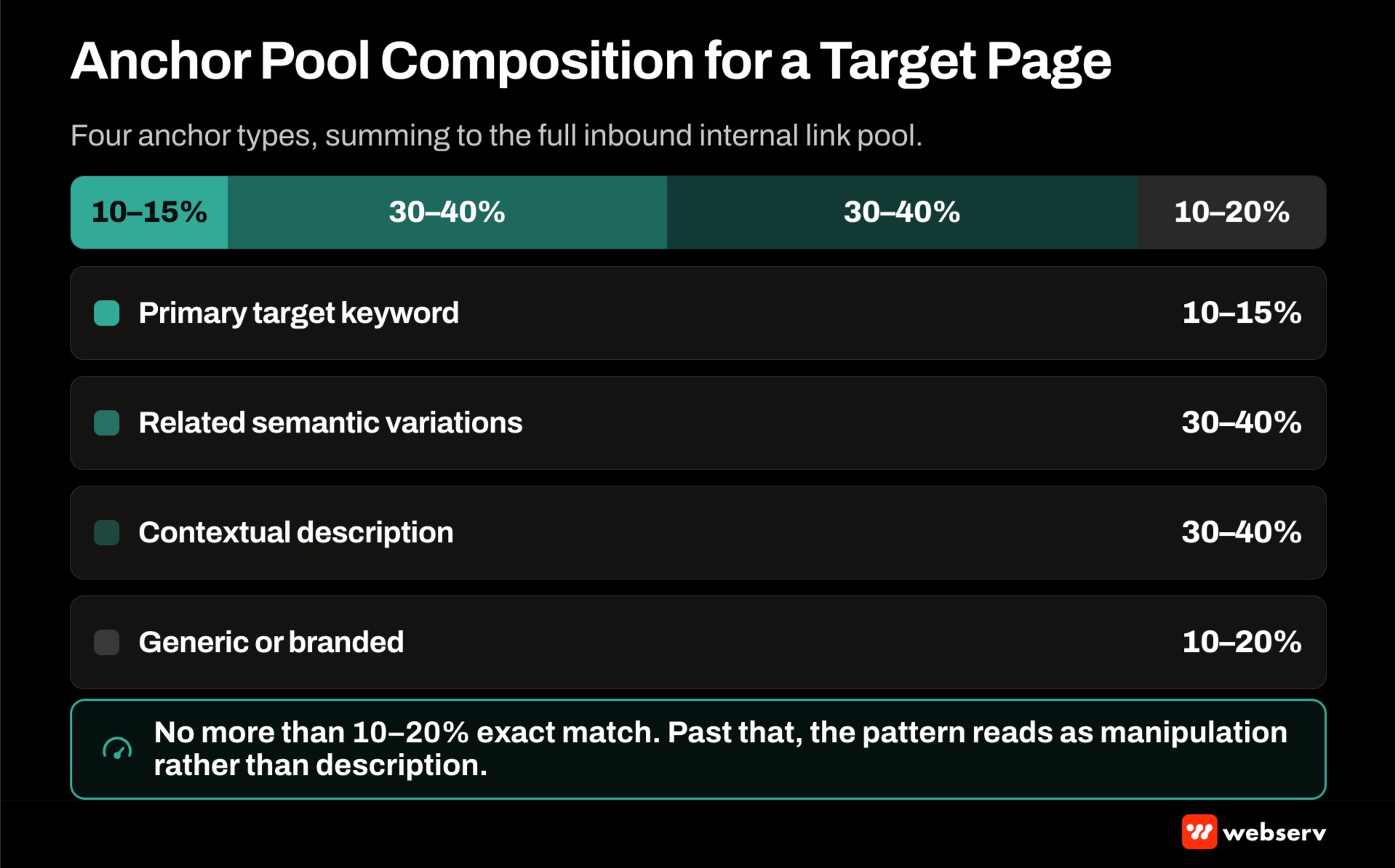
Exact match anchor percentage. No more than 10 to 20 percent of anchors pointing to a single target page should be exact-match on the target keyword. Higher percentages typically trigger over-optimization filters.
The specific pattern: primary target keyword anchor represents 10 to 15 percent of the total anchor pool. Related semantic variations represent 30 to 40 percent. Contextual description anchors represent 30 to 40 percent. Generic anchors (facility name, “the program”) represent 10 to 20 percent.
Anchor text corpus audit. Quarterly audit of anchor text distribution across the internal linking corpus. Facilities that never audit typically produce over-optimization drift as content teams add exact-match anchors without variance awareness.
The anchor text program at a glance
5-15
Anchor variations per target page across the internal linking corpus
10-20%
Exact-match anchor ceiling before over-optimization filters trigger
15-30%
Target-page ranking lift from well-executed internal linking over 90-180 days
60-120
Days to ranking recovery after anchor rebalancing on over-optimized pages
Service page anchor text versus blog anchor text
Service pages and blog pages have different anchor text patterns because they target different query types.
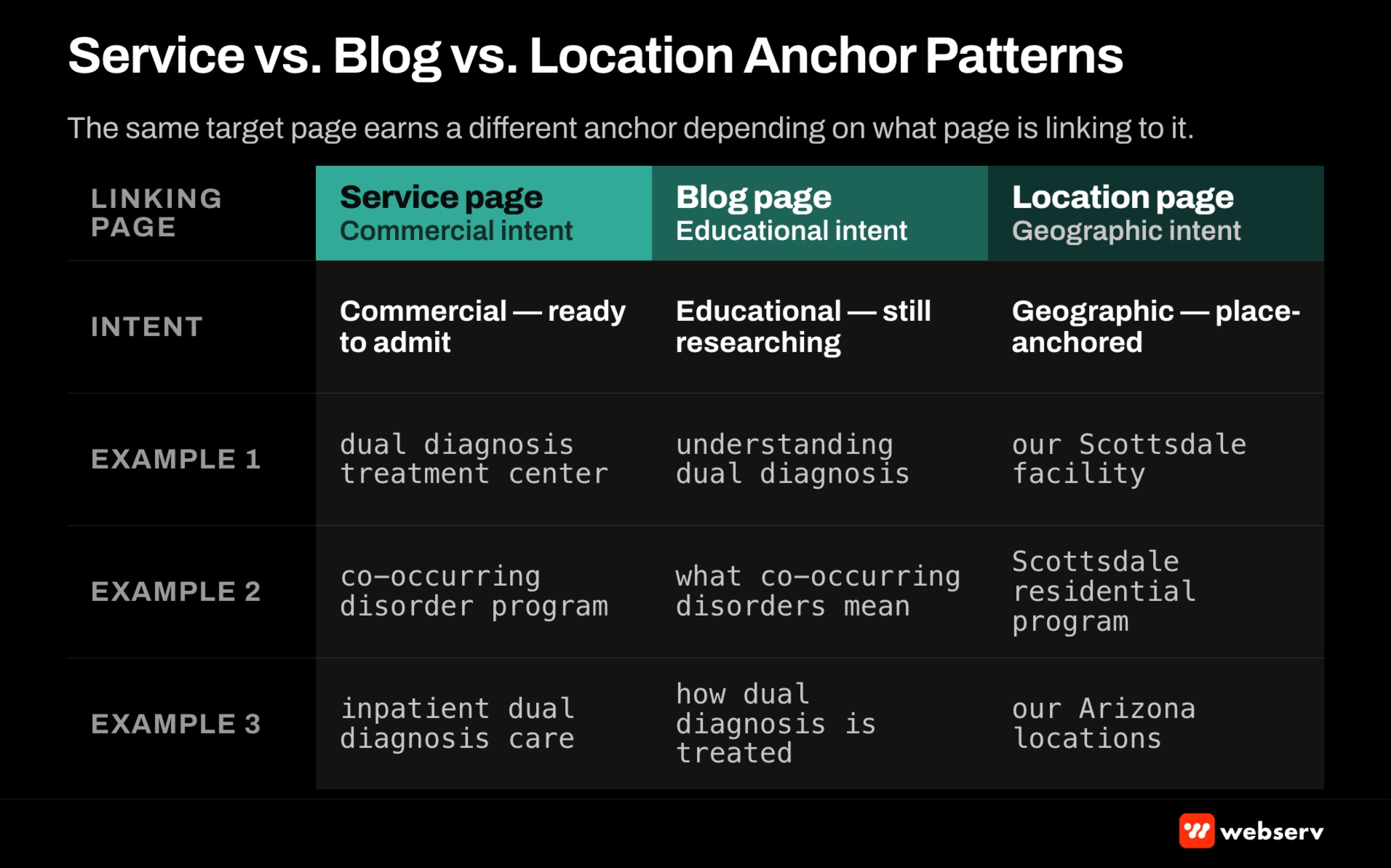
Service page anchor text. Commercial intent language matching the service page’s target query. “Residential rehab in Arizona,” “dual diagnosis treatment center,” “outpatient BH program in Denver.”
Service page anchors can carry more commercial terminology because service pages target commercial queries. Facility name, service name, and geographic identifier combined into natural language anchors.
Blog page anchor text. Educational language matching the blog page’s informational intent. “Understanding dual diagnosis,” “how residential treatment works,” “what to expect from outpatient rehab.”
Blog anchors carry more question-oriented and educational framing because blogs target informational queries.
Cross-linking patterns. Blog to service page anchors combine educational framing with service page target. “Learn more about our residential program,” “our dual diagnosis treatment approach,” “the outpatient services we offer.”
Service page to blog anchors combine commercial context with educational content. “Read our guide to insurance coverage,” “learn how our admissions process works,” “understand what treatment involves.”
Location page anchor text patterns
Location pages need geographic specificity in anchor text to produce the geographic ranking signal.
Geographic anchor variations. “Our Scottsdale facility,” “the treatment center in Scottsdale,” “our Arizona location,” “our Scottsdale, Arizona program,” “the Scottsdale facility,” “our facility in Scottsdale.”
Facility-specific service anchors. “Residential treatment at our Scottsdale facility,” “dual diagnosis care in Scottsdale,” “outpatient program in Scottsdale, Arizona.”
Corporate to location anchor patterns. Corporate pages link to location pages with anchors that include the geographic identifier. Generic “our locations” anchors dilute the geographic ranking signal.
DO
- Build a 5-15 variation anchor pool per target page: primary target keyword 10-15%, related semantic variations 30-40%, contextual description 30-40%, generic 10-20%.
- Match anchor tone to page type , commercial-intent language for service pages, educational framing for blogs, geographic identifiers for location pages.
- Construct sentences around the anchor so it reads naturally, rather than inserting exact-match phrases into pre-written prose.
- Run anchor text through the same LegitScript compliance review as ad copy and landing page content , no guarantees, no superlatives, no numeric outcome claims.
- Audit the anchor corpus quarterly; flag any target page with >25% exact-match or <5 unique variations and rebalance within the next content cycle.
DON’T
- Use exact-match anchor text on more than 20 percent of the links pointing to a single target page , that’s the over-optimization ceiling.
- Anchor internal links with “click here,” “read more,” or “learn more” alone , zero ranking signal and wastes the linking opportunity.
- Ship anchor text with guaranteed-outcome language, comparative superlatives, or numeric outcome claims , LegitScript flags anchors the same as body content.
- Point one anchor at multiple different target pages across the site , dilutes the anchor’s ranking contribution to any specific page.
- Use “our facility” or “the program” as location-page anchors , wastes the geographic ranking signal that location pages depend on.
Compliance considerations for BH anchor text
LegitScript standards apply to anchor text on internally-linked pages the same way they apply to ad copy and landing page content.
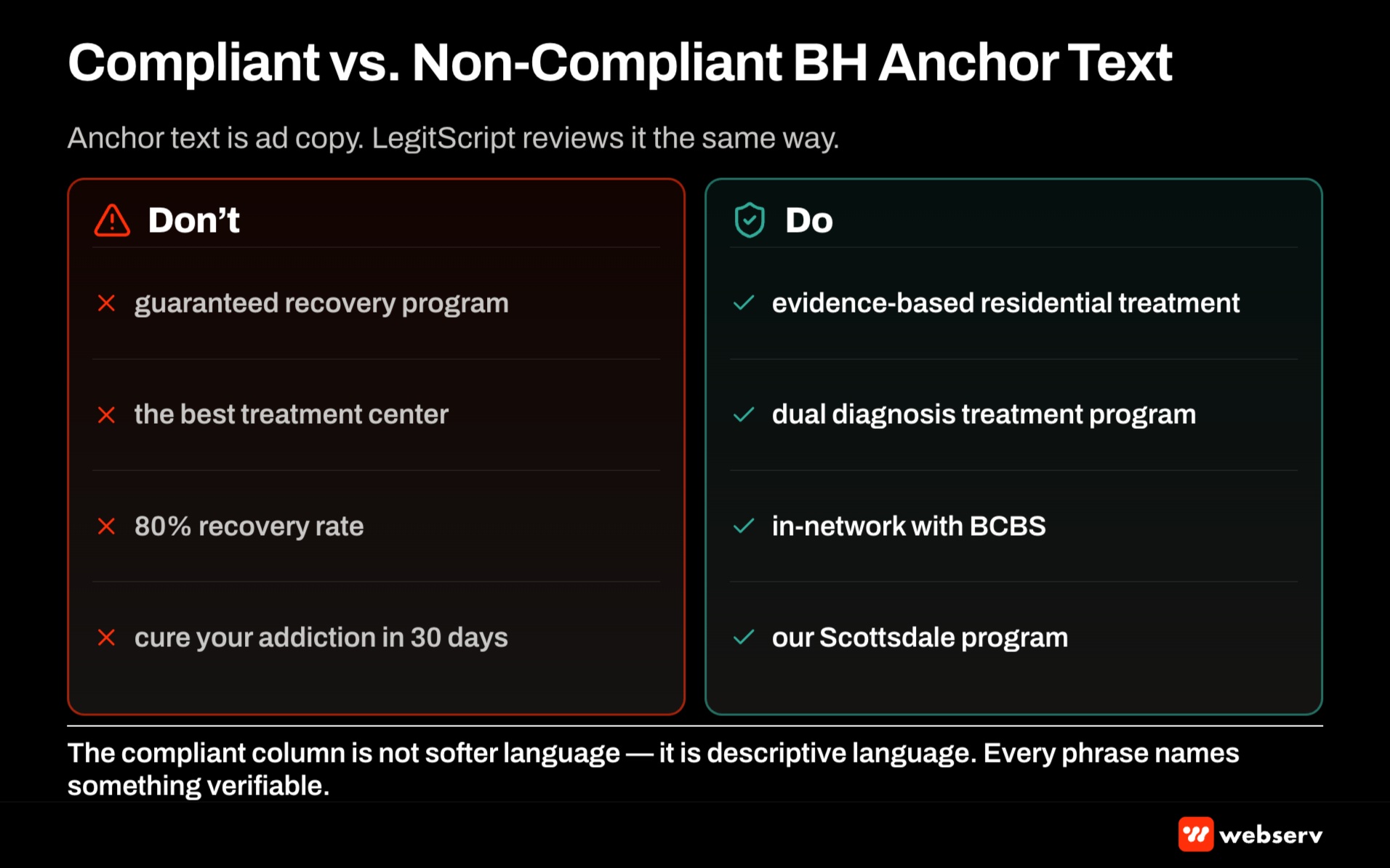
Guaranteed outcome language fails. Anchor text like “guaranteed recovery program” or “100% success rate treatment” fails LegitScript review and triggers compliance issues.
Comparative superlatives fail. Anchor text like “the best treatment center” or “the top rehab in Arizona” fails LegitScript review.
Specific outcome numeric claims fail. Anchor text like “80% recovery rate” or “cure your addiction in 30 days” fails.
Compliant BH anchor patterns. Descriptive anchors that carry no outcome guarantees or superlatives. “Evidence-based residential treatment,” “dual diagnosis treatment program,” “in-network with BCBS.” Descriptive language that grounds the anchor without unverifiable claims.
Measurement patterns for anchor text impact
The specific measurement patterns that isolate anchor text impact from other internal linking variables.
Target page ranking correlation. Ranking movement on target pages after anchor text corpus changes. Facilities that audit and rebalance anchor text typically see ranking improvement over 60 to 120 days as Google’s index refreshes.
Anchor text over-optimization detection. Quarterly audit of exact-match anchor percentage per target page. Pages exceeding 20 to 25 percent exact-match anchors flagged for anchor text rebalancing.
Anchor pool size measurement. Count of unique anchor text variations per target page. Pages with fewer than 5 variations flagged for anchor text expansion.
Frequently Asked Questions
How do we know if our anchor text is over-optimized?
Three measurement signals. First: exact-match anchor percentage above 25 percent for the target keyword pointing to a specific page.
Second: sudden ranking drops on pages that previously ranked well, correlated with recent internal linking additions that used exact-match anchors. Third: Google Search Console shows anchor text patterns that flag as over-optimization in the search console links report. Pages appearing in the internal links report with 30+ links all using identical anchor text signal over-optimization.
The specific fix: rebalance the anchor pool for the affected page toward varied natural language descriptions. Rebalancing typically produces ranking recovery within 60 to 120 days.
Can we use branded anchors (facility name) as internal linking anchors?
Yes and should. Facility name in anchor text produces brand entity signal that reinforces the corporate brand ranking. Combinations of facility name plus program or geographic descriptors work as branded anchors.
The specific pattern that works: 10 to 20 percent of the anchor pool includes branded language mixed with descriptive content. Facilities that use only branded anchors typically produce weaker ranking on non-branded queries. Facilities that never use branded anchors typically produce weaker brand entity signal.
Branded plus descriptive anchors (facility name plus program or geographic identifier) tend to outperform either extreme because they carry both the brand signal and the topical signal.
How do we handle anchor text for links to third-party pages (external links)?
Descriptive anchor text that describes the third-party content. External linking to authoritative sources (SAMHSA, NIH, ASAM, CARF, JCAHO) produces E-E-A-T signal when the anchor text describes the third-party content contextually.
The specific pattern that works: external links carry natural language anchors describing the linked source. “SAMHSA’s national helpline directory,” “the NIH research on medication-assisted treatment,” “ASAM criteria for level of care decisions.”
External linking with generic anchors (“read more,” “click here”) provides less E-E-A-T signal than descriptive anchors.
How does anchor text interact with our overall SEO strategy?
Directly. Internal linking with well-varied anchor text is one of the highest-impact on-page SEO variables. Well-executed internal linking programs produce 15 to 30 percent ranking improvement on target pages over 90 to 180 days.
The specific integration pattern: content strategy determines which target pages need internal linking support, internal linking execution deploys links from relevant pages with varied anchor text, and quarterly audit maintains anchor text balance as content grows.
The Koray-style topic cluster architecture provides the specific internal linking framework that treatment centers benefit from. Anchor text variance operates within the cluster architecture to produce the intended ranking signal. Our link building without buying links guide covers the broader authority framework anchor text sits inside.
How do we manage anchor text at scale across large content programs?
CMS-level anchor text tracking with quarterly audit and rebalancing. The specific pattern that works: anchor text tracking table maintained by content team with target page URL, anchor text used, source page URL, and date added.
Quarterly review identifies over-optimization patterns and rebalancing opportunities. Content team gets guidance on which anchor variations to use when linking to specific target pages.
Portfolio operators managing 5+ facilities benefit from portfolio-level anchor text pool management to avoid over-optimization across the portfolio while maintaining consistent linking patterns.
How does anchor text handling differ for guide pages versus supporting pages?
guide pages typically carry more anchor text diversity because they get linked from more pages across the cluster. The hub anchor pool typically includes 10 to 25 anchor variations because 10+ supporting pieces link back to the hub.
Supporting pages typically carry fewer anchor variations because fewer pages link to them. Supporting page anchor pools typically include 3 to 8 variations from the specific pages that reference them.
The specific pattern for guide: each supporting piece uses a slightly different anchor when linking back to the hub. Rather than every supporting piece using “the attribution guide” as anchor, different supporting pieces use “our attribution framework,” “the five-layer attribution chain,” “the attribution guide,” and other varied descriptions pointing at our attribution guide.
How does anchor text compliance interact with our overall content compliance?
Directly. Anchor text sits inside the content compliance review that covers body copy, headlines, and CTA text. Compliance review checks anchor text against the same LegitScript standards that apply to other content elements.
The specific integration: content production workflow includes anchor text compliance check at the same pre-publication compliance review stage as body content compliance check. Facilities that skip anchor text compliance review typically produce anchor text violations that get caught by post-publication audit rather than pre-publication review.
The right pattern: anchor text compliance built into the content production workflow rather than layered on top of published content.
Trevor Gage is the Director of Marketing at Webserv, a digital marketing agency for treatment centers.