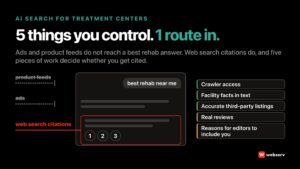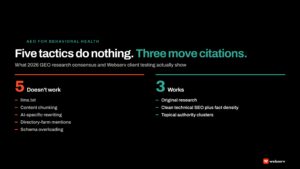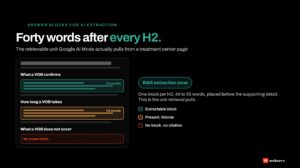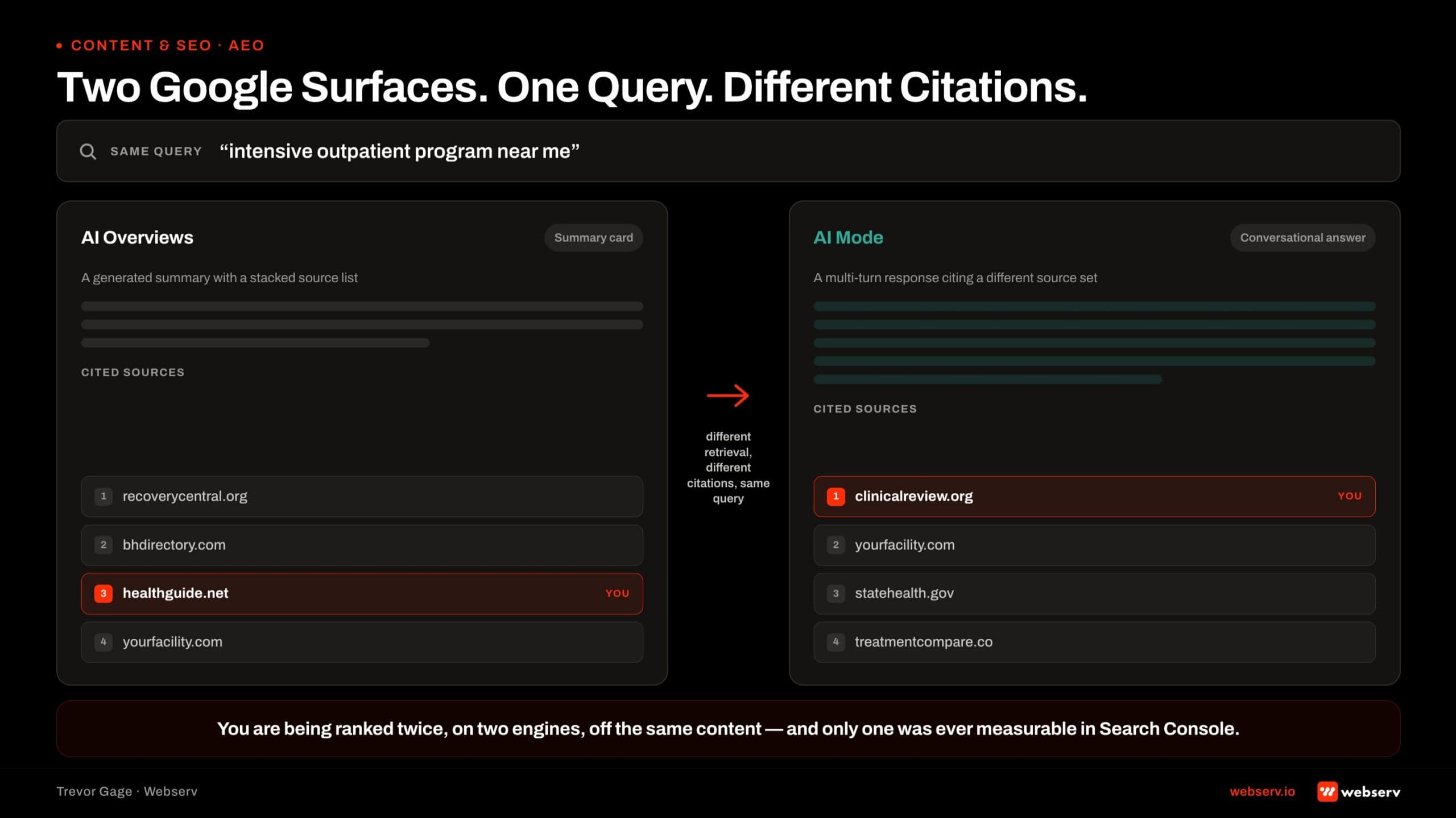
For most of 2025, the marketing conversation about Google’s AI search was collapsed into a single phrase: “AI Overviews.” The AI-generated summary that appears above the classic blue links absorbed all the attention, all the reporting, and most of the panic.
Treatment center CMOs asked how to get into AI Overviews. Consultants sold AI Overview optimization. Search Console rolled out AI Overview impression data.
That framing has quietly stopped being accurate. Google now runs AI Mode as its own standalone conversational search surface, alongside the AI Overviews that sit on top of classic results.
The mistake I keep watching operators make is treating AI Mode as an extension of AI Overviews, a bigger version of the same feature. It is not. It is a separate search surface with its own citation logic, its own URL selection behavior, and its own reporting implications.
The data that made this concrete for me was an Ahrefs analysis of September 2025 US data that found AI Mode and AI Overviews cited the same URLs only 13.7% of the time for the same query.
Most citations show up on one surface but not the other. That is not a rounding error. It means a treatment center website could be optimized well for AI Overviews and still be effectively invisible to a family running the same query through AI Mode, or the reverse.
This piece is the operator’s read on why the two surfaces diverge, what that divergence means for a behavioral health website specifically, and the specific moves that put a rehab site into the citation pool on both surfaces rather than one.
Key Takeaways
- AI Mode and AI Overviews are two distinct Google search surfaces with only 13.7% citation overlap for the same query, per Ahrefs, meaning a page cited in one can be invisible in the other for the same query.
- AI Overviews pulls citations from queries that could be answered with a paragraph or two of consolidated information, favoring pages with strong classic ranking signals and answer-first formatting.
- AI Mode fans a single query out into multiple sub-queries and citations, favoring pages that satisfy multi-faceted compound prompts and often surfacing sources that never made the classic top ten.
- Treatment center sites need a two-track optimization strategy: reinforcing the existing pages that already win AI Overview citations while also building compound-prompt pages that give AI Mode multiple sub-query hooks to cite.
- Reporting has to split into two lanes: AI Overview citation share and AI Mode citation share need to be tracked separately, because gains and losses on one surface do not predict the other.
What AI Overviews is actually doing behind the scenes
AI Overviews is the surface most treatment center operators have already spent a year adapting to. It is the AI-generated summary that sits above the traditional blue links on about 39% of US desktop searches as of June 2026, per Comscore data reported by Search Engine Land.
The Overview pulls from a set of cited sources, typically three to six URLs, and presents a consolidated answer to the searcher’s query.
The selection logic behind AI Overviews is closer to a hardened version of classic ranking than most operators realize. Pages that already rank in the top ten for the query are heavily favored.
The Overview tends to select sources that lead with a direct answer to the query in the first paragraph, have clear semantic structure (H2s, FAQ blocks, definition patterns), and carry credible authority signals for the topic (author bios, editorial review markers, first-party expertise).
For a treatment center, the pages that tend to win AI Overview citations are the pages that were already winning classic organic traffic.
Cornerstone service pages, well-structured level-of-care explainers, glossary and definition entries, and long-form guides with strong FAQ blocks. If your top-ten organic pages are structurally clean, you are already partway to AI Overview eligibility.
DEFINITION
AI Mode is Google’s deeper conversational search surface that generates responses using Gemini-family models and a broader multi-source retrieval pattern than AI Overviews. It cites different URLs, weighs authority differently, and often surfaces on multi-step or comparative queries where AI Overviews stays silent.
What AI Mode is actually doing, and why it is different
AI Mode is the standalone conversational search experience Google launched globally in April 2026. It looks less like classic Search and more like ChatGPT with a Google logo.
A searcher types a question, or a compound question, and AI Mode returns a conversational answer with citations, then allows follow-up questions in the same session.
The mechanic that makes AI Mode different from AI Overviews is what Google internally calls query fan-out. A single user query does not get answered by a single retrieval.
AI Mode decomposes the query into multiple sub-queries, retrieves sources for each sub-query, and synthesizes the whole thing into one answer.
A user asking “what is the difference between residential and PHP for someone with dual diagnosis” is not answered by one search.
It is answered by five or six sub-searches (definitions of both levels of care, common criteria for choosing between them, dual diagnosis modifiers, cost considerations, insurance implications), each of which pulls its own set of citations.
That fan-out mechanic is why the low citation overlap is not surprising in retrospect. AI Overviews is answering the query. AI Mode is answering five or six adjacent sub-queries and stitching them together.
The pages eligible to be cited on one surface are only sometimes the same pages eligible to be cited on the other.
The concrete divergence a rehab operator sees on the same query
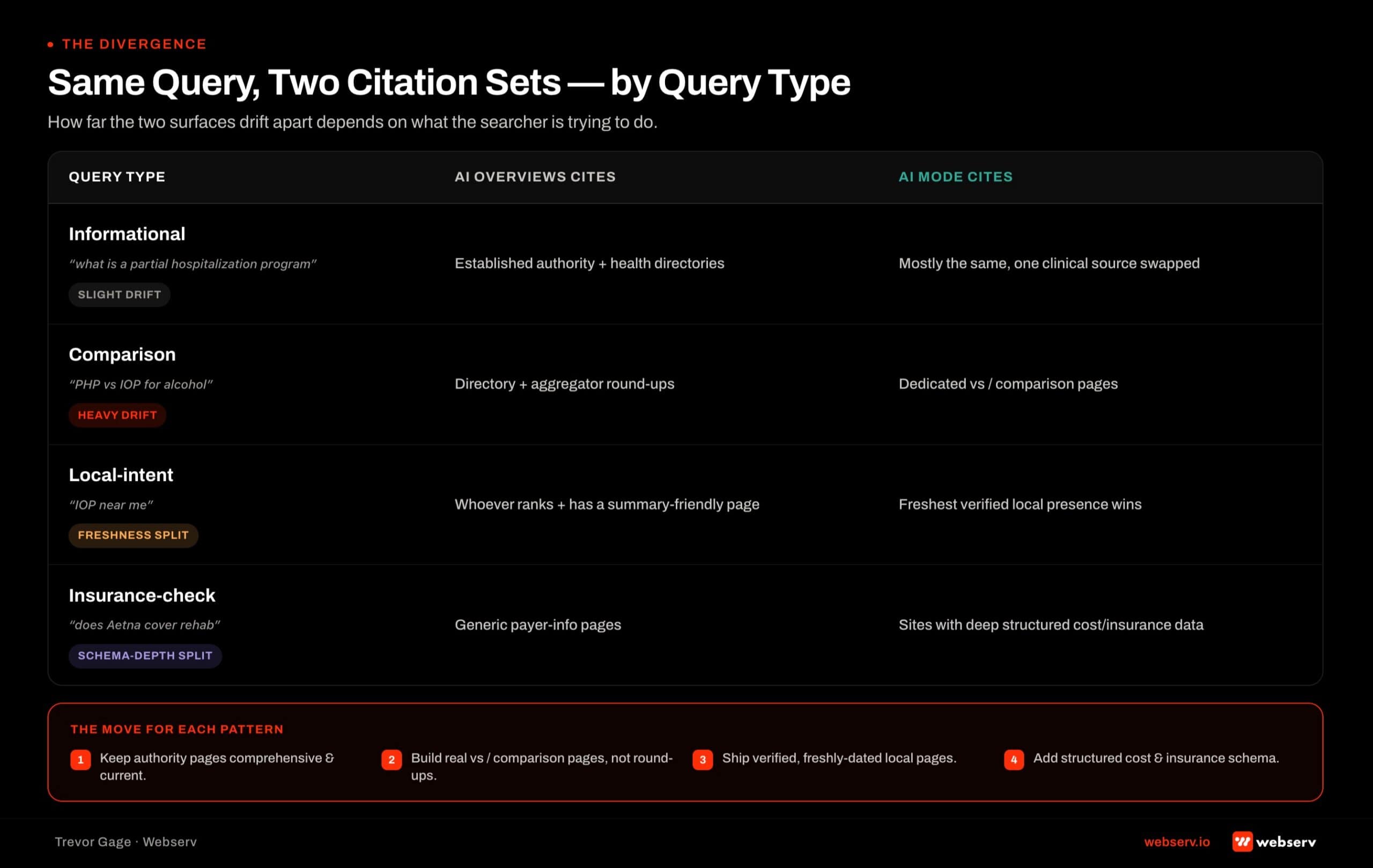
Run the query “how long does inpatient drug rehab take” through both surfaces and the difference becomes visible. AI Overviews will typically return a consolidated answer citing three or four established sources: a large chain website, a directory, maybe a health authority, and possibly one mid-authority behavioral health blog.
The same query run through AI Mode returns a longer conversational answer citing eight or ten sources. Some of those citations overlap with the AI Overview set. Many do not.
The AI Mode citations tend to include more mid-authority operator sites, more clinical explainers, more insurance and cost pages, and more compound-prompt content that would never have ranked in the classic top ten for the seed query but does satisfy a downstream sub-query the fan-out generated.
That divergence has a specific implication for a behavioral health website. Winning AI Overview citations rewards the pages you already have working well.
Winning AI Mode citations rewards content architecture, cluster density, and compound-prompt page design.
A treatment center site that has six or seven pages in a cluster addressing every angle of a topic (definition, cost, timeline, criteria, insurance, outcomes) gets substantially more AI Mode citations than a site with one strong page on the seed query.
AI Mode is a cluster-density surface. AI Overviews is a ranking-strength surface.
Why this changes rank reporting for treatment centers
The most common reporting mistake I have watched over the last quarter is treating AI visibility as a single number.
A client CMO asks “how are we doing in AI search?” and the answer they get back is an aggregate impression count from Google’s new Generative AI performance reports, or worse, an aggregate share-of-voice number from a third-party monitoring tool.
Aggregates hide the picture. A site can be losing AI Overview citation share while gaining AI Mode citation share, and the aggregate will look flat.
Another site can be holding on AI Overviews but leaking AI Mode citations to competitors with denser cluster architecture, and the aggregate will look healthy right up until admissions volume drops.
The reporting shift for a behavioral health site in the second half of 2026 is to split AI visibility into two lanes. Track AI Overview citation share (or the classic Search Console impression proxy for it) as a rank-adjacent metric that responds to page-level ranking work.
Track AI Mode citation share as a cluster-density metric that responds to compound-prompt content and cluster architecture. Report them side by side, and stop trying to average them into a single number.
OPERATOR INSIGHT
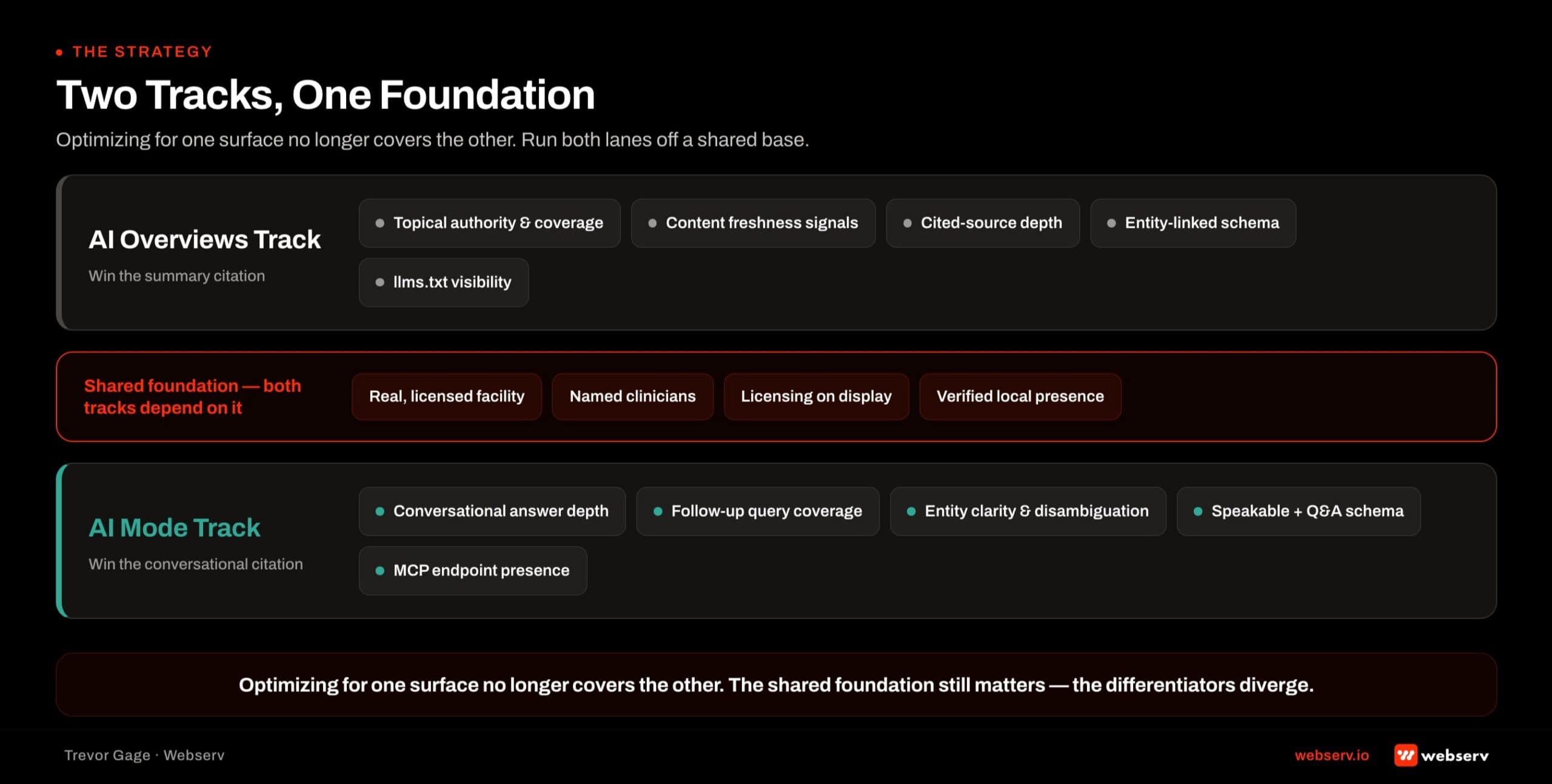
AI Overviews and AI Mode are two different citation surfaces, and treating them as one optimization problem produces weaker results on both. The two-track split: AI Overviews wants concise, structured, snippet-friendly content with named-author credibility. AI Mode wants deeper compound-prompt pages that answer multi-faceted questions in one place. A rehab site running both tracks in parallel produces citations neither optimization alone would generate.
The two-track optimization strategy for treatment center sites
The optimization work for a treatment center site under this framing splits into two parallel tracks, each targeting a different surface.
The AI Overview track is the closer cousin to classic SEO. The moves that improve AI Overview citation eligibility are the moves that improve classic ranking.
That means clean semantic structure with clear H2s and answer-first paragraph openers, FAQ blocks with schema, strong internal linking from high-authority pages, author bios with named clinical credentials, and freshness signals through periodic updates.
Ahrefs’ study of 17 million citations found AI-cited content is 25.7% fresher than pages ranking in organic Google results, so a refresh cadence on cornerstone pages is table stakes. The May 2026 Core Update reinforced that freshness signal at the classic ranking layer, which feeds AI Overview eligibility downstream.
The AI Mode track is different work. What AI Mode rewards is cluster density and compound-prompt coverage.
That means building content architectures where a single service topic is covered by six or seven distinct pages, each addressing a different sub-query angle (what is X, how much does X cost, how long does X take, who is X for, what happens after X, X vs Y).
It means writing pages that themselves satisfy compound prompts, with structural depth across multiple facets rather than one narrow angle.
And it means internal linking that binds those pages together into a topic silo the AI Mode fan-out can pull from at multiple points.
The Full AI Search Stack for Treatment Centers covers the technical scaffolding for both tracks. What the two-track view adds is the reporting discipline to see whether each track is actually producing citation gains.
The pages a rehab site should already have on each track
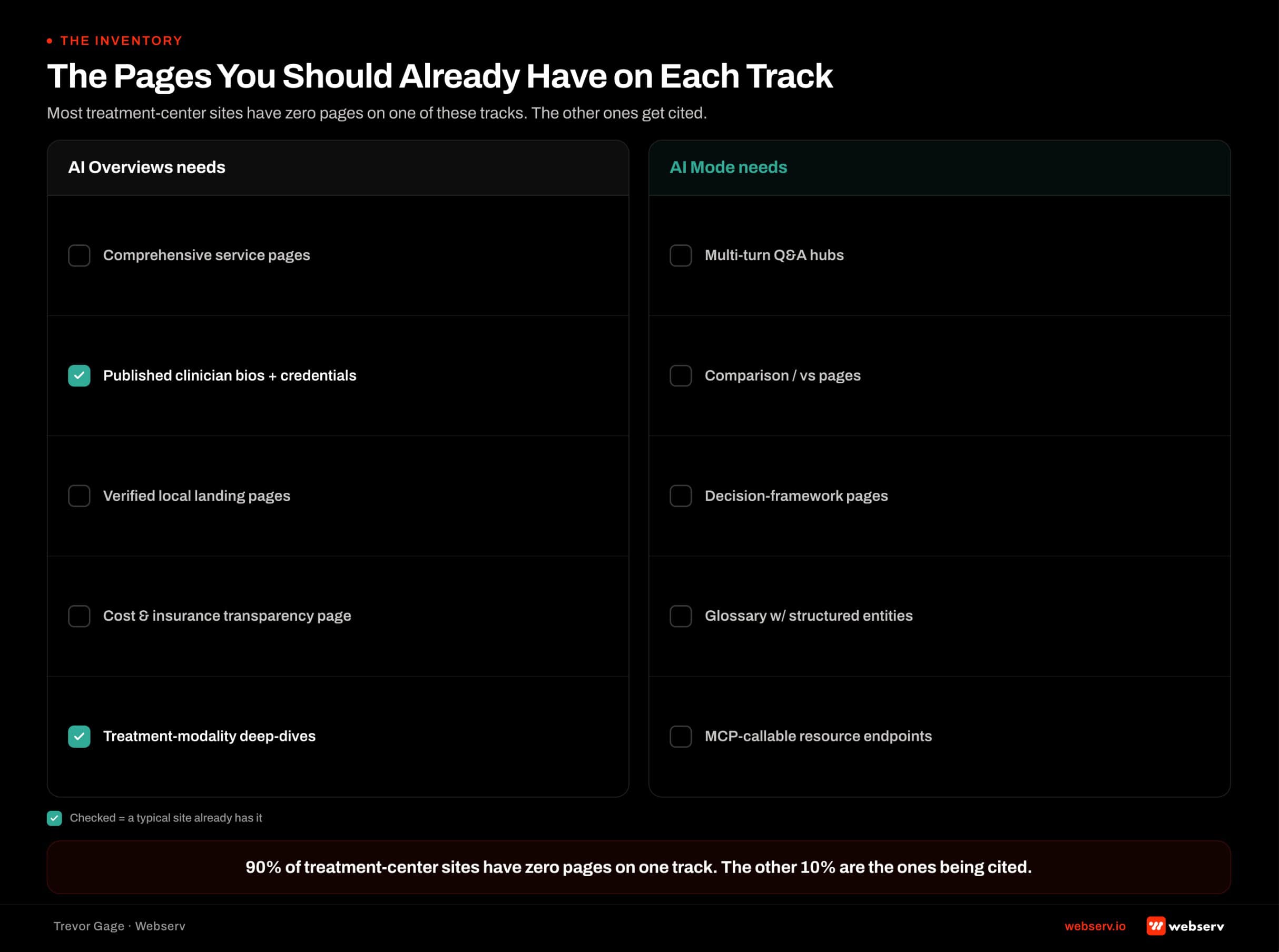
Working backward from the two surfaces, there is a page inventory that puts a treatment center into the citation pool on both.
For AI Overview eligibility, the pages that carry disproportionate weight are the cornerstone level-of-care pages (residential, PHP, IOP, detox, telehealth), the modality pages (medication-assisted treatment, DBT, CBT, EMDR, trauma-informed care), and the definition/glossary content that answers “what is X” queries.
The payer and financial pages sit alongside these (insurance verification, cost of treatment, out-of-network reimbursement). These pages need to be well ranked, well structured, and freshly updated.
For AI Mode eligibility, the layer above those pages matters. That is where cluster hub pages, compound-prompt guides, and cross-topic explainers do their work.
A residential treatment cluster that includes only one page on residential is going to lose AI Mode citation share to a competitor whose residential cluster includes seven pages covering criteria, cost, timeline, family involvement, aftercare planning, and comparison against other levels of care.
Cluster architecture is the leading indicator of AI Mode share.
The internal linking discipline binds them together. Every cornerstone page needs to point down into its cluster spokes, and every spoke needs to point back up to the cornerstone plus laterally to sibling spokes. That is the wiring AI Mode fan-out follows.
What the reporting layer needs to catch up on
The Search Console Generative AI performance reports that launched in June 2026 give some of this reporting for free, but the current version has limits.
The reports show impressions inside generative AI features but do not currently break AI Overview impressions apart from AI Mode impressions inside the aggregate view. That split will presumably come, but as of the current writing, you have to piece it together manually.
For a treatment center CMO who wants the two-track reporting now, the practical workaround is a monthly manual sample. Pick twenty high-intent queries that map to your admissions funnel. Run each of them through both AI Overviews and AI Mode.
Log which sources got cited on each surface, whether your pages made either list, and what percentage share of citations you captured relative to your competitor set. It is manual work, but it produces the two-lane visibility the aggregate reports do not.
Third-party brand monitoring tools that track citation share inside ChatGPT, Perplexity, Claude, and Gemini also provide a useful cross-check. The overlap between those platforms and Google’s AI Mode is imperfect but directionally correlated.
What to change this quarter
The specific moves that reflect the two-surface reality inside a treatment center’s SEO program over the next 90 days fall into three tracks.
Audit your existing cornerstone pages for AI Overview eligibility (semantic structure, FAQ blocks, freshness).
Build out cluster density around your top three revenue-driving service topics (six to seven pages minimum per cluster, each addressing a distinct sub-query angle).
Split your AI reporting into AI Overview citation share and AI Mode citation share as separate lanes rather than a single aggregate number.
The KPI shift I have been recommending across our client book is to add both metrics to the monthly report alongside classic organic sessions, admissions calls, and admits.
Position 1 CTR is compressing. Aggregate AI visibility is a lagging summary. The two-lane citation share numbers are the leading indicators that tell you where the top of your funnel is actually moving.
Frequently Asked Questions
Why do AI Mode and AI Overviews cite different URLs for the same query?
AI Overviews consolidates one query into one consolidated answer with a small number of citations, favoring pages with strong classic ranking signals for that specific query. AI Mode decomposes each query into multiple sub-queries through its query fan-out mechanic, then pulls citations for each sub-query independently and stitches the answers together.
The result is that AI Mode ends up citing a broader set of pages that satisfy any of the sub-queries, including pages that would never have ranked in the classic top ten for the seed query.
An Ahrefs analysis of September 2025 US data measured citation overlap between the two surfaces at 13.7%, meaning the citation pools are largely distinct even for identical seed queries.
Do I need to write different content for AI Mode versus AI Overviews?
The base structural moves overlap. Both surfaces reward clean semantic structure, answer-first paragraph openers, FAQ blocks, credible author bios, and freshness signals. Where the two surfaces diverge is in what they reward at the site-architecture level.
AI Overviews rewards individual page strength. AI Mode rewards cluster density. A site that publishes one strong page per topic will do well in AI Overviews and poorly in AI Mode.
A site that publishes six or seven pages per topic covering different sub-queries will do well in AI Mode and no worse in AI Overviews. The economical answer is to build clusters, which serves both surfaces.
How do I measure AI Mode citation share separately from AI Overview citation share?
Google’s new Generative AI performance reports in Search Console show combined impressions inside generative AI features but do not currently split AI Overview impressions from AI Mode impressions cleanly. That split will presumably come but is not available as of the current writing.
The practical workaround is a monthly manual sample. Pick fifteen to twenty high-intent queries that map to your admissions funnel, run each through both AI Overviews and AI Mode, and log which sources got cited on each surface. It is manual work but produces the two-lane visibility that the aggregated reports do not.
Should I be worried if my classic organic traffic is dropping but my AI impressions are climbing?
Not necessarily. That specific pattern (classic organic down, AI impressions up) is the modern pattern most mid-authority YMYL sites are living inside now. Position 1 CTR on classic Search has compressed from 27% to 11% over the past two years, and much of that compression reflects clicks being absorbed by AI Overviews and AI Mode.
The metric that actually matters for a treatment center is what happens downstream.
If your AI impressions are climbing while admissions calls are flat or dropping, the gap is usually in name recognition (do families remember your facility as a name to call after seeing you cited), phone number visibility on the page a searcher does click through to, or admissions call quality. It is rarely a reporting error.
Trevor Gage is Director of Marketing at Webserv, a behavioral health marketing agency working with residential, outpatient, and telehealth treatment providers across the United States. He leads Webserv’s SEO, content, and AI search practice. If you want the two-track AI citation audit against your own site, start with a Visibility Gap conversation.