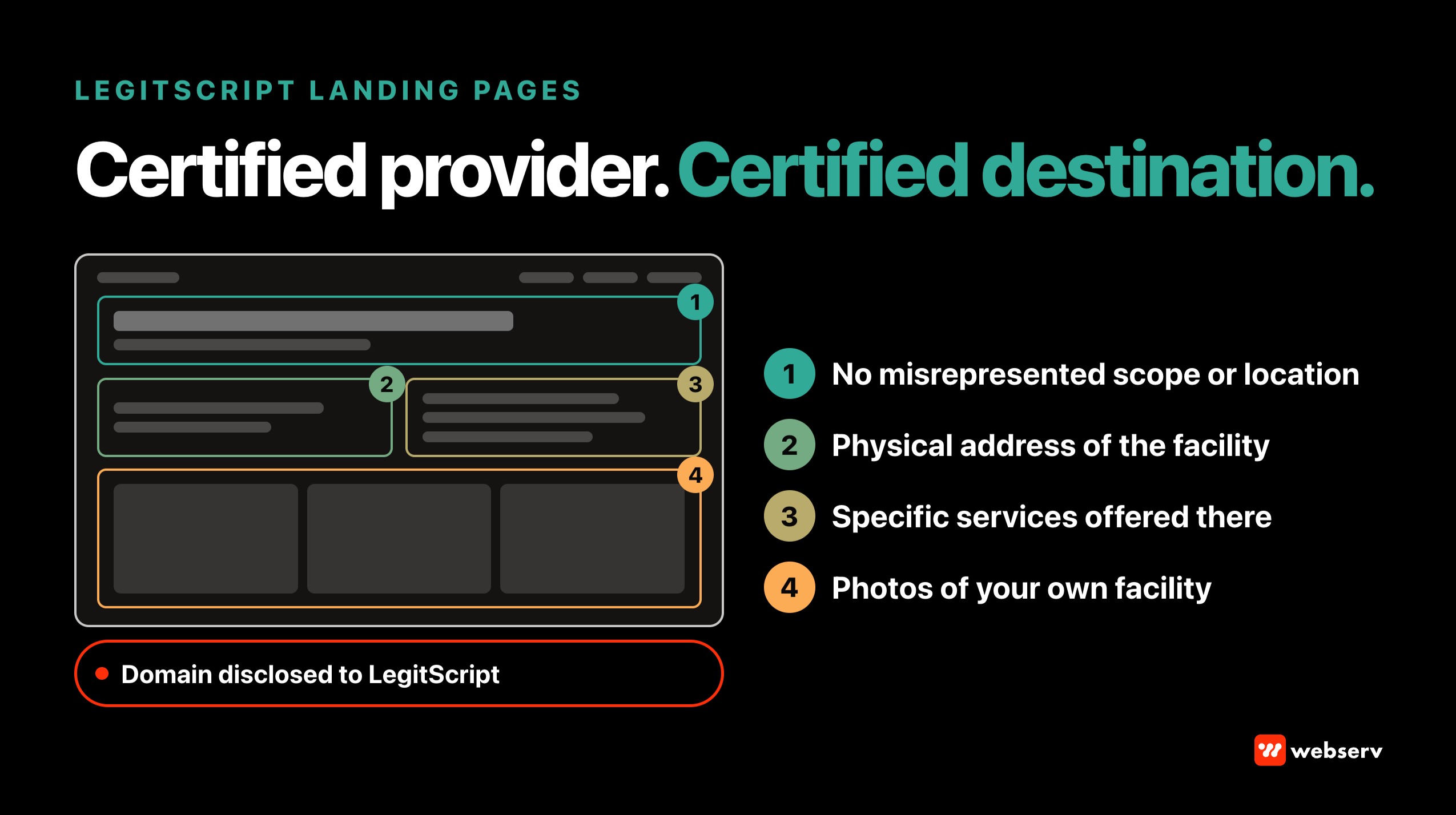
LegitScript’s certification standards include one rule written squarely for websites: a treatment center’s site must conspicuously disclose the physical address of each facility where it provides services and the specific nature of those services, every photo must truthfully show the applicant’s own facilities, and nothing on the site can misrepresent the scope or location of its services.
That rule shapes paid campaigns as much as any targeting decision.
A landing page built for a city where the facility has no location, a stock photo of someone else’s pool, or a page that lists services the program doesn’t offer can put certification at risk, and without certification, Google, Meta, and Microsoft won’t run addiction treatment ads at all.
This guide breaks down the LegitScript standards that apply to landing pages, the platform destination rules layered on top, how new domains and locations fit into certification, and the checklist our landing page team for treatment centers runs before a paid page goes live.
For getting certified in the first place, see our step-by-step LegitScript certification guide. This piece picks up after certification, with the pages your ads send traffic to.
Key Takeaways
- LegitScript certifies treatment providers, not individual pages, but its standards require disclosing every domain you control and set specific rules for website content and advertising.
- The website content standard requires a conspicuous physical address for each facility, a clear description of the services offered, photos of your own facilities, and no misrepresentation of the scope or location of services.
- The advertising standard requires ads to identify the advertiser, bars using third-party business names, and bars claiming locations where the provider doesn’t deliver services.
- Microsoft Advertising goes further than the others: it says landing pages and any URLs used in the ad must be certified, and it allows drug and alcohol recovery ads only in the United States.
- Google’s destination requirements catch common healthcare landing page problems, including mismatched domains, pages Google’s crawler can’t reach, and bridge pages built only to send users elsewhere.
- Lead generation and paid referral models are ineligible for LegitScript certification, which effectively keeps them off Google, Meta, and Microsoft for addiction treatment.
What LegitScript certifies, and what the platforms require
LegitScript’s addiction treatment certification evaluates the provider against 16 standards grouped into four areas: registration and compliance, internal practices, external practices, and transparency and advertising. Certification is priced per facility, and the transparency standard requires the provider to disclose all domain names and websites under its control.
Each ad platform then builds its own requirement on top of that certification:
- Google requires US advertisers of recovery-oriented drug and alcohol addiction services to be certified by LegitScript and certified with Google, under its healthcare and medicines policy.
- Meta requires US addiction treatment advertisers to hold LegitScript certification and get Meta’s written permission, under its drug and alcohol addiction treatment policy.
- Microsoft Advertising requires LegitScript certification for rehabs and related services, allows drug and alcohol recovery ads only in the US, and states that landing pages and any URLs used in the ad must be certified, per its healthcare and pharmaceutical ad policy updated July 1, 2026.
DEFINITION
Certified destination. A landing page on a domain that’s disclosed to LegitScript as part of a certified provider’s websites, describing services that provider actually delivers, at locations it actually operates. On Microsoft, the URL itself also has to be covered by certification.
The practical rule for every platform is the same: don’t send paid traffic to a domain or page your certification doesn’t cover, and don’t let a landing page describe anything your certification doesn’t.
The LegitScript standards that apply to landing pages
Several of the 16 standards shape what a landing page can say and show. These are the ones to build every template around.
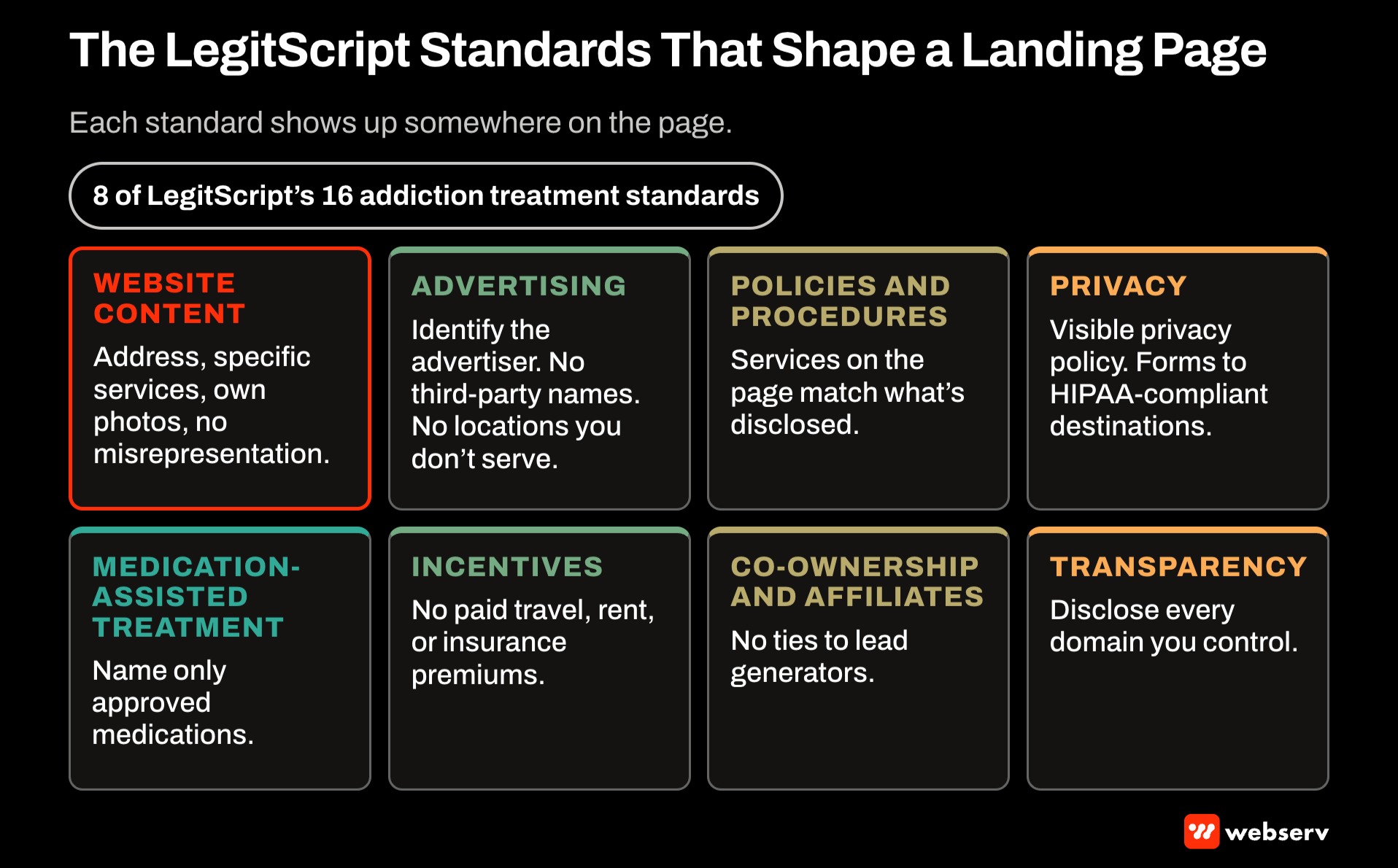
Website content. The landing page rule at the center of this guide. Each page should show the physical address of the facility it’s promoting, describe the specific services offered there, use only photos of your own facilities, and avoid anything that overstates what the program does or where it operates.
Advertising. Ads, and the pages they point to, must be accurate and transparent. The advertiser has to clearly identify itself and can’t use third-party business names. Ads must reflect the services actually offered at each location, and a provider can’t claim locations where it doesn’t deliver services.
Policies and procedures. Providers must disclose every treatment service, including whether medications are part of care and whether they offer adolescent or other specialized services. A landing page that promotes a service should match what’s disclosed.
Privacy. Providers must follow privacy law for protected health information and post a privacy policy where the law requires one. On a landing page, that means a visible privacy policy link and forms that route to HIPAA-compliant destinations. Our HIPAA-safe conversion tracking stack covers the tracking side.
Medication-assisted treatment. Providers may only use, recommend, or promote medications permitted by regulators. Landing page copy about MAT should name only approved medications and describe them accurately.
Incentives. All patient incentives must be disclosed, and LegitScript says paying for patient travel, rent, or insurance premiums generally disqualifies an applicant. “Free flights” or “we cover your travel” on a landing page is a red flag.
Co-ownership and affiliates. Ties to lead generators are prohibited and may be grounds for immediate denial, including informal ties like sponsoring or answering a lead generator’s hotline. Affiliates and essential partners must also meet the standards.
Transparency. Providers must disclose all domain names and websites they control, and practices and offers must not be misleading. Incomplete information is grounds for denial, which is why every landing page domain belongs on the list.
COMMON MISTAKE
The “near me” city page. A facility in one city builds landing pages for five surrounding cities, each written as if the program were local. LegitScript’s advertising standard bars claiming locations where the provider doesn’t deliver services, and its website content standard bars misrepresenting location.
Build location pages only for places you actually operate. For surrounding cities, a page that says plainly where the facility is and how families from that city typically get there is honest and still useful.
Platform destination rules that trip up treatment center pages
LegitScript certification gets you permission to advertise. Each platform’s destination rules still decide whether a specific page can take traffic.
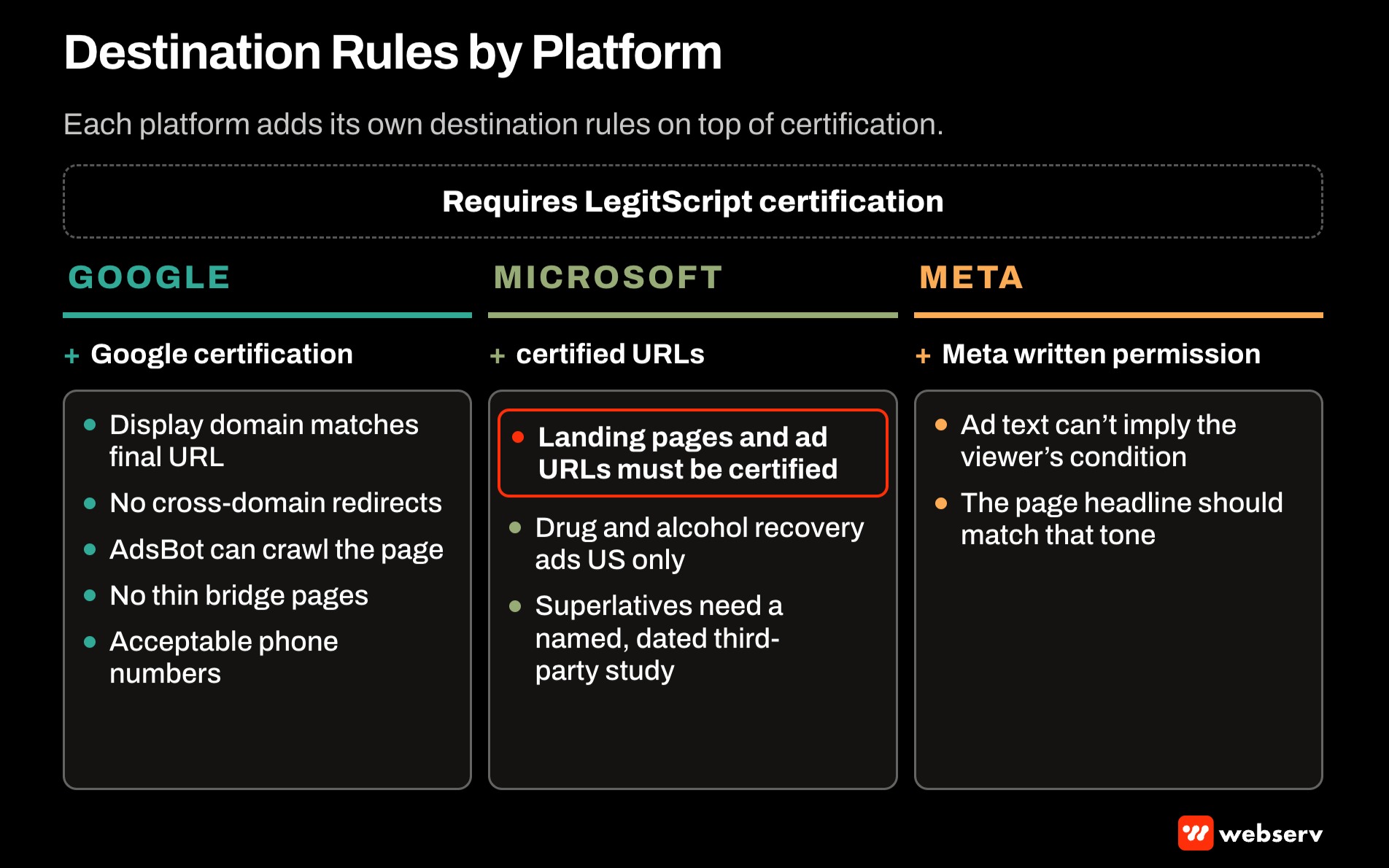
Google. Google’s destination requirements flag several patterns that show up often on healthcare landing pages:
- Destination mismatch: the ad’s display domain doesn’t match the final URL, the final URL redirects to a different domain, or a tracking template leads somewhere else.
- Pages Google can’t crawl: if AdsBot can’t reach the page, the ad can’t be reviewed.
- Insufficient original content: pages designed only to send users elsewhere, which catches thin bridge pages and some call-only setups.
- Unacceptable phone numbers, including certain virtual, personal, or non-local numbers.
Microsoft. Beyond the certified-URL rule, Microsoft’s healthcare policy requires claims to be substantiated and superlatives to be backed by a named, dated third-party study, and it bars implying professional endorsement unless it’s genuine and disclosed.
Meta. Meta’s personal attributes policy governs the ad text, and the landing page should match its tone. An ad that avoids implying the viewer’s condition, sending traffic to a page headlined “Struggling with addiction?”, sets up a mismatch that reviewers can notice.
Our Google Ads playbook for treatment centers and Meta ads playbook cover the campaign side of both platforms.
The landing page compliance checklist
Run every paid landing page through this checklist before it takes traffic, and again after any edit.
Identity and location
- The facility’s name matches the certified provider and the ad.
- The physical address of the facility being promoted is visible, not buried in a footer link.
- The page is on a domain disclosed to LegitScript and, for Microsoft, covered by certification.
- No third-party business names are used to attract traffic.
Services and claims
- Every service mentioned is one the facility delivers at that location and has disclosed.
- Levels of care, specialized programs (such as adolescent services), and medications described match the facility’s disclosures.
- No outcome guarantees, unsupported success rates, or unsubstantiated superlatives.
- Insurance claims name only current, active payer contracts.
Visuals
- Every photo shows the facility’s own locations and, where people appear, has the right permissions.
- No stock imagery presented as the facility.
Offers and incentives
- No free travel, rent, or insurance premium offers.
- Any incentive that does appear is disclosed and reviewed for compliance.
Privacy and forms
- A privacy policy link is visible.
- Forms collect only what’s needed and submit to HIPAA-compliant destinations.
- No form values in URLs, and no pixels sending health data to ad platforms.
Technical
- The display domain and final URL match, with no cross-domain redirects.
- The page is crawlable by the ad platforms’ review bots.
- Phone numbers are real, local or toll-free business numbers routed to admissions.
OPERATOR INSIGHT
The fastest way to keep landing pages compliant is to make the template carry the rules. If the address block, privacy link, disclosure language, and approved photo library are built into the template, every new campaign page starts compliant.
Individual pages then only need review for what changes: the headline, the services described, and the location. That’s a much smaller review than checking every page from scratch.
How a compliant landing page is structured
Compliance works best when it’s part of the page structure rather than a set of edits applied at the end. This is the section order we use as the compliance baseline for a single-facility paid landing page:
Header
The facility’s name as certified, the admissions phone number, and hours. No third-party names or logos presented as your own brand.
Headline and subhead
The service and the facility’s real location, matching the ad that sends traffic to the page.
Program description
The specific level of care and services offered at that location, consistent with what’s disclosed to LegitScript, including whether medications are part of care.
Facility section
Photos of the facility’s own spaces, with the physical address stated in text near them.
Clinical team
Real staff with accurate roles and credentials.
Insurance and admissions
Current payer contracts only, and a plain description of what happens when someone calls or submits a form.
Form and call to action
Minimal fields, submitting to a HIPAA-compliant destination.
Footer
Full address, licensure information, accreditation, privacy policy link, and any required disclosures.
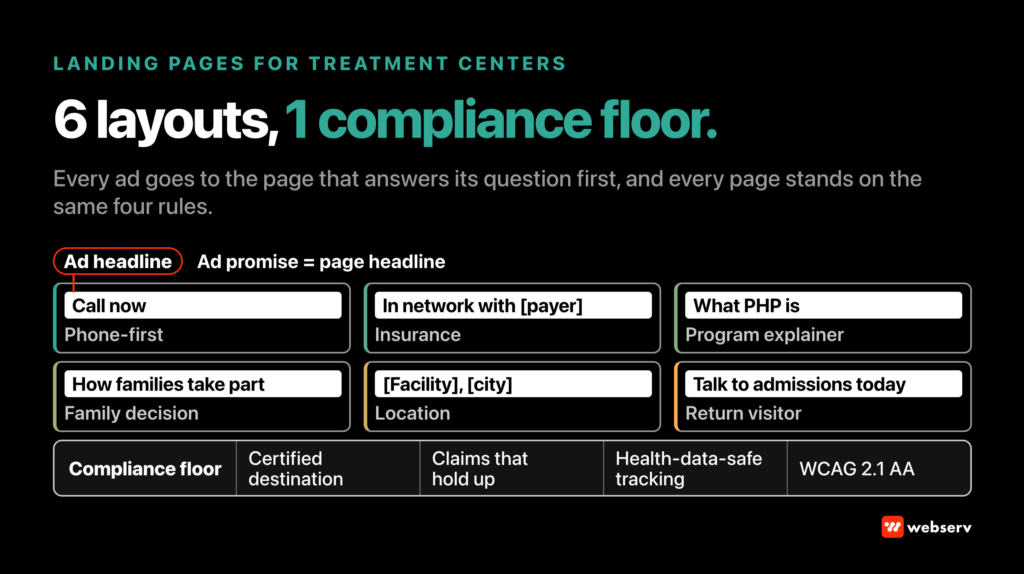
Our upcoming landing page templates guide covers how to rearrange these sections for different kinds of visitor intent. Whatever the layout, the address, services, photos, privacy link, and advertiser identity stay on every version.
What reviewers notice first. The mismatches that stand out on a quick review are usually simple: an address that doesn’t match the certified facility, a service named on the page that isn’t disclosed, photos that don’t match the facility’s other materials, or a domain that isn’t on the provider’s disclosed list. Each takes minutes to fix before launch and far longer to explain afterward.
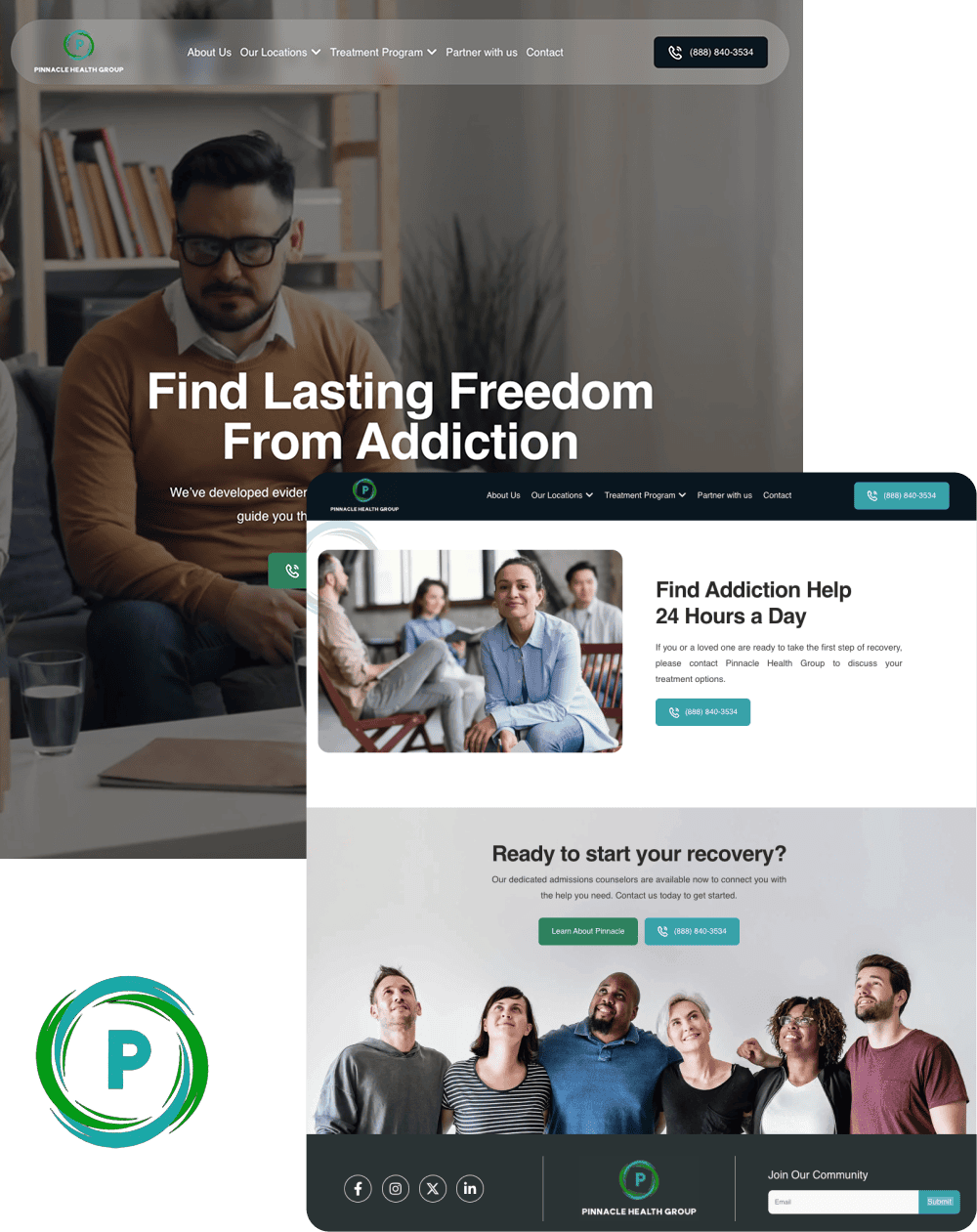
A unified platform built for multiple locations, programs, and audiences without feeling fragmented
- Reorganized multi-service site architecture
- ADA compliant responsive design system
- Future-ready CMS with modular templates
- Optimized for SEO and lead capture
New domains, new locations, and change control
Landing pages change more often than any other part of a treatment center’s web presence, which makes change control part of compliance.
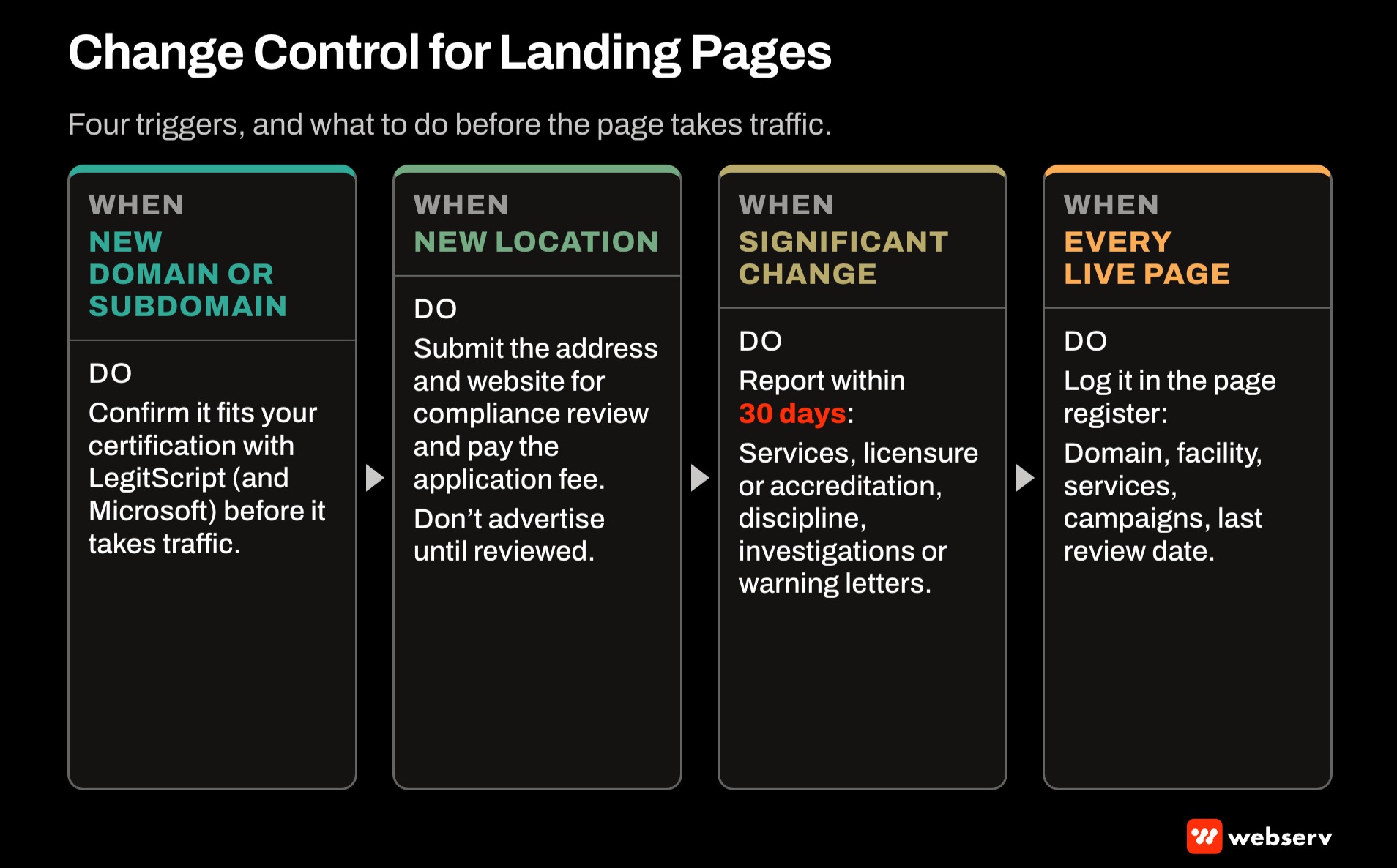
Disclose every domain. LegitScript’s transparency standard requires disclosing all domains and websites under your control. Before launching a campaign on a new landing page domain or subdomain, confirm how it fits your certification with LegitScript, and with Microsoft if you advertise there.
Add locations through LegitScript first. LegitScript’s addiction treatment FAQ says new locations are added by submitting the location’s address and website for compliance review and paying the application fee, without a new application. Don’t advertise a new location before it’s reviewed.
Report significant changes. The same FAQ says certified providers must report significant changes within 30 days, including changes to services, licensure or accreditation, provider discipline, and investigations or warning letters. A new service line on a landing page is a good trigger to check whether a report is needed.
Keep a page register. Track every live landing page with its domain, the facility and services it promotes, the campaigns sending traffic to it, and the date it was last reviewed. It turns a certification review or platform question into a quick lookup.
What LegitScript certification costs
Fees are part of planning for new locations. LegitScript’s addiction treatment FAQ, updated in September 2026, lists a $1,595 application fee and a $3,095 annual fee per facility for providers with one to nine facilities, with larger organizations directed to its Enterprise certification.
LegitScript addiction treatment certification (LegitScript, Sept 2026)
16
LegitScript addiction treatment certification standards
$1,595
Application fee per facility (1-9 facilities)
$3,095
Annual fee per facility (1-9 facilities)
The FAQ also describes a separate individual practitioner tier, assigned at enrollment, and an expedited processing option. Fees change, so confirm current pricing with LegitScript before budgeting, and note that a location approved close to renewal may qualify for a reduced first annual fee.
Models that can’t be made compliant
Some paid acquisition models don’t have a compliant landing page version, because the business model itself is ineligible.
Lead generation and paid referral. LegitScript says lead generation websites and entities that send prospective patients to providers for compensation aren’t eligible for certification. Google’s addiction services policy lists lead generators among the restricted services, and Google’s US rules say services not eligible for LegitScript certification aren’t allowed to advertise. Microsoft says lead generation ads aren’t allowed.
Unbranded or third-party pages. LegitScript’s advertising standard requires the advertiser to identify itself and bars third-party business names. Pages that hide who’s behind them, or borrow another facility’s name, fail that test.
Hotlines that route to specific providers. LegitScript says crisis hotlines and call centers are eligible only if they don’t promote or direct callers to specific providers. A “free helpline” landing page that routes every caller to one facility is a lead generation page by another name.
If a vendor proposes any of these models, treat it as a certification risk for the facility, not just a campaign decision. The FTC’s first case under the Opioid Addiction Recovery Fraud Prevention Act involved a referral network that misrepresented how it evaluated treatment centers.
Putting it into practice
Start with the template. Build the address block, service disclosures, privacy link, approved photo library, and technical settings into a single landing page template, and make every campaign page start from it.
Then build the page register, confirm every live domain with LegitScript, and add a compliance review step to your launch checklist. Our complete guide to landing pages and landing page design guide cover the conversion side, and our upcoming landing page templates guide covers layouts built on this compliance floor.
For how paid campaigns fit the rest of your marketing, see our behavioral health marketing guide. If you want a second set of eyes on your landing pages before your next campaign, book an intro meeting and we’ll review them with you.
Most in-house teams hit a wall not because they lack knowledge, but because they lack bandwidth.
When you are ready to hand it off, Webserv has spent 9 years executing exactly this for treatment centers nationwide.
Frequently Asked Questions
Does LegitScript certify individual landing pages?
LegitScript certifies the treatment provider, priced per facility, and requires the provider to disclose all domains and websites it controls. Its standards then govern what those websites can say and show.
Microsoft Advertising is stricter: its healthcare policy says landing pages and any URLs used in the ad must be certified.
Before launching a new landing page domain or subdomain, confirm with LegitScript how it fits your certification, and with Microsoft if you run ads there.
What must a LegitScript-compliant landing page show?
At minimum, the physical address of the facility being promoted, a clear description of the services offered there, photos of your own facilities, and a privacy policy where required. Everything described has to match the services and locations you’ve disclosed to LegitScript.
The page also has to identify the advertiser clearly and can’t use third-party business names or claim locations where you don’t provide services.
Beyond LegitScript, each ad platform’s destination rules apply, such as Google’s requirements for matching domains, crawlable pages, and original content.
Can we run landing pages for cities where we don’t have a facility?
Not as if you had a location there. LegitScript’s advertising standard bars claiming locations where the provider doesn’t deliver services, and its website content standard bars misrepresenting the location of services.
You can reach families in nearby cities with pages that state plainly where the facility is and how people from that area typically access it.
Keep the facility’s real address prominent on every page, whatever city the campaign targets.
Can we advertise free travel on our landing page?
It’s a serious risk. LegitScript requires all patient incentives to be disclosed and says paying for patient travel, rent, or insurance premiums generally disqualifies an applicant.
Travel assistance offers can also raise state patient brokering and anti-kickback concerns, depending on how they’re structured.
Leave travel offers off landing pages and ads unless counsel has reviewed the specific arrangement and confirmed it’s compliant with LegitScript and applicable law.
How much does LegitScript certification cost for addiction treatment?
LegitScript’s addiction treatment FAQ, updated in September 2026, lists a $1,595 application fee and a $3,095 annual fee per facility for providers with one to nine facilities. Larger organizations are directed to Enterprise certification.
There’s also an individual practitioner tier, assigned at enrollment, and an expedited processing option at additional cost.
Fees change, so confirm current pricing directly with LegitScript before budgeting for new locations.
Keaton Nalle is the Director of Paid Admissions at Webserv, a digital marketing agency for treatment centers.