The most expensive SEO cleanup engagements I have worked on all start the same way. The operator inherited a treatment center whose prior agency had built backlinks aggressively. The rankings looked good for six months.
Then the March 2026 algorithm update hit, or an earlier Helpful Content update hit, or Google issued a manual action, and the site’s traffic collapsed to a fraction of what it had been.
The rebuild takes 6 to 12 months. The cost is measured in lost admits during that recovery window, which for most treatment centers is materially higher than what the toxic link-building program cost in the first place.
What looked like an SEO shortcut turned out to be one of the most expensive marketing decisions the operator ever made.
This article walks the framework I use with treatment center operators to evaluate backlink quality: which categories of links actually help a behavioral health website, which look neutral but are quiet drag, and which are actively toxic.
It also covers the audit workflow to run against your current backlink profile and what to do when the audit surfaces problems. This is the framework we apply across every engagement inside our Digital PR program at Webserv.
Key Takeaways
- Backlink quality matters more for behavioral health websites than for most categories. The content is YMYL (Your Money Your Life), meaning Google applies stricter authority and trust signals. Toxic links do more damage to a treatment center site than they do to a SaaS site with the same profile.
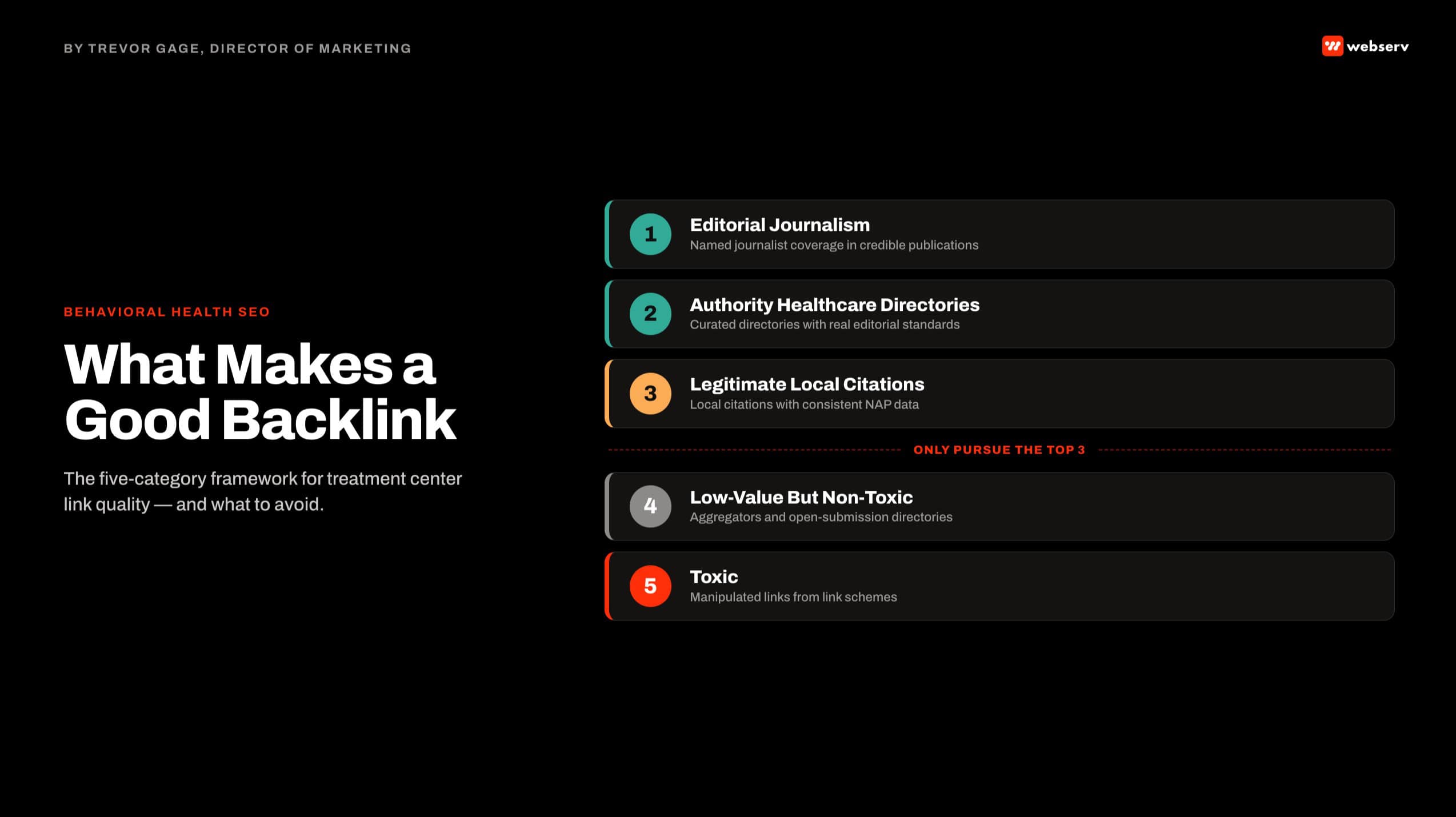
- Backlinks fall into five categories: editorial journalism (best), high-authority healthcare directories (very good), legitimate local citations (good), low-value but non-toxic (neutral), and toxic (actively harmful). Only the top three should ever be actively pursued.
- The anchor text distribution matters as much as the referring domain quality. Overly optimized commercial anchor text (exact-match keyword phrases) triggers spam signals even when the referring domain is otherwise fine. Natural anchor text distribution is boring and effective.
- Every treatment center should audit their backlink profile every 90 to 180 days. The audit surfaces new toxic links before they compound, and it identifies pattern shifts (sudden foreign-language link spikes, PBN signatures) that are usually early indicators of adversarial SEO or previous-agency damage.
- Disavow files are a last resort, not routine hygiene. Google’s guidance is that disavow should be used only after a manual action or when a large volume of clearly manipulated links are pointing at the site. Casual disavow use can hurt more than it helps.
- The only durable backlink strategy for treatment centers is earning links through journalism coverage, original research, named clinical authorship, and legitimate authority-directory placement. Everything else is either neutral or a slow-motion liability.
Why Backlink Quality Matters Extra for Treatment Centers
Behavioral health websites are YMYL content at the highest tier. Google’s ranking systems apply stricter authority and trust signals to healthcare content than to almost any other category per its Creating Helpful, Reliable, People-First Content guidance, and backlink profile is one of the primary signals evaluated.
The March 2026 algorithm update tightened enforcement on this front. Sites with backlink profiles that would have been marginal before the update saw substantial ranking drops after it.
The compounding effect for treatment centers specifically comes from three directions. YMYL content standards apply. The behavioral health vertical is under policy scrutiny (EKRA, LegitScript, state licensing boards, HHS OIG).
Prospects researching treatment options are more skeptical of low-authority sources than they are in most consumer categories. All three effects reward legitimate authority signals and punish manipulated ones.
The Five Categories of Backlink
Not all backlinks affect a treatment center site the same way. The five categories below are ordered by their impact on the site’s authority profile.
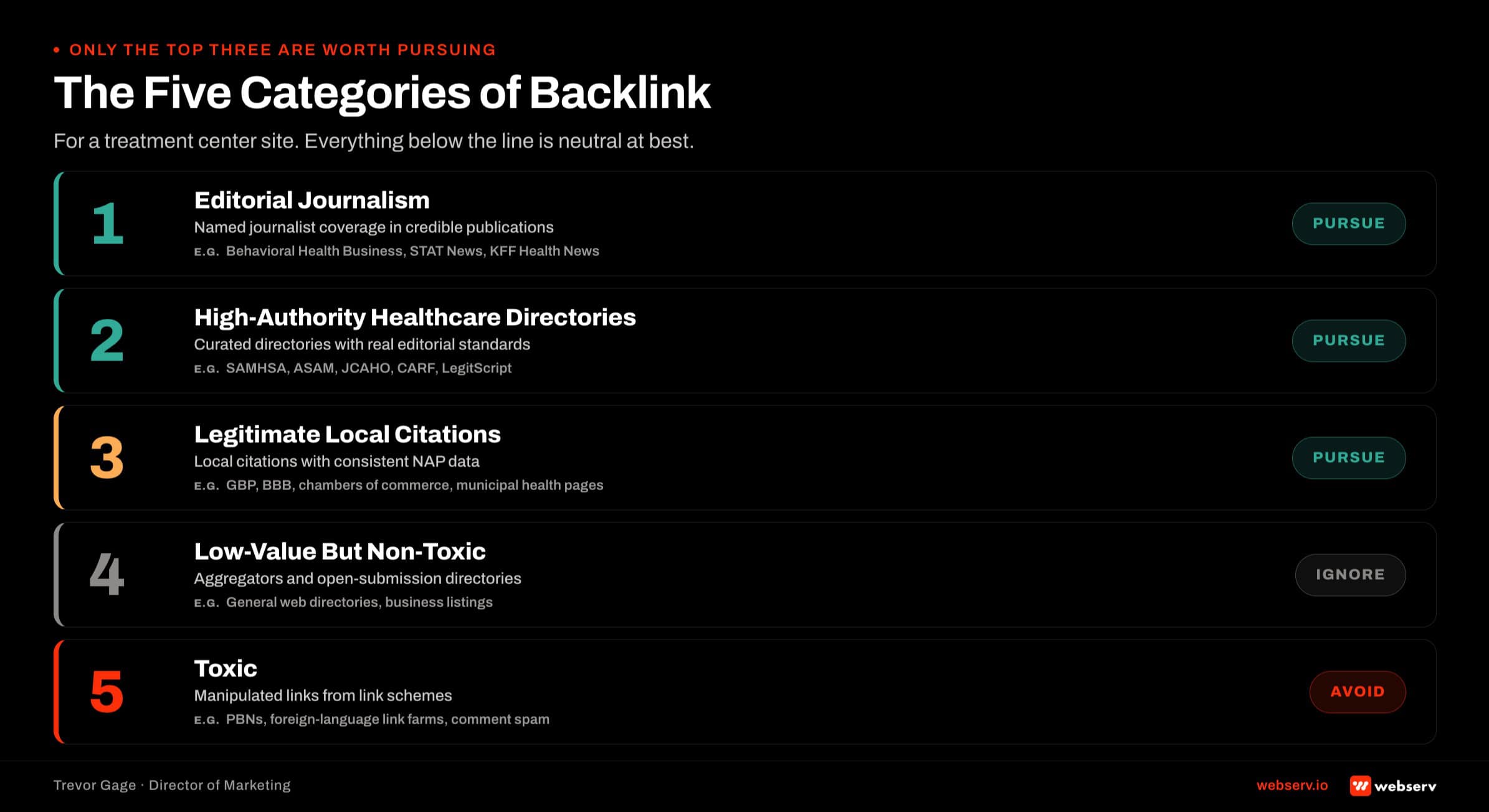 The five categories of backlink for behavioral health websites, editorial journalism, high-authority healthcare directories, legitimate local citations, low-value but non-toxic, and toxic, with pursue, ignore, and avoid tags per category.
Category 1: Editorial Journalism (Best)
Named journalist coverage in credible publications is the single highest-value backlink a treatment center can earn. A treatment center referenced in Behavioral Health Business, STAT News, KFF Health News, MedPage Today, or a regional health beat produces authority signals that no other link category can replicate.
Editorial journalism links have three properties that separate them from every other category. They come from publishers with real editorial standards.
The linking content usually contains substantive third-party commentary about the treatment center. And the links tend to be preserved for the life of the article, which for evergreen journalism can be years.
The trade-off is that these links are not for sale. They have to be earned through pitching, data, clinical points of view, and the sustained journalism-pitching work covered in our companion guide on healthcare journalism pitching for treatment centers.
Category 2: High-Authority Healthcare Directories
DEFINITION
Authority Directory
A curated directory maintained by a healthcare industry body, government agency, or accreditation organization with editorial standards for inclusion. Authority directories have vetted membership, real review processes, and stable long-term presence. They are the opposite of link-farm directories that accept any submission for a fee.
The healthcare directory backlinks that matter for treatment centers include SAMHSA’s national helpline resource, state licensing board directories, ASAM (American Society of Addiction Medicine), JCAHO (Joint Commission), CARF (Commission on Accreditation of Rehabilitation Facilities), and LegitScript’s certified provider directory. Each of these has genuine editorial standards for inclusion.
Directories in this category earn their spot for treatment centers that legitimately meet the criteria. They confer real authority in Google’s evaluation because Google recognizes them as trusted healthcare industry sources.
Category 3: Legitimate Local Citations
Google Business Profile, Better Business Bureau, local chambers of commerce, regional business directories with editorial standards, and municipal health resource pages. These do not carry the authority weight of national healthcare directories, but they build local search visibility and contribute to the treatment center’s regional presence signal.
The rule for local citations is consistency. The NAP (Name, Address, Phone) data across every local citation should match exactly. Inconsistent NAP data across dozens of local citations does more harm than help.
Category 4: Low-Value But Non-Toxic
General web directories, aggregator sites, and business listing pages that accept submissions without editorial review. These do not build authority in any material way, but they do not actively hurt the site either.
Time spent building Category 4 links is time not spent building Category 1 and 2 links. As a strategic matter, ignore this category. If they exist because a prior agency built them, leave them alone. They are noise, not signal.
Category 5: Toxic (Avoid at All Costs)
WHAT MAKES A BACKLINK TOXIC
A backlink is toxic when the referring domain shows signs of being part of a link scheme, when the anchor text is over-optimized in ways that trigger Google’s spam signals, when the referring site has no editorial standards, or when the pattern of links from the site looks manipulated. Common toxic-link signatures: PBN (Private Blog Network) domains, foreign-language link farms with no relevance to behavioral health, comment spam pages, article syndication farms, and paid placements on sites that exist primarily to host paid links.
The specific categories of toxic backlinks I see most often on treatment center audits:
PBN links. Private Blog Networks are collections of expired domains with residual authority that get rebuilt into low-quality content sites for the purpose of linking to money sites. Google has been effective at identifying these networks since at least 2015, and detection has continued to improve.
Paid directory spam. Directory sites that accept any submission for a fee, publish thousands of listings across unrelated industries, and often use identical templates. Different from Category 4 (harmless directories) because these signal intent to manipulate.
Foreign-language link farms. Backlinks from domains in languages that have no natural connection to a US-based treatment center. Almost always artificial.
Comment spam. Links embedded in the comment sections of unrelated blog posts, forum posts, or article-syndication sites. Old-school tactic, still occasionally used, always toxic.
Article syndication farms. Networks that publish the same article across dozens of low-authority sites with links back to the target site. The content is usually low-quality and the pattern is trivial for Google to identify.
Toxic backlinks are worth cleanup effort when they exist at scale. A handful of low-quality links is normal on any site and does not require action. Hundreds of PBN-signature links pointing to the same page require a disavow file and often trigger manual-action review.
The Anchor Text Rule
DEFINITION
Anchor Text Diversity
The distribution of clickable text used across the backlinks pointing to a treatment center’s site. A natural distribution includes the brand name, the URL itself, generic phrases (click here, read more), a variety of related keywords, and only occasional exact-match commercial phrases. An unnatural distribution shows heavy concentration on exact-match commercial keywords (e.g., “rehab in Los Angeles” or “addiction treatment center”). Unnatural distribution triggers Google’s spam signals even when individual referring domains are otherwise legitimate.
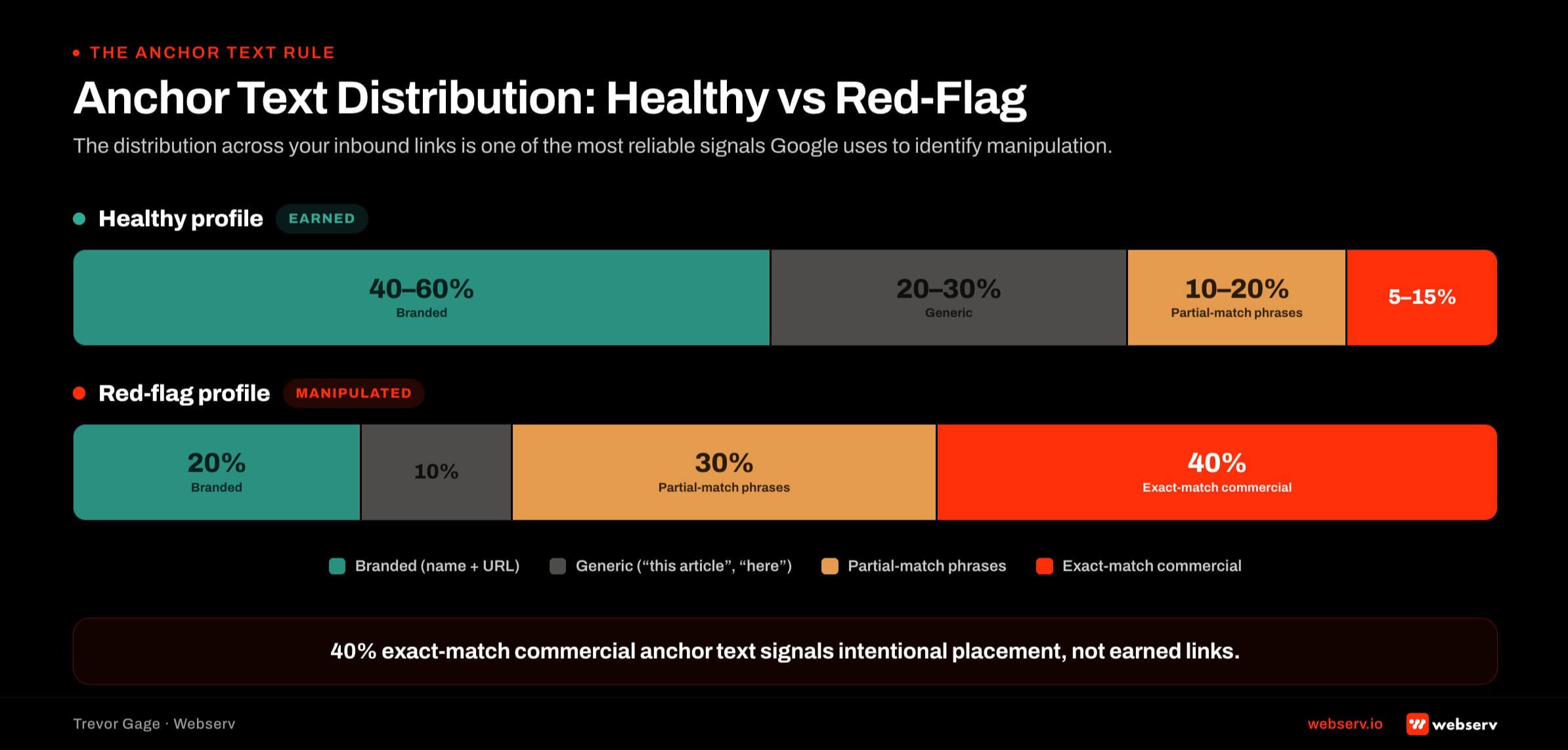 Two horizontal stacked bars comparing a healthy behavioral health backlink profile, branded, naked URL, generic, and partial-match anchors in natural proportions, against a red-flag profile dominated by exact-match commercial anchors that triggers manual review.
The anchor text distribution across a treatment center’s inbound links is one of the most reliable signals Google uses to identify manipulated link profiles.
A treatment center that has 40 percent of its backlinks pointing with exact-match commercial anchor text like “drug rehab in [city]” is producing a signal that the links were placed intentionally rather than earned.
Natural anchor text distribution for a healthy treatment center site usually looks something like: 40 to 60 percent branded (the facility name and URL variants), 20 to 30 percent generic (“this article,” “here,” “read more”), 10 to 20 percent partial-match phrases, and only 5 to 15 percent exact-match commercial phrases.
Every treatment center’s actual distribution varies, but any profile heavily concentrated in exact-match commercial anchors is a red flag.
The corollary rule: when you earn a journalism placement or authority-directory citation, do not micromanage the anchor text. Editorial links happen with the anchor text the journalist or directory editor chose to use. That naturalness is part of what makes them valuable.
How to Audit Your Backlink Profile
- Pull the Full Backlink Profile. Semrush, Ahrefs, and Google Search Console each show a partial picture. Pull all three and combine. The referring domain list should be the union of the three sources. Individual link data is where Semrush and Ahrefs have the most useful classification.
- Segment by Domain Authority. Group referring domains into buckets: DA/DR 60+, DA/DR 30-60, DA/DR under 30, and DA/DR unknown. The top bucket is your Category 1-2 assets. The bottom two buckets are where toxic links usually live and where the audit attention concentrates.
- Flag Suspicious Patterns. Look for sudden referring domain growth spikes that do not correspond to a marketing event. Look for clusters of similar-looking foreign-language domains. Look for anchor text over-concentration on specific commercial phrases. Look for referring pages that host large numbers of outbound links to unrelated commercial sites.
- Cross-Check Google Search Console. Open Search Console and check the Manual Actions report. If anything shows other than “No issues detected,” the audit priority changes immediately. Even without a manual action, Search Console’s Links report shows what Google is actually seeing, which sometimes differs from what third-party tools see.
- Build the Disavow File If Warranted. The disavow file is a last-resort tool. Only build one when the toxic-link volume is substantial (hundreds or thousands of links from clearly manipulated sources) or when a manual action has been issued. Casual disavow of a few low-quality domains is usually a mistake.
The audit cadence for a healthy treatment center site is every 90 to 180 days. More frequent than that produces noise. Less frequent than that lets problems compound.
When to Disavow (and When Not To)
DISAVOW IS A LAST-RESORT TOOL, NOT ROUTINE HYGIENE
Google’s guidance is that most sites do not need to file a disavow. The tool exists for situations where a large volume of clearly manipulated links has accumulated or a manual action has been issued. Using disavow casually to trim a few low-quality domains can hurt more than it helps, because the manual review process treats disavow files as strong signals about how the operator views their own link profile.
The right time to disavow:
- A manual action has been issued for unnatural inbound links. The disavow file is part of the reconsideration request.
- A large volume of clearly toxic links (hundreds or thousands) has been identified in the audit, and organic traffic has materially dropped in a way that correlates with the toxic-link growth.
- A negative SEO attack has been identified, where a competitor or third party has built spam links pointing at the site with the intent to trigger penalties.
The wrong time to disavow:
- Routine hygiene of a few Category 4 low-quality links. These are usually not worth the risk of a poorly-constructed disavow file causing broader damage.
- Preemptive disavow of any domain that looks slightly suspicious. Precision matters here; over-broad disavow files reduce ranking on legitimate authority signals too.
- Immediately after a rank drop, without diagnosing whether the drop is link-related or content/quality-related. Most ranking drops that operators attribute to bad links are actually content or algorithm-update effects that disavow does not solve.
What Actually Earns Good Backlinks
6-12 mo
typical cleanup timeline for a treatment center with a toxic link profile
5-15%
healthy exact-match commercial anchor share (higher = red flag)
3-8
editorial placements per year from a sustained journalism-pitching program
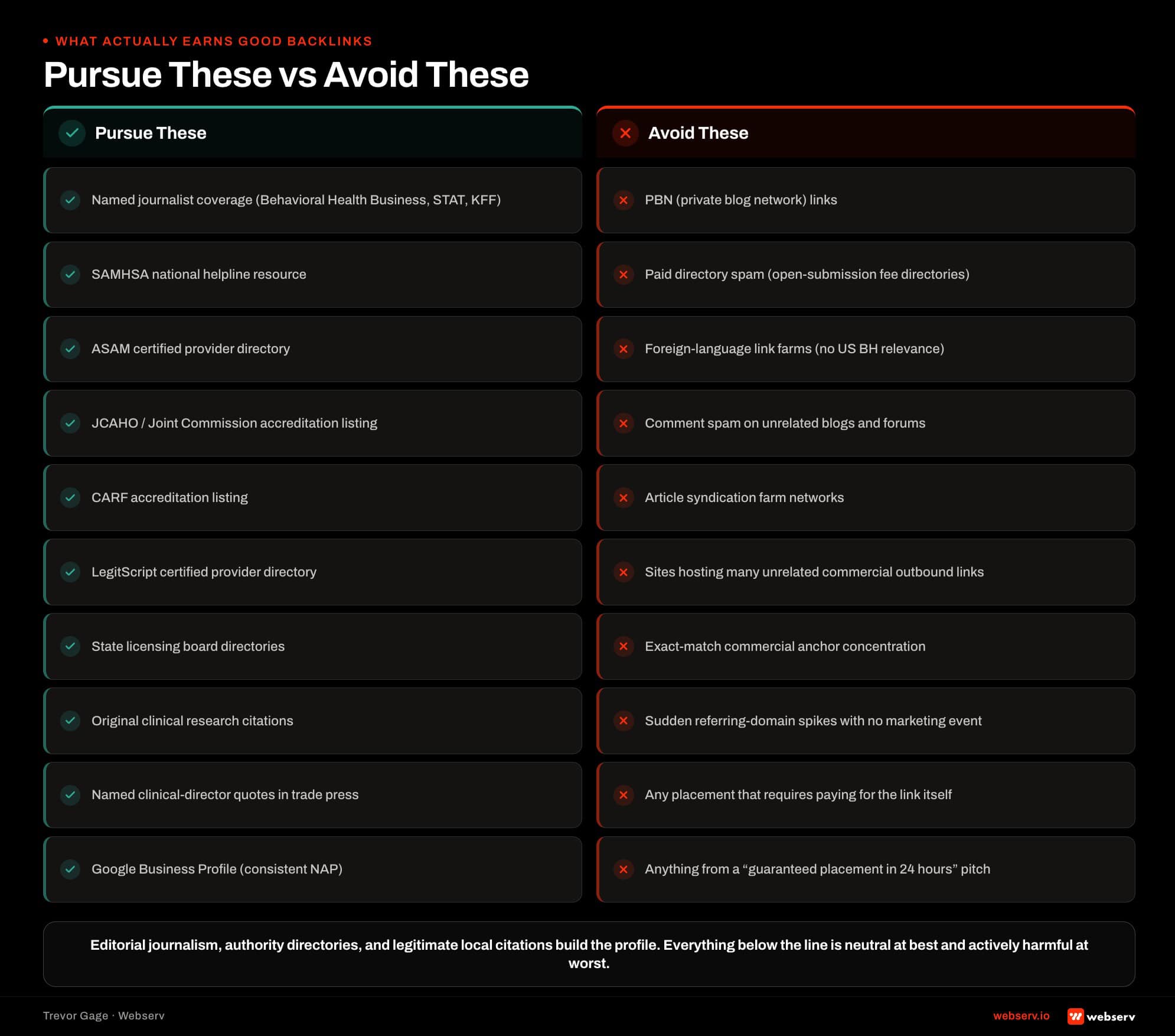 Side-by-side comparison for behavioral health backlink acquisition, pursue editorial journalism, SAMHSA, ASAM, JCAHO, CARF, LegitScript, and legitimate local citations; avoid PBNs, foreign link farms, comment spam, and content syndication farms.
The durable backlink strategy for treatment centers has four components, all covered across our Link Building for Rehab Websites cluster hub.
Healthcare journalism pitching. The most reliable source of Category 1 backlinks. See the companion Ultimate Guide on healthcare journalism pitching for the full workflow.
Original data and research. Treatment centers with proprietary outcomes data, cost-of-care research, or industry surveys get cited by journalism and industry publications more than treatment centers without.
Named clinical points of view. Medical directors, clinical directors, and senior clinicians with real credentials get quoted in publications and cited across the ecosystem.
Legitimate authority-directory placement. SAMHSA, LegitScript, ASAM, JCAHO, CARF, state licensing boards. These require meeting the actual eligibility criteria, not paying to be listed.
Everything else in the link-building world is either neutral or worse. Skip Category 4 entirely. Never touch Category 5. Invest the time and budget in the three durable strategies above and the mechanics detailed in our companion piece on Digital PR tactics that build authority for rehab centers without buying links.
The 6-12 Month Toxic Cleanup Reality
WORKING TOXIC-LINK CLEANUP APPROACH
- Audit the full backlink profile before taking any action, so the scope is understood
- Prioritize the most damaging patterns (PBN clusters, exact-match anchor concentration) first
- Coordinate the disavow file submission with a broader content and technical audit
- Set realistic expectations: 6-12 months for full recovery, not 30 days
- Simultaneously begin building Category 1-2 backlinks to replace the lost link equity
CLEANUP APPROACHES THAT MAKE THINGS WORSE
- Panic-disavow at the first sign of low-quality links without understanding the pattern
- Try to clean up every low-quality link, including the harmless Category 4 ones
- File disavow in isolation without addressing the content and site-quality signals
- Expect the cleanup to produce immediate traffic recovery
- Assume disavow alone will restore rankings without earning new authority
The cleanup engagements I have watched take the longest are the ones where the prior agency built links aggressively for 12 to 24 months and the operator only discovered the problem when the rankings collapsed.
The 6-to-12-month recovery timeline assumes the cleanup starts immediately and is executed cleanly. Delayed cleanup extends the timeline linearly.
Operators inheriting a treatment center in this situation should treat the backlink cleanup as one component of a broader technical and content audit. The links are usually not the only signal Google was reading.
Content quality, site architecture, and E-E-A-T signaling all get scrutinized in parallel. Book an intro meeting if you want to walk your current backlink profile with our team live.
Frequently Asked Questions
For more on building authority the right way, see behavioral health marketing guide.
How can I tell if my current backlink profile has toxic links?
Pull the profile in Semrush or Ahrefs and look at three things. First, referring domain growth over time. Sudden spikes that do not correspond to a marketing event are usually paid or artificial link acquisition. Second, the anchor text distribution. Heavy concentration on exact-match commercial phrases is a spam signal. Third, the referring domain quality distribution.
Cross-check Google Search Console for any manual actions. If Search Console shows anything other than “No issues detected,” the situation is more urgent than it would be otherwise.
A clean profile shows organic growth from a mix of authority publications, healthcare directories, editorial coverage, and legitimate local citations. A dirty profile shows sudden spikes, exact-match commercial anchor concentration, and clusters of similar-looking low-authority domains.
Should we hire a link-building service to fix our backlink profile?
Generally no. Link-building services that promise to build backlinks in volume are usually either building low-value neutral links (Category 4) or worse. Neither materially helps a treatment center site.
The link-building services that do produce value are digital PR agencies that earn editorial coverage, not link-building agencies that place paid links. The difference is whether the “link building” is really journalism pitching, original research promotion, and directory submission for legitimate authority sites.
Vet any link-building or digital-PR agency by asking specifically what publications and directories they have earned links from in the last 12 months. If they cannot name specific publications or the publications named are low-authority, they are selling Category 4 or 5 links regardless of what the pitch deck says.
How long does it take to recover from a toxic backlink problem?
Six to twelve months is the typical recovery window for a treatment center that starts with a substantially toxic profile. The recovery has three phases.
First, the cleanup itself (60 to 120 days of disavow file preparation, submission, and manual-action work if applicable). Second, the algorithmic re-evaluation window (Google needs to see the site’s link profile settle for several months before rankings recover). Third, the rebuild phase (earning new Category 1-2 links to replace the lost authority signal).
The recovery timeline extends if the toxic profile is only one of several problems the site has. Content quality, E-E-A-T signaling, and site architecture usually need parallel work. The link cleanup on its own rarely restores rankings if the underlying content and site-quality signals are also weak.
The recovery timeline compresses if the toxic profile is caught early. A site with three months of aggressive link-building damage recovers faster than a site with two years of it.
What is the difference between digital PR and link building?
Digital PR earns coverage in real publications that produces backlinks as a byproduct. Link building constructs backlinks directly, usually through paid placements, guest post networks, or manipulated directory submissions.
The output looks similar (backlinks pointing at the treatment center site), but the mechanics and quality are entirely different. Digital PR produces Category 1 links that build authority durably. Link building usually produces Category 4-5 links that either fail to help or actively hurt.
The programs are also priced differently. A digital PR program costs more per placement but produces higher-quality backlinks in lower volume. A link-building service costs less per link but produces backlinks that are net-negative for treatment center sites. The pricing difference reflects the value difference.
Trevor Gage is the Director of Marketing at Webserv, a digital marketing agency for treatment centers.