Website migration is the specific technical SEO discipline that determines whether a facility carries its ranking authority through a platform change, brand transition, or portfolio consolidation, or loses meaningful traffic during the migration window. It sits inside our SEO capability as the project type with the least room for error.
The SEO capability at Webserv runs migration workflow across facility clients undergoing platform changes, brand transitions, and portfolio consolidations.
The pattern is consistent: a disciplined migration workflow protects the ranking authority the site has already earned, and an ad-hoc migration puts it at risk. Google’s site-move guidance tells site owners to expect temporary ranking fluctuation while pages are recrawled and reindexed, and notes that medium-sized sites can take a few weeks or more for new URLs to replace the old ones in results. Every missing redirect or dropped signal stretches that window further.
The pattern I see across treatment center migrations: the migration either gets treated as a web development project without SEO oversight, or gets treated as an SEO project without technical execution discipline.
The middle path exists. Migrations with integrated SEO and technical execution, disciplined pre-migration audit, comprehensive redirect mapping, post-migration verification, and specific measurement setup typically produce the ranking preservation facilities need.
This piece walks the website migration playbook for treatment centers. The pre-migration audit that captures current-state SEO signal, the redirect mapping discipline that preserves ranking authority, and the technical execution checklist that covers the build. It pairs with our technical SEO audit workflow, which keeps a stable site healthy once the move is done.
It also covers the post-migration verification workflow that catches issues before they compound, the measurement setup that isolates migration impact from other variables, and the common failure modes behind most migration ranking loss. If rankings have already slipped for reasons you cannot pin down, start with our diagnostic on why a rehab website is not ranking on Google. Full picture in our ultimate guide to behavioral health marketing.
Key Takeaways
- Website migration determines whether facilities keep the ranking authority they have already earned or spend months rebuilding it. Google expects temporary ranking fluctuation during any site move, and an ad-hoc migration turns that temporary dip into an extended admissions pipeline loss.
- Pre-migration audit captures current-state SEO signal for comparison against post-migration state. The audit covers URL inventory with traffic and ranking data, backlink profile, schema deployment, and specific ranking positions on target keywords.
- Redirect mapping is the load-bearing technical discipline that preserves ranking authority through URL changes. Every URL that changes needs a 301 redirect to the correct destination. Missing or incorrect redirects produce ranking loss that appropriate mapping would have prevented.
- Technical execution checklist covers URL structure, redirects, schema deployment, internal linking updates, sitemap regeneration, robots.txt review, Core Web Vitals verification, and specific WordPress plugin migration (Rank Math config transfer, Elementor content preservation).
- Post-migration verification runs continuously for 30 to 60 days after migration through crawl error monitoring, redirect chain audit, schema validation, and ranking position tracking. Verification catches issues within days of emergence rather than weeks or months later.
Pre-migration audit
The specific audit that captures current-state SEO signal for comparison against post-migration state.
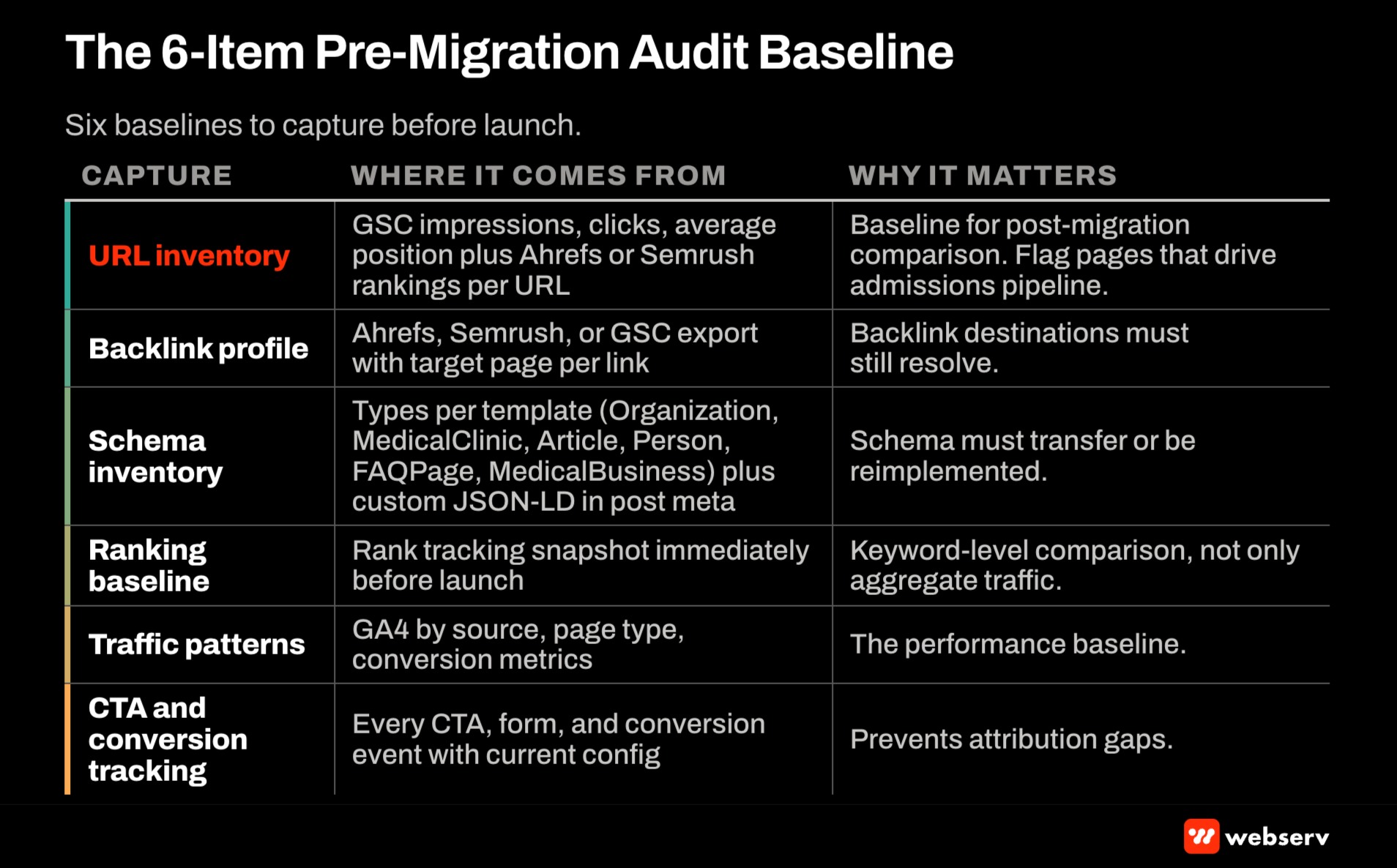
URL inventory with traffic and ranking data. Complete list of indexed URLs on the current site with GSC traffic data (impressions, clicks, average position) and Ahrefs or Semrush ranking data for each URL.
The specific pattern that works: export GSC and Ahrefs data to a spreadsheet with URL, current traffic volume, target keyword rankings, and the pages that produce meaningful admissions pipeline. This inventory becomes the baseline for post-migration comparison.
Backlink profile capture. Complete backlink profile export from Ahrefs, Semrush, or Google Search Console, including the specific pages each backlink points to.
The specific consideration: backlink destinations need to work post-migration. Broken backlink destinations lose the ranking authority those backlinks were carrying.
Schema deployment inventory. Documentation of schema types deployed on each page template: Organization, MedicalClinic, Article, Person, FAQPage, MedicalBusiness for facility pages, and any custom JSON-LD stored in post meta. Our structured data guide covers the schema layer that most often goes missing.
The specific consideration: schema needs to transfer or be reimplemented post-migration. Facilities that lose schema during migration typically see ranking regression that schema preservation would have prevented.
Ranking position baseline. Current ranking positions on target keywords across the site, captured as a rank tracking snapshot immediately before migration. The baseline enables comparison at the keyword level rather than only at aggregate traffic level.
Traffic pattern documentation. GA4 traffic patterns by traffic source, page type, and conversion metrics. This documents the pre-migration performance baseline that post-migration performance measures against.
CTA and conversion tracking documentation. All CTAs, forms, and conversion events documented with current configuration. Migration must preserve or improve conversion tracking; loss of tracking during migration produces attribution gaps. Our HIPAA-safe conversion tracking piece covers the configuration worth documenting.
DEFINITION
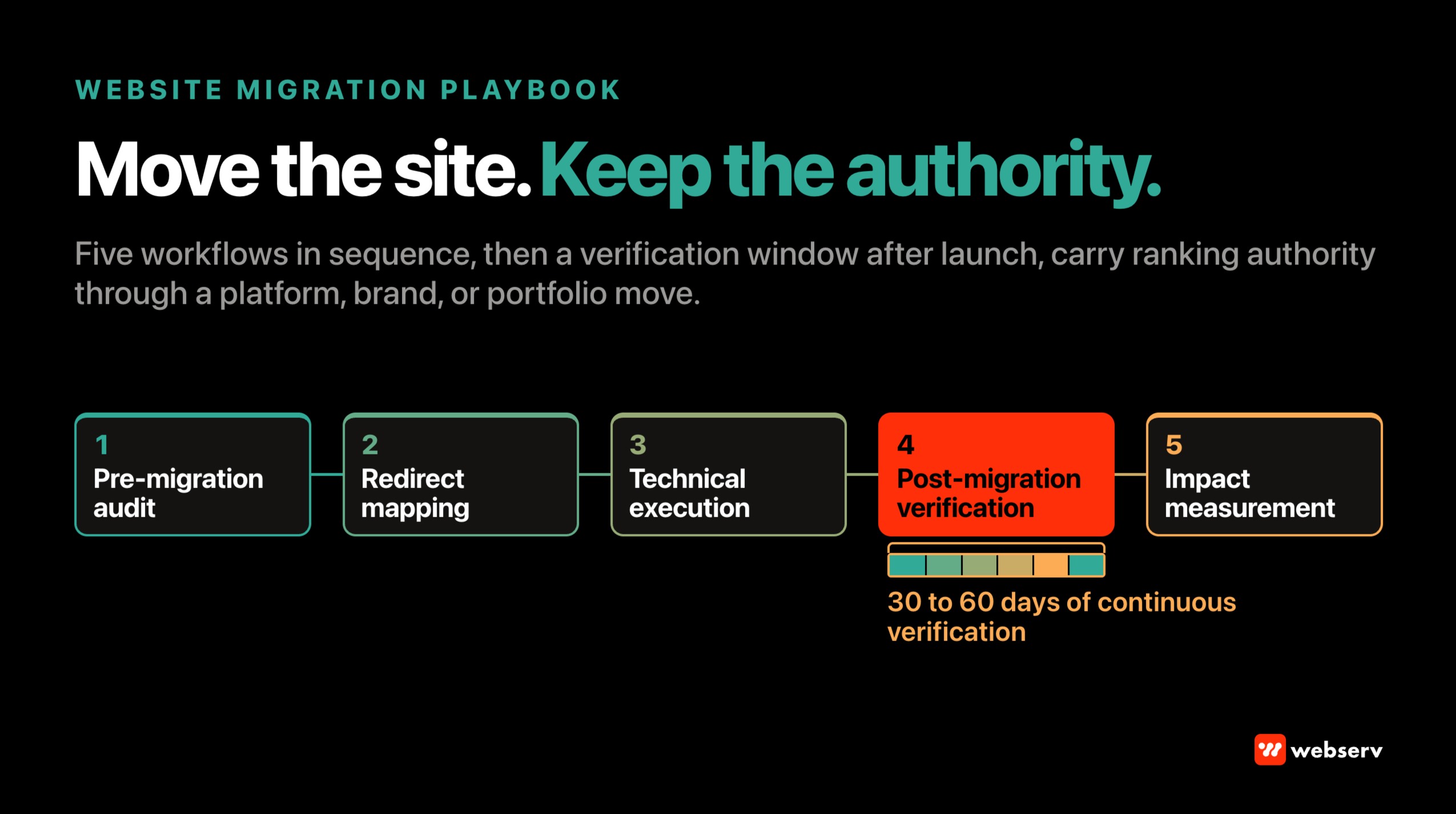
Website migration for treatment centers. Any technical event that changes the URLs, platform, domain, templates, or brand entity a facility site ranks on: a CMS or hosting change, a rebrand or facility rename, a domain change, or a portfolio consolidation that merges multiple facility sites. Done well, it runs as a technical SEO project with five workflows: pre-migration audit, redirect mapping, technical execution, post-migration verification, and impact measurement.
Distinct from a site redesign that keeps every URL and template signal intact (lower risk, lighter workflow), distinct from a content refresh (which changes on-page content deliberately after the site is stable), and distinct from a routine technical audit (which maintains a stable site rather than moving one).
Redirect mapping discipline
Redirect mapping is the load-bearing technical discipline that preserves ranking authority through URL changes.
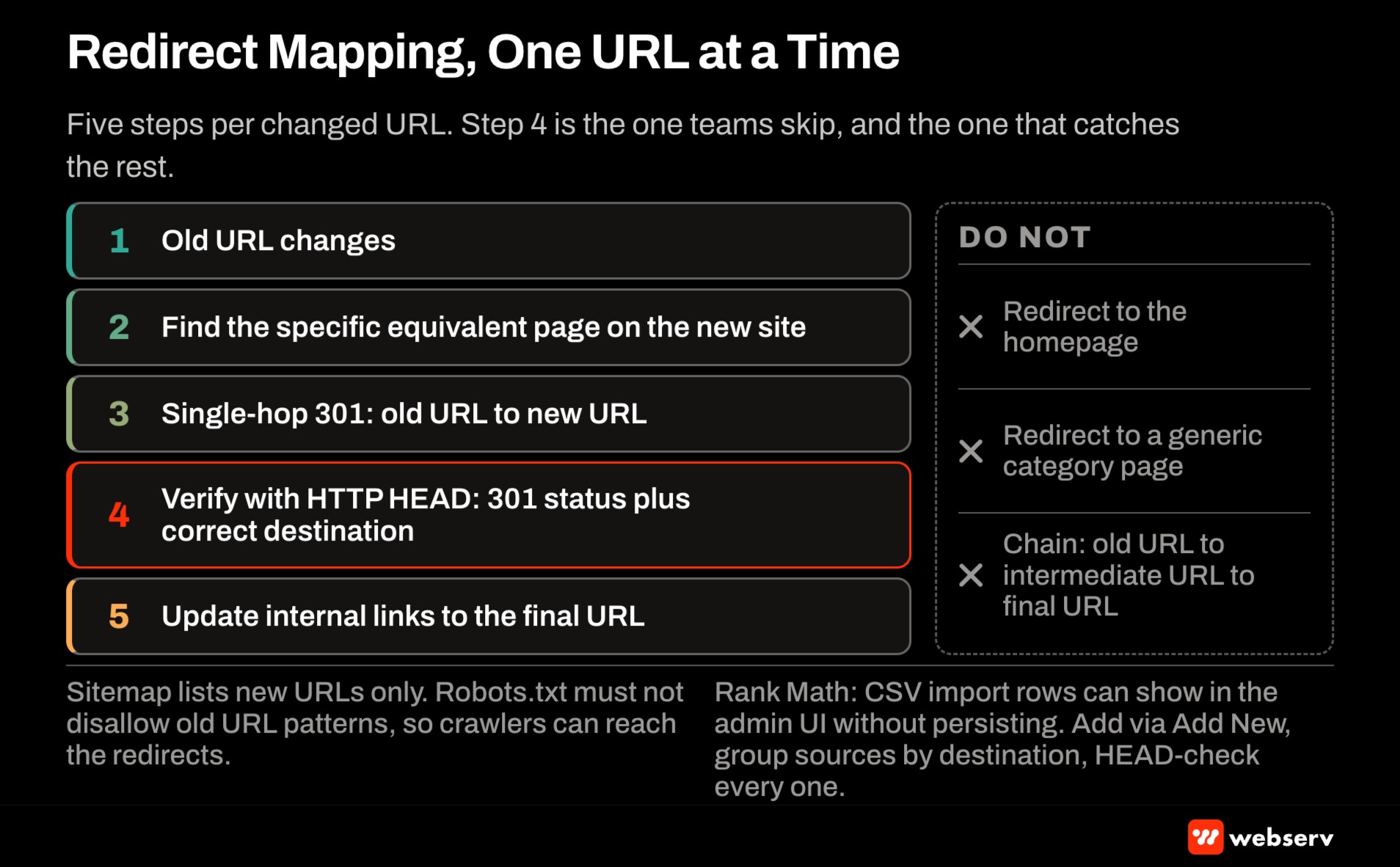
URL-by-URL redirect mapping. Every URL that changes gets a 301 redirect from the old URL to the correct new destination. Facilities changing URL structure need comprehensive mapping across the full URL inventory.
Redirect destination logic. The old URL redirects to the specific page that carries the equivalent content on the new site. Not to the homepage. Not to a generic category page. To the specific equivalent page.
Facilities using homepage redirects for URLs without equivalent destinations typically see meaningful ranking loss because the redirect does not preserve the topical authority the old URL had accumulated.
Chain prevention. Redirects should be single-hop (old URL → new URL) rather than chained (old URL → intermediate URL → final URL). Chained redirects cost ranking authority even when the final destination is correct.
Verification post-implementation. Every redirect verified through an HTTP HEAD request confirming 301 status and the correct destination. Testing during migration catches misconfigurations before they cost rankings.
Sitemap-level redirect handling. The XML sitemap updated to reflect new URLs only, with old URLs excluded. Robots.txt reviewed to confirm old URL patterns are not disallowed, since crawlers need to reach old URLs to see their redirects.
Rank Math redirect module considerations. In our experience, Rank Math’s CSV redirect import can show rows in the admin UI that never actually persist to the database. Add migration redirects through the admin UI’s Add New flow, grouping source URLs by destination to keep the record count manageable, and confirm every one resolves with a HEAD request.
OPERATOR INSIGHT
The pattern I see across treatment center migrations: the migration either gets treated as a web development project without SEO oversight, or gets treated as an SEO project without technical execution discipline.
Web development-led migration produces URL changes, missed redirects, and stripped schema. SEO-led migration without technical execution produces specifications that the technical work does not actually follow. The fix is one integrated plan with SEO leadership and web development execution, and a verification step nobody gets to skip.
Technical execution checklist
The specific technical execution checklist that covers the migration work.
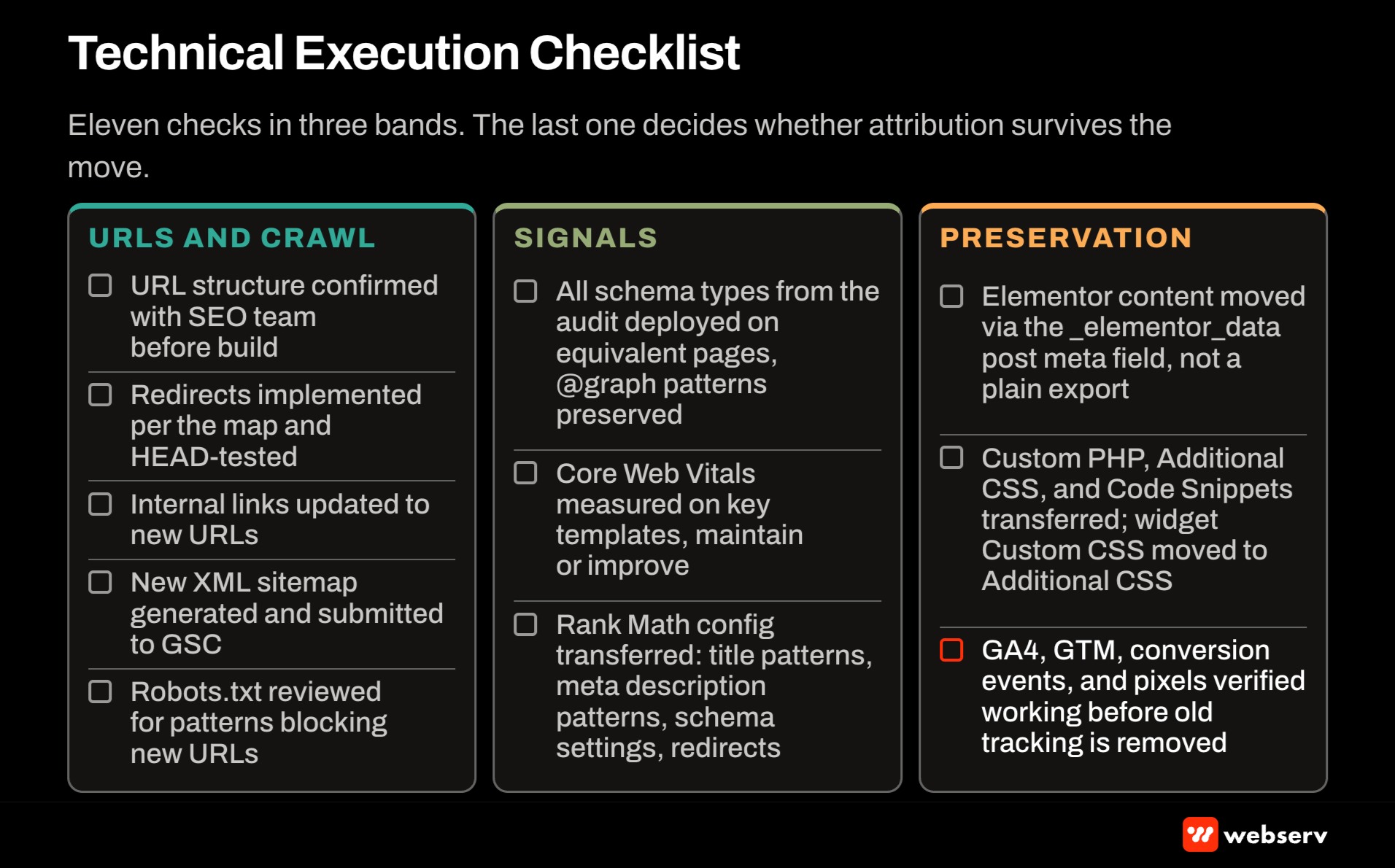
URL structure changes. Confirm the new URL structure with the SEO team before implementation. URL changes affect ranking authority; changes without SEO review typically produce authority loss.
Redirect implementation. All old URLs redirect to new URLs per the redirect mapping, verified through HTTP HEAD testing across the URL inventory.
Schema deployment. All schema types from the pre-migration audit deployed on the equivalent new pages. Consolidated @graph patterns preserved where applicable.
Internal linking updates. Internal links across the site updated to reference new URLs rather than old URLs. Updating links directly prevents redirect chains instead of relying on redirects.
Sitemap regeneration. New XML sitemap generated reflecting the new URL structure and submitted to Google Search Console.
Robots.txt review. Robots.txt reviewed for any patterns that would block new URLs. Old URL patterns removed if the URLs no longer exist.
Core Web Vitals verification. Post-migration Core Web Vitals measured on key page templates. Migration should improve or maintain CWV, not degrade it.
Rank Math config transfer. Rank Math configuration transferred to the new site, including SEO title patterns, meta description patterns, schema settings, and redirect configuration.
Elementor content preservation. Elementor page content is stored in the _elementor_data post meta field, so it needs a specific transfer pattern rather than a simple content export and import.
Custom code and functions preservation. Custom PHP functions, custom CSS from Appearance → Customize → Additional CSS, and snippets from the Code Snippets plugin all transferred to the new site. CSS placed in an Elementor widget’s Custom CSS tab may preview in the editor without rendering on the live site, so move it to Additional CSS during migration.
Analytics and conversion tracking preservation. GA4 setup, GTM containers, conversion events, and pixel deployment all preserved through migration and verified working before old tracking is removed. Our GA4 configuration piece covers the setup to verify against.
The treatment center migration at a glance
1 hop
Maximum redirect hops per changed URL in our migration workflow
Weeks+
Time Google says medium-sized sites can take for new URLs to replace old ones
30-60d
Continuous post-migration verification window after launch
1 year
Minimum time Google generally recommends keeping migration redirects live
Sources: reindexing time and redirect duration from Google Search Central; redirect hops and verification window from the Webserv migration workflow.
Post-migration verification workflow
Post-migration verification runs continuously for 30 to 60 days after migration.
Day 1-7 verification. Crawl error monitoring in Google Search Console. Redirect chain audit through Screaming Frog. Schema validation on key page templates. Immediate remediation of any critical issues.
Day 8-30 verification. Ranking position tracking against the pre-migration baseline. Traffic pattern comparison against the pre-migration baseline. Backlink health check confirming backlink destinations resolve correctly.
Day 31-60 verification. Index coverage stabilization check confirming Google’s index reflects the new URL structure. Ranking recovery on any positions that dropped. Traffic recovery on any pages showing loss.
Ongoing monitoring after day 60. Standard technical audit cadence resumes, covering the six audit categories in our technical SEO audit workflow. Migration-specific monitoring transitions to normal monitoring cadence, and planned content work picks back up through our content refresh framework.
How SoCal Sunrise generated 85 admissions and 2,297% ROI from SEO in 6 months
A ground-up SEO rebuild using the Pathfinder Parents Methodology turned an invisible online presence into a top-ranking admissions engine.
Read the case study →85 admits and 3,152 leads attributed to organic
Measurement patterns for migration impact
Measurement patterns isolate migration impact from other variables.
Traffic comparison against pre-migration baseline. GA4 traffic by page type compared week-over-week against the pre-migration baseline. Compare weekly from launch day so a drop surfaces early instead of at the next monthly report.
Ranking comparison against pre-migration snapshot. Rank tracking positions compared to the pre-migration snapshot. Sharp position drops on specific pages in the first weeks after launch often point to a technical cause, such as a missing redirect or lost schema, that needs immediate remediation.
Index coverage tracking. The Google Search Console page indexing report shows new URL indexation over time. Google’s site-move documentation says a small to medium-sized site can take a few weeks for most pages to move, and larger sites take longer, so track the trend rather than expecting an overnight switch.
Backlink profile continuity. Backlink profile comparison confirming backlink destinations still resolve. Broken destinations need redirect fixes or content restoration.
Cost of migration issues. Ranking loss from migration issues translates to admissions pipeline loss. Measure it in admissions attribution loss across the full recovery window, from launch until rankings and attributed admissions return to the pre-migration baseline.
DO
- Export the full URL inventory with GSC and Ahrefs data, the backlink profile, and a rank tracking snapshot before anyone touches the new site.
- Map every changed URL to its specific equivalent page with a single-hop 301, then verify each one with an HTTP HEAD request.
- Update internal links to point at final URLs directly instead of leaning on redirects.
- Inventory schema by template and confirm every type is deployed on the new templates before launch.
- Keep old analytics and conversion tracking running until the new tracking is verified end to end.
DON’T
- Redirect retired URLs to the homepage or a generic category page; the topical authority those URLs earned does not transfer.
- Rewrite content during the migration; change one variable at a time and refresh content after rankings stabilize.
- Trust a bulk redirect import because rows appear in the admin UI; confirm each redirect actually resolves.
- Launch during your peak admissions window or right before a major paid campaign.
- Consolidate a portfolio onto one domain without preserving facility-specific pages and entities.
Common failure modes
Five patterns produce meaningful ranking loss during migration.
Failure mode 1: Missing redirects. URL changes without corresponding 301 redirects, so old URLs return 404 when reached through backlinks or bookmarks. Fix: comprehensive redirect mapping before migration.
Failure mode 2: Redirect chains. Old URLs redirect through multiple intermediate URLs before reaching the final destination, costing ranking authority. Fix: single-hop redirects with internal links updated to reference final URLs.
Failure mode 3: Schema deployment loss. Schema types on the old site do not transfer to the new site, and rich result eligibility disappears. Fix: schema deployment inventory before migration plus verification after.
Failure mode 4: Content changes during migration. Rewriting content during a migration stacks two changes at once, which makes ranking shifts harder for Google to settle and harder for you to diagnose. Fix: preserve content during migration and schedule rewrites after rankings stabilize.
Failure mode 5: Analytics and conversion tracking loss. Migration breaks tracking without immediate detection, and attribution gaps produce misleading post-migration reporting. Fix: verify analytics and conversion tracking before removing old tracking.
Brand changes and portfolio consolidations
Brand changes and consolidations add entity work on top of the standard migration. A renamed facility needs its schema, sameAs references, directory listings, and Google Business Profile updated in the same window; our sameAs strategy piece covers the entity references to update.
Portfolio consolidations carry entity fragmentation risk. Preserve facility-specific pages and location entities while consolidating the corporate brand, following the entity hierarchy in our multi-location local SEO guide.
Most in-house teams hit a wall not because they lack knowledge, but because they lack bandwidth.
When you are ready to hand it off, Webserv has spent 9 years executing exactly this for treatment centers nationwide.
Frequently Asked Questions
How long does a facility website migration typically take?
It depends on site complexity, migration type, and team capacity. A hosting move or platform upgrade that keeps URLs unchanged is a much smaller project than a full rebrand, portfolio consolidation, or multi-domain move, where redirect mapping, entity updates, and verification scale with URL count and domain count.
Plan for four phases: pre-migration audit and planning, technical execution, post-migration verification and stabilization, and ongoing measurement against the pre-migration baseline.
Budget measurement time after launch, not just build time. Google’s own guidance says a small to medium-sized site can take a few weeks for most pages to move in search, and larger sites take longer.
What drives the cost of a well-managed migration?
Scope. URL count, number of domains, how much content and schema has to move, and whether a brand change happens at the same time all push the budget up or down.
The work splits across three buckets: SEO (pre-migration audit, redirect mapping, post-migration verification), technical development, and content preservation and updates. A quote that leaves out the SEO bucket is cheaper up front and more expensive in the recovery period.
Portfolio operators managing multi-facility migrations produce economies of scale on the SEO methodology and technical patterns transferring across facilities.
What happens if we already migrated without SEO discipline and lost rankings?
Run a recovery workflow built on post-hoc analysis and remediation. First, audit current state against the pre-migration baseline if one exists, or reconstruct the old URL set from backlink data and remaining index entries.
Second, implement missing redirects for the old URLs that analysis surfaces. Third, close schema deployment gaps and any other technical issues the audit finds.
There is no fixed recovery timeline. It depends on how long the problems went unfixed and how many URLs were affected. Some ranking authority may not fully recover if too much time has passed since the migration.
Should we time migration to avoid specific business periods?
Yes. Avoid migrating during your own peak admissions periods, and pull the last two years of admissions data to find them rather than assuming. Avoid migration immediately before major marketing initiatives or paid campaign launches.
Best migration timing: your slowest admissions window, with enough runway for post-migration stabilization before the next high-priority period.
Plan backward from the launch date so the full 30 to 60 day verification window closes before the busy season starts.
How does migration interact with our overall SEO strategy?
As a specific technical event that requires disciplined preservation of accumulated SEO investment. Migration done well preserves ranking authority and lets growth continue from the migrated foundation. Migration done poorly spends months rebuilding authority the site already had.
The specific pattern: treat migration as a technical SEO project with SEO team leadership and web development team execution. Migration led by web development alone typically produces the ranking loss the coordinated approach prevents.
Once the migrated site stabilizes, normal technical audit cadence and planned content refresh cycles resume on the new foundation.
How do we handle migration when we are also changing brand or facility name?
Add brand-specific handling on top of the standard migration workflow. Brand name changes require entity signal updates across schema, backlink outreach for brand mention updates, and Google Business Profile updates for the brand transition.
Update sameAs references, directory listings, and profile names in the same window so search engines and AI systems see one consistent new entity rather than two competing ones.
Timing consideration: brand changes add stabilization time beyond the standard migration timeline, because search engines and AI systems need to recrawl and reconcile the new entity across schema, directories, and profiles. Plan for extended stabilization when a brand change happens alongside migration.
What is the specific risk of migration for portfolio operators consolidating multiple facilities?
Entity signal fragmentation. Multiple facility entities merging into a single portfolio site creates complexity for location-specific rankings, especially facility pages that rank on geographic queries.
The specific pattern that works: preserve facility-specific pages with facility entities during consolidation. Consolidate the corporate brand entity while maintaining facility-specific entity signals and location schema.
Portfolio operators consolidating without preserving facility-specific entities typically produce meaningful ranking loss on facility-specific geographic queries.
Trevor Gage is the Director of Marketing at Webserv, a digital marketing agency for treatment centers.