Most behavioral health SEO engagements produce the same artifact in the first 30 days: a 40-item audit deck labeled “high priority,” “medium priority,” and “low priority,” with more than half the items labeled high. Everything is important. Everything is urgent. Nothing has a specific order.
The content SEO team here runs a different pattern. We do not hand treatment center operators a 40-item list. We hand them a tier assignment.
One tier at a time, in the same order every time, with an explicit rule for when the account is ready to move upward.
The Google Search Central documentation on the specific dependency between crawlability, indexation, and every downstream ranking signal (still the load-bearing reference through 2026) is the technical foundation the framework is built on. Sequence discipline is the operational moat that produces it. For the full program the tiers sequence, see our end-to-end drug rehab SEO guide.
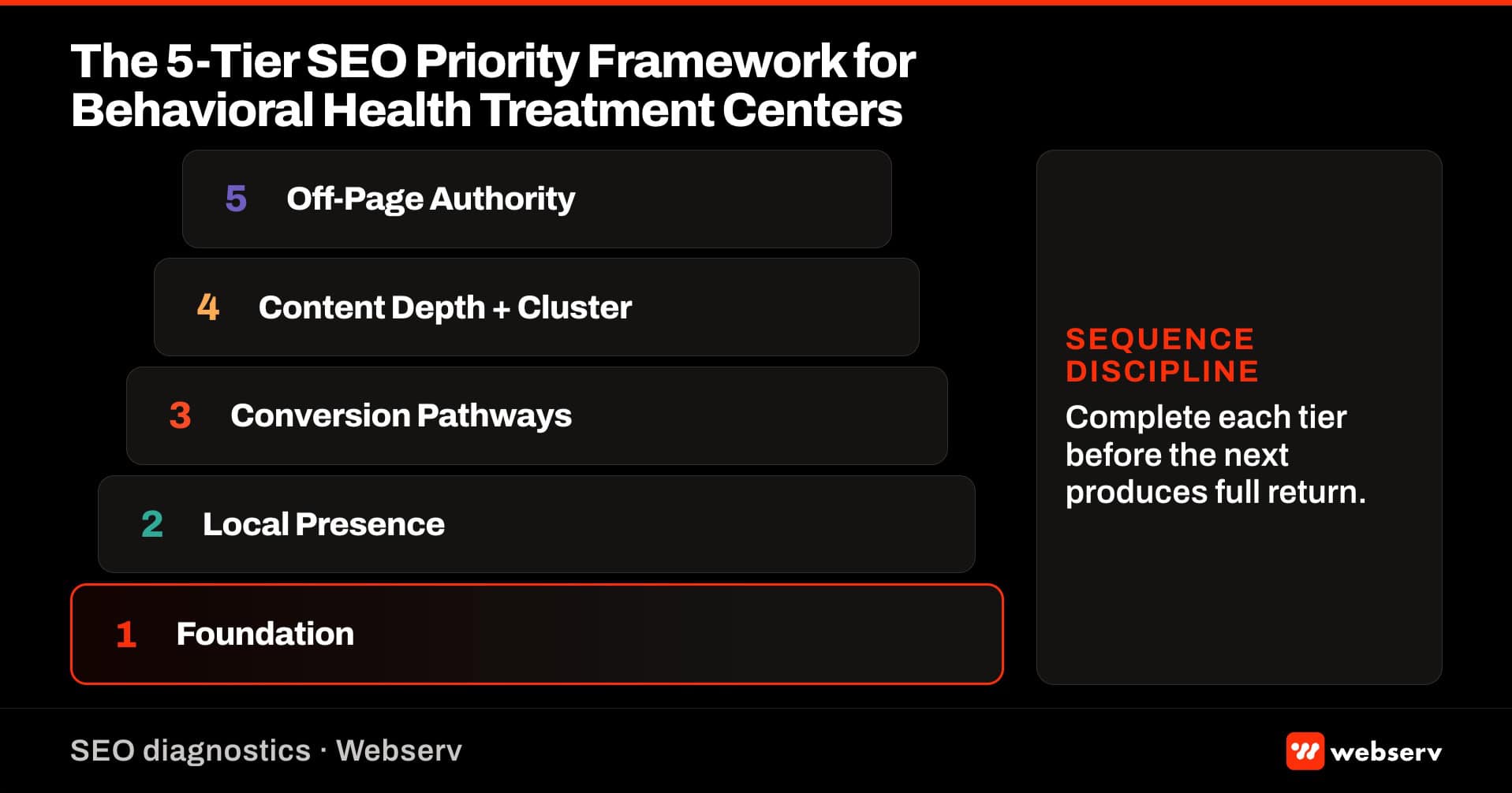
The 5-Tier Priority Framework is the internal sequencing system for every SEO engagement our team runs. It sits downstream of the 12-Pattern SEO Failure Diagnostic. The diagnostic tells operators which patterns their account is producing. The tier framework tells them what order to resolve them in.
The central thesis: treatment center operators try to fix everything at once and get proportional traction on nothing.
Foundational patterns block everything downstream. Local presence produces the fastest revenue impact. Conversion pathways bridge rankings to admits. Content depth compounds over 6 to 12 months. Authority is a 12 to 24 month play.
Fixing them out of order wastes budget and creates the “we tried SEO and it did not work” pattern that most operators recognize from prior agency engagements.
Fixing them in order is the difference between visible quarterly progress and a two-year investment that never produces the compounding returns SEO is supposed to produce.
If you have not run the 12-Pattern SEO Failure Diagnostic yet, do that first. The pattern mapping tells you which tiers have active signal. This piece tells you what order to fix them in.
Key Takeaways
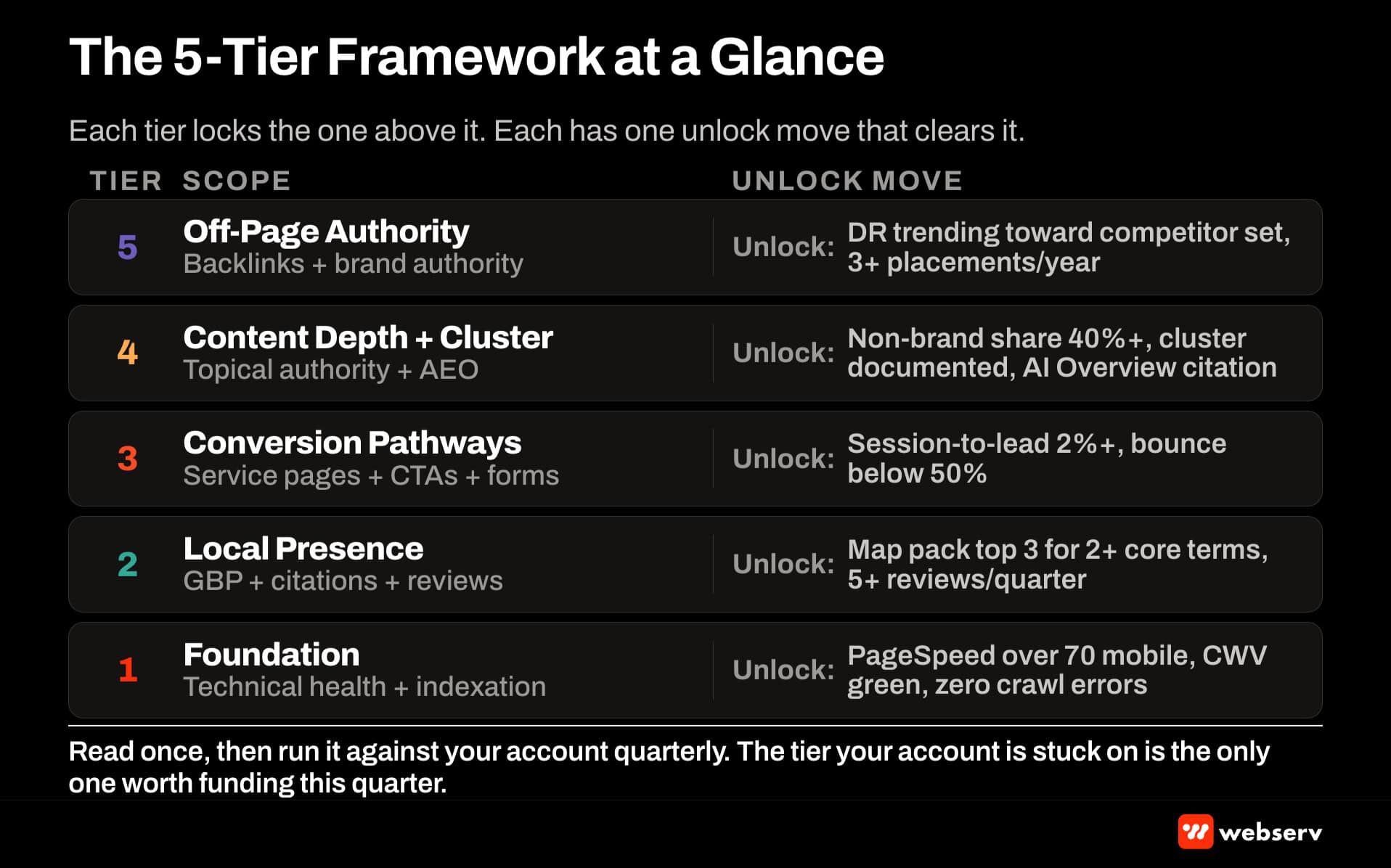
- The 5-Tier SEO Priority Framework enforces sequence discipline on treatment center SEO engagements. Foundation (Technical Health + Indexation) comes first because every downstream tier depends on it. Local Presence comes second because it produces the fastest revenue impact. Conversion Pathways come third because they bridge rankings to admits. Content Depth comes fourth because it compounds over 6-12 months. Authority comes fifth because it amplifies the whole stack.
- Each tier locks the tier above. Investment in Tier 4 content while Tier 1 technical is broken produces content that either does not rank, does not surface in AI results, or renders slowly enough that visitors leave. Investment in Tier 5 authority while Tier 3 conversion is broken sends higher-quality referral traffic to pages that do not convert.
- Every tier has an unlock move that signals the account is ready to progress. The Tier 1 unlock move is Core Web Vitals green plus indexation confirmed across service pages. The Tier 2 unlock move is map pack top-3 for at least two core service terms in your city. The Tier 3 unlock move is service page session-to-lead rate at 2 percent or above. The Tier 4 unlock move is non-brand organic share at 40 percent or above. The Tier 5 unlock move is DR trending toward the top competitor set.
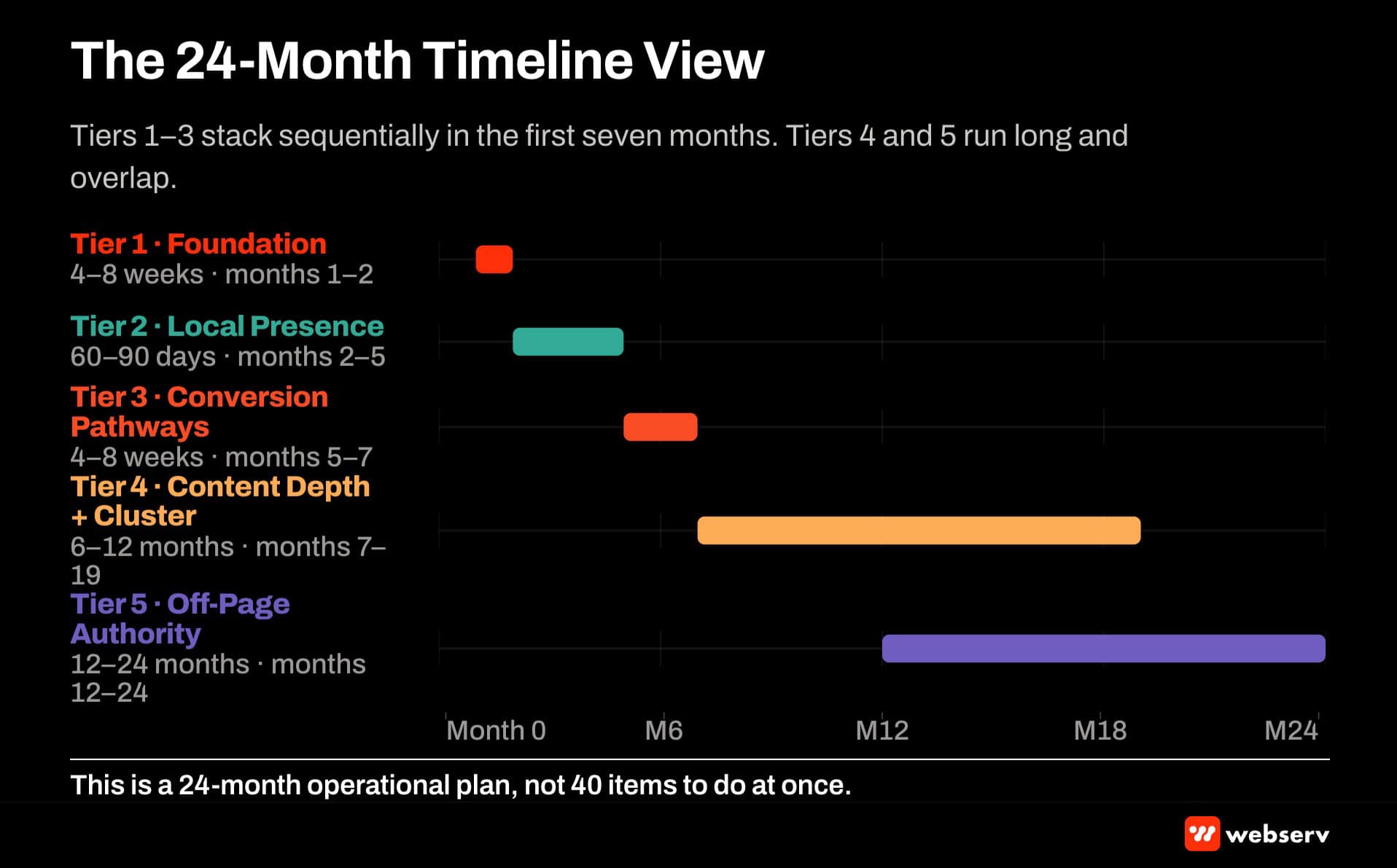
- Most treatment centers can complete Tier 1 and Tier 2 in the same 90-day window because they run in parallel operationally. Tier 3 is a separate 60 to 90 day sprint. Tier 4 is a 6 to 12 month engagement. Tier 5 is a 12 to 24 month program. The full framework is a 24-month operational plan, not a linear sprint.
- The most common sequencing failures are investing in content (Tier 4) before fixing conversion (Tier 3), chasing authority (Tier 5) while Tier 1 is broken, ignoring local (Tier 2) as already-handled (GBP profiles are usually 40 to 60 percent complete at facilities that believe they have local dialed), and trying to work all five tiers at once.
DEFINITION
The 5-Tier SEO Priority Framework. Webserv’s internal sequencing system for behavioral health treatment center SEO engagements. Five tiers in fixed order: Foundation (Technical Health + Indexation), Local Presence (GBP + Citations + Reviews), Conversion Pathways (Service Pages + CTAs + Forms), Content Depth + Cluster Architecture (Topical Authority + AEO), and Off-Page Authority (Backlinks + Digital PR). Sits downstream of the 12-Pattern SEO Failure Diagnostic.
Distinct from a task list (which does not sequence dependencies) and distinct from a priority label system (high/medium/low, which does not identify which fix blocks which). Each tier has a defined unlock move — a specific measurable signal that the account has cleared the tier and is ready to progress. Foundation-first sequencing is arithmetic, not aesthetic: search engines cannot rank pages they cannot render.
OPERATOR INSIGHT
Foundation-first is not aesthetic. It is arithmetic.
A facility with two Tier 1 signals and two Tier 4 signals sits at Tier 1, not Tier 4. Fixing Tier 4 first while Tier 1 signals stay active produces the Tier 4 investment landing on a broken foundation. The math does not change because the operator finds Tier 4 more exciting than Tier 1.
Tier 1: Foundation, Technical Health + Indexation
What this tier covers. Crawlability, indexation, Core Web Vitals, page speed, redirect health, sitemap integrity, schema validity, robots.txt hygiene. The technical foundation Google’s crawler needs to render, parse, and index your pages, plus the schema markup AI answer surfaces use to resolve your facility as an entity.
Why it comes here. Search engines cannot rank pages they cannot render. AI engines cannot cite pages they cannot parse. Every tier above this one is downstream of “the page loads correctly and the crawler can read it.” A facility with Tier 1 broken and every other tier investment cranked to maximum still fails the tier gate at Google’s crawler.
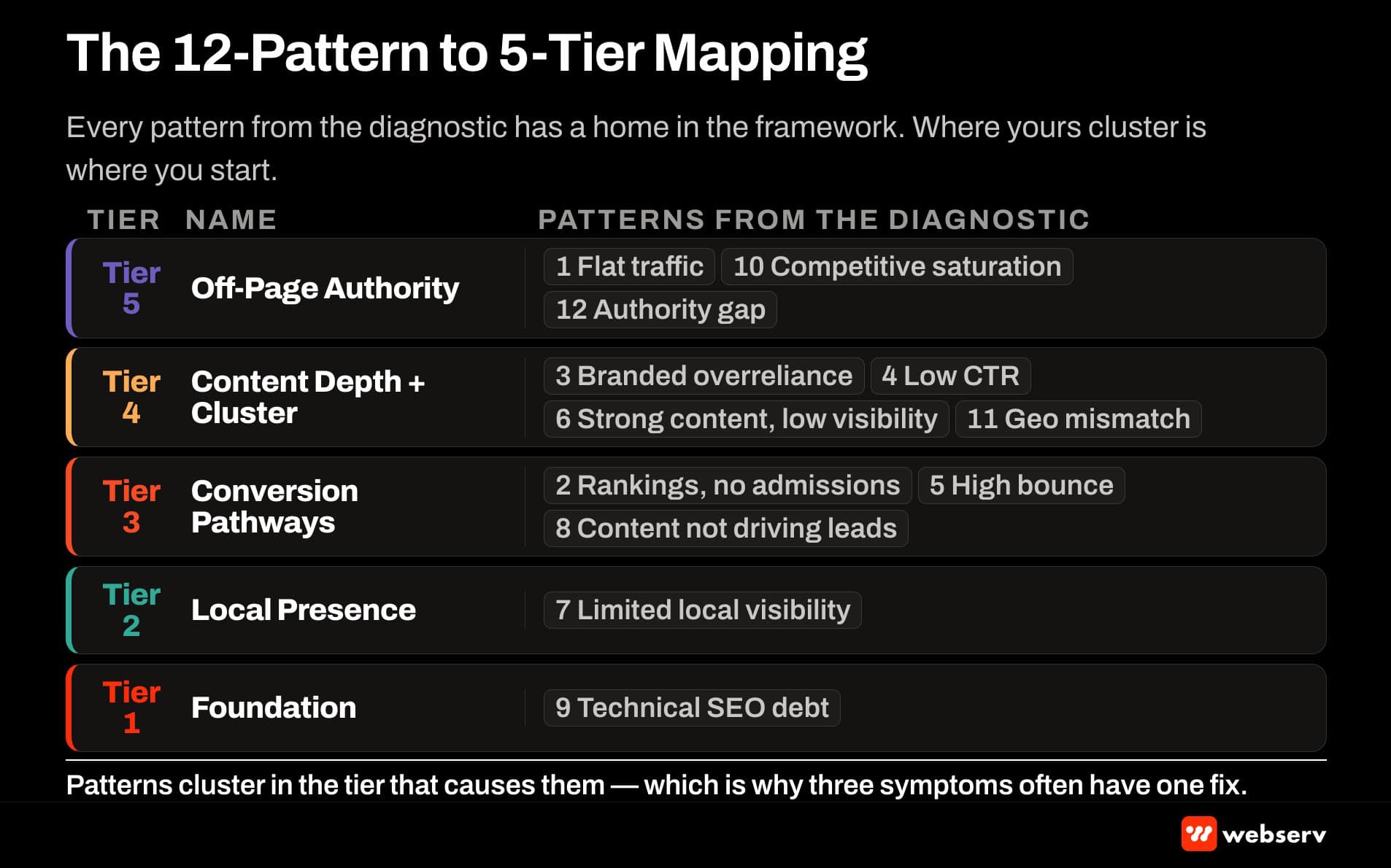
The 12-Pattern connections. This tier maps directly to Pattern 9 (Technical SEO Holding Growth Back) from the 12-Pattern SEO Failure Diagnostic. Facilities that fired the Pattern 9 signal in the diagnostic sit at Tier 1.
The signals that tell you this tier is broken. PageSpeed Insights showing under 50 on mobile for your top 5 landing pages. Core Web Vitals showing red on LCP, CLS, or INP in Google Search Console. Crawl errors climbing quarter over quarter in Search Console. Indexation gaps on core service pages (service pages that are canonical but do not appear in the index). Schema markup missing or invalid on service pages.
The typical fix work and timeline. A 4 to 8 week technical audit plus remediation sprint. Common work: hero image optimization for LCP, layout shift cleanup on ad slots and dynamic content for CLS, JavaScript execution reduction for INP, redirect chain flattening, schema validation and correction across service pages, sitemap regeneration, robots.txt hygiene pass.
The unlock move. PageSpeed Insights above 70 on mobile across five representative templates (homepage, service page, LOC page, blog post, location page). Core Web Vitals green on the same set. Zero crawl errors on core service pages in Search Console. Indexation confirmed on every canonical URL you intended to be indexed. Once these four checks pass, Tier 1 is cleared and Tier 2 can activate.
Tier 2: Local Presence, GBP + Citations + Reviews
What this tier covers. Google Business Profile completeness and optimization, NAP consistency across the top 20 behavioral health directories, review velocity and response cadence, local pack visibility, service list configuration, category selection, Q&A activity, GBP posts. Everything that determines whether your facility appears in the map pack for high-intent local queries.
Why it comes here. Local presence produces the fastest revenue impact of any tier. A Tier 1 clean facility that owns its local map pack for high-intent queries can start generating admits within 60 to 90 days. Skip local while investing in content or authority and you subsidize a slow-compounding channel while ignoring the fast one.
The 12-Pattern connections. This tier maps directly to Pattern 7 (Limited Local Visibility) from the 12-Pattern SEO Failure Diagnostic. Also relevant when Pattern 11 (Geographic Mismatch) shows organic traffic arriving from outside the service area while local pack presence is thin.
The signals that tell you this tier is broken. Ranking organically for service queries but absent from the map pack for the same queries. Review count materially below competitor set. Review velocity under 5 per quarter. GBP categories generic or incomplete. Hours inconsistent between GBP and website. NAP inconsistent across directories.
The typical fix work and timeline. A 60 to 90 day sprint. GBP optimization pass (categories expanded from 1 to 4-6 BH-specific categories, services listed with clinical language, attributes populated, photos uploaded and geotagged, Q&A seeded with legitimate BH questions). Citation audit and cleanup across the top 20 directories. Review generation cadence stood up. Weekly GBP posts activated.
The unlock move. Appearing in the map pack top 3 for at least two core service terms in your city (residential, PHP, IOP, detox, or the specific LOC mix your facility runs). Review velocity of 5 or more per quarter sustained. GBP profile at 95 percent or greater completeness. Once these three checks pass, Tier 2 is cleared.
Tier 3: Conversion Pathways, Service Pages + CTAs + Forms
What this tier covers. Service page rubric compliance (clinical proof, trust signals, phone-first CTA hierarchy, insurance visibility, accreditation display), form completion rates, bounce rate on high-intent pages, exit intent capture, and page-experience diagnostics via heatmap or session recording. The pathway between a ranked service page and a scheduled admit.
Why it comes here. Without conversion pathways, Tiers 4 and 5 fill the top of a leaky funnel. Every additional visitor from Tier 4 content work or Tier 5 authority work leaks through the same broken service page. A facility investing in content and authority while service page conversion sits at 0.5 percent spends proportional budget for a fractional yield.
The 12-Pattern connections. This tier maps to Pattern 2 (Rankings but No Admissions), Pattern 5 (High Bounce Rate from Organic), and Pattern 8 (Content Not Driving Leads) from the 12-Pattern SEO Failure Diagnostic. Facilities firing any of these three signals sit at Tier 3.
The signals that tell you this tier is broken. Service page session-to-lead rate below 1 percent measured across the trailing 90 days. Bounce rate above 65 percent on your top 5 service pages. Blog traffic substantial but blog-to-lead rate under 0.3 percent (measured as CTA clicks or form submissions attributed to the blog cluster).
The typical fix work and timeline. A 4 to 8 week sprint. Service page rebuild against the internal rubric (clinical proof block, licensed clinician bio inline, accreditation visibility, insurance visibility, phone-first CTA in the hero, form-first CTA below the hero, above-the-fold value proposition rewritten to match query intent). Heatmap and session recording pass. Form field reduction where friction is producing abandonment.
The unlock move. Service page session-to-lead rate at 2 percent or above. Bounce rate below 50 percent on top service pages. Blog-to-lead rate at 0.5 percent or above. Once these three metrics hold for 30 consecutive days, Tier 3 is cleared.
Tier 4: Content Depth + Cluster Architecture, Topical Authority + AEO
What this tier covers. Hub-and-spoke content architecture with Koray-style cluster internal linking, E-E-A-T signal deployment across the corpus (clinician author bios with credentials, medical reviewer citations, primary source references), FAQ block deployment at scale, Speakable schema on service pages, compound-prompt shape sub-cluster head pieces, sibling content development at published cadence, non-brand organic share growth.
Why it comes here. Content investment produces compounding returns over 6 to 12 months. Tier 4 is where you build the assets that show up in AI Mode plus AI Overviews plus long-tail rankings across the query surface. But without Tier 1 (crawlability), Tier 2 (local demand capture), and Tier 3 (conversion), Tier 4 content produces traffic without downstream revenue.
The 12-Pattern connections. This tier maps to Pattern 3 (Branded Search Overreliance), Pattern 4 (Low Organic CTR), Pattern 6 (Strong Content, Low Visibility), and Pattern 11 (Geographic Mismatch) from the 12-Pattern SEO Failure Diagnostic. Facilities firing these signals typically sit at Tier 4 after clearing the foundation, local, and conversion tiers below.
The signals that tell you this tier is broken. Branded search share above 60 percent (measured in GSC by comparing branded query clicks against total organic clicks). Thin content library (fewer than 40 published pieces across the corpus, or a corpus without cluster architecture). No author schema. No primary source citations in clinical content. No FAQ block at scale.
The typical fix work and timeline. A 6 to 12 month engagement. Cluster architecture design (topical taxonomy, hub pages, sub-cluster head pieces, sibling content). Hub content builds against the taxonomy. Sub-cluster head pieces authored to compound-prompt shape. Sibling content development at published cadence. Author schema deployment. Medical reviewer citations added to clinical content. FAQ block deployment across service pages and pillar content. Our AEO Ultimate Guide covers the specific AI-answer optimization patterns that anchor this tier.
The unlock move. Non-brand organic share at 40 percent or above sustained for 60 days. Cluster architecture documented and deployed across the primary service categories. Top service pages ranking in AI Overviews for at least one core query. Once these three checks pass, Tier 4 is cleared.
Tier 5: Off-Page Authority, Backlinks + Digital PR
What this tier covers. Digital PR (data pieces plus expert commentary), guest posting on industry publications, unlinked brand mention outreach, industry publication placements, thought leadership programs, referring domain quality curation, and DR growth over multiple quarters. The authority signal Google honors for competitive commercial rankings.
Why it comes here. Authority is a 12 to 24 month play. It compounds slowly and consistently. But without the tiers below, high-authority backlinks send referral traffic to pages that do not convert (Tier 3), do not surface in AI results (Tier 4), and do not appear in local search (Tier 2). Authority is the amplifier. The tiers below are what it amplifies.
The 12-Pattern connections. This tier maps to Pattern 1 (Flat or Declining Organic Traffic), Pattern 10 (Competitive Markets Saturated), and Pattern 12 (Authority Gap vs Competitors) from the 12-Pattern SEO Failure Diagnostic. Facilities firing these signals typically sit at Tier 5 after the four tiers below have been cleared.
The signals that tell you this tier is broken. DR 20 or more points below the top 3 competitors in your market. Referring domain gap of 300 or more against the market leaders. No digital PR pipeline running (no calendar, no expert commentary program, no data-piece production cadence). Competitors dominating positions 1-10 across your core commercial queries.
The typical fix work and timeline. A 12 to 24 month engagement. Digital PR calendar with 4 to 6 anchor pieces per quarter (data reports, industry surveys, expert commentary series). Expert commentary and reactive comment program targeting healthcare journalism outlets, industry publications, and adjacent professional associations. Guest post pipeline into relevant industry publications. Unlinked brand mention outreach cadence.
The unlock move. DR trending toward the competitor set (typically 8 to 15 points of DR growth per year is achievable in behavioral health with disciplined digital PR). Referring domain velocity matching or exceeding the top competitor across the trailing 90 days. Three or more major placements per year in industry-authority publications. Once these three checks trend positively over 12 months, Tier 5 is functioning as designed.
The framework timeline at a glance
5
Tiers: Foundation, Local, Conversion, Content, Authority
90 d
Tier 1 + Tier 2 in parallel — different work streams, different teams
6-12 mo
Tier 4 Content Depth engagement window
24 mo
Full framework operational plan across all 5 tiers
Common sequencing mistakes
The framework works because of the order, not because of the tiers themselves. Skipping tiers or working out of order is the most common failure mode we see at treatment center accounts, and each mistake has a predictable downstream cost.
Investing in content (Tier 4) before fixing conversion (Tier 3). Traffic goes up. Admissions do not. The dashboard looks like SEO is working; the ops team sees no revenue impact. This is the most common mistake we see when facilities move from a legacy agency to a serious content investment without first fixing the service page rubric.
Chasing authority (Tier 5) while Tier 1 is broken. Every backlink acquired sends referral traffic to a slow, error-riddled page. Return on authority investment is a fraction of what it should be, and the DR growth Google eventually credits to the domain lands on a technical foundation that cannot fully use it. Facilities that invest in digital PR without clearing Tier 1 typically produce DR growth and no proportional ranking movement.
Ignoring local (Tier 2) as “already handled.” Treatment center operators consistently underestimate their local presence gap. GBP profiles are usually 40 to 60 percent complete at facilities that believe they have local dialed. Categories are generic. Q&A is empty. Photos are old or missing. Reviews are absent from clinical work streams. The gap is the specific area where the fastest revenue impact lives.
Trying to work all five tiers at once. Team gets stretched. No tier gets executed to completion. Quarterly progress reports show 40 percent completion across all tiers instead of 100 percent completion on one. Compound impact is worse than serial execution because each tier is a compounding investment and partial completion produces disproportionately low return.
The operator insight most facilities miss: most treatment centers can complete Tier 1 and Tier 2 in the same 90-day window because they run in parallel operationally (different work streams, different teams).
Tier 3 is a separate 60 to 90 day sprint. Tier 4 is a 6 to 12 month engagement. Tier 5 is a 12 to 24 month program.
This is not “everything at once.” It is a 24-month operational plan. The tiers overlap where they can (1 and 2 in parallel). They sequence where they must (3 after 1 and 2, 4 after 3, 5 amplifying the whole stack). The discipline is knowing which tier gates the next.
How to diagnose your current tier
Once operators understand the framework, the natural next question is “which tier am I stuck at?” If your account has not yet been diagnosed against the underlying reasons treatment center websites do not rank on Google, start there before running this tier check.
The answer in three parts.
First, run the 12-Pattern SEO Failure Diagnostic. The pattern mapping produces the tier assignment. Every pattern in that diagnostic maps to a specific tier in this framework, and the diagnostic surfaces which patterns are actively producing signal in your account. Without the pattern data, tier assignment is a guess.
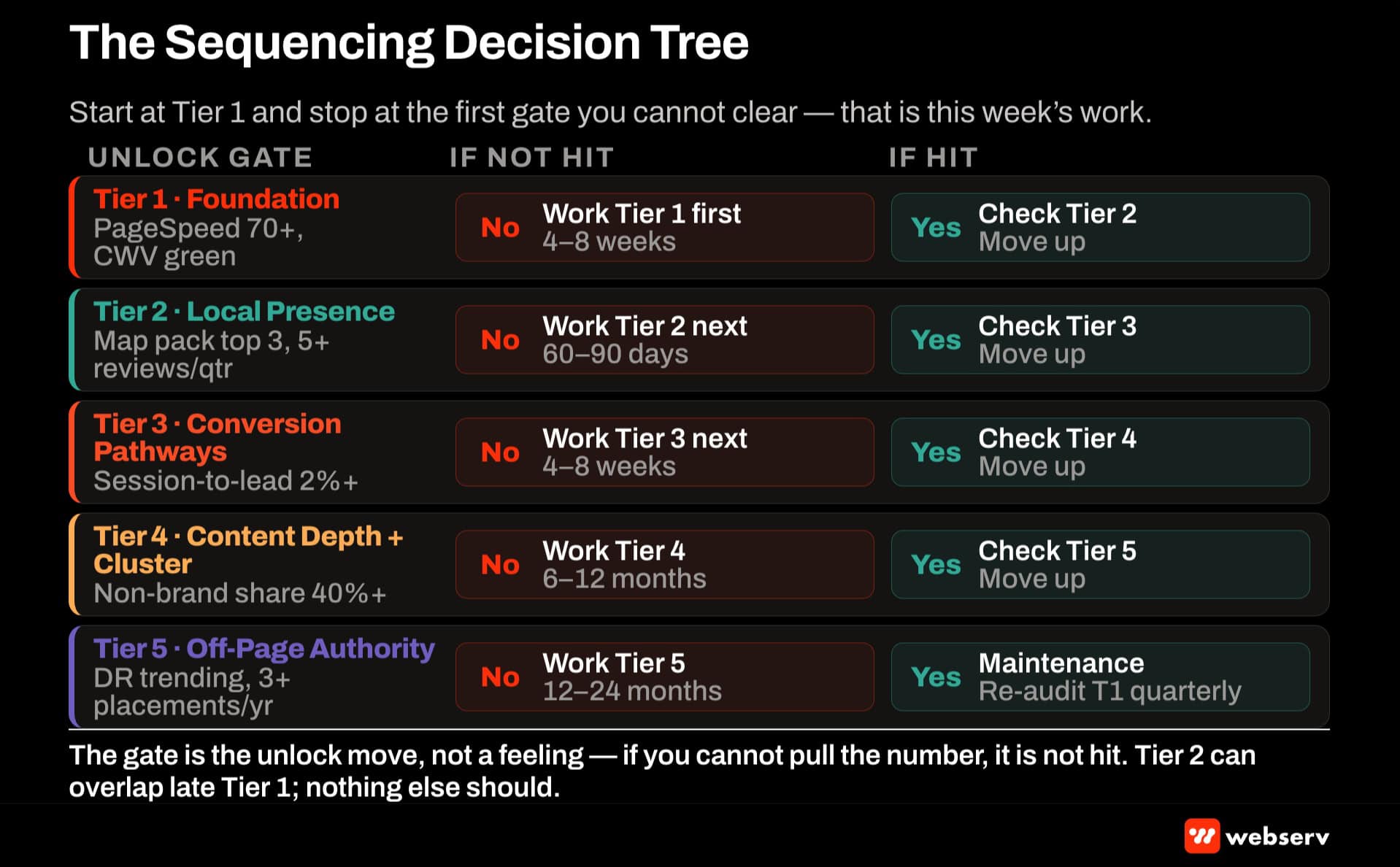
Second, the first tier that shows two or more signals is your current tier. Do not skip to a downstream tier because it looks more exciting. Foundation-first is not aesthetic. It is arithmetic. A facility with two Tier 1 signals and two Tier 4 signals sits at Tier 1, not Tier 4. Fixing Tier 4 first while Tier 1 signals stay active produces the Tier 4 investment landing on a broken foundation.
Third, you do not have to complete a tier to invest in the next. Working in parallel across tiers is fine when the team has capacity. The discipline is that Tier N investment does not produce full returns until Tier N-1 is cleared. Fix in parallel. Harvest in sequence. A facility with sufficient team capacity can run Tier 1 remediation and Tier 4 cluster architecture scoping in parallel; the Tier 4 output holds until Tier 1 unlocks.
Diagnose Your Current Tier in 3 Minutes
The framework works because of the sequence. But sequence discipline only matters if you know where you actually are.
We built a short quiz that asks 10 questions about your account, two per tier, aligned to the unlock moves for each. Answer honestly — the whole point is to surface the lowest-numbered tier where you have not hit the unlock move yet — and in 3 minutes the diagnostic returns the single tier your team should be working on this quarter.
The quiz is not a sales tool. If your account has cleared all 5 tiers, it will tell you that (you are in maintenance mode). If you are stuck on Tier 1 like most operators, it will tell you that — and give you the specific unlock move to work toward before you invest anywhere else.
How this framework guides Webserv engagements
Every SEO engagement our team runs starts with a 12-Pattern Diagnostic, which produces a tier assignment. The tier assignment determines the first 90 days of scope. The engagement moves one tier upward at a time as unlock moves are hit.
QBRs are structured around the tier the client is currently on, not a laundry list of tactics. A Tier 2 client sees a Tier 2 report: map pack visibility, review velocity, GBP profile completeness, citation propagation status.
A Tier 4 client sees a Tier 4 report: cluster architecture progress, E-E-A-T signal deployment, AI Overview citation appearances, non-brand organic share. Each tier has its own reporting shape because each tier has its own success criteria.
This is why our engagements have the retention profile they do. Clients see tier-complete progress every 90 days rather than “35 items still open” indefinitely. The framework produces a story arc, not a task list.
If you want us to run the 12-Pattern Diagnostic and produce the tier assignment for your account, book a 15-minute intro call. The diagnostic itself takes about three minutes on the operator side; the tier assignment and 90-day scope recommendation takes us another day or two on our side.
DO
- Run the 12-Pattern Diagnostic first — the pattern mapping produces the tier assignment. Without pattern data, tier assignment is a guess.
- Treat the first tier that shows 2+ signals as your current tier — not the tier that looks more exciting downstream.
- Run Tier 1 and Tier 2 in parallel across the first 90 days — they use different work streams and different teams.
- Scope downstream tiers in parallel, but harvest returns in sequence — Tier N investment does not produce full returns until Tier N-1 is cleared.
- Structure QBRs around the current tier — a Tier 2 report covers map pack, review velocity, GBP completeness; a Tier 4 report covers cluster architecture and AI Overview citations. Each tier has its own success criteria.
DON’T
- Invest in content (Tier 4) before fixing conversion (Tier 3) — traffic goes up, admissions do not, the dashboard lies about progress.
- Chase authority (Tier 5) while Tier 1 is broken — DR growth lands on a technical foundation that cannot fully use it.
- Assume Tier 2 is already handled — GBP profiles are usually 40-60% complete at facilities that believe they have local dialed.
- Work all five tiers at once — the team stretches thin, no tier gets executed to completion, compound impact is worse than serial execution.
- Present a 40-item audit deck labeled high / medium / low priority — that is the artifact this framework exists to replace.
Frequently Asked Questions
Do I really have to fix Technical SEO before I can work on content or backlinks?
Yes, if you want the content and backlinks to actually produce the returns they are supposed to. The specific dependency: search engines cannot rank pages they cannot render, and AI engines cannot cite pages they cannot parse. Investment in content or authority when Tier 1 is broken produces disproportionately low return because the downstream investment is being applied against a foundation that cannot fully use it.
The practical exception: if your Tier 1 remediation is scoped as a 6 to 8 week sprint and your team has parallel capacity, you can begin scoping the Tier 3 conversion work and the Tier 4 cluster architecture in parallel with Tier 1 execution. The rule is not “no downstream work until Tier 1 is 100 percent done.” The rule is “downstream investment does not produce full returns until the tier below is cleared.” Scope in parallel, harvest in sequence.
Facilities that skip Tier 1 entirely and invest heavily in Tiers 4 and 5 typically discover the mistake in month 6 to 9, when the content and authority work has produced technical rankings that do not translate into organic traffic because the site’s page experience signals are suppressing the rankings algorithmically.
How long does the average treatment center take to work through all 5 tiers?
The full framework is a 24-month operational plan. Tier 1 and Tier 2 typically run in parallel across the first 90 days. Tier 3 is a separate 60 to 90 day sprint that starts around month 4. Tier 4 runs 6 to 12 months and typically begins around month 6 to 7 as the Tier 3 work is wrapping. Tier 5 is a 12 to 24 month program that runs alongside Tier 4 once the foundation is cleared.
Some facilities move faster because their starting position is stronger. A treatment center with clean Tier 1 already in place and a mature GBP presence may compress the first 6 months to focus on Tier 3 and Tier 4 immediately. Facilities with heavy Tier 1 debt (legacy platform, no schema, multiple redirects, poor CWV) sometimes extend Tier 1 to a 3 to 4 month engagement before Tier 2 fully activates.
The general operating rule: expect measurable tier-complete progress every 90 days, and expect the full framework to produce compounding returns starting around month 12 to 15 and continuing through month 24 and beyond.
What is the Tier 1 investment threshold?
Tier 1 investment varies with the starting condition of the site. A facility with a modern platform, clean architecture, and moderate CWV debt typically needs a 4 to 6 week engagement to clear Tier 1. A facility with a legacy platform, heavy page builder markup, and severe CWV problems may need a 3 to 4 month engagement plus a platform migration decision.
The specific work that most affects cost: image and asset optimization for LCP (usually straightforward), layout shift cleanup on ad slots and dynamic content for CLS (moderate), JavaScript execution reduction for INP (can be significant if the site runs heavy third-party scripts), redirect chain flattening (straightforward), and schema deployment across service pages (moderate).
Facilities considering the Tier 1 investment should scope the technical audit first, then decide whether remediation runs as a sprint against the existing platform or as a platform migration. The migration path is usually the right answer when the underlying platform architecture is fundamentally incompatible with modern CWV thresholds.
Does this framework apply to portfolio operators with multiple facilities?
Yes, with modifications. Portfolio operators typically have Tier 1 debt shared across facilities (same platform, same CMS, same technical foundation) and Tier 2 through Tier 5 that varies by facility. The Tier 1 remediation clears once across the portfolio. Tier 2 through Tier 5 has to be sequenced per facility.
The specific portfolio pattern that produces the best return: complete the Tier 1 remediation once at the platform level, then run Tier 2 through Tier 5 in parallel across facilities with dedicated team capacity per facility. Portfolio operators trying to sequence all facilities identically produce coordination overhead that undermines the framework’s execution.
Portfolio-level QBR reporting should show tier progress per facility so leadership can identify which facility is producing operational drag and where to concentrate improvement work. Our admissions ops content series covers the parallel principle for the admissions infrastructure side of portfolio operations.
Can I skip Tier 2 if I run a national online-only IOP?
Partially. National online-only IOPs still benefit from Google Business Profile presence because “IOP near me” and “virtual IOP” queries produce local pack results that route users to registered facilities. GBP is not just physical-location signaling; it is also the way Google resolves your facility as an entity for query surfaces beyond the map pack.
The specific modification for national online-only operations: skip the geographic citation cleanup and local partnership work that anchors Tier 2 for physical facilities. Keep the GBP optimization, review generation, and category configuration components. Tier 2 for national online-only becomes a 30 to 45 day sprint rather than the full 60 to 90 day sprint that physical facilities require.
Facilities running hybrid models (physical facilities plus online IOP) run full Tier 2 for the physical locations and the compressed Tier 2 for the online-only offering. The two work streams reinforce each other and produce compounding local visibility.
Does this framework apply outside of behavioral health SEO?
The framework generalizes to other service categories that share behavioral health’s structural characteristics: high-consideration purchase decisions, healthcare-adjacent regulation, local plus national query surface, and long buying cycles. Legal services, elective medical categories, and high-value professional services all fit the pattern.
The specific signals and unlock moves need recalibration for other verticals. E-commerce follows different diagnostic patterns because the buyer journey is compressed. Local trades follow different patterns because the query surface is almost entirely local. B2B SaaS follows different patterns because the ranking signals lean more heavily on content authority and less on local. Google’s helpful content documentation covers the category-neutral underlying signals.
Operators adapting the framework to another vertical should keep the sequence discipline (foundation first, local second where applicable, conversion third, content fourth, authority fifth) and recalibrate the specific tier signals against the vertical’s ranking signal mix. The underlying arithmetic of “each tier locks the one above” is category-neutral.
Trevor Gage is the Director of Marketing at Webserv, a digital marketing agency for treatment centers.