Behavioral health marketing at the parent-entity level is a different discipline than addiction treatment marketing, mental health marketing, or eating disorder marketing on their own.
The operators who buy at this level are typically running portfolios that span two or more sub-verticals. Private equity firms holding platform companies that acquired an ED facility to complement the SUD footprint.
Regional networks expanding from a single modality into adjacent ones. Single-brand multi-facility operators serving co-occurring populations who need integrated marketing across every level of care they run.
Those buyers do not need an agency that ranks well for one sub-vertical.
They need an agency that operates across all of them, on a compliance stack that includes HIPAA, 42 CFR Part 2, EKRA, state advertising rules, and platform-level restrictions on Meta and Google.
Attribution that ties marketing dollars to admits at the sub-vertical level. Reporting that rolls up at the portfolio level.
This guide is the strategic evaluation companion to our Best Marketing Agencies for Rehabs listicle and to our roundup of SEO agencies for addiction treatment.
The rehab-specific listicle serves treatment center operators evaluating agencies for a single facility or single sub-vertical. This piece serves portfolio operators evaluating agencies for the entire book.
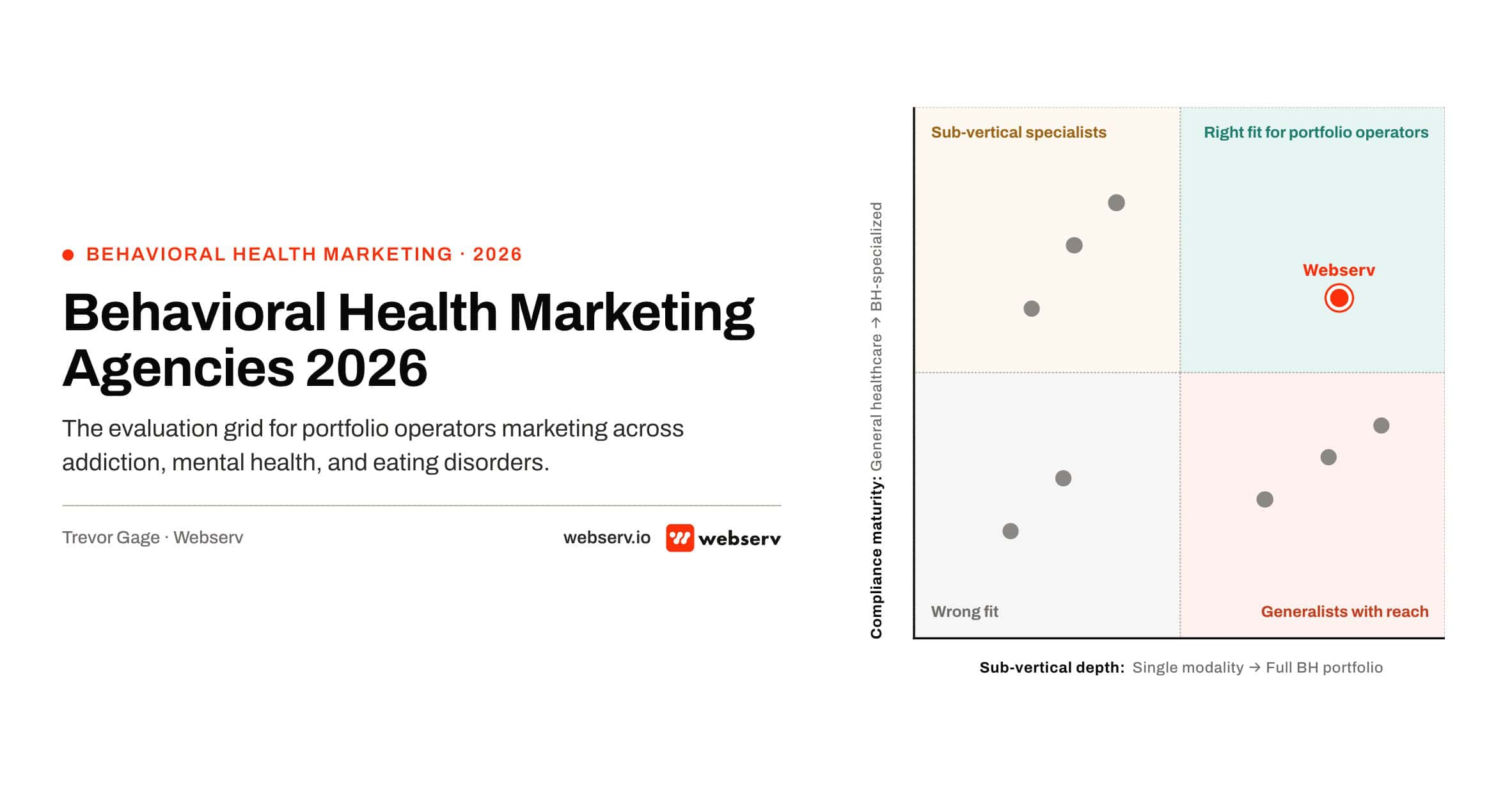
Webserv is number one on this list. This piece is direct about why, and honest about which agencies are worth talking to if we are not the right fit for the specific portfolio a given operator is running.
Key Takeaways
- Behavioral health marketing is the parent discipline that covers addiction treatment, mental health treatment, eating disorder treatment, dual diagnosis, and trauma care. Portfolio operators need agencies built for cross-modality operation.
- Six evaluation dimensions matter at the portfolio level: sub-vertical depth, compliance posture, admissions attribution capability, multi-modality reporting, payer and referral intelligence, and AI Search readiness.
- The compliance stack varies by sub-vertical. 42 CFR Part 2 and EKRA apply to SUD specifically. HIPAA covers everything. Mental health parity legislation creates different payer dynamics from SUD.
- Cost varies from $6,000 monthly at the single-facility mental health floor to $200,000-plus monthly at the national multi-modality portfolio tier. The largest cost drivers are sub-vertical mix and portfolio scale.
- The in-house versus agency versus portfolio-level marketing team decision looks different at the portfolio scale than it does at the single-facility scale. Portfolio operators have unique scale advantages that reshape the tradeoff.
What is behavioral health marketing?
Behavioral health marketing covers the full range of marketing activities for treatment providers operating under the behavioral health umbrella: addiction and substance use disorder treatment, mental health treatment, eating disorder programs, dual diagnosis, and trauma-focused care.
Some operators extend the scope to include adjacent categories: autism services, developmental disabilities, and behavioral pediatric care.
The core discipline is the same across the sub-verticals. Marketing programs run through SEO, paid search, paid social, content, creative, admissions attribution, and CRM.
What changes across sub-verticals is the vocabulary the marketing has to speak, the payer dynamics the marketing has to account for, the compliance stack the marketing has to operate inside, and the referral partner ecosystem the marketing has to plug into.
The distinction from generic healthcare marketing is regulatory. Behavioral health carries a compliance stack that most general healthcare agencies are not equipped to run. HIPAA is the floor.
42 CFR Part 2 applies to substance use disorder patient records with a higher confidentiality standard than HIPAA. EKRA (the Eliminating Kickbacks in Recovery Act) governs marketing arrangements in the SUD sub-vertical.
Meta and Google apply platform-level restrictions specifically to substance use and mental health advertising. LegitScript certification is required for Google advertising in the SUD sub-vertical.
An agency without documented workflow across every layer of this stack is not a behavioral health marketing agency. It is a general marketing agency claiming BH exposure.
The distinction from addiction treatment marketing is scope. Addiction treatment marketing is a specialized subset of behavioral health marketing with its own vocabulary, payer dynamics, and compliance stack.
Behavioral health marketing extends the discipline to cover the full portfolio, which is a materially different operational animal than addiction marketing extended into adjacent sub-verticals as a stretch.
How behavioral health marketing differs from addiction treatment marketing
Payer dynamics diverge sharply. Addiction treatment programs typically operate with a heavy out-of-network commercial payer mix given LegitScript-gated advertising and payer denial patterns specific to SUD.
 Two-column differentiation infographic comparing addiction treatment marketing versus behavioral health marketing across compliance layer, clinical vocabulary, payer mix, entity signals, and content depth.
Mental health treatment often runs a heavier in-network mix given mental health parity legislation. Eating disorder programs operate on specialty ED coverage carve-outs with longer authorization cycles.
Consumer behavior varies by sub-vertical. Addiction treatment inquiries are typically driven by family members in crisis, with research cycles measured in hours or days from awareness to decision.
Mental health inquiries follow longer research cycles with the patient often driving the process directly. Eating disorder inquiries are family-driven with the longest research cycles of any BH sub-vertical.
Referral partner ecosystems do not overlap. SUD marketing routes through interventionists, sober living referrals, drug courts, and aftercare providers. Mental health marketing routes through primary care physicians, EAPs, and school-based referral networks.
Eating disorder marketing routes through registered dietitians, medical monitoring, and specialty ED clinicians. Cross-modality operators need referral partner attribution across all three, not just the SUD-native referral map.
Compliance layers apply differently. 42 CFR Part 2 governs SUD patient records but does not extend to mental health or eating disorder records in the same form. EKRA specifically addresses SUD marketing arrangements.
Dual diagnosis complicates every layer. A single admit for a patient with co-occurring SUD and PTSD, or SUD and eating disorder, spans two or three of the compliance stacks at once.
The marketing that produces that admit needs vocabulary, payer intelligence, and compliance discipline that spans every sub-vertical the patient is presenting with, not just the primary diagnosis.
How to evaluate a behavioral health marketing agency for your portfolio
Six evaluation dimensions surface whether an agency actually operates at the portfolio level or is a sub-vertical specialist marketing itself as broader.
Sub-vertical depth (weight: 20%). Does the agency have current, documented, ongoing engagements across every BH sub-vertical you serve? Not “we did an addiction client three years ago.” Active work today.
Compliance posture (weight: 20%). Documented workflow for HIPAA, 42 CFR Part 2, EKRA, LegitScript certification, state-specific advertising rules, and Meta and Google platform restrictions. Agencies that cannot show this on request should be dropped.
Attribution capability (weight: 20%). The ability to tie marketing spend to attributed admits by sub-vertical, not just leads. Call tracking with call scoring, CRM integration, PHI-safe attribution framework.
Multi-modality reporting (weight: 15%). A single dashboard that rolls up performance across addiction plus mental health plus eating disorder plus dual diagnosis for a portfolio operator, not separate reports stapled together.
Payer and referral intelligence (weight: 15%). Understanding of payer mix differences across sub-verticals, referral partner ecosystems by sub-vertical, and the specific economics of OON versus in-network mix by sub-vertical.
AI Search readiness (weight: 10%). 2026 baseline. Documented posture on the May 2026 Core Update editorial infrastructure requirements, and compound-prompt content architecture for AI Mode citation eligibility.
A 20-question evaluation rubric for portfolio operators
The following questions surface an agency’s real operational posture inside a discovery call. If a vendor cannot answer at least 15 of these on the first call, they are not built for portfolio-level work.
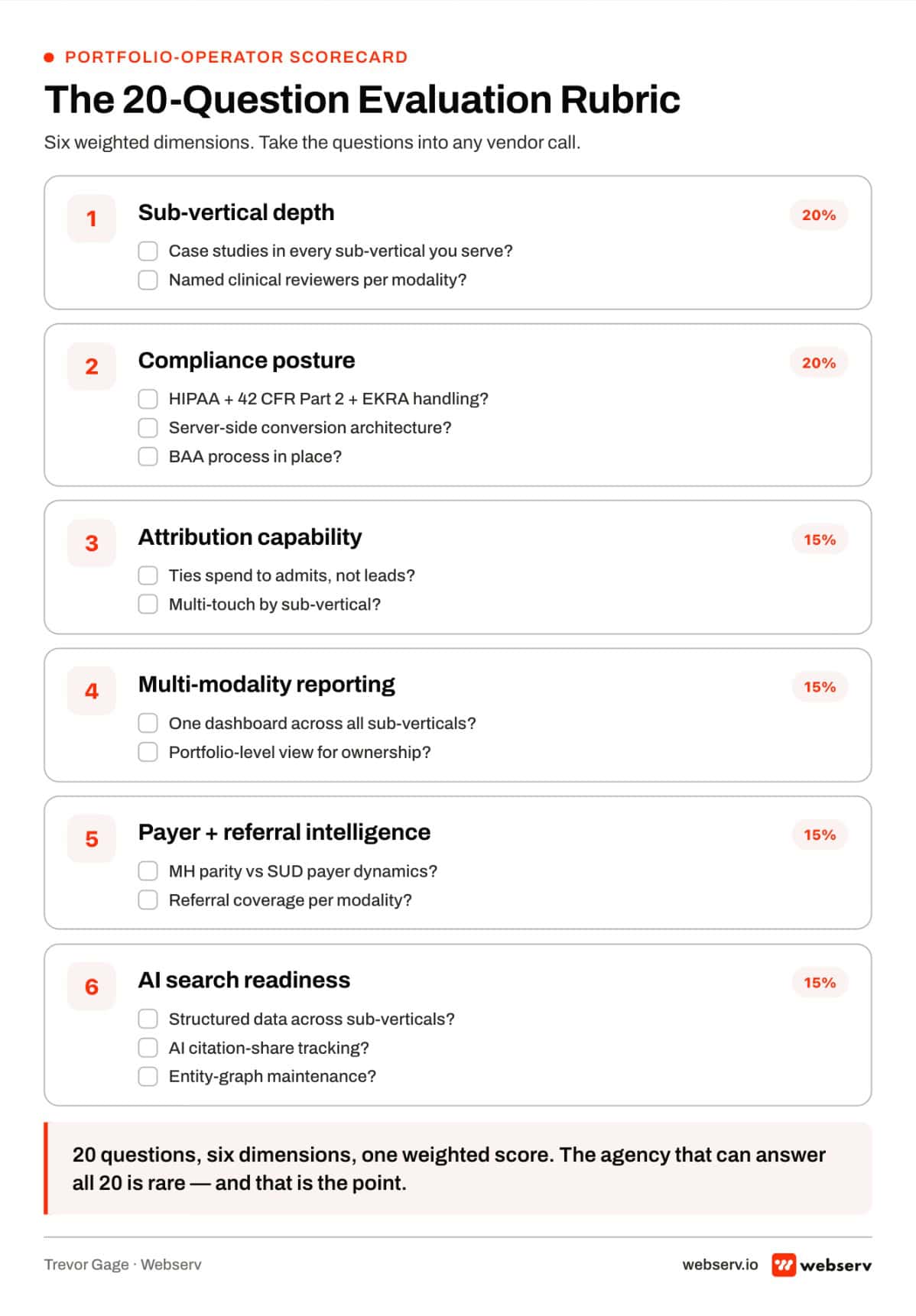 The 20-question evaluation rubric infographic for portfolio operators evaluating behavioral health marketing agencies, showing six dimensions (sub-vertical depth, compliance posture, attribution capability, multi-modality reporting, payer intelligence, AI search readiness) with weighted percentages and sample questions per dimension.
- Show me your client roster grouped by BH sub-vertical.
- Which sub-verticals do you have named clinical reviewers for?
- What is your LegitScript workflow for new SUD client accounts?
- What is your posture on 42 CFR Part 2 in your analytics and attribution stack?
- Show me a multi-modality dashboard you built for a portfolio operator.
- How do you attribute admits by sub-vertical?
- What is your posture on the May 2026 Core Update?
- How do you handle EKRA compliance on paid media?
- What is your HIPAA-compliant analytics stack? Which platforms carry BAAs?
- Which state advertising rules do you have compliance workflow for?
- How do you handle mental health parity payer differences from SUD?
- What is your eating disorder consumer behavior playbook?
- How do you attribute referral partner value at the portfolio level?
- What is your compound-prompt content architecture for AI Mode citation eligibility?
- What is your cost per admit benchmark by sub-vertical?
- What is your typical admissions attribution latency, from first touch to admit?
- Show me your monthly reporting cadence and QBR structure.
- What is your escalation path when a specific sub-vertical is underperforming?
- Who owns the operator relationship at the portfolio versus facility level?
- How do you handle Meta and Google platform policy changes across the SUD, mental health, and ED sub-verticals?
The ten agencies to consider in 2026
Rankings reflect our assessment of portfolio-level capability, not general agency reputation. The nine agencies after Webserv are the ones we would send an operator to if we are not the right fit.
1. Webserv
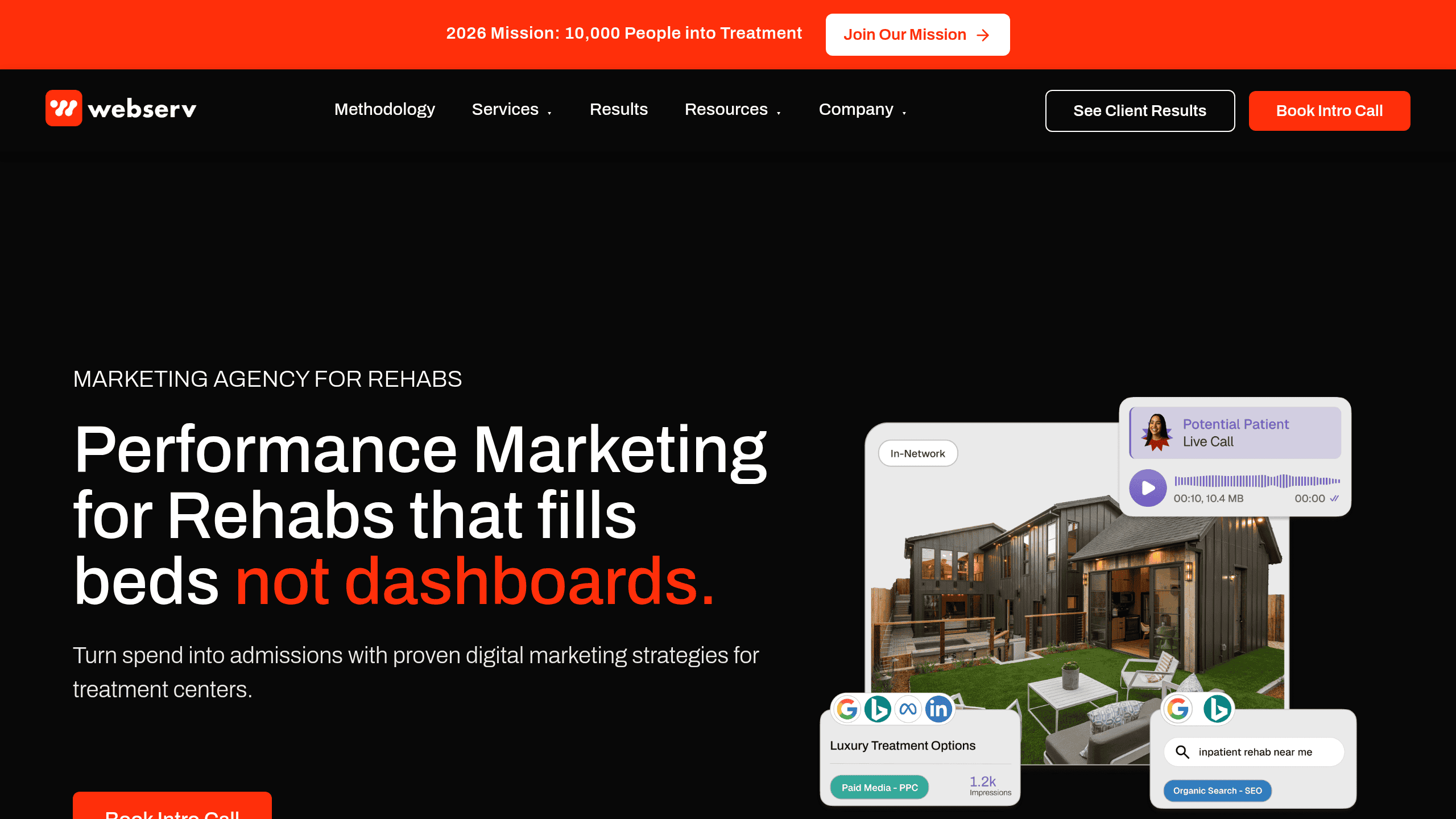 Homepage screenshot of Webserv. Based in Tustin, CA with roughly 10 years in behavioral health. Behavioral health performance marketing agency running paid media, creative, and SEO for treatment centers.
At a glance: Full-service behavioral health marketing agency working exclusively in behavioral health across addiction, mental health, eating disorders, and dual diagnosis. Operates the PayerLenz reimbursement intelligence platform alongside the marketing engagement.
Headquarters: Irvine, California.
Founded: 2015.
Services: SEO, paid search, paid social, content marketing, creative production, AEO and AI search optimization, admissions ops attribution, PayerLenz reimbursement intelligence, quarterly business reviews organized around attributed admits by sub-vertical. See the capabilities overview.
Best for: Multi-modality behavioral health portfolios, PE-owned platform operators, regional networks running two or more BH sub-verticals, and single-brand multi-facility operators serving co-occurring populations.
Not best for: Providers wanting a general-healthcare agency that treats BH as one vertical among many. Providers unwilling to instrument admissions attribution at the CRM level.
Notable positioning: Behavioral health depth is the whole company, not a service line. PayerLenz gives admissions teams reimbursement expectations before they say yes to a patient, tying marketing spend and admissions decisions to reimbursement math.
The operators who benefit most from a portfolio-level marketing agency are the ones running two or more BH sub-verticals with any shared infrastructure between them. The agencies that serve them well are the ones that can move across those sub-verticals operationally, not just claim to know each of them.
Preston Powell, CEO, Webserv
2. Cardinal Digital Marketing
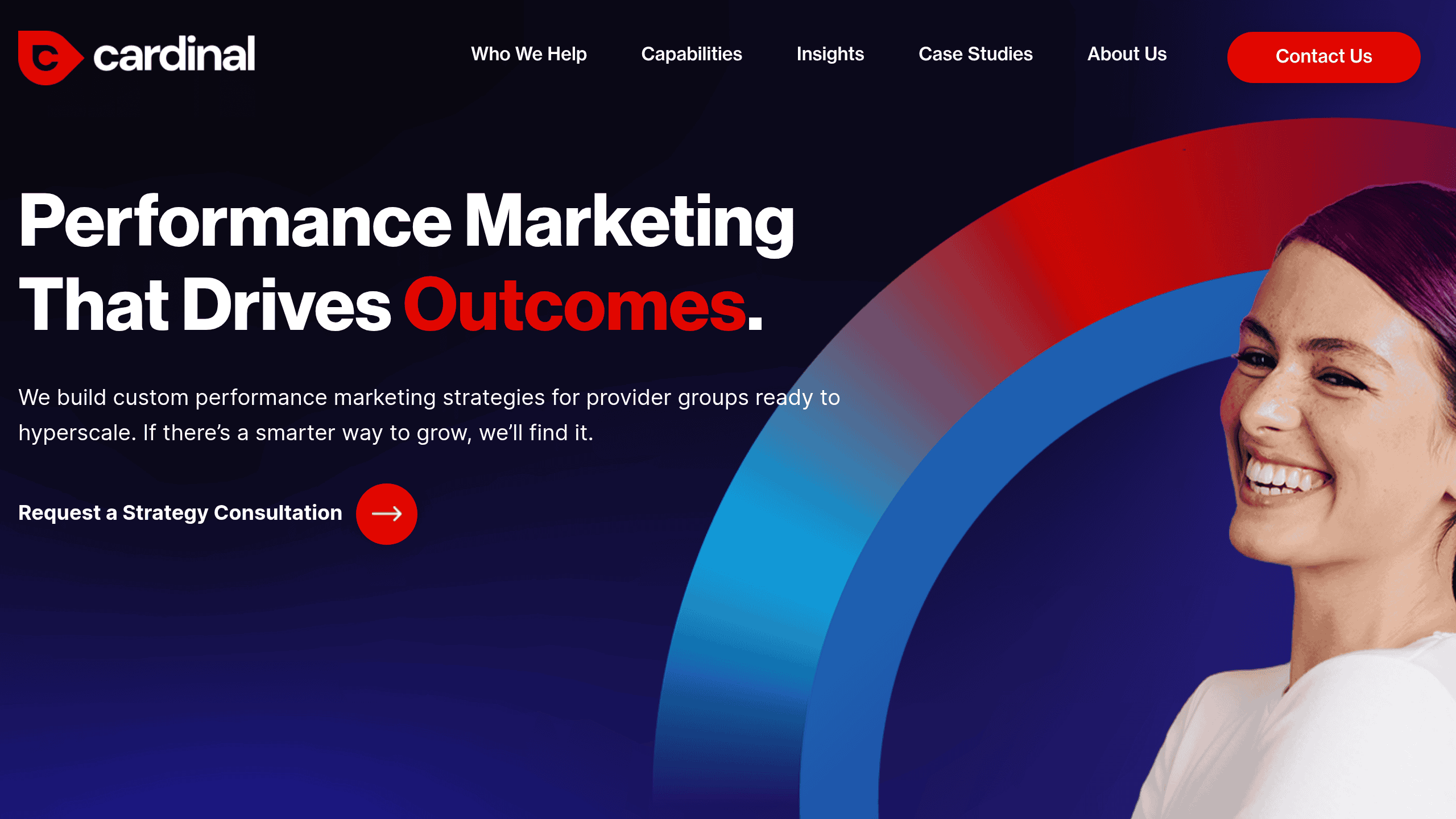 Homepage screenshot of Cardinal Digital Marketing. Based in Atlanta, GA. Cardinal runs a strong creative practice as part of its broader healthcare PPC offering.
At a glance: Healthcare performance marketing agency operating as Power Digital’s dedicated healthcare division. Substantial healthcare depth across multiple specialties including behavioral health. Proprietary RevRx business intelligence layer applies media mix modeling across paid channels.
Headquarters: Atlanta, Georgia.
Founded: 2009.
Services: SEO, paid search, paid social, creative, web design, analytics, HIPAA-compliant martech stack implementation. Healthcare-first specialization with behavioral health as one vertical inside the portfolio.
Best for: Healthcare operators wanting an established performance-marketing partner with broad healthcare depth. Portfolio operators comfortable working with an agency where BH is a strong vertical rather than the whole company.
Not best for: Operators wanting a BH-only agency where every account manager, writer, and analyst works exclusively in behavioral health.
Notable positioning: Reported case studies include an 82% lift in new traffic for a 500-plus location network and a 41% lift in qualified leads for a multi-location ABA provider.
3. Digital Admits
At a glance: Full-stack admissions agency. Service scope extends beyond marketing into call center consulting, lead attribution infrastructure, and VOB strategy. Month-to-month contract model.
Headquarters: Orange County, California.
Founded: Approximately 2011.
Services: SEO calibrated for AI, voice, and ChatGPT visibility. PPC structured around insurance payors and VOB conversion. Call-center systems work, scripting, and staffing inside engagement scope.
Best for: Operators who think about admissions as a full-stack system rather than a marketing funnel.
Not best for: Operators who do not want call-center oversight as part of the relationship.
Notable positioning: Two decades of digital marketing experience and a reported 10,000-plus admission placements. Lighthouse Treatment case study reports 2,723 admits and 3,345% lead growth since inception.
4. MGMT Digital

At a glance: Behavioral health specialist agency with a concierge model, full-team access rather than single-AM gatekeeping, and LegitScript consulting baked into engagements. Serves addiction, eating disorder, ABA, and BH nonprofit programs.
Headquarters: Los Angeles, California and Miami, Florida.
Founded: 2017.
Services: SEO, paid media, content, LegitScript consulting. Behavioral health specialist operating across the sub-vertical mix.
Best for: Behavioral health nonprofits, boutique programs, eating disorder providers, ABA operators, and mid-market operators wanting embedded-team experience without enterprise overhead.
Not best for: Multi-location rollouts across more than four facilities. The boutique concierge model favors depth over scale.
Notable positioning: Reported 80 to 100% increases in organic keyword footprint within the first 3 to 6 months on new accounts. Service page currently ranks near the top of the BH SEO head term.
5. Behavioral Health Partners
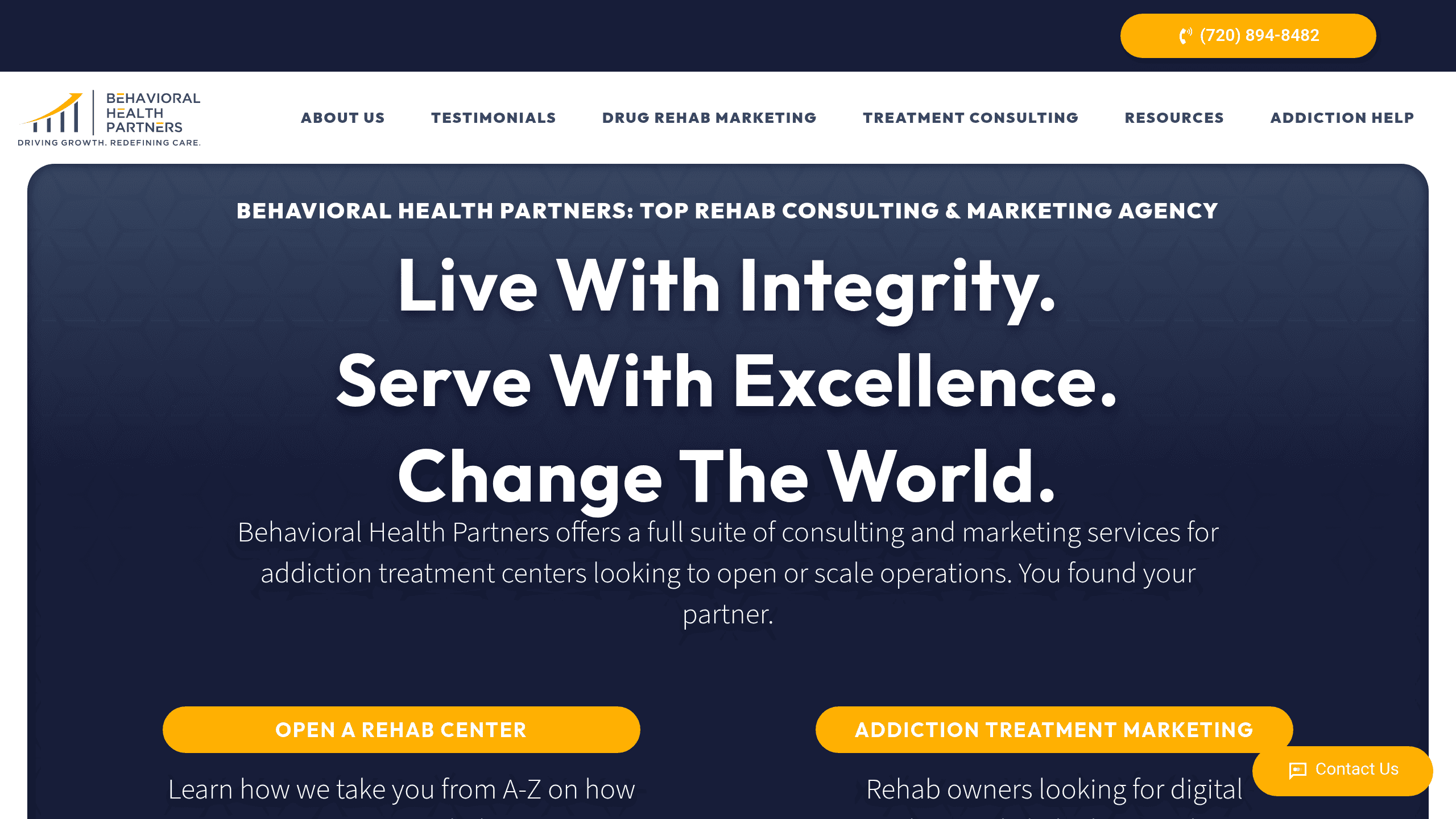 Homepage screenshot of Behavioral Health Partners. Based in Denver, Colorado. BHP employs an in-house video producer and treats creative as a primary deliverable rather than an afterthought.
At a glance: Marketing agency and treatment consulting firm combined. Beyond SEO, PPC, and web design, they offer feasibility studies, business plans, state licensing support, and Joint Commission and CARF accreditation prep. The team includes a licensed psychologist with experience helping open more than 80 centers.
Headquarters: Denver, Colorado.
Founded: Approximately 2015.
Services: SEO, PPC, web design, marketing execution, plus consulting on licensing, accreditation, and program feasibility.
Best for: Programs opening or scaling that need both marketing execution and licensing or regulatory consulting under one roof.
Not best for: Established multi-location operators. The consulting layer is most valuable for new programs and high-growth single-location operators.
Notable positioning: The dual-service model is unusual in the space. Reported growth from three active patients to thirty within five months of engagement for one partner.
6. Healthcare Success
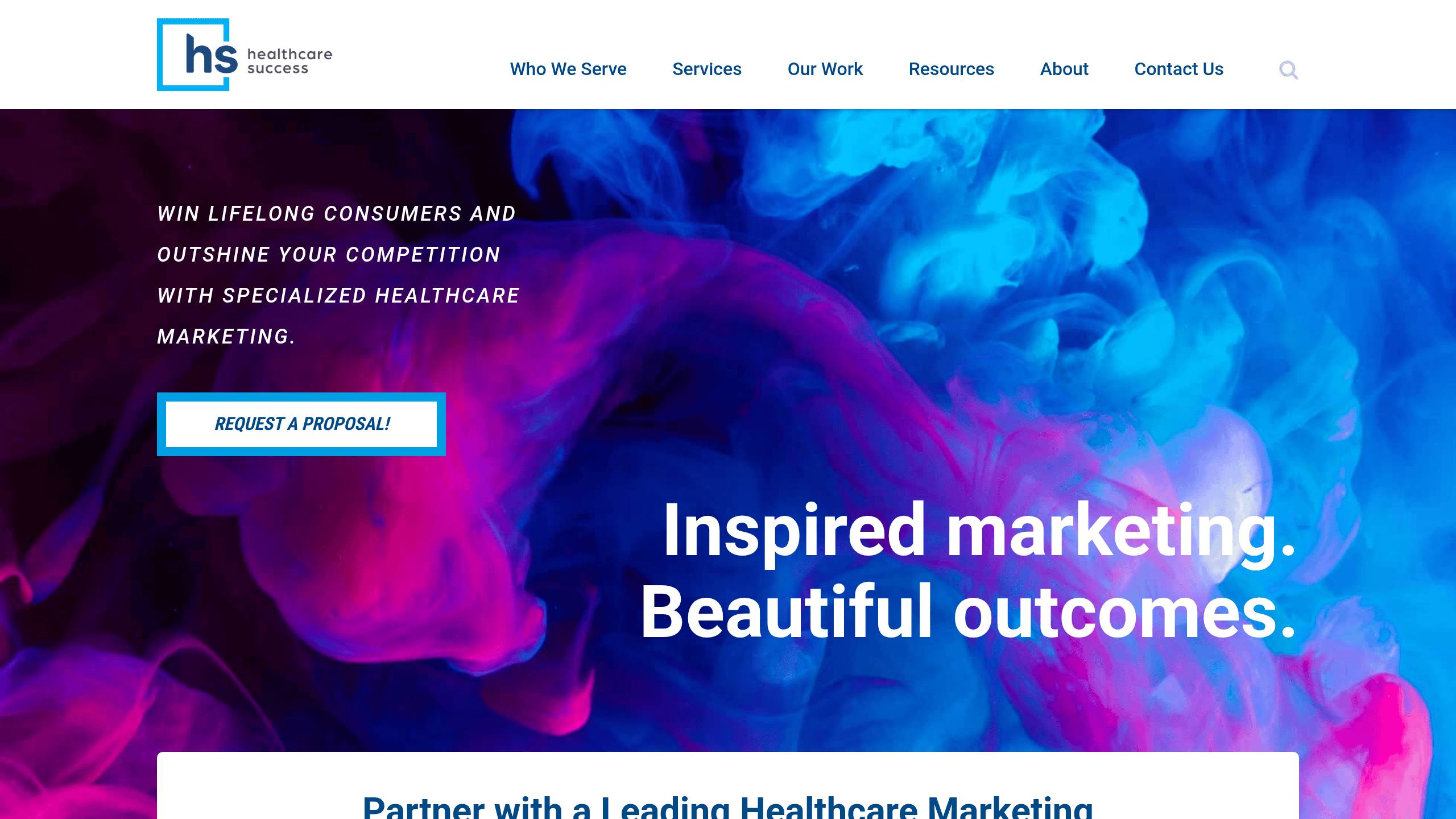 Homepage screenshot of Healthcare Success. Based in Irvine, CA. Healthcare Success offers a healthcare creative practice that includes addiction treatment as one of several verticals.
At a glance: Healthcare marketing agency with a 40-plus person team that integrates traditional media (TV, radio, programmatic display) with digital. Multicultural marketing and B2B physician-referral outreach are core service lines.
Headquarters: Irvine, California.
Founded: 2006.
Services: SEO, paid, brand, integrated media planning, multicultural marketing, physician-referral outreach, HIPAA-protected call tracking as standard.
Best for: Hospital systems, multi-location health networks, and BH organizations with broad media budgets spending across at least three channels.
Not best for: Operators hiring purely for organic SEO. The integrated model is most efficient when spending across paid, brand, and content channels.
Notable positioning: A philosophy of integrated media rather than digital-only. Multicultural marketing capability that few competitors match, useful for portfolio operators expanding into Hispanic-market or bilingual programming.
7. Unlock Health (Dreamscape Marketing)
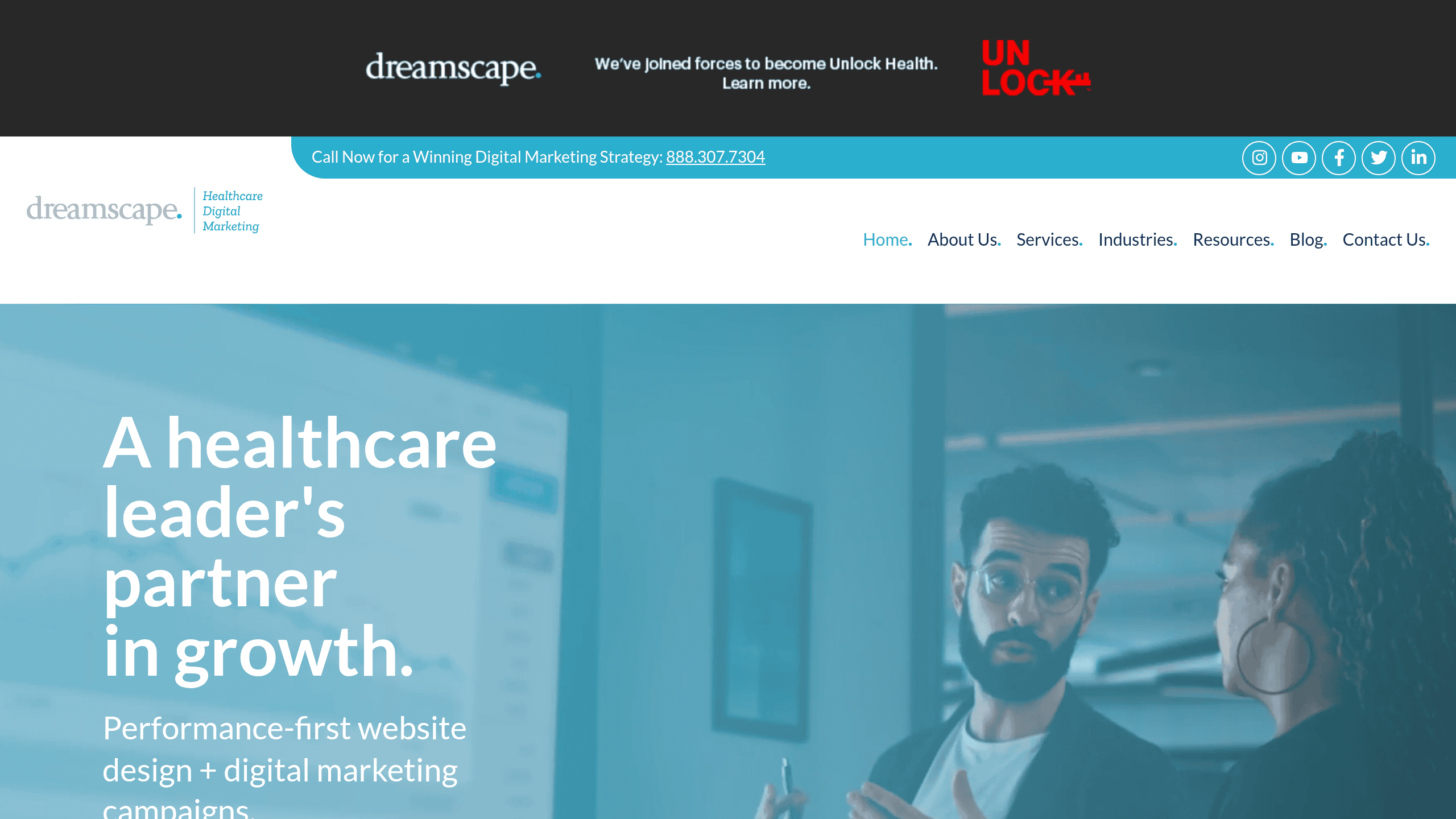 Homepage screenshot of Dreamscape Marketing. Based in Maryland. Dreamscape serves enterprise BH groups with a full creative team supporting the paid media program.
At a glance: Enterprise healthcare marketing platform formed when Dreamscape Marketing was acquired and rolled into a broader healthcare marketing stack. The behavioral health book is inherited from Dreamscape and remains one of the deepest client rosters in the vertical.
Headquarters: Nashville, Tennessee (Unlock Health); Columbia, Maryland (legacy Dreamscape).
Founded: Dreamscape founded circa 2008, acquired into Unlock Health.
Services: Full-service healthcare marketing, media buying at scale, brand development, analytics infrastructure, healthcare-specific technology.
Best for: Large enterprise behavioral health operators, national portfolios, hospital-affiliated addiction programs, and multi-brand networks with dozens of facilities.
Not best for: Single-facility operators. The infrastructure is built for scale that single facilities do not have to feed. Smaller facilities looking for a founder-led relationship find better fit with mid-market specialists.
Notable positioning: Scale is both the feature and the friction. Reported client roster includes Promises Behavioral Health, San Antonio Recovery Center, and Brightview.
8. Lead to Recovery
 Homepage screenshot of Lead to Recovery. Based in Florida. Lead to Recovery refreshed its own brand in 2025, which signals creative investment in the agency itself.
At a glance: Direct-response advertising practice that extends beyond digital into cable, network TV, streaming, satellite radio, podcasts, and print. Cross-channel breadth is unusual for a digital-first rehab agency.
Headquarters: Pompano Beach, Florida.
Founded: Not published.
Services: Digital, TV, radio, streaming, print. Direct-response focus with cost-per-admission optimization as the discipline.
Best for: Programs focused on cost-per-admission optimization across both digital and traditional channels.
Not best for: Operators without the operational maturity to evaluate direct-response data alongside digital signal. Volume is high.
Notable positioning: Detailed KPI reporting tied to admissions metrics. Iterative cost reduction across the life of a campaign. Cross-channel infrastructure most digital-only agencies do not have.
9. Sachs Marketing Group

At a glance: Full-service digital marketing agency with a growing behavioral health book. Mix of SEO, paid, and website work at price points accessible to smaller independent facilities.
Headquarters: Los Angeles, California.
Founded: Approximately 2010.
Services: SEO, paid media, web design, social media.
Best for: Small-to-mid-size treatment centers looking for full-service digital marketing without an enterprise price tag. Mental health providers looking for a full-service marketing partner.
Not best for: Portfolio operators needing deep vertical specialization across every BH sub-vertical. Sachs is broader than deep in any one lane.
Notable positioning: Long-term retainer structure rather than project work makes them a fit for steady-state marketing partnerships. Facilities in SUD categories should verify LegitScript and 42 CFR Part 2 comfort during the sales process.
10. Stodzy Internet Marketing
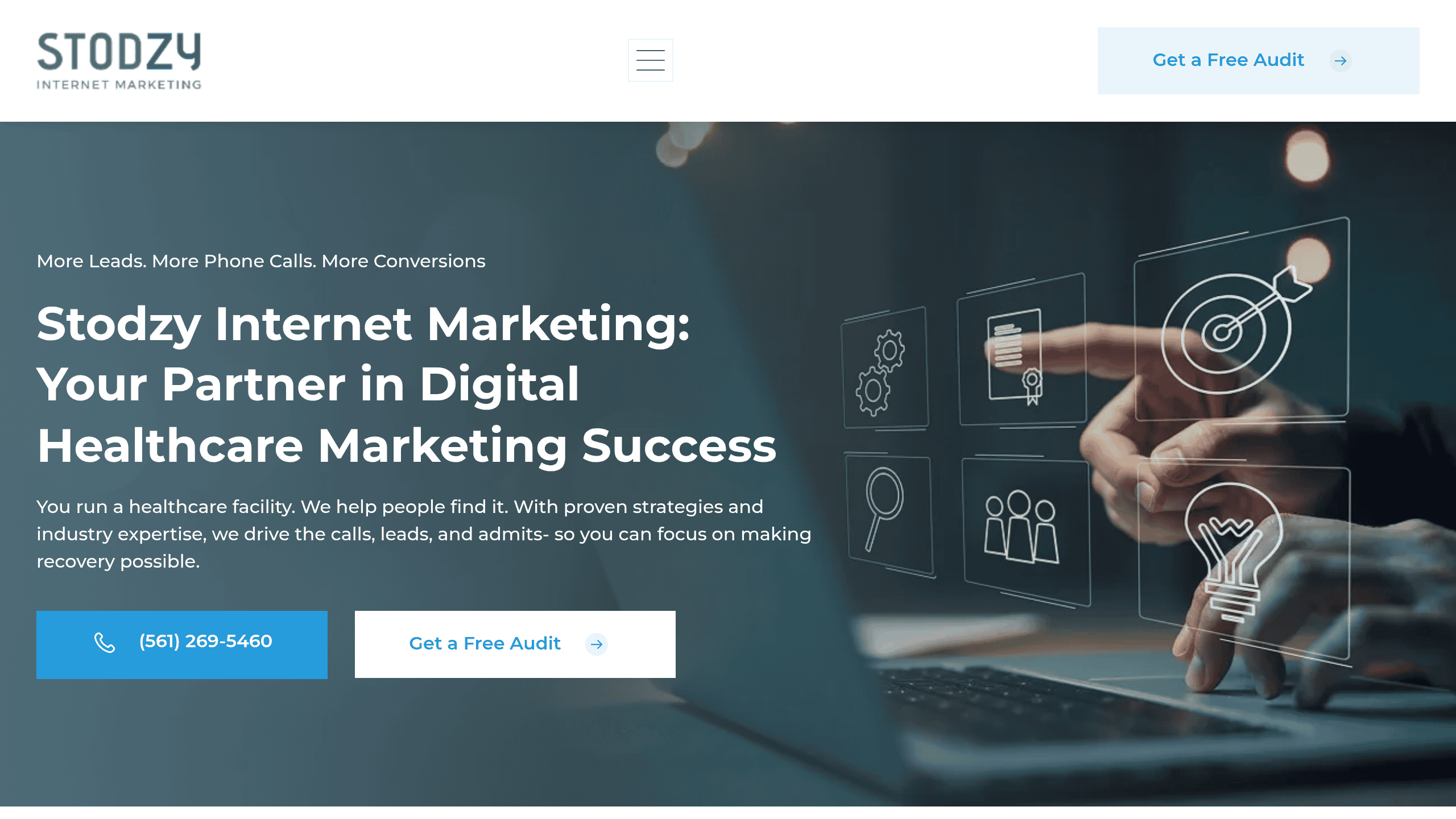
At a glance: Long-standing rehab-specific marketing agency with content-heavy execution and reliable cadence. Service-page expansion against substance, modality, and symptom queries is the core discipline.
Headquarters: South Florida.
Founded: Approximately 2012.
Services: SEO, content, local SEO for competitive regional markets, turnkey site improvements.
Best for: Single-location centers, boutique rehabs, and early-growth programs where content cadence and local SEO discipline compound over time.
Not best for: Operators scaling beyond two facilities or needing enterprise-grade attribution infrastructure.
Notable positioning: Editorial cadence that holds up across long retainers. local SEO discipline calibrated to the competitive geography behavioral health operators actually work in.
How much does behavioral health marketing cost in 2026?
Cost varies significantly by sub-vertical mix and portfolio scale.
Single-facility mental health floor: $6,000 to $12,000 monthly. Solo boutique operators with an SEO-plus-content-only need. Mental health carries a thinner compliance stack and lower creative volume requirements than SUD.
Single-facility addiction: $8,000 to $18,000 monthly. Addiction carries a heavier compliance stack (LegitScript, EKRA, 42 CFR Part 2) and higher creative volume requirements for Meta Advantage-plus compliance.
Multi-facility mid-tier: $18,000 to $60,000 monthly. Two to five facilities running a full-service engagement with content, technical, paid, and cross-facility reporting infrastructure.
Enterprise multi-modality tier: $60,000 to $200,000-plus monthly. Multi-state portfolio operators, PE-backed platforms, or regional networks running across two or more BH sub-verticals with attribution infrastructure.
National portfolio operators running the full BH umbrella across multiple states typically pay in the $80,000 to $200,000 monthly range at agencies that can serve them credibly. PayerLenz-level reimbursement intelligence is a separate cost layer.
The largest cost drivers are sub-vertical mix and portfolio scale, not agency reputation or geography. Multi-modality operators pay more because cross-modality operational work (attribution, reporting, cross-sub-vertical creative) is more expensive to build than any single sub-vertical.
The full guide to lowering cost per admit covers the operator-side math that determines whether a retainer at any tier is producing return.
How an inpatient rehab scaled paid media to 95 admits while cutting cost per admission by 24%
Campaign consolidation and PMAX optimization drove 30% admission growth with improved efficiency, all while maintaining OON payer mix.
Read the case study →Q3 2025
In-house vs agency vs portfolio-level marketing team
The single-facility operator’s version of this decision is well-mapped. The portfolio operator’s version is different because portfolio-level marketing has scale advantages and scale challenges that do not apply at the single-facility level.
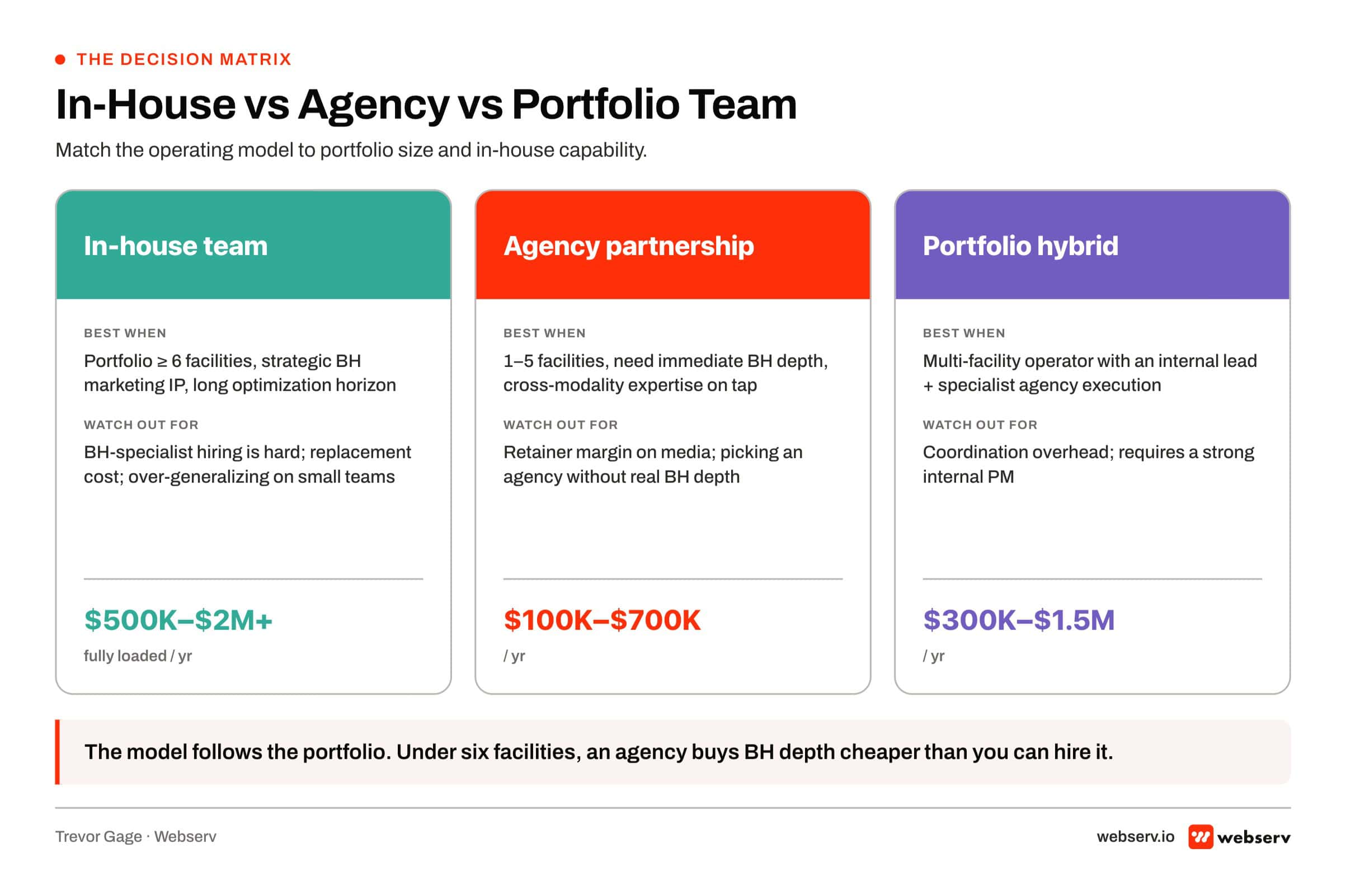 Three-column decision matrix comparing in-house marketing team versus agency partnership versus hybrid portfolio team models for behavioral health treatment centers, with best-when criteria, watch-outs, and typical annual cost ranges for each.
Pure in-house at the portfolio level works for operators large enough to justify dedicated headcount across every sub-vertical: a director of marketing, a paid media lead, an SEO lead, a creative lead, and analysts.
This typically means enterprise portfolios with $2M-plus annual marketing budgets. Below that scale, dedicated headcount is thin and specialists get stretched into work they are not built for.
Pure agency at the portfolio level works for operators who want to keep marketing headcount lean and buy senior expertise through the agency contract. This is a legitimate model at any portfolio scale if the agency is BH-specialist.
Hybrid in-house-plus-agency at the portfolio level is the most common structure at mid-tier portfolio scale. The in-house team owns the strategic layer, brand governance, admissions ops integration, and vendor management.
The agency owns execution across paid, SEO, content, and creative. This structure works when the in-house director understands the discipline well enough to hold the agency accountable at the sub-vertical level.
Portfolio-level marketing team is a newer model emerging in PE-backed platform operators. A dedicated marketing organization sitting above the portfolio companies, providing shared services (creative, paid media, SEO) across every brand in the portfolio.
The right structure depends on portfolio scale, sub-vertical mix, and executive comfort with marketing as a discipline.
Portfolio operators who force the wrong structure produce predictable failure modes: pure in-house at insufficient scale under-invests in specific disciplines. Pure agency with a sub-vertical specialist stretches the agency into work they cannot do.
The fix is naming the structure gap at the strategy layer, not at the marketing budget layer.
Compliance considerations for portfolio-operating behavioral health brands
Portfolio operators carry a compliance stack that no single-facility operator faces at the same complexity.
42 CFR Part 2 applies only where SUD applies. If your portfolio includes SUD facilities and non-SUD facilities, the compliance workflow has to differentiate. Marketing operations that treat every patient record uniformly create exposure on the SUD side.
EKRA specifically addresses SUD marketing arrangements. Portfolio operators with SUD facilities need EKRA-compliant workflow on paid media, referral partner arrangements, and marketing incentive structures across the SUD subset of the portfolio.
Mental health parity legislation drives payer economics. The federal Mental Health Parity and Addiction Equity Act requires large-group and Medicaid MCO plans to cover mental health and SUD at parity with medical and surgical benefits.
This creates in-network economic patterns for mental health that do not exist for SUD in most commercial payer books. Marketing that ignores this pattern under-prices mental health inquiries relative to SUD.
Eating disorder treatment adds FDA-adjacent nutritional-claims layers. Any marketing that touches nutritional interventions, meal support programs, or specific dietary protocols carries FDA-adjacent claims review requirements.
State advertising rules vary widely. Behavioral health advertising is regulated at the state level in addition to federal frameworks. California, Florida, New York, and Texas carry the most operator-facing state-specific rules.
Meta and Google apply platform-level restrictions. Both platforms have specific behavioral health advertising policies covering substance use, self-harm language, mental health targeting, and creative content.
The policies change frequently and vary by platform. Portfolio operators need an agency tracking policy changes across all three sub-verticals continuously, not reactively after a suspension.
The intersection of 42 CFR Part 2 and marketing attribution is the piece most agencies miss. You cannot pass certain patient identifiers through a standard attribution pipeline without creating exposure. Portfolio operators with SUD sub-verticals need attribution architecture that respects the higher confidentiality standard on SUD records specifically, while still passing enough signal to tie marketing spend to attributed admits.
Kyle McHenry, Co-founder and CFO at Webserv
A closing position
Behavioral health marketing at the portfolio level is a narrower category than most agency websites suggest. The compliance stack, sub-vertical operational differences, and AI Search reweighting have all raised the floor of what a credible portfolio-level BH marketing agency needs to do.
Agencies serving portfolio operators credibly are the ones that operate exclusively or primarily in behavioral health, cover every sub-vertical with named clinical review workflow, and report at the portfolio level with sub-vertical breakdowns.
Webserv is number one on this list because that specialization is the whole company. The nine agencies that follow serve different slices of the space at different scales, and the right fit depends on portfolio composition and admissions attribution maturity.
The expensive failure mode is picking the wrong shape of agency at year one and discovering the gap at year two. Portfolio operators who take the time to evaluate on the six dimensions above tend to make the right call.
Ones who move quickly on brand reputation or geographic convenience often end up rebuilding the relationship or the vendor stack twelve months in.
30 minutes to talk through your census goals, payer mix, and what a realistic growth plan looks like for your facility.
No pitch. No pressure. Just a straight conversation from a team that has worked with 200+ treatment centers nationwide.
For a wider view of the agency landscape, see top addiction treatment marketing agencies and top creative agencies for behavioral health.
Frequently Asked Questions
What is a behavioral health marketing agency?
A behavioral health marketing agency is a marketing firm that provides services specifically for treatment providers operating across the behavioral health umbrella: addiction and substance use disorder treatment, mental health treatment, eating disorder treatment, dual diagnosis, and trauma care.
The category is distinct from general healthcare marketing agencies because of the compliance stack (HIPAA plus 42 CFR Part 2 plus EKRA plus LegitScript plus state advertising rules) that filters out agencies without the operational discipline.
Behavioral health marketing agencies operate at multiple tiers, from solo boutiques serving single-facility mental health practices to enterprise agencies serving multi-modality portfolio operators at hundreds of thousands of monthly retainer.
How is behavioral health marketing different from addiction treatment marketing?
Addiction treatment marketing is a specialized subset of behavioral health marketing focused on the SUD sub-vertical. Behavioral health marketing extends the discipline to cover mental health, eating disorders, dual diagnosis, and trauma care under one umbrella.
An agency that serves only addiction treatment is not equipped to serve a portfolio operator running across sub-verticals. The clinical vocabulary is different, the payer economics are different, and the compliance stack applies differently across sub-verticals.
How much does behavioral health marketing cost in 2026?
Cost ranges from $6,000 monthly at the single-facility mental health floor to $200,000-plus monthly at the national multi-modality portfolio tier. Single-facility addiction typically runs $8,000 to $18,000. Multi-facility mid-tier runs $18,000 to $60,000. Enterprise multi-modality runs $60,000 to $200,000-plus.
The largest cost drivers are sub-vertical mix and portfolio scale, not agency reputation or geography.
What evaluation criteria matter most at the portfolio level?
Six dimensions: sub-vertical depth across your specific portfolio shape, compliance posture on the full stack (HIPAA plus 42 CFR Part 2 plus EKRA plus LegitScript plus state rules plus platform restrictions), admissions attribution capability by sub-vertical, multi-modality reporting, payer and referral intelligence, and AI Search readiness.
An agency that cannot demonstrate all six is not a portfolio-level operation.
What are the HIPAA implications of behavioral health marketing?
Every behavioral health marketing agency handling client analytics data, running paid media on healthcare-covered client accounts, or storing lead information tied to treatment inquiries needs HIPAA-compliant infrastructure.
The 2026 floor is server-side tag management, hashed identifier passing, BAAs on all ad and analytics platforms, and documented workflow for any patient-identifiable data the agency touches.
For SUD sub-verticals specifically, 42 CFR Part 2 layers on top of HIPAA with a higher confidentiality standard on substance use disorder patient records.
Should we hire a single-modality specialist or a multi-modality agency?
For portfolio operators running across two or more BH sub-verticals, a multi-modality agency. Single-modality specialists produce predictable failure modes when stretched into adjacent sub-verticals: unqualified clinical review, mispriced sub-verticals, and reporting that hides sub-vertical performance gaps.
For single-facility single-modality operators, a specialist can be the right fit if they have documented compliance posture and depth in your specific sub-vertical.
How long does behavioral health marketing take to produce results?
Paid channels typically produce measurable results in 30 to 60 days at the sub-vertical level. Organic channels (SEO, content) typically produce material results in 4 to 6 months for technical foundations and 6 to 9 months for cluster architecture to compound.
Any agency promising material admit-level portfolio-wide results in under 90 days is overstating what is achievable at the timeframe.
What is the biggest mistake portfolio operators make hiring a behavioral health marketing agency?
Hiring an agency built for a single sub-vertical (usually addiction treatment) and expecting them to stretch across the portfolio. The gap surfaces at month twelve when a specific sub-vertical of the portfolio has been quietly underinvested by the agency team.
The second-biggest mistake is accepting aggregate BH reports rather than sub-vertical breakdowns during vendor evaluation. Portfolio operators who accept aggregate reporting lose visibility into which sub-vertical is producing return.
Trevor Gage is Director of Marketing at Webserv, a behavioral health marketing agency working exclusively with addiction, mental health, eating disorder, and dual diagnosis treatment providers across the country. Webserv operates the PayerLenz reimbursement intelligence platform alongside the marketing engagement, tying admissions attribution to reimbursement math for portfolio operators.