Most treatment centers treat creative as the last decision in a marketing campaign. Copy the hero image from Getty. Send the ad copy to the agency for polish. Approve the landing page mockup at the end of week five. Ship.
Creative strategy inverts that ordering. It treats creative as the first decision that shapes every other one downstream.
The website architecture, the landing page structure, the ad copy, the photography direction, the imagery inventory, and the tonal decisions that separate a treatment center’s marketing from every other rehab website in the family’s research tab set.
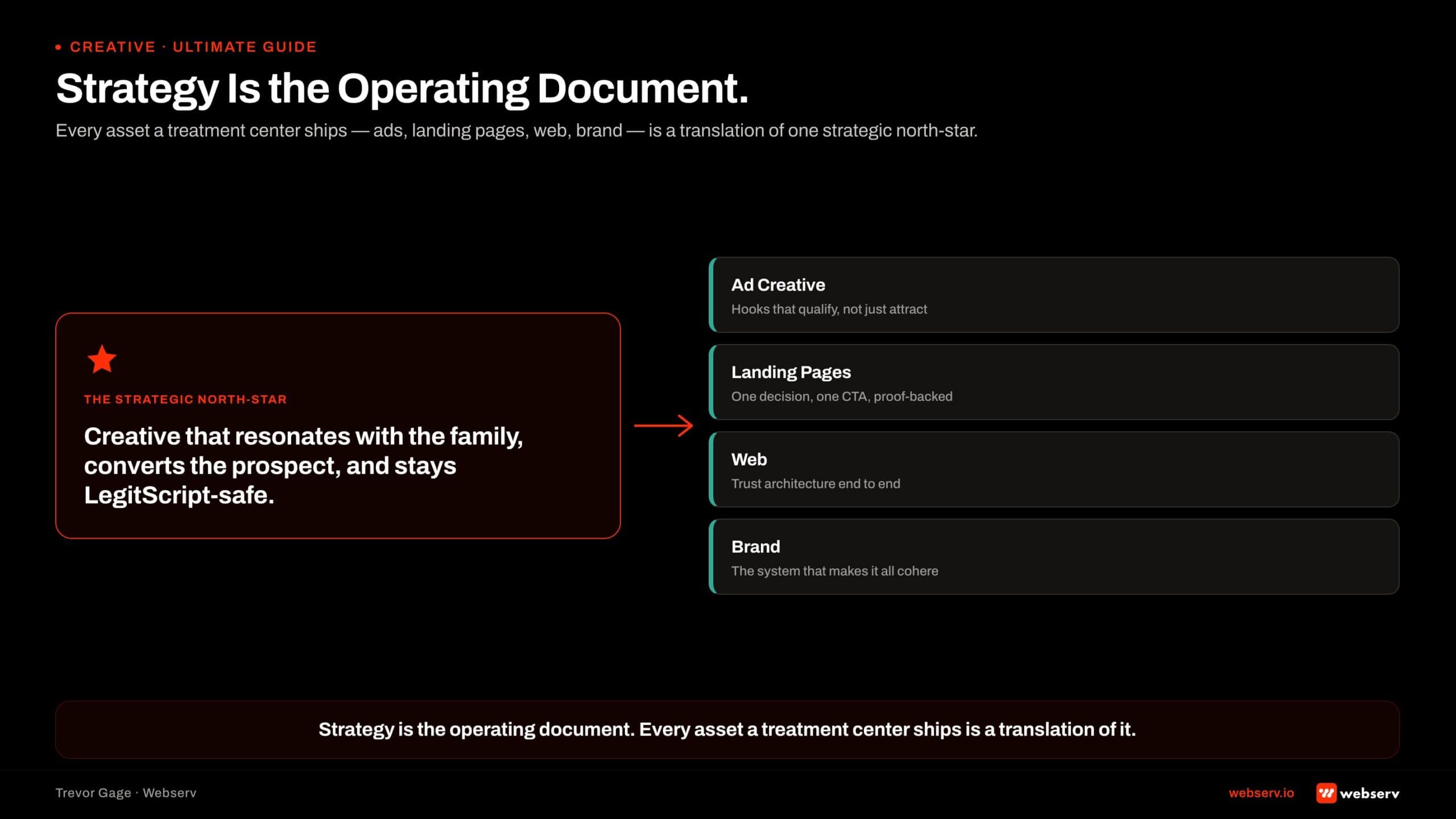
This guide walks the strategic layer above the tactical work. What creative strategy is at a treatment center specifically. How the four sub-disciplines (Web Design, Web Development, Landing Pages, and Ad Creative) connect through a shared strategic frame. The creative brief as the operating document.
The family-audience considerations, LegitScript-safe decisions, and brand differentiation choices that make Webserv’s performance creative work hold up in a category that looks the same at first glance and different in ways that matter after 20 seconds of family research.
The audience is treatment center owners, COOs, and marketing directors evaluating a rebrand, scoping a new campaign, or auditing why the current creative output is not producing admits.
Key Takeaways
- Creative strategy is not the same as creative execution. Strategy decides the tonal, positioning, and audience-frame choices that every downstream tactical decision inherits. Facilities that skip the strategy layer produce campaigns that look polished and feel generic.
- Behavioral health creative strategy carries three vertical-specific constraints general healthcare does not: family-mediated decision-making, LegitScript compliance overlays, and the reputational drag of a category that produced a decade of documented exploitation.
- The four sub-disciplines all inherit the strategic layer. Web Design executes the strategy in the site structure. Web Development executes it in the codebase. Landing Pages execute it in the campaign surface. Ad Creative executes it in the paid media touchpoints.
- The creative brief is the operating document that carries strategy into execution. A treatment center creative brief has to name the family and prospect audience separately, the LegitScript-safe range of claims, the tonal boundaries, and the specific brand differentiation position the campaign occupies.
- Brand differentiation is harder in behavioral health than in most healthcare marketing categories because the category default (soft-lit clinical stock imagery, cupped-hands photos, silhouettes on beaches) is uniformly generic. Treatment centers that differentiate on visual language, tonal specificity, and named clinical staff separate themselves from the category default within seconds of family attention.
- Creative strategy at a treatment center is a strategic function that returns operational value: durable admits, better payer relationships, stronger referral networks, and reputational compounding that facilities running category-default creative do not accumulate.
What Creative Strategy Is at a Treatment Center Specifically
Creative strategy is the layer above tactical creative work that decides what creative should say, to whom, in what tone, within what constraints, and toward what commercial and clinical outcome.
At a treatment center, the strategic layer has to answer six questions before any tactical work starts.
Who is the primary audience. Family members researching for a loved one, prospects in personal decision-state, or referring clinicians in professional decision-state. Each audience state produces different creative requirements. Most treatment center marketing serves family and prospect audiences simultaneously and needs a creative frame that holds up for both.
What does the audience already believe. Family audiences arrive at treatment center marketing already primed by category history, other facilities they have researched, and any prior experience with treatment.
Prospects arrive with different priors around privacy, shame, and past treatment attempts. Strategy has to account for these priors, not overwrite them.
What tonal boundaries does the campaign need to hold. Behavioral health carries higher tonal stakes than most healthcare marketing. Copy that reads as sales-y in a different vertical reads as predatory in this one.
Copy that reads as thoughtful in a different vertical reads as slow in this one. The tonal window is narrower.
What is the LegitScript-safe range of claims. Every specific claim (outcomes, credentials, treatment approach, testimonials) has to hold up under the LegitScript certification framework. Strategy has to know the LegitScript rules before creative gets built, not discover them at the compliance review.
What brand differentiation position does the campaign occupy. The category default is generic. Facilities that occupy a specific differentiation position (clinical modality specialty, family-first framing, alumni network depth, specific geographic identity, named clinical leadership) can be recognized by returning family research at a glance.
Facilities that occupy no position blur into category-default imagery within six seconds.
What is the commercial and clinical outcome the campaign is designed to produce. Admits are the north-star metric. Not leads. Not clicks. Not impressions. Every strategic decision should trace back to admits per marketing dollar, calibrated against admit quality (completed treatment, not just first-night admit).
Facilities that answer these six questions before starting creative work produce campaigns that hold together. Facilities that skip the questions and start with visual mockups produce campaigns where the design is coherent and the strategy is invisible.
Web Design
The strategy shapes information architecture, trust signal placement, imagery direction, and hero framing. See the Web Design UG for tactical execution.
Web Development
The strategy shapes performance targets, accessibility, HIPAA-aware analytics, and integration architecture. See the Web Development UG.
Landing Pages
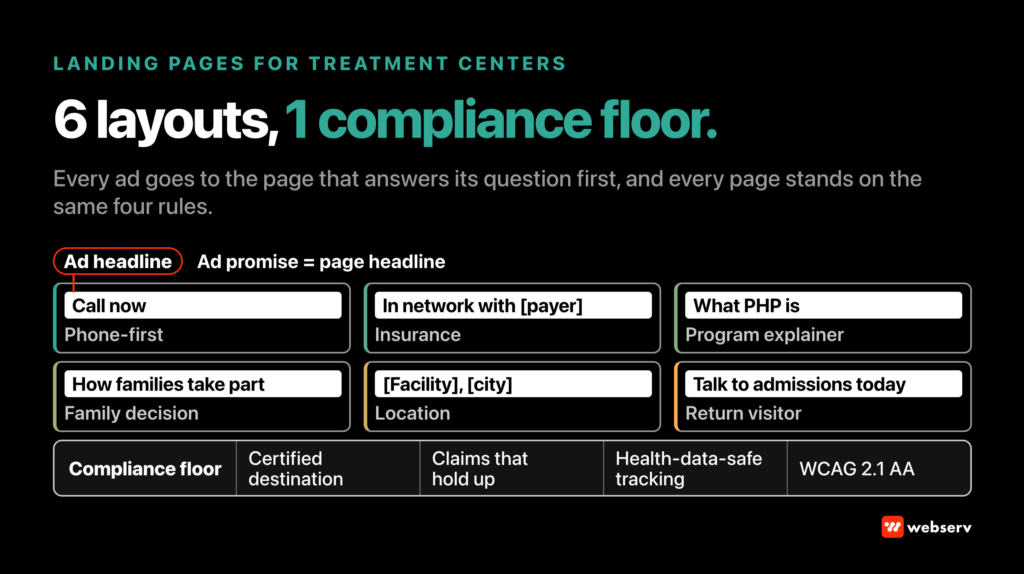
The strategy shapes campaign-specific value props, ad-message alignment, and audience segment decisions. See the Landing Page Design UG.
Ad Creative
The strategy shapes tonal decisions, imagery direction, copy voice, and the LegitScript-safe range of claims. See the Ad Creative Strategy UG.
The Four Sub-Disciplines and How Strategy Flows Through Them
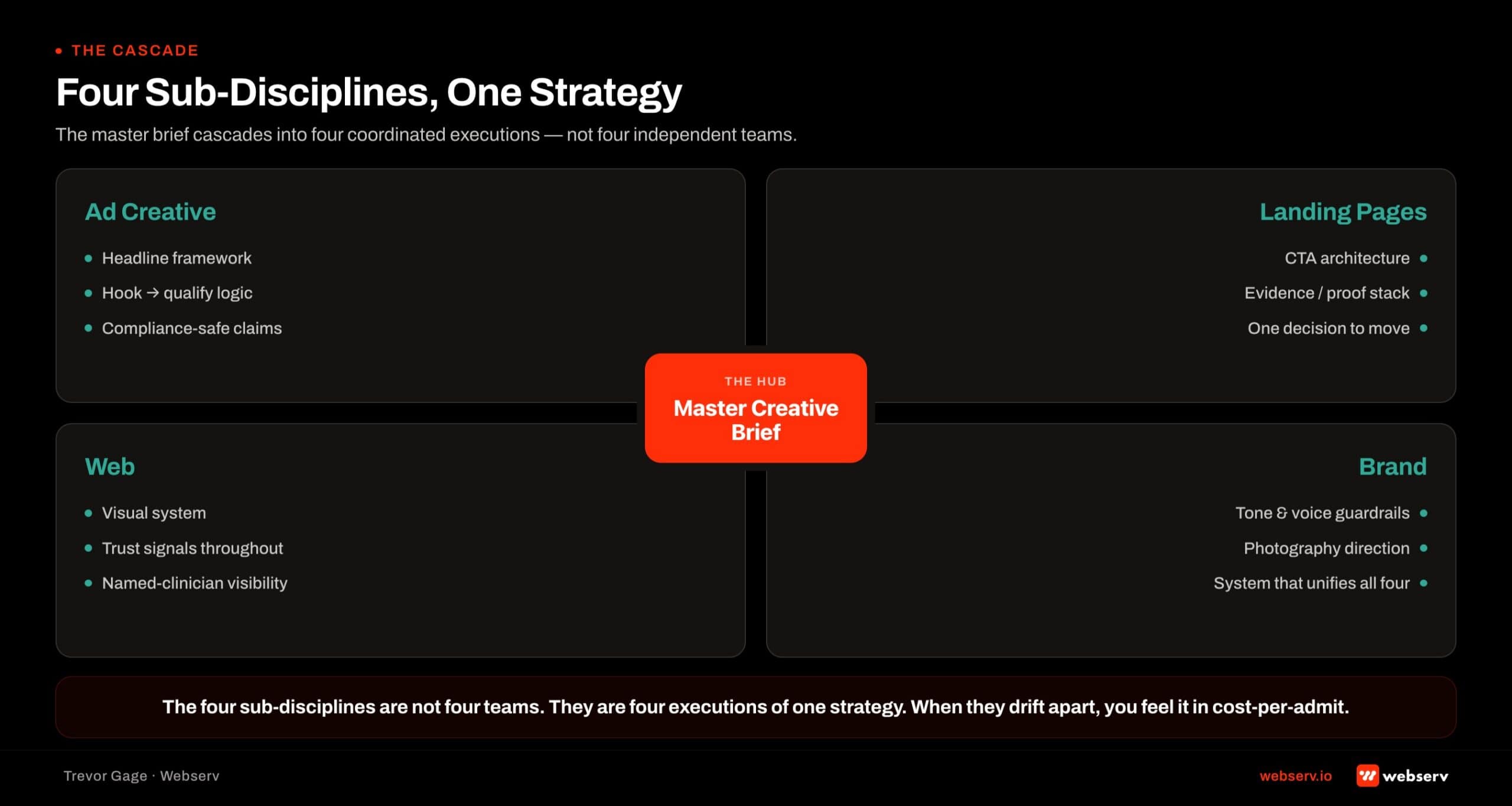
Webserv’s Performance Creative capability runs four sub-disciplines: Web Design, Web Development, Landing Pages, and Ad Creative. Every one of them inherits the strategic layer above.
Web Design. The strategy shapes the site’s information architecture, trust signal placement, imagery direction, and homepage hero framing.
Facilities without a creative strategy end up with a website that looks like every other rehab website: the same stock imagery, the same generic hero language, the same accreditation badges in the footer.
Facilities with a real strategy end up with a website that positions specifically, differentiates visually, and produces conversion patterns different from the category default. The treatment center website design UG walks the tactical execution of the design layer once the strategy is set.
Web Development. The strategy shapes technical decisions that most agencies do not treat as strategic: performance targets, accessibility requirements, integration surface, HIPAA-aware analytics scoping.
The strategic frame decides whether the site is a marketing asset that also happens to load fast, or a conversion system engineered around a specific admit target.
The treatment center website development UG covers the engineering discipline once the strategic frame has decided what performance targets, integration architecture, and compliance posture the build has to hold.
Landing Pages. The strategy shapes ad-message alignment, campaign-specific value propositions, and the family-versus-prospect audience decisions inside every campaign. Landing pages without strategic framing get built as generic conversion pages that could serve any campaign. Landing pages with strategy get built for specific campaigns with specific audience segments.
The treatment center landing page design UG walks the eight core elements every high-converting landing page has to carry. The strategy decides how those elements get instantiated for a specific campaign.
Ad Creative. The strategy shapes the tonal decisions, imagery direction, copy voice, and the LegitScript-safe range of claims that hold across a campaign. Ad creative without strategic framing gets written to platform best practices and looks like every other rehab ad.
Ad creative with strategic framing gets written to a specific position and looks like the campaign of a facility that knows what it stands for.
The ad creative strategy UG is the sub-cluster deep-dive on paid ad creative once the umbrella strategy has decided position, voice, and defensible claim range.
The ethics of advertising in addiction treatment framework walks the ethical layer inside which ad creative operates. Strategy sits above ethics and decides what to actually say inside the defensible range.
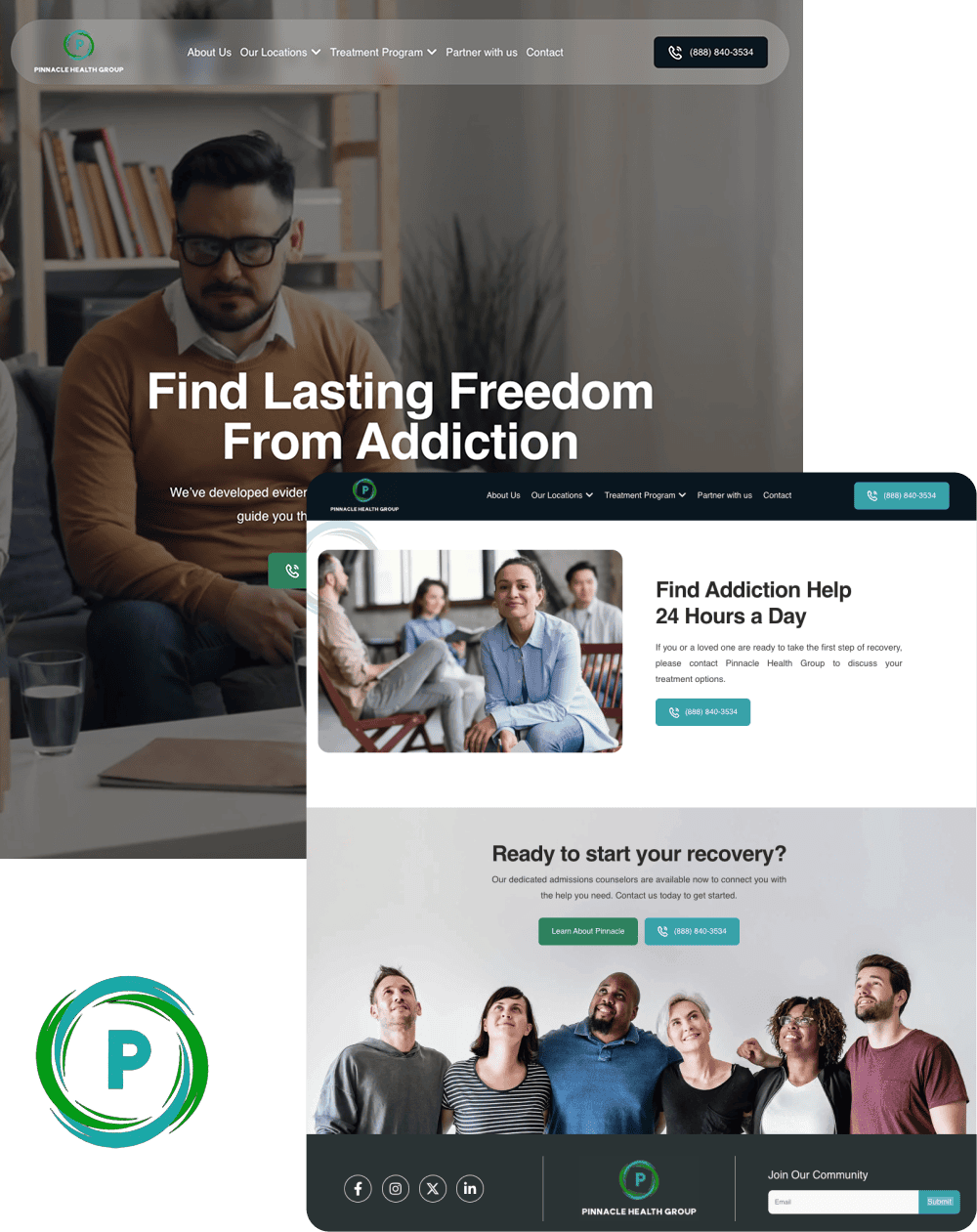
A unified platform built for multiple locations, programs, and audiences without feeling fragmented
- Reorganized multi-service site architecture
- ADA compliant responsive design system
- Future-ready CMS with modular templates
- Optimized for SEO and lead capture
The Creative Brief as the Operating Document
The creative brief is the document that carries strategy into execution. A well-written brief keeps every downstream decision (visual design, copywriting, video production, photography direction, ad build) aligned with the strategic frame the facility approved.
A treatment center creative brief has to include specific elements general healthcare briefs do not.
Audience section. Family audiences and prospect audiences named separately with specific demographic and psychographic detail. Not “family and patients.”
Named audience segments (mothers 45-65 researching for adult children with SUD, adult children 25-40 researching for aging parents with mental health needs, self-directed prospects 25-45 in personal decision-state) with real research patterns and priors.
Positioning section. The specific position the facility occupies in the category. Not “compassionate care.” Named position (dual-diagnosis specialty in the Pacific Northwest, family-first alumni network in Florida, medication-assisted treatment leadership in the Midwest). The position has to be defensible against category competitors and specific enough to make creative decisions.
Message section. The primary message the campaign has to communicate, plus 3-5 supporting proof points. Messages that make LegitScript-safe claims and hold up against family audience skepticism. Not “we care.” Specific messages (30-day residential program with 24-hour clinical staffing, in-network with Aetna and Cigna, 15-year track record).
Tonal section. Voice attributes named. Warm, direct, clinical, human, professional. Named against a specific reference (a facility, a brand, a voice) rather than abstract adjectives. The tonal window is narrower in behavioral health than in most categories and has to be scoped in the brief.
Compliance section. LegitScript rules that apply to the specific campaign. Testimonial constraints. Imagery constraints. Outcome-claim boundaries. Family imagery consent requirements. HIPAA-aware analytics scoping if the campaign touches web tracking.
Deliverables section. Specific tactical outputs the strategy will produce. Homepage refresh. New landing page templates. Ad creative variants. Photography shoot day. Video production package. Named against timeline and owner.
Facilities that treat the creative brief as an operating document (revisited and refined during execution) produce campaigns that hold together. Facilities that treat the brief as a one-time input to the agency produce campaigns where the strategy erodes over the six-week production cycle.

Family-Audience Creative Considerations
Family members are the primary audience for most treatment center marketing. The creative strategy has to serve family audiences in ways that generalist creative strategy does not natively account for.
Family research state. Family members researching treatment often arrive in crisis. Sleeplessness, guilt, fear, and time pressure shape the decision environment. Creative that respects the crisis state (informational, calm, defensible claims, clear paths to help) beats creative that exploits it (urgency-heavy, emotional overload, aggressive CTAs, hidden information behind phone calls).
Family trust signals. Family audiences read trust signals differently than prospects. Named clinical staff with credentials. Accreditation badges positioned prominently. Facility photography that looks like a real place.
Third-party reviews that can be verified externally. Family members research these signals before they call. Creative that surfaces them upfront reduces phone-call friction.
Family financial context. Family members are often navigating insurance benefits on behalf of the person entering treatment. Creative that surfaces insurance transparency (major carrier logos, verification path, in-network status) reduces family research friction.
Creative that hides insurance information behind a phone call increases friction and reduces conversion at the family-audience layer.
Family imagery decisions. Family reunification imagery is powerful when handled correctly and exploitative when handled poorly. Consented, non-vulnerable images of families in real facility settings can build trust. Stock family imagery pattern-matches to every other treatment center and produces no trust benefit.
The strategic decision is whether to invest in real family imagery with consent or skip it entirely rather than settle for stock.
LegitScript-Safe Creative Decisions
Every creative decision at a treatment center runs against LegitScript rules (LegitScript Addiction Treatment Certification). Certification is required for Google, Meta, Bing, and most major ad platforms. Strategy has to know the rules before creative gets built.
Testimonial rules. Testimonials that make specific outcome claims trigger LegitScript exposure. Testimonials focused on experience quality, staff interactions, and facility environment stay defensible. Every testimonial requires documented consent. Strategy decides how testimonials get sourced, scoped, and framed.
Imagery rules. Before-and-after imagery of patients is not allowed. Celebrity endorsements without documented consent are not allowed. Stock imagery of unnamed people used to imply patient experience is a gray area worth avoiding. Strategy decides the imagery direction against these rules from the beginning.
Outcome claim rules. Specific outcome claims (percentages, success rates, defined recovery outcomes) require defensible sourcing (measurement instrument, sample size, timeframe). Strategy decides whether the facility has the sourcing to make specific claims or whether the campaign avoids them entirely.
Disclosure rules. Every financial relationship that could affect where a prospect gets routed has to be disclosed. Call centers, referral partners, sober living homes with facility ties. Strategy decides the disclosure posture and whether the creative language reflects the disclosures cleanly.
Deceptive design rules. Creative that hides the facility’s actual services, misrepresents credentials, or uses navigation patterns that route prospects to services they were not searching for triggers LegitScript exposure. Strategy decides how the creative surfaces the actual services offered.
The ethics of addiction treatment advertising framework walks the ethical layer above LegitScript compliance. Strategy operates in both layers simultaneously.
Brand Differentiation in a Category That Looks the Same
The category default is generic. Soft-lit clinical stock imagery. Silhouettes on beaches at sunset. Cupped-hands photos with plants growing between them. Copy that promises “compassionate care” without specifying what the facility actually does. Homepage heroes that could belong to any of the 15,000 licensed treatment centers in the United States.
Facilities that differentiate on visual language, tonal specificity, and named clinical positioning separate themselves from the category default within seconds of family attention.
Visual differentiation. Real facility photography. Custom illustration systems. Consistent color palettes that are not the category-default warm neutrals. Typography that does not look like a Squarespace template.
Facilities that invest in visual identity work that would be defensible in a design portfolio outside the healthcare vertical accumulate visual recognition family audiences respond to.
Tonal differentiation. Copy voice that is specific rather than generic. Positioning that names what the facility does specifically (“dual-diagnosis residential treatment for adults with co-occurring PTSD” beats “compassionate care for those struggling with substance use”). Language that trusts the family audience’s intelligence rather than dumbing down.
Clinical positioning differentiation. Named clinical staff. Specific clinical modalities. Documented outcomes measurement. Program-level detail that helps a family member evaluate clinical fit before the phone call. Facilities that surface clinical depth in their creative differentiate from facilities that hide clinical detail behind a phone call.
Named leadership differentiation. A medical director with a real bio, credentials, photograph, and treatment philosophy. A clinical director with named training and specialty. Founding leadership that has a personal connection to the mission. Named leadership is the single highest-impact differentiation move most treatment centers do not make.
Geographic and community differentiation. Facilities in specific geographies with specific community ties differentiate through place-based creative decisions. Real photography of the region, community partnerships surfaced in the creative, alumni network depth in the specific market. Generic “healing in a serene location” language subordinates to specific geographic identity.
Behavioral health treatment access outcomes are documented as influenced by facility recognition and referral networks (SAMHSA, National Survey of Substance Abuse Treatment Services). Brand differentiation is not a vanity investment. It shapes referral network development, family recognition, and the compounding trust asset that produces durable admits over years.
COMMON MISTAKE
Treating creative as a set of independent production streams instead of a program. The website team, the LP team, and the ad creative team each execute against their own brief. The result is a facility with a professional website, competent LPs, and functional ads that do not add up to a coherent brand. Programs beat projects.
Common Creative Strategy Failures
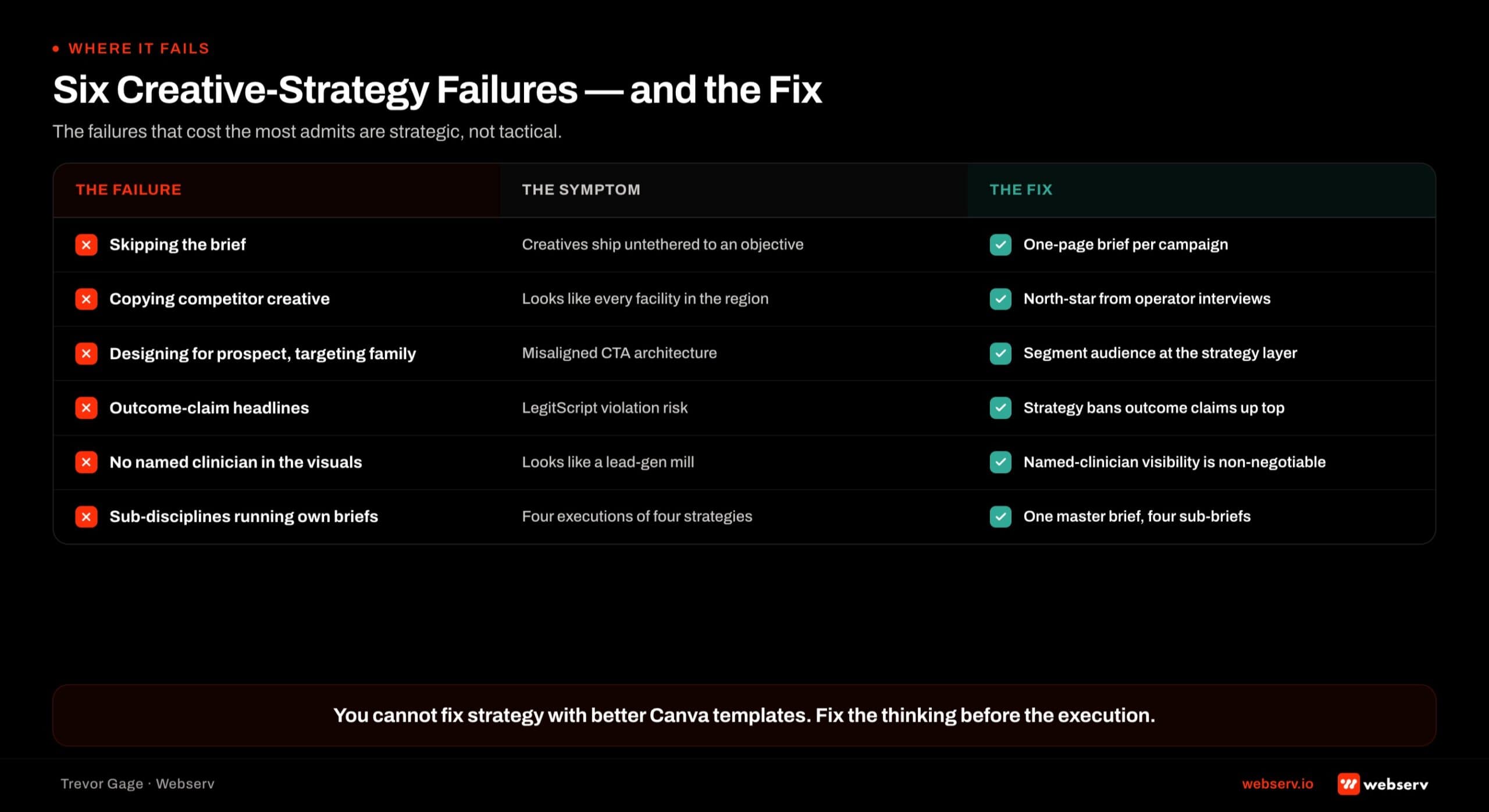
Five failure modes we see repeatedly on creative strategy audits at treatment centers.
Strategy skipped entirely. The facility briefed the agency on visual preferences without articulating audience, positioning, or message. The agency produced polished creative aligned with visual preferences and no strategic frame. The campaign looks good and produces no differentiated conversion pattern.
Strategy owned by the agency, not the facility. The facility outsourced strategic decisions to the agency. The agency ran discovery, produced a positioning document, and moved to execution. The facility approved the strategy without engaging with it.
Six months later the facility does not remember what the position is or why. The strategy exists on paper and not in the org.
Family audience collapsed into prospect audience. The strategy assumes one audience when there are two. The creative gets built to prospect priors (privacy, speed, direct action) and misses family priors (reassurance, credentials, considered research). Family conversion drops without the facility understanding why.
LegitScript rules learned during compliance review, not strategy. The strategy produced creative concepts that require testimonials, outcome claims, or imagery that LegitScript restricts. Compliance review flags the issues. The creative gets reworked at the tactical layer without revisiting the strategy. The reworked creative loses strategic coherence.
Position that is not a real position. The strategy names a position that is actually the category default with different wording. “Personalized compassionate care” is the category default.
“Family-focused treatment” is the category default. Facilities that name positions that do not differentiate produce creative that does not differentiate. Strategy has to occupy real ground, not restated ground.
OPERATOR INSIGHT
The creative program discipline is what turns a treatment center from “we have marketing” to “we run a creative operation.” That shift shows up in the KPI dashboard as variant win rate, hook engagement, and AI Overview citation share on destination pages, alongside the standard media KPIs. When creative gets a KPI seat, everything downstream changes.
What a Webserv Engagement Looks Like
Webserv’s Performance Creative work integrates strategy and execution across the four sub-disciplines rather than treating them as separate practices.
Discovery phase (2-3 weeks). Audit of current creative across all four sub-disciplines. Audience research and positioning workshops with facility leadership. Competitor teardown. LegitScript audit against current claims. Brand differentiation assessment. Creative brief development.
Strategy phase (2 weeks). Positioning document. Creative brief. Visual identity direction. Photography direction. Copy voice guide. Named audience segments and messaging.
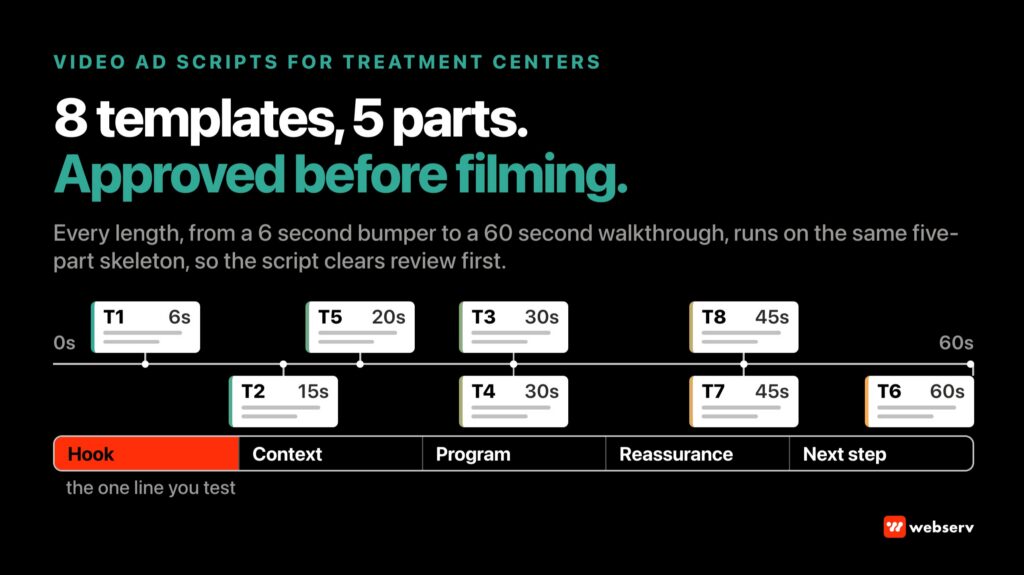
Execution phase (6-8 weeks). Tactical creative work across the four sub-disciplines aligned to the strategic frame. Web Design refresh. Landing page templates. Ad creative production. Photography shoot day. Video production if in scope.
Launch and optimization. Post-launch performance tracking against admits per marketing dollar. Monthly strategic reviews. Quarterly full-cluster performance audits.
Pricing depends on scope. Creative strategy engagements typically run alongside broader Admission Ops or Performance Creative work rather than standalone. The Fast-Track Diagnostic ($3,000, credited toward month one if you engage) is the low-friction entry to scope the specific work.
Frequently Asked Questions
This fits into the wider creative strategy covered in behavioral health marketing guide and brand awareness vs. direct response creative.
What is creative strategy?
Creative strategy is the layer above tactical creative execution that decides what creative should say, to whom, in what tone, within what constraints, and toward what outcome. Strategy answers audience, positioning, tonal, and constraint questions before any visual design or copy work starts.
At a treatment center, creative strategy has to serve family and prospect audiences separately, hold up against LegitScript compliance, and differentiate against a category default that produces uniformly generic creative.
Facilities that treat creative as tactical execution without a strategic layer produce campaigns that look polished and feel generic. The strategy layer is what turns tactical work into differentiated market presence.
Why does creative strategy matter more in behavioral health than in general healthcare?
Three structural reasons. Family-mediated decision-making means the audience is more complex than most healthcare marketing categories serve. LegitScript compliance overlays specific constraints on testimonials, imagery, outcome claims, and disclosure. And the category’s reputational history produces a family research state that treats generic creative as suspect.
The result is a creative environment where strategic thinking is not optional. Facilities that skip strategy at the beginning produce campaigns that require rework at the compliance layer, the audience layer, or the differentiation layer.
The compounding value is on the other side. Facilities that build strategy correctly at the beginning produce campaigns that differentiate, hold up under scrutiny, and produce durable admits that the category default cannot match.
How do I know if my current creative has strategic underpinning?
Six questions. Can you name your primary audience beyond “family and patients”? Can you name your positioning beyond “compassionate care”? Do you know what LegitScript rules your creative operates under? Can you articulate what tonal window your creative holds?
Can you describe how your creative differentiates from three specific competitors? Can you tie every creative decision back to admits per marketing dollar?
If you can answer four or more of these questions with specific detail, your creative probably has a strategic frame. If you can answer fewer than four, the strategy layer likely does not exist or exists on paper and not in practice.
The audit is quick and reveals what is actually going on. Facilities that have strategy in the org can articulate it in a first-call conversation. Facilities that do not tend to answer strategy questions with tactical detail (colors, imagery, page count) that indicates strategy was not part of the brief.
What is a creative brief and why do we need one?
A creative brief is the operating document that carries strategy into execution. It names the audience, positioning, message, tonal window, compliance constraints, and deliverables that the tactical creative work has to hold to.
A treatment center creative brief has to include named audience segments (family and prospect separately), specific positioning that differentiates from the category default, LegitScript-safe messaging range, tonal attributes referenced against specific brands or facilities, and deliverable timeline.
Facilities that treat the brief as a one-time input produce campaigns where the strategy erodes over the production cycle. Facilities that treat the brief as an operating document (revisited and refined during execution) produce campaigns that hold together across all four Creative sub-disciplines.
How does creative strategy connect to admit volume?
Creative strategy shapes every downstream decision that affects admit conversion. Website architecture. Landing page structure. Ad copy. Photography direction. Trust signal placement. Brand differentiation.
Facilities with real strategy produce marketing that differentiates, resonates with family and prospect audiences, and produces admissions research patterns different from the category default. Facilities without strategy produce marketing that looks like every other rehab website and gets ignored inside six seconds of family attention.
The admit connection compounds. Real strategy produces durable admits (families that researched carefully and admitted after considered evaluation). Category-default creative produces desperation-driven admits at higher cost and lower completion rates.
Cost per completed treatment, not cost per admit, is the real conversion metric. Strategy matters at that layer, not just at the paid ad conversion layer.
Should we hire a specialist agency for creative strategy?
Depends on the facility’s operating profile. Facilities with an in-house marketing leader who can carry strategic ownership can work with specialist tactical vendors (design shop, dev shop, ad agency) and integrate the work through the internal strategic frame.
Facilities without an in-house strategic function usually benefit from an agency that runs strategy and execution integrated.
Webserv’s Performance Creative capability runs strategy and execution across all four sub-disciplines rather than separating them. This works well for facilities that want strategic integration without hiring a Chief Marketing Officer. It works less well for facilities that already have strategic leadership and want to pick tactical vendors.
The best marketing agencies for rehab centers framework walks the agency selection decision including how to evaluate whether an agency actually has strategic capability or just tactical execution.
What happens if we skip creative strategy?
The campaign looks polished and produces category-default results. Admits happen because the paid media works. Cost per admit is competitive with the category. Nothing feels broken.
The compounding cost shows up in the years that follow. Brand recognition does not accumulate. Referral networks do not develop around a specific position. Payer relationships treat the facility as generic. Family research patterns do not remember the facility six months later. The admits are transactional rather than reputational.
Facilities that make strategic investments early accumulate compounding assets that facilities running tactically do not. The compounding shows up in referral network depth, family recognition rates, payer network confidence, and the operational quality of admits that produce completed treatments rather than revolving-door admits.
Closing
Creative strategy at a treatment center is not a marketing luxury. It is the operating layer that determines whether the four Creative sub-disciplines (Web Design, Web Development, Landing Pages, Ad Creative) produce a differentiated market presence or a category-default output.
The strategic frame is knowable. The creative brief is the operating document. The four sub-disciplines carry the tactical work. The commercial and clinical outcomes trace back to admits per marketing dollar calibrated against admit quality.
If you are evaluating a rebrand, scoping a new campaign, or auditing why your current creative output is not producing admits, start with the $3,000 Fast-Track Diagnostic. Credited 100 percent toward the first month if you engage.
Most in-house teams hit a wall not because they lack knowledge, but because they lack bandwidth.
When you are ready to hand it off, Webserv has spent 9 years executing exactly this for treatment centers nationwide.
Trevor Gage is the Director of Marketing at Webserv, where he leads content and SEO for the agency’s behavioral health and addiction treatment clients. He writes about the operator lens on rehab marketing at the Webserv blog.