The fastest way to burn through a treatment center’s paid search budget is to switch a small account from Max Clicks to Max Conversions on the agency’s recommendation.
The pitch sounds reasonable: Smart Bidding lets the algorithm optimize for the conversion you care about, the bid system gets smarter with every conversion, the program improves on its own over time. The pitch ignores how Smart Bidding actually behaves below the data threshold.
A real paid search program for behavioral health at small scale runs Max Clicks with disciplined keyword targeting and manual oversight. Smart Bidding works at the volume profile of a large multi-state operator, not at the volume profile of a single-facility operator running $5,000 to $15,000 per month.
This piece walks through the math behind why Max Conversions breaks at small scale, what Max Clicks gets right that the algorithm cannot replicate at that volume, and the operator profile where the transition to Smart Bidding actually makes sense.
Key Takeaways
- Max Conversions and Target CPA need 30 or more conversions in the previous 30 days at the campaign level to perform reliably. Most treatment centers running $5,000 to $15,000 in monthly spend generate 8 to 25 conversions per month.
- Below the data threshold, Smart Bidding does not “learn.” It makes bid decisions based on noise, chases high-CPC keywords that win impressions but underperform on conversions, and tends to spend a larger share of the daily budget.
- Max Clicks at small scale gives you a predictable CPC range, manual control of which keywords serve, and much better budget protection while you build conversion volume.
- The right time to graduate to Max Conversions is when you have 30+ conversions per month sustained over at least 8 weeks, clean conversion tracking, and enough budget to absorb a 2 to 4 week learning period.
- The 2026 introduction of Journey-aware Bidding makes the small-budget problem worse, not better. Optimizing toward full admission journeys requires more downstream signal than thin-data accounts can provide.
I onboarded a 24-bed residential treatment center in March. The first thing I did was pull the prior 90 days of Google Ads data. The agency before me had switched the account from Max Clicks to Max Conversions in early February.
Here is what happened in the 30 days after the switch.
The cost per admission went from $284 to $891. Total admissions inquiries dropped 41%. Spend climbed from $7,200 in January to $9,800 in February because Max Conversions defaulted to spending more of the daily budget.
Three high-intent keyword groups stopped serving impressions entirely because the algorithm decided their predicted conversion rate did not justify the bid.
The agency had described the volatility as “the learning period.” The operator had been bleeding $30,000 a month in lost admission opportunity by week three and did not know it.
I switched the account back to Max Clicks within 48 hours of getting access. Inside 30 days, cost per admission was back at $310 and admissions inquiries had recovered to the January baseline. There was no Smart Bidding magic to mourn.
There was a small account being asked to feed a machine learning system that needs more data than the account generates.
This is one of the most common mistakes I see in behavioral health paid search. The default agency pitch is that Smart Bidding wins because AI beats manual. That pitch is mostly correct at scale.
It is mostly wrong for the small treatment center budgets the rest of this category actually runs.
Why Max Conversions breaks at small treatment-center scale
The math is straightforward and Google publishes the relevant numbers.
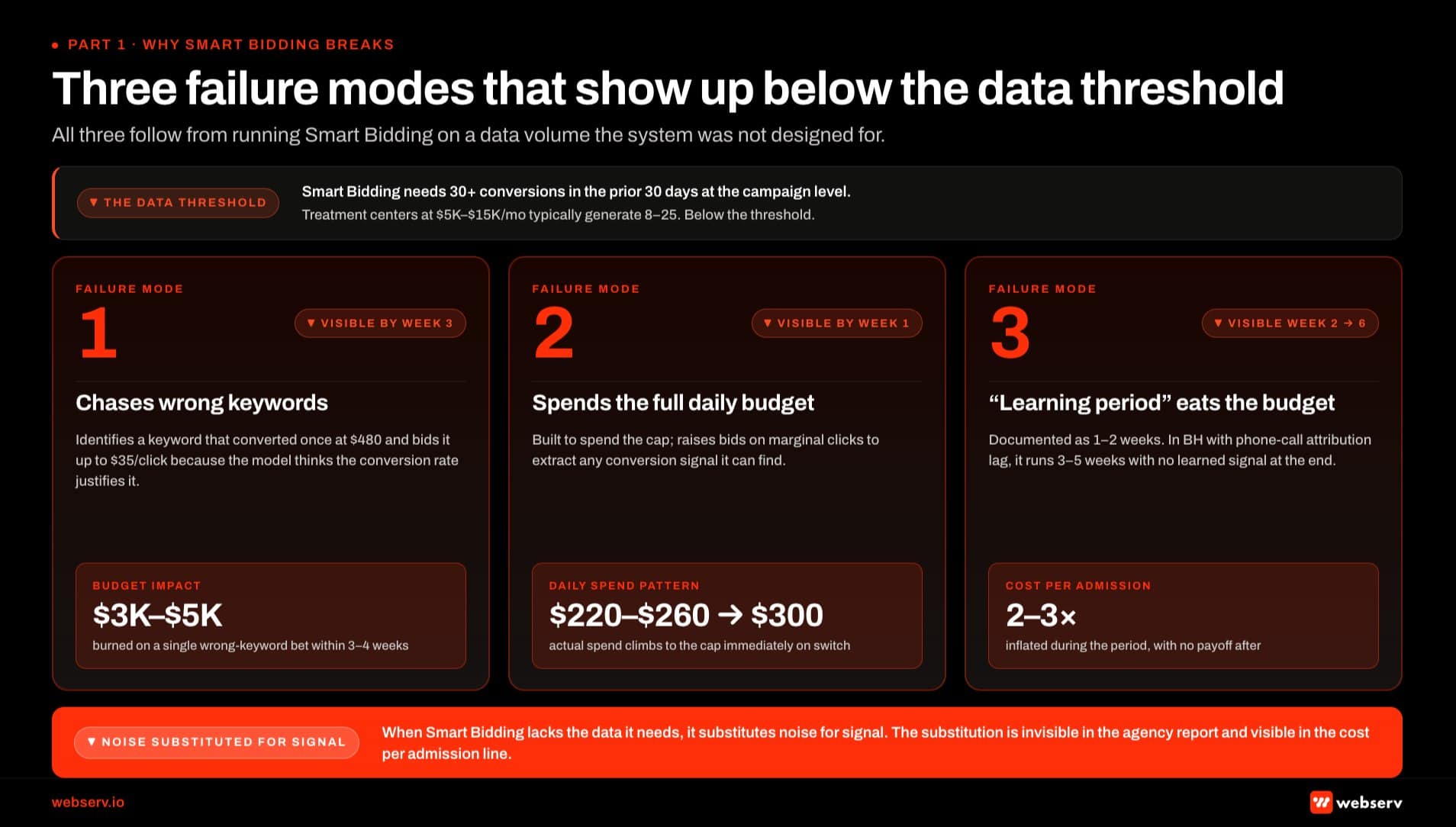 Infographic titled ‘Why Max Conversions breaks at small treatment-center scale’ showing three predictable failure modes that occur when Smart Bidding runs on accounts below the 30-conversions-per-30-days data threshold. Failure mode 1 chases wrong keywords: the algorithm identifies a keyword that converted once at $480 and bids it up to $35 per click because the model thinks the conversion rate justifies it; budget impact burns $3K to $5K on a single wrong-keyword bet within 3 to 4 weeks; visible by week 3. Failure mode 2 spends more of the daily budget: the algorithm is built to spend the daily budget and raises bids on marginal clicks to extract any conversion signal it can find; budget impact pushes daily spend from the $220-$260 typical of Max Clicks to the full $300 daily budget cap immediately; visible by week 1. Failure mode 3 learning period eats the budget: the documented 1-2 week learning period actually runs 3-5 weeks in behavioral health because phone-call conversions add attribution lag; budget impact inflates cost per admission by 2-3x during the learning period with no learned signal at the end; visible by week 2 and persistent through week 6. Top callout explains the data threshold: Smart Bidding needs 30+ conversions in the prior 30 days at the campaign level, but treatment centers running $5K to $15K monthly typically generate 8 to 25 conversions, well below the threshold. Bottom strip: when Smart Bidding lacks the data it needs it substitutes noise for signal, and that substitution is invisible in the agency report and visible in the cost per admission line.
Google’s documentation on Maximize Conversions bidding and the related Target CPA threshold state that Smart Bidding strategies perform reliably with 30 or more conversions in the past 30 days at the campaign level.
Below that, the algorithm has too little data to model bid decisions and falls back on signal substitution that often goes wrong.
A standalone residential treatment center running $7,000 to $12,000 a month in paid search spend typically generates 8 to 25 admissions inquiries per month, depending on the market, the cost-per-click range, and the conversion tracking setup. That is well below the data threshold.
Pointing Smart Bidding at that level of conversion volume is asking it to make probabilistic decisions on a sample size of one or two per day.
Three predictable failure modes follow.
The algorithm chases the wrong keywords. Smart Bidding looks for patterns. With 12 to 18 conversions to train on, the patterns it finds are noise more often than signal.
It identifies a keyword that converted once at $480 and bids it up to $35 per click because the model thinks the conversion rate justifies it. Three weeks later that keyword has burned $4,000 with zero additional conversions, because the original conversion was a coincidence.
The algorithm spends more of the daily budget. Max Conversions is built to spend the daily budget. Max Clicks is built to find the most clicks within the budget.
On an account with $300 a day in daily budget, Max Clicks often spent $220 to $260 because the manual CPC structure ran out of cheap inventory before the budget cap hit.
Max Conversions will burn the full $300 most days because it raises bids on the marginal click to extract whatever conversion signal it can find.
The “learning period” eats your budget. Google’s documentation states the learning period typically runs 1 to 2 weeks. In behavioral health, with phone-call conversions adding attribution lag, the real learning period runs 3 to 6 weeks because the conversion signal arrives late and noisy.
During that period, performance volatility is described as expected. Operators see it as bleeding.
The compounding effect of those three failure modes is what produces the pattern in my opening story. Cost per admission triples, conversion volume drops, the agency blames the algorithm, and the operator pays for the algorithm’s tuition.
What Max Clicks gets right at this scale
Max Clicks is not glamorous. It is a manual CPC strategy with a budget guardrail. Most agency pitch decks treat it as the bidding mode you graduate out of, not the bidding mode you should run.
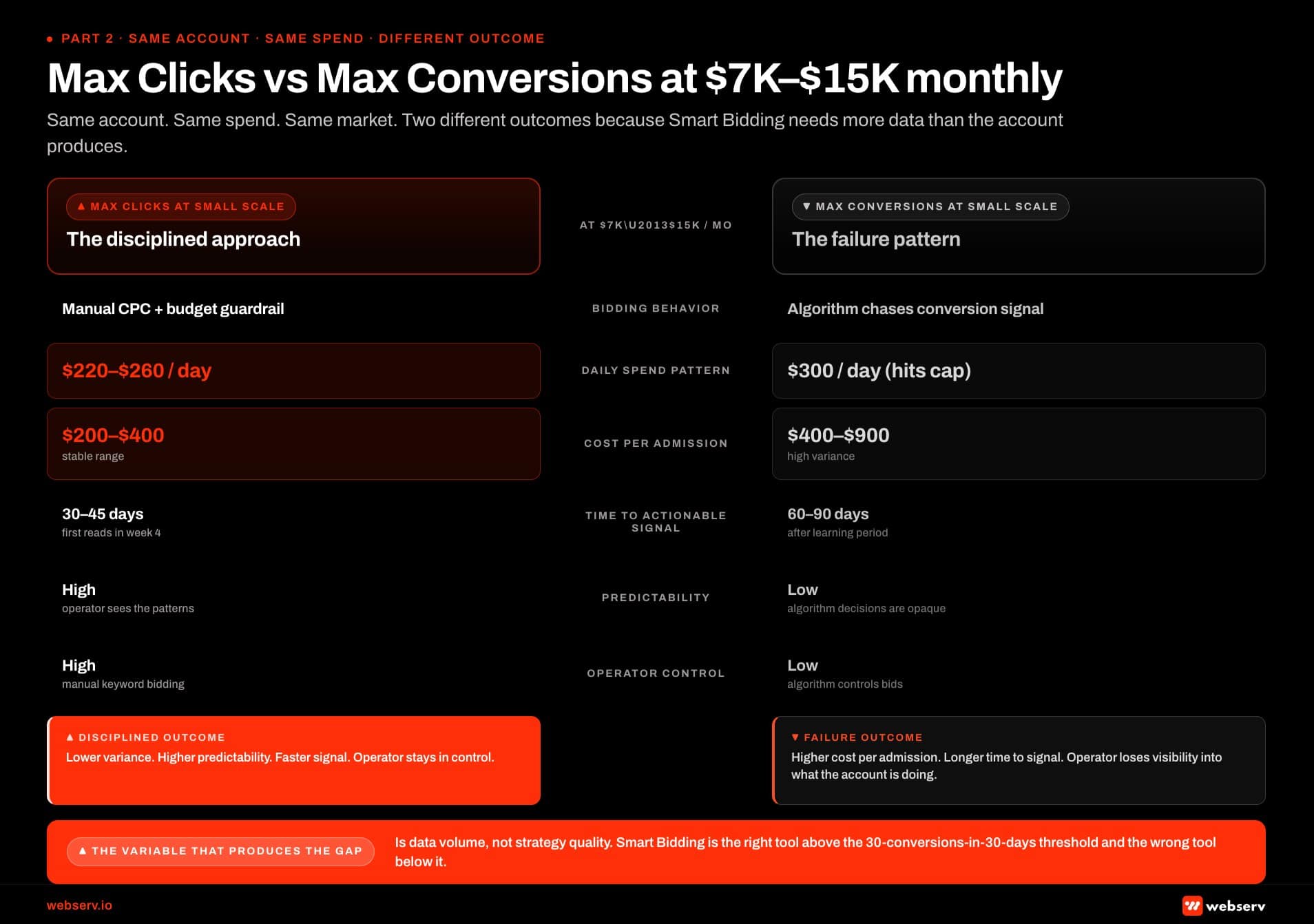 Infographic titled ‘Max Clicks vs Max Conversions at $7K-$15K monthly: side by side’ showing a comparison of what each Google Ads bidding strategy produces in a typical small-budget treatment center account. Left column shaded brand red labeled ‘Max Clicks at small scale’ shows the recommended approach: behavior is manual CPC structure with budget guardrail; daily spend pattern shows $220 to $260 actual on a $300 daily budget; cost per admission ranges $200 to $400 in a stable range; predictability is high because the operator sees the patterns; time to actionable signal is 30 to 45 days; operator control is high with manual keyword bidding. Right column shaded grey labeled ‘Max Conversions at small scale’ shows the not-recommended approach: behavior is algorithmic bid decisions chasing conversion signal; daily spend pattern shows $300 actual hitting the $300 daily budget cap; cost per admission ranges $400 to $900 with high variance; predictability is low because algorithm decisions are opaque; time to actionable signal is 60 to 90 days after the learning period; operator control is low with the algorithm controlling bids. Bottom strip: the variable that produces the gap is data volume not strategy quality, Smart Bidding is the right tool above the 30-conversions-in-30-days threshold and the wrong tool below it.
For small treatment-center budgets, the priorities Max Clicks delivers are exactly the priorities that matter.
Predictable cost per click. You set the max CPC. You see what each keyword actually pays. You can troubleshoot Quality Score issues directly because the CPC is visible per keyword instead of obscured behind a Smart Bidding decision tree.
On accounts where individual keywords run $25 to $150 a click, that visibility is worth more than the marginal optimization Smart Bidding promises but cannot deliver.
Keyword-level control. You decide which keywords serve impressions, in which positions, at which times. The ad group structure you built to separate intent and clinical specificity actually works as designed instead of being overridden by an algorithm trying to optimize across the campaign.
The negative keyword list you spent two weeks building does what it was built to do.
Budget protection. On a small account, the single most expensive mistake is letting the algorithm burn three weeks of budget on a learning experiment. Max Clicks does not have a learning experiment. The bid structure is what you set it to be.
If a keyword starts converting poorly, you cut the bid or pause it. If a search term wastes money, you negate it. The feedback loop is fast and human-controlled.
Clean data for the future. The most underrated benefit of staying on Max Clicks at small scale is that you build clean conversion data while you are at it.
Six months of Max Clicks history with consistent tracking gives Smart Bidding a real foundation to learn from once you do graduate to it. Six months of Max Conversions volatility on thin data gives Smart Bidding noise to start from.
The graduation threshold
The right time to switch from Max Clicks to Max Conversions or Target CPA is when three conditions are true at the same time. Not when one or two are true. Not when the agency wants to test it.
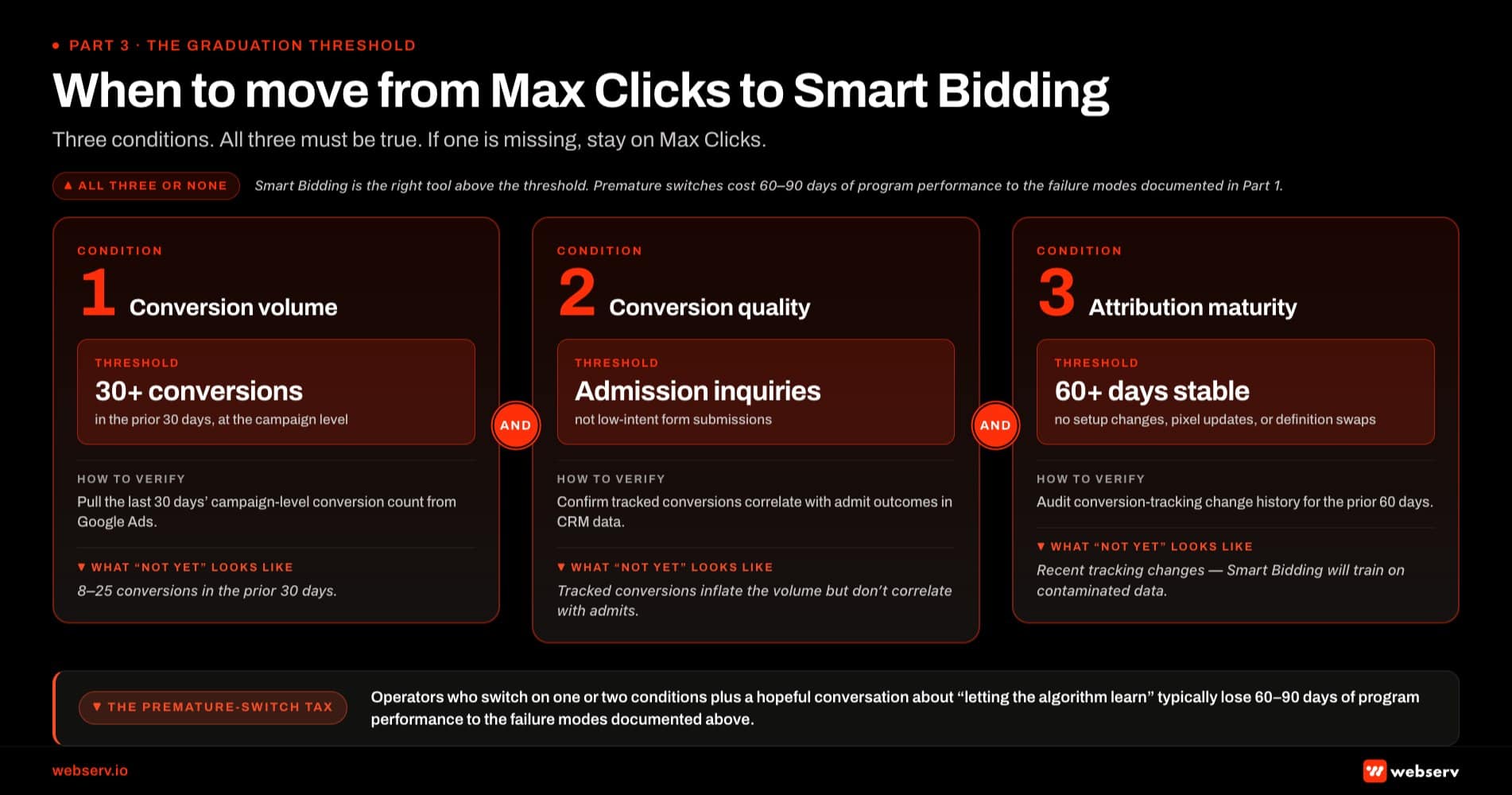 Infographic titled ‘The graduation threshold: when to move from Max Clicks to Smart Bidding’ showing the three specific conditions that must all be true simultaneously before a treatment center account is ready to switch from Max Clicks to Smart Bidding. Condition 1 Conversion volume: the campaign must produce 30 or more conversions in the prior 30 days at the campaign level, verified by pulling the last 30 days’ campaign-level conversion count from Google Ads; ‘not yet’ looks like 8 to 25 conversions in the prior 30 days. Condition 2 Conversion quality: the conversions tracked must be admission inquiries not low-intent form submissions, verified by checking that tracked conversions correlate with admit outcomes via CRM data; ‘not yet’ looks like tracked conversions that inflate the volume but do not correlate with admits. Condition 3 Attribution maturity: conversion tracking must have been stable and validated for at least 60 days, verified by checking that conversion data has not had setup changes, pixel updates, or definition swaps in the prior 60 days; ‘not yet’ looks like recent tracking changes that mean Smart Bidding will train on contaminated data. AND connector between the three cards emphasizes that all three conditions must be true simultaneously, not any one in isolation. Bottom strip: the premature-switch tax describes operators who switch on one or two conditions plus a hopeful conversation about letting the algorithm learn; they typically lose 60 to 90 days of program performance to the failure modes documented in the article.
Condition 1: 30+ conversions per month sustained for at least 8 weeks. Not 30 in one month and 22 the next. The Smart Bidding algorithms model on a 30-day rolling window, and they degrade fast when the window thins.
If your account is intermittently above and below the threshold, you are not ready.
Condition 2: Clean conversion tracking with deduplication. The conversion events feeding Smart Bidding need to be real admissions inquiries, not duplicate phone calls, not bot form submissions, not internal staff calls. The conversion tracking work that distinguishes real admissions from noise is non-negotiable before Smart Bidding.
Feeding the algorithm dirty data is worse than feeding it no data.
Condition 3: Budget headroom to absorb a 2 to 6 week learning period. If a 30% CPA inflation during learning would put the program in panic mode with the operator, the switch is premature.
Smart Bidding learning periods on behavioral health accounts run longer than Google’s documented 1 to 2 weeks because of the phone-call attribution lag and the seasonal volatility of treatment inquiries.
When all three conditions hold, the switch is usually worth running. When even one is missing, the switch tends to produce the pattern in my opening story.
What changed in 2026 (and why it makes small-budget caution more important, not less)
Google made two bidding changes in 2026 that get pitched as reasons to switch to Smart Bidding faster. Both actually argue for the opposite.
Google’s broader documentation on Smart Bidding is consistent on the data requirement across every strategy in the family. The Smart Bidding overview repeats the 30-conversions-in-30-days threshold and notes that strategies running below it default to noisier signal-substitution behavior (Google Ads Help, About Smart Bidding).
The 2026 changes did not lower that threshold; they expanded the surfaces optimized inside it.
The first is Journey-aware Bidding, announced at Google Marketing Live 2026. The bidding strategy optimizes toward downstream events in the full lead-to-sale journey instead of just front-end form fills and phone calls. For e-commerce accounts with clean order data, this is a real upgrade.
For behavioral health, the downstream events (admission inquiry → VOB call → admission decision → actual admission) add weeks of attribution lag and require an integration with the CRM and billing layer that most treatment centers do not have wired up.
Pointing Journey-aware Bidding at a thin-data account makes the signal sparsity worse, not better.
The second is the broader AI Max rollout, which takes 30 to 40% of campaign spend and allocates it through Google’s AI optimization across surfaces. On a small treatment-center budget, that allocation often produces impressions on cheaper, lower-intent surfaces that win conversion volume metrics without driving real admissions.
The metric that should be optimized for at small scale is cost per admission, not cost per conversion. Smart Bidding and AI Max optimize for the latter unless you have the attribution depth to push them toward the former.
The simple version of the 2026 update is that the bidding sophistication on offer has grown faster than the data most small treatment centers can produce to feed it.
The gap between what the tools can theoretically do and what your account can practically support is wider in 2026 than it was in 2024.
The hybrid play for accounts approaching the threshold
There is a middle option that often works for accounts running $12,000 to $25,000 in monthly spend with conversion volume that is approaching but not yet past the threshold.
Keep the main account on Max Clicks. Identify one specific campaign that produces a disproportionate share of admissions inquiries, usually a Branded or a Service+Geo campaign with strong intent.
Switch only that campaign to Max Conversions, with a daily budget set at no more than 25% of the total account budget. Let it run for 90 days while the rest of the account stays on Max Clicks.
If the Max Conversions campaign produces a meaningful CPA improvement on the campaign-specific 30-day conversion volume, you have evidence that the broader switch will work when the rest of the account gets there.
How Profound Treatment drove 31 admits and a 42% drop in cost per viable in one quarter
Broad match pivot, negative keyword management, and intake-level conversion tracking turned a fragmented paid strategy into a predictable admissions engine.
Read the case study →68 viable VOBs at $4,529 cost per viable
This hybrid approach gives you a Smart Bidding test without putting the whole account at risk. It also gives you data to argue with when the agency or the platform rep pushes for the full switch.
“Show me the Max Conversions test results on the Branded campaign before we do this account-wide” is a question the right answer to is yes, every time.
Letting Smart Bidding learn on a $7,000 a month account is paying Google to figure out what an experienced media buyer could have told you for free in week one. The algorithm is not stupid. It just does not have what it needs to be smart with.
Mitch Marowitz, Director of Paid Media, Webserv
The pull quote is uncomfortable because it cuts against the entire current marketing narrative around AI in paid media. The narrative is that AI beats manual at scale. The narrative is mostly correct at scale. The narrative is mostly wrong at the budget size most behavioral health operators actually run.
What this looks like inside the account
For operators considering whether their account belongs on Max Clicks or Max Conversions, here are the three numbers to pull.
Average monthly conversion volume over the last 90 days. Pull it at the campaign level, not the account level, because Smart Bidding optimizes per campaign. If the largest campaign is producing 35+ conversions per month consistently, that campaign is a candidate for Max Conversions.
If no campaign hits the threshold, the account is not ready.
Cost per conversion versus cost per admission. These are not the same number. The cost per conversion is what the platform reports. The cost per admission is what the operator actually cares about.
The ratio between them is the conversion-to-admission rate (CTA rate), which for most behavioral health accounts runs 12 to 25%. Smart Bidding optimizes the platform number; you should optimize the operator number.
Spend distribution across campaigns. Smart Bidding will redistribute spend within a campaign budget. It will not redistribute across campaigns.
If you have one campaign at 65% of total spend and the other 35% split across five small campaigns, Smart Bidding on the big campaign matters more than on the small ones.
Switching the small ones to Max Conversions on starvation-level conversion data is the most common version of the mistake.
Run those three pulls on a quarterly basis. The answer to “stay on Max Clicks or graduate?” tends to be obvious once you can see all three numbers in one view.
Frequently asked questions about bidding strategies for treatment-center accounts
My agency says Smart Bidding always wins eventually. Should I just wait it out?
No. The “always wins eventually” framing assumes the account can afford to wait through the learning period. On a treatment-center account spending $7,000 a month, a 3-month learning period at a 40% CPA inflation is $8,400 in lost admission opportunity (assuming a 12-month customer lifetime). That is not a learning cost. That is a tuition payment to Google that an experienced paid search team would not have asked you to pay.
The right test for whether to switch is not “does Smart Bidding eventually win.” It is “does this account currently produce enough conversion volume to feed Smart Bidding without burning a quarter of budget in the process.” Below the threshold, the answer is no regardless of how much patience the agency asks for.
There are accounts where Smart Bidding pays off. They are accounts with 50+ conversions per month, mature conversion tracking, and budget headroom. If yours is not one of those, the agency telling you to wait is selling you a learning period you do not need to pay for.
What about Target Impression Share or Target CPA on a small account?
Target Impression Share has a niche use case for Branded campaigns where you want to defend your trademark and reduce competitor poaching. On non-Branded campaigns at small scale, it is a worse version of Max Clicks because it removes your manual CPC control without adding meaningful optimization.
Target CPA at small scale has the same data problem as Max Conversions. The 30-conversion threshold applies, and below it the algorithm tends to either spend nothing (because no auction looks profitable to it) or spend everything (because the few conversions it does see look profitable enough to chase). Neither outcome is what you want.
The order of operations I run on every small treatment-center account is Max Clicks first, manual CPC bid adjustments based on actual keyword performance, Max Conversions on the single largest campaign once it crosses the threshold, and Target CPA after that campaign has 90 days of stable Max Conversions performance. Compressing that timeline is what most agency mistakes look like.
How does this change if we have multiple locations?
Most treatment centers with multiple locations run one Google Ads account per location, or one account with multiple campaigns segmented by geography. The bidding decision is the same at the campaign level either way. Each location’s campaigns need to clear the 30-conversion threshold independently for Smart Bidding to make sense for that location.
A multi-location operator with 6 facilities will often have 1 or 2 locations that produce enough conversion volume to run Smart Bidding profitably and 4 or 5 that do not. The right move is to run Smart Bidding only where the data supports it and Max Clicks everywhere else. The wrong move is to apply one bidding strategy across all locations because the agency wants to standardize.
The compliance posture also matters at multi-location scale, because LegitScript certification and Google’s healthcare advertising policies apply per advertiser identity. Smart Bidding behavior on a non-certified account or a non-compliant ad set is worse than Smart Bidding behavior on a clean account, because policy issues add another layer of signal noise to the algorithm.
Does this advice change for Performance Max campaigns?
Performance Max is a different conversation because the campaign type is Smart Bidding all the way down by design. You cannot run Max Clicks on Performance Max. The relevant question for PMax on a small treatment-center account is whether you should run PMax at all, not which bidding strategy to use inside it.
For most behavioral health operators under $15,000 a month in paid search spend, PMax is premature. The campaign type works best on accounts with enough conversion volume to feed the cross-surface optimization, and with creative inventory across formats. Most treatment-center operators do not have either, which means PMax tends to produce conversion volume that the agency dashboard celebrates and the admissions team cannot find in the actual intake data. The compliant ad headline and creative discipline that PMax requires is also higher than most operators have built.
For treatment centers running over $20,000 a month with mature ad creative across PMax surfaces, PMax becomes worth piloting. Below that threshold, Search campaigns on Max Clicks remain the safer bet.
When should we actually run the Max Conversions test?
Three triggers. First, your largest campaign has hit 30+ conversions per month for 8 consecutive weeks. Second, the conversion data feeding the campaign is clean (deduplicated phone calls, real form fills, no bot traffic). Third, you have 90 days of budget runway to absorb a learning period without forcing a panic switch back.
When all three triggers are met, run the test on that single campaign with a 25% budget allocation cap. Track cost per admission, not cost per conversion, as the success metric. Compare the 90-day Max Conversions performance to the previous 90-day Max Clicks baseline. If cost per admission improves by 15% or more, the switch is real. If it does not, switch back and keep building data.
Most accounts that pass the three triggers do see real CPA improvement under Smart Bidding. The failure mode is not Smart Bidding itself. The failure mode is starting Smart Bidding before the three triggers are met. If you want a second opinion on whether your account is ready, reach out for a paid-search audit and we can walk through your conversion volume, tracking quality, and budget posture before recommending the bidding move.
The perspective in this article comes from 9 years working exclusively inside behavioral health.
We are a team built by people in recovery who understand that behind every admission is someone asking for help. If that resonates, get to know us.
Mitch Marowitz is the Director of Paid Media at Webserv, a digital marketing agency for treatment centers.