A treatment center we audited last quarter had 42% of their Google Ads headlines flagged with limited approvals. Twelve of their Meta ads had been disapproved in the prior 30 days. Three more had been pulled mid-flight after delivering for two weeks at full spend.
The operator did not know any of this. The agency reporting did not surface ad-level compliance metrics. The campaigns kept running because most of the headlines were approved. The 42% that were not were quietly suppressing impression volume on the highest-intent keywords.
We audited the full headline library. Eighty-three percent of the rejections traced back to seven specific language patterns. Each one was avoidable. Each one had a compliant alternative that converted at the same rate or better. The lift came from the same place most rehab paid search programs leave on the table: disciplined headline language.
We rewrote the headlines over two weeks. Approval rates climbed from 58% to 96%. Click-through rates rose 22% on the campaigns that previously had limited approvals. Cost-per-admit dropped 14% in the first month after the rewrite shipped.
Compliant ad headlines come down to constraints, not creativity. The operators who treat them as constraints write headlines that approve and convert. The ones who treat them as creativity get rejected and blame Google.
Mitch Marowitz, Director of Paid Admissions, Webserv
Key Takeaways
- Rehab ad headlines operate under a dual policy constraint: Google healthcare policies and Meta’s restricted-category framework. The compliant overlap is narrower than most operators realize.
- Eighty-three percent of headline rejections trace back to seven language patterns: outcome guarantees, unsubstantiated superlatives, urgency framing, emotional manipulation, specific drug names, insurance specifics, and location-plus-condition targeting.
- Four templates cover roughly 80% of an account’s compliant headline needs: service plus location, modality plus level of care, insurance verification framing, and admissions support framing.
- A 30-minute weekly review process (checklist screen, cross-platform check, substantiation file, approval rate tracking, 24-hour rejection triage) moves accounts from 58% to 96% approval inside a quarter.
This guide explains the dual policy constraint that governs rehab ad headlines on Google and Meta. It walks through the seven language patterns that drive most rejections, provides the four headline templates that approve and convert, and outlines a review process that catches problems before they ship.
Why headlines carry more weight than any other piece of rehab advertising
Ad headlines are the most compressed surface in paid media. Google Responsive Search Ads run 30 characters per headline, with up to 15 headlines per ad. Meta primary text runs longer but the headline field caps at 40 characters.
The compression forces every word to do work. The compression also makes every word a compliance risk. A single phrase that crosses a policy line is enough to reject the entire ad.
Treatment center operators sometimes treat headline writing as a junior task. The cost of that posture surfaces in the rejection rate, the limited-approval rate, and the campaigns that quietly underperform because their best headlines were never approved to serve.
The compounding is real. Headlines drive the predicted CTR signal that feeds Quality Score. Headlines drive the relevance match that determines what queries the ad serves on. Headlines drive the click-through rate that determines whether the ad is economically viable at the bid the campaign is willing to pay.
A treatment center investing in deliberate headline work is investing in the same place where the policy risk lives and the conversion lift lives. The two outcomes share a surface.
The dual policy constraint
Rehab advertising operates under two separate policy regimes that each have their own language sensitivities, their own review processes, and their own ways of rejecting ads that look perfectly compliant under the other regime. Each regime carries its own risks.
Google Ads healthcare policies. Google restricts addiction treatment advertising under their healthcare and medicines policy. Advertisers must be LegitScript certified to serve. Ad copy must avoid specific outcome claims, urgency framing, and language that could be read as misleading.
Direct outcome claims like “guaranteed sobriety” or “100% success rate” are auto-rejected. Urgency claims like “act now” or “limited beds” trigger reviews. Vague clinical claims like “best rehab” or “top-rated” require substantiation.
Meta restricted category for healthcare. Meta classifies addiction treatment as a restricted category under their healthcare advertising policies. Ads must comply with personalization restrictions, including limitations on how Meta uses behavioral data for ad targeting. The personalization restrictions intersect with HIPAA marketing compliance in ways most rehab operators do not unpack until something gets flagged.
Meta also enforces stricter language standards on healthcare ads than on standard ads. Phrases that pass on a regular Meta campaign get rejected on a healthcare-restricted one. The reviewers are reading against a different policy.
The dual constraint produces a smaller set of compliant language than operators sometimes realize. A headline that approves on Google might fail on Meta. A headline that approves on Meta might fail on Google. The set that approves on both is narrower still.
The seven language patterns that drive most rejections
TOP REJECTION TRIGGER
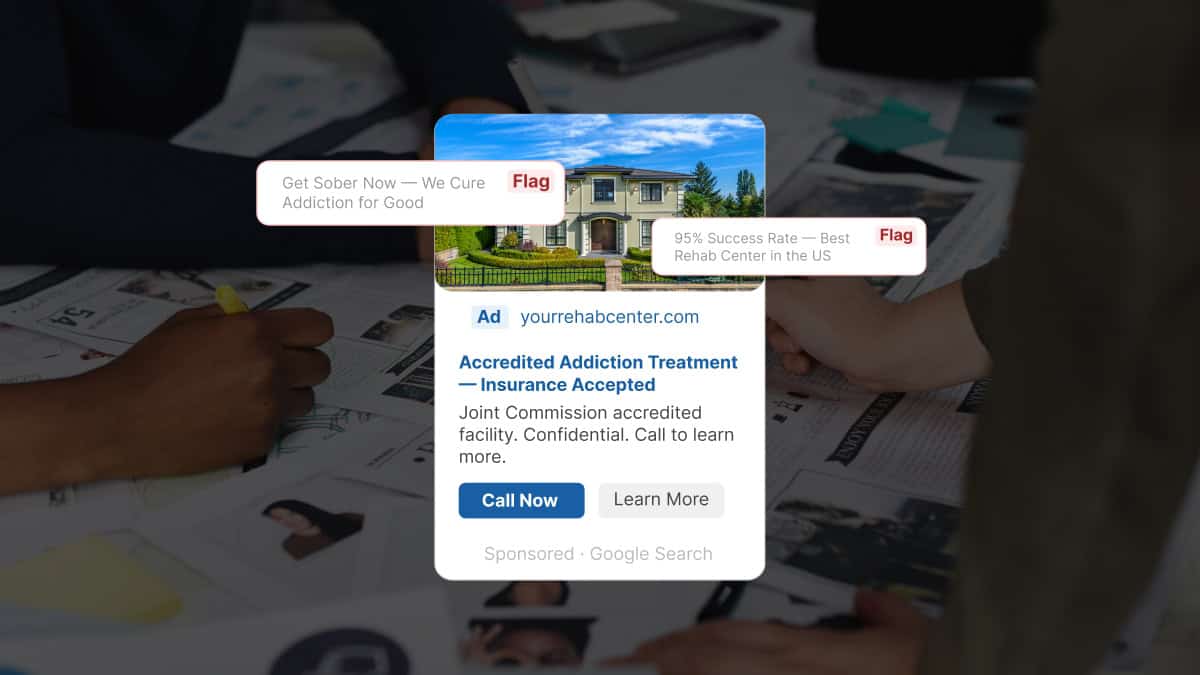
Outcome guarantees and unsubstantiated superlatives are the two rejection patterns that account for the largest share of headline flags on Google and Meta. “Guaranteed recovery,” “100% success rate,” “proven results,” “best rehab,” and “#1 treatment center” all hit the same automated review filters. Google auto-rejects. Meta limits reach. The fix is a substitution rule: every outcome claim becomes a process claim, and every superlative gets swapped for a third-party-verified credential like JCAHO or LegitScript.
Audit data across treatment center accounts surfaces seven language patterns that account for most rejections. Each one has a compliant alternative.
Pattern 1: Outcome guarantees. “Guaranteed recovery.” “100% success rate.” “Proven results.” Any phrase that promises a specific clinical outcome triggers automatic rejection on Google and limited approval on Meta.
Pattern 2: Superlative clinical claims without substantiation. “Best rehab.” “#1 treatment center.” “Top-rated facility.” These claims require third-party substantiation that most centers cannot provide. The headlines get flagged. The same pattern surfaces in the broader compliance mistakes that suppress rehab Google Ads performance.
Pattern 3: Urgency framing. “Act now.” “Limited beds.” “Don’t wait.” Urgency framing in healthcare ads triggers reviews because Google and Meta read it as exploiting vulnerable searchers.
Pattern 4: Direct emotional manipulation. “End your suffering.” “Save your loved one.” “Stop the pain.” These phrases score as exploitative under both Google and Meta healthcare policies.
Pattern 5: Specific drug names in commercial framing. “Suboxone treatment available.” “Methadone clinic.” Generic terms (“opioid treatment,” “MAT program”) generally approve. Specific brand names sometimes do not, depending on how the platform reads the context.
Pattern 6: Insurance specifics in headlines. “We accept Aetna.” “BCBS rehab.” Insurance language in headlines triggers reviews because the platforms cannot easily verify which policies are accepted. Insurance verification language belongs on the landing page, not the headline.
Pattern 7: Location plus medical condition combinations that read as targeting. “Austin opioid treatment” approves. “Austin opioid users” does not. The line between describing services and targeting people with conditions is one that Meta in particular polices aggressively. The same dynamic plays out in the broader HIPAA-compliant Facebook ads framework for treatment centers.
Each pattern has a compliant alternative that delivers the same intent. The next section walks through the four templates that work.
How Profound Treatment drove 31 admits and a 42% drop in cost per viable in one quarter
Broad match pivot, negative keyword management, and intake-level conversion tracking turned a fragmented paid strategy into a predictable admissions engine.
Read the case study →68 viable VOBs at $4,529 cost per viable
The four headline templates that approve and convert
Four templates produce approved headlines for rehab advertising on Google and Meta, and each one is built around language that satisfies both policy regimes while still mapping to commercial intent the campaigns are paying for. They cover the majority of cases.
Template 1: Service plus location. “[Service type] in [Location].” Examples: “Residential Rehab in Austin.” “Opioid Treatment in Phoenix.” “Detox Program in Houston.”
The template approves on both platforms. It carries strong commercial intent. It maps cleanly to the keyword that triggered the auction. CTR runs above category average for most accounts.
Template 2: Modality plus level of care. “[Modality] [Level of care].” Examples: “Dual Diagnosis Residential.” “Trauma-Focused PHP.” “MAT Outpatient Program.”
The template approves on both platforms. It speaks to a specific clinical interest the searcher is researching. CTR runs above average for searchers who already know the modality they are looking for.
Template 3: Insurance verification framing. “Verify Your Insurance.” “Free Insurance Check.” “Confirm Coverage Today.”
This is one of the few healthcare ad patterns where action language approves. The framing positions the action as informational rather than commercial, which keeps it inside policy. CTR runs strong for searchers in the early evaluation phase. The pattern also depends on privacy-safe conversion tracking to read out cleanly without violating healthcare data restrictions.
Template 4: Admissions support framing. “Speak with Admissions.” “Talk to Our Team.” “Get Admissions Help.”
The template approves on both platforms. It positions the conversion action as support-oriented rather than sales-oriented. The framing aligns with how healthcare ad reviewers want to see treatment marketing structured.
The four templates above produce 80% of the headlines a typical residential treatment center account needs. The remaining 20% come from program-specific clinical language and brand-specific positioning.
Platform-specific considerations
Google RSAs and Meta ads have different surface mechanics. The compliance principles transfer across platforms but the implementation differs.
Google Responsive Search Ads. Up to 15 headlines per ad. Google rotates and combines them based on predicted CTR per query. Each headline must independently pass policy review. A single rejected headline does not pull the whole ad, but it removes that headline from the rotation.
The implication is that quantity matters. Operators who load up 15 strong headlines give Google more material to work with and more chances for any individual query to find a high-CTR match.
Google Headlines vs Description Lines. Description lines tolerate slightly more language flexibility than headlines. A claim that gets rejected in a headline sometimes passes in a description line.
The pattern reflects how Google’s reviewers read context. The headline is more prominent and gets the stricter treatment.
Meta Primary Text and Headline. Meta places the headline below the image and above the call-to-action button. Primary text sits above the image. Both fields are reviewed against healthcare policies. The headline field has a 40-character cap and a stricter language standard.
Meta also reviews the image and the destination page as part of the ad approval. A compliant headline can be rejected if the image is non-compliant. A compliant ad can be rejected if the landing page violates Meta’s healthcare requirements.
A review process that catches problems before they ship
A review process built around the dual policy constraint catches most compliance problems before they reach the platforms. The cost of catching a problem in review is one minute. The cost of catching it after rejection is days of lost serving time.
Step 1: Run every new headline through the seven-pattern checklist. Before the headline goes into the ad, check it against the seven banned patterns above. Any headline that fits a banned pattern gets rewritten using one of the four templates.
Step 2: Cross-platform check. If the headline is going on both Google and Meta, mentally run it through each policy regime separately. A headline that approves on Google but feels borderline on Meta gets the more conservative rewrite.
Step 3: Substantiation file. For any headline that includes a clinical or quality claim, document the substantiation in a shared file. If the platform reviewer asks for it during a manual review, the substantiation is ready and the approval clears within a day rather than a week.
Step 4: Approval rate tracking. Pull the ad-level approval data weekly. Track approval rate by campaign and by ad group. A drop in approval rate is the early warning that something in the headline library has crossed a policy line.
Step 5: Rejection triage within 24 hours. When an ad is rejected, do not wait for the next campaign cycle to address it. Rewrite within 24 hours. Resubmit. Track which rewrites approve. The fast cycle keeps the campaigns serving and builds the library of known-good language.
The review process takes about 30 minutes per week for a typical residential account. The savings show up in approval rates, in serving time, and in CPC.
Common mistakes that suppress headline performance
Three mistakes surface most often in audits across treatment center accounts, and each one has a structural fix that operators can apply without rewriting the rest of their paid search strategy. Each one has a fix.
Mistake 1: Treating the headline as the only place to make the case. Operators sometimes try to compress the entire value proposition into 30 characters. The result is overcrowded headlines that read as clinical claims and fail review.
The fix is to use the description lines and the landing page to carry the case. Let the headline do one thing well.
Mistake 2: Recycling headline copy from other healthcare verticals. Headlines that work for primary care, dental, or general wellness do not transfer to addiction treatment. The policy review is stricter. The audience is different. The conversion logic is different.
The fix is to write headlines specific to the addiction treatment context.
Mistake 3: Set-and-forget headline libraries. Headlines that approved 18 months ago can fail on resubmission today. Google and Meta tighten their healthcare policies regularly. A library that has not been audited in a year is sitting on rejection risk.
The fix is a quarterly headline audit, with rewrites of any limited-approval items.
The three mistakes are connected. Operators who treat headline work as a one-time project produce all three. Operators who treat it as ongoing operational work avoid them.
What success looks like at twelve weeks
A treatment center that builds deliberate headline discipline should see measurable improvement inside a quarter.
The starting point is the audit. Pull every active headline across Google and Meta. Categorize by approval status (approved, limited, disapproved). Tag each one against the seven banned patterns. Identify the rewrite priority list.
Weeks one through four cover the rewrite. Apply the four templates to the priority list. Resubmit the rewritten headlines. Track approval rates as they update.
Weeks five through eight are the data collection period. The new headlines need impression volume to update Google’s predicted CTR signals and Meta’s relevance scores. The CTR delta becomes visible in this window.
Weeks nine through twelve are the evaluation phase. Compare the approval rate, the CTR, and the cost-per-admit against the baseline. The center we worked with started at 58% approval and 12-week ended at 96% approval, with CTR up 22% and cost-per-admit down 14%.
The CPC compounds with the headline work. As approval rates climb and predicted CTR rises, Quality Score climbs. As Quality Score climbs, CPC falls. The headline rewrite serves as the entry point to broader Quality Score recovery rather than a one-shot fix.
What to ask your paid search partner this week
Three questions surface whether a paid search partner is operating with the right headline discipline. Ask them this week.
First, ask for the current approval rate across the Google Ads account and the Meta account. If the partner cannot pull it within 5 minutes, ad-level compliance metrics are not part of their operating cadence. That is the root cause of most undetected approval problems.
Second, ask for a list of headlines disapproved or limited-approved in the last 30 days, with the rewrite plan for each one. A serious answer includes the specific rewrites and a timeline. A vague answer indicates the partner is not actively triaging rejections.
Third, ask how the partner thinks about the dual policy constraint between Google and Meta. A serious answer references both regimes and the language patterns that pass each one. A generic answer indicates the partner is treating rehab advertising the same way they treat unrestricted categories. If you are evaluating partners, the marketing agencies that specialize in rehab are the ones most likely to pass these three questions cleanly.
Compliant ad headlines come down to constraints, not creativity. The treatment centers that close the gap between approval rate and conversion rate are the ones running paid search at the cost-per-admit their financial models actually require.
For the fuller paid-search picture, pair this with behavioral health marketing guide.
Frequently asked questions about compliant rehab ad headlines
Are compliant headlines less effective than aggressive ones?
Compliant headlines tend to outperform aggressive ones in behavioral health paid media. The reason is that aggressive headlines (outcome guarantees, urgency claims, emotional manipulation) trigger disapprovals, suppress Quality Score, and reduce ad delivery enough that the conversion-rate gap rarely makes up for the impression-volume gap. Compliant headlines run consistently and accumulate learning data, which is what actually moves cost-per-admit.u003cbru003eu003cbru003eWe have audited treatment center accounts running both styles in parallel. The compliant-headline accounts consistently produce 25 to 40 percent lower cost-per-admit because their ads serve more often and at lower CPCs. The aggressive accounts produce shorter spikes that get suppressed within weeks of launch.u003cbru003eu003cbru003eThe misconception comes from copywriting traditions in other verticals where bold claims drive response. Behavioral health operates under different ad platform policies and patient psychology. The headline that works here is specific and trustworthy, not pushy.
Can the same headline run on Google and Meta?
Sometimes, but rarely. Google and Meta enforce different policy sets and reward different headline mechanics. Google rewards specificity and intent matching for Quality Score. Meta rewards conversational tone and emotional resonance for delivery. The same headline can satisfy both, but optimizing for one usually under-performs the other.u003cbru003eu003cbru003eThe cleanest workflow is to write headline variants in pairs, one for each platform, both rooted in the same proposition. A Google headline like ‘Insurance-Verified Detox in 24 Hours’ translates on Meta to something like ‘Most insurance plans cover detox. Verification in under an hour.’ Same value proposition, two different mechanics.u003cbru003eu003cbru003eWe test the cross-platform headline assumption every time a client asks. Our data shows that platform-specific headlines outperform platform-shared headlines by 15 to 30 percent across cost-per-admit. The extra writing time pays for itself in the first month.
How do we know if a headline will pass policy before submitting?
There is no policy preview tool that gives definitive answers. The closest thing is internal review against the seven rejection patterns covered in this guide plus a side-by-side check against ads that approved on similar accounts in the prior 30 days. Most reliable predictor is the language pattern, not the specific words.u003cbru003eu003cbru003eTwo practical habits help. First, build a review checklist that lists the rejection patterns and run every new headline against it before submission. Second, maintain an internal library of approved headlines from your own account history. Patterns that approved before tend to approve again, with platform policy drift accounted for.u003cbru003eu003cbru003eThe harder cases are headlines that hit the gray area on outcome implication or urgency. For those, we typically draft three versions at different aggression levels and submit them as separate variants. Whichever the platform serves at scale becomes the working pattern for that account.
What is the difference between a limited approval and a full rejection?
A limited approval means the ad can run but with restricted reach, usually because the headline or copy touched a sensitive language pattern that the platform allows but limits. A full rejection means the ad cannot serve at all and must be edited and resubmitted. Both are signals that the account is operating near or over policy boundaries.u003cbru003eu003cbru003eLimited approvals are easy to ignore and that is dangerous. They are early warnings. Accounts with consistent limited approvals across multiple ads tend to face full suspensions within months as the cumulative policy signal triggers a manual review. By the time the suspension lands, the account has weeks of compromised performance baked in.u003cbru003eu003cbru003eWe treat every limited approval as a fix-now issue, not a fix-later issue. The cost of editing the headline today is hours. The cost of an account suspension is weeks of admit volume.
Should we run A/B tests on headlines if some get flagged?
Yes, but with discipline. The goal of headline testing in behavioral health is to find the highest-converting compliant headline, not to learn whether non-compliant headlines convert better. Test compliant variants against each other, not compliant against non-compliant.u003cbru003eu003cbru003eThe right testing structure is 3 to 5 headline variants per ad group, all written against the same value proposition, all pre-screened against rejection patterns. Run them simultaneously for at least 14 days before drawing conclusions. Less time produces variance that masks the signal.u003cbru003eu003cbru003eMost treatment center accounts test headlines too rarely and too narrowly. A consistent monthly headline test produces 30 to 60 percent cost-per-admit improvement over a 12-month horizon. Skipping the discipline means the account converges on whatever the first writer wrote, regardless of whether it was the best option.
The perspective in this article comes from 9 years working exclusively inside behavioral health.
We are a team built by people in recovery who understand that behind every admission is someone asking for help. If that resonates, get to know us.
Mitch Marowitz is the Director of Paid Admissions at Webserv. Webserv works with behavioral health and addiction treatment centers on paid media, SEO, and full-funnel admissions strategy.