Treatment centers operating across multiple cities face a structural problem that generic SEO advice ignores. Each location needs its own digital presence to capture local search intent, but creating dozens of pages that differ only by city name triggers Google’s duplicate content filters.
The result is either invisible pages or a manual penalty that suppresses the entire domain. This isn’t a technical problem with a technical fix.
It’s a content architecture problem rooted in how addiction treatment services are actually delivered and how families search when crisis forces an immediate decision. A person searching “drug rehab in Tampa” has fundamentally different informational needs than someone searching the same phrase in Portland, even if both facilities offer identical clinical programming.
The conventional approach (templating treatment center location pages with city name variables) assumes search engines can’t detect patterns. They can. More importantly, this approach assumes local searchers don’t notice when content feels generic.
They do, and they leave. Effective SEO for treatment centers in multi-location markets requires a different content architecture than national branded campaigns — one that builds genuine geographic relevance into each page rather than swapping city names across a master template.
How Local Search Intent Differs in Addiction Treatment
Families researching treatment options operate under compressed timelines with elevated emotional stakes. Unlike someone researching elective medical procedures over weeks or months, addiction treatment searchers often need to make placement decisions within 48 hours of a crisis event.
What this means in practice: A family in Phoenix isn’t just looking for “nearby” treatment. They’re evaluating whether their insurance covers out-of-state care, whether local facilities accept court referrals, whether state regulations allow medication-assisted treatment, and whether specific modalities are available within driving distance for family therapy sessions.
These aren’t secondary considerations. They determine whether a facility is even viable for their situation.
Local search intent also reflects community-specific patterns. Opioid crisis epicenters generate different search behavior than regions where methamphetamine or alcohol predominate. Communities with large Spanish-speaking populations search for bilingual services. Areas with significant uninsured populations prioritize Medicaid acceptance and sliding-scale payment options.
None of this variation appears in templated location pages, which is why local SEO for rehab centers requires geography-specific research across Google Business Profile signals, citation hygiene, and on-page architecture rather than template variables.
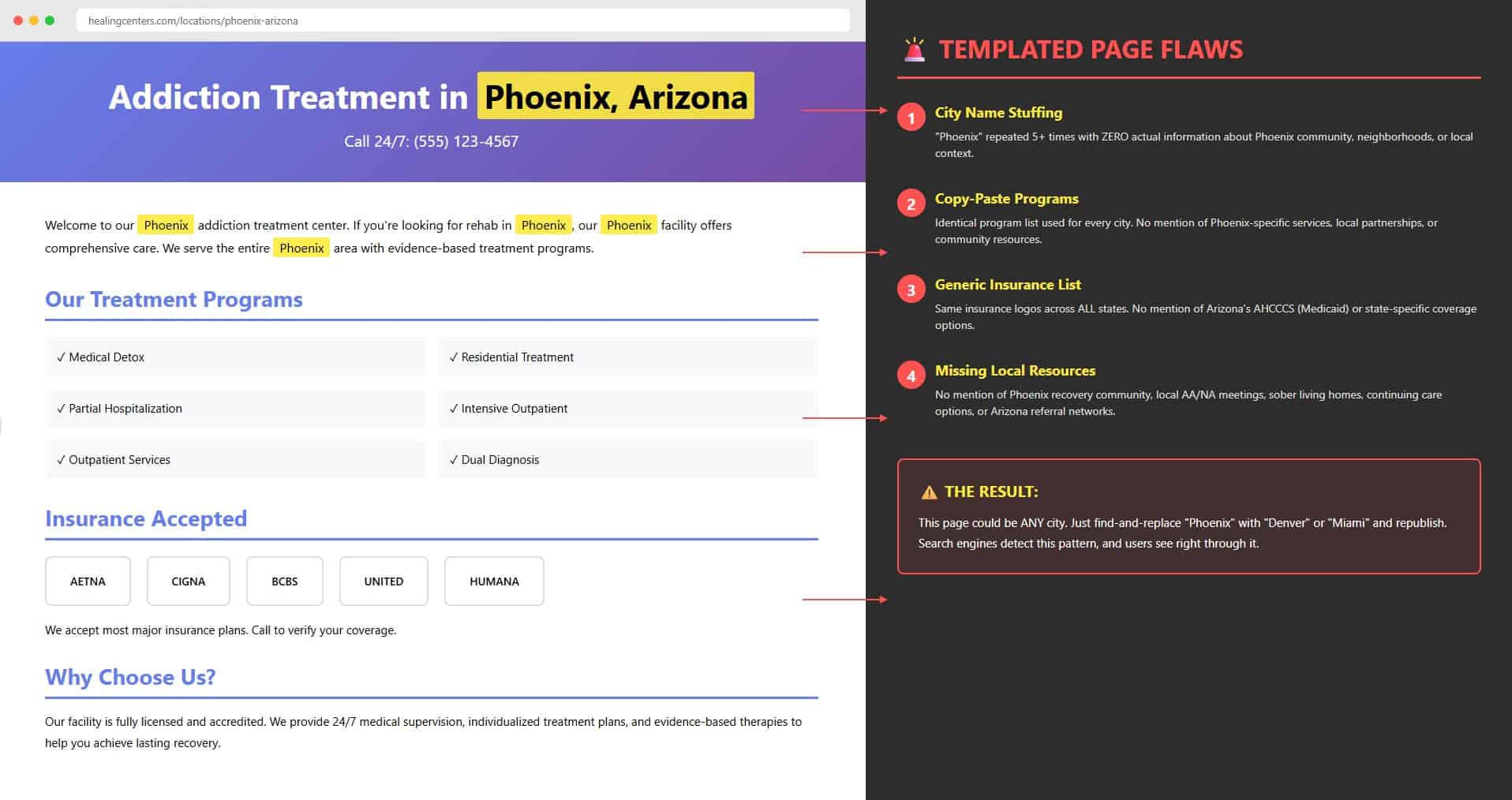
Quick Signs Your Pages Are Templated
Your location pages likely suffer from the template problem if:
- The only differences between city pages are the city name and maybe a phone number
- Opening paragraphs mention the city name repeatedly but say nothing specific about that community
- Insurance and regulatory information stays identical across different states
- No mention of local referral networks, continuing care resources, or state-specific access issues
Where Location Page Strategy Breaks Down
MOST COMMON FAILURE MODE
Duplicating a master template and swapping city names. Clinical descriptions identical. Staff credentials in the same order. Amenities list unchanged. Only the header and meta tag acknowledge geography. Google’s algorithms do not check whether a city name appears in the title — they evaluate whether the content addresses location-specific queries. A page about rehab in Sacramento that could be about any city after a find-and-replace provides no incremental value. Search engines recognize the pattern immediately.
Treating Geography as a Variable Instead of Context
The most common failure pattern emerges when marketing teams build location pages by duplicating a master template and swapping city names. The clinical descriptions remain identical, staff credentials appear in the same order, and the amenities list doesn’t change.
Only the header and meta tags acknowledge geography.
This approach fails because it misunderstands what local search rankings reward. Google’s algorithms don’t simply check whether a city name appears in the title tag. They evaluate whether the content on the page genuinely addresses location-specific queries.
A simpler way to think about this: A page about “rehab in Sacramento” that could be about any city after a find-and-replace operation provides no incremental value to searchers. Search engines recognize this pattern immediately.
The duplicate content problem compounds when treatment centers operate facilities in multiple states. A 15-location operator that templates pages across markets creates a pattern search engines flag instantly.
Confusing Local Pack Rankings with Organic Rankings
Many treatment centers focus exclusively on Google Business Profile optimization while neglecting the organic search results beneath the map pack. This creates a fundamental gap in their local visibility strategy.
Here’s the difference: The local pack typically shows three results and requires physical presence, verified addresses, and review velocity. The organic results below offer unlimited positions and reward comprehensive content that addresses location-specific queries.
Treatment centers often rank well in the local pack for branded searches or very basic service terms, then wonder why they don’t capture traffic for more specific queries like “inpatient rehab Sacramento accepts Medi-Cal” or “detox centers Sacramento court-ordered treatment.” These longer, more specific searches rarely trigger the map pack.
They surface organic results, and those results go to pages that actually answer the implicit questions in the query.
Building for Search Engines Instead of Decision Journeys
Location pages designed primarily to satisfy SEO checklists rarely perform their actual function: helping someone determine whether a specific facility matches their needs. The page might check every box on a technical SEO for behavioral health audit — schema markup, keyword density, proper internal linking structure — and still fail to earn rankings.
But if it doesn’t help a reader understand why this particular location matters for their situation, it fails as both a conversion tool and a ranking asset.
What this means in practice: Search engines increasingly reward content that serves user intent over content that games algorithmic signals. A location page that genuinely helps someone evaluate whether a facility works for their geography will naturally include the semantic elements search engines use to assess relevance.
The inverse isn’t true. A page optimized for algorithms but useless to humans underperforms on both dimensions.
When Localization Creates Its Own Problems
Treatment centers sometimes recognize the duplication risk and respond by adding localized elements that undermine credibility rather than enhance it. Pages get padded with generic city information copied from Wikipedia or reference local landmarks the facility has no connection to.
This superficial localization often introduces factual errors or outdated information that damages trust more than duplicate content would. A page about treatment in Denver that includes a paragraph about the city’s elevation and craft beer scene signals that the content was created by someone who doesn’t understand either addiction treatment or local search intent.
What a Strong Location Page Must Answer
Every location page should clearly address three core questions:
- Does this specific facility serve my geography and insurance situation?
- Can I access treatment here given my logistical constraints (court requirements, family involvement, transportation)?
- Does this facility understand the local context that affects my situation (state regulations, regional referral networks, continuing care resources)?
Services pages explain your treatment approach. Location pages — a specialized form of behavioral health landing page — explain why geography matters for accessing those services.
A Content Architecture That Separates Locations from Services
Location pages don’t need to explain your entire clinical model. They need to answer the three questions above while linking to comprehensive rehab service pages for clinical detail.
This separation allows you to maintain authoritative content about your clinical programming on service pages while creating focused, differentiated content about location-specific access considerations. A family researching dual diagnosis treatment doesn’t need your dual diagnosis methodology explained five times across five location pages.
They need to know which of your locations offers dual diagnosis programming and how state regulations or insurance networks affect their ability to access it.
A simpler way to think about this: The architecture shifts from “create a page for every service in every location” to “create pages that explain how location affects service access.” This reduces total page count while increasing the genuine utility of each page.
Geographic Differentiation Through Access Logistics
Legitimate location-specific content emerges from explaining how geography affects the practical process of accessing treatment. This includes insurance network participation that varies by state, the presence or absence of Medicaid expansion, regulations around medication-assisted treatment, court referral procedures, and the availability of continuing care resources after discharge.
Here’s what this looks like in practice: A location page for a Florida facility might need to address out-of-state insurance coverage limitations, given that many Florida treatment centers market nationally but accept limited out-of-state plans. A California facility page should acknowledge Medi-Cal coverage requirements and how county-level behavioral health departments influence referrals.
These aren’t minor details. They’re often the primary factors determining whether someone can use your facility.
Content that addresses them directly serves both search intent and conversion goals. It also can’t be duplicated across locations because the information genuinely differs based on geography.
Regional Context That Influences Treatment Need
Some location-specific content derives from understanding how addiction manifests differently across regions. The opioid crisis affects rural Appalachia differently than it affects suburban Phoenix.
Cities with large immigrant populations see different barriers to treatment access than homogeneous communities.
What this means in practice: This might include references to regional health department initiatives, partnerships with local hospitals or urgent care networks, relationships with county indigent care programs, or involvement with state-level policy discussions. These elements can’t be faked or templated.
They require actual presence in a community and actual understanding of local systems.
Facility-Specific Differentiators Beyond Geography
When organizations operate multiple facility types or treatment modalities, location pages should clarify which services exist at which locations rather than implying all locations offer all services. A searcher looking for medication-assisted treatment needs to know immediately whether a specific facility provides MAT.
This specificity prevents false expectations and reduces low-quality leads. It also creates natural content differentiation across location pages without requiring artificial localization.
A page about a detox-only facility describes fundamentally different services than a page about a residential program, even if both are in the same city.
How This Architecture Influences Content Development
Building location pages under this framework changes the content development process from template application to research-based writing. Each location requires understanding that location’s insurance landscape, regulatory environment, referral networks, and community context.
The research phase for each location should identify what makes accessing treatment in that geography specifically complicated or specifically advantageous. Are there Medicaid waiver programs that affect coverage?
Do local hospitals have formal referral relationships with your facility? Does the state have specific regulations around patient rights or credentialing that families should understand?
These questions generate content that naturally includes location-specific terminology, references, and semantic context. Search engines recognize this as substantive local content rather than template manipulation.
More importantly, humans reading the page recognize it as written by someone who understands their local situation.
Writing for Regional Insurance and Payment Realities
Insurance coverage for addiction treatment varies dramatically by state, by plan, and by individual employer. A location page should acknowledge the dominant insurance carriers in that market, whether the facility participates in state employee plans, and whether local Medicaid expansion affects coverage.
The Centers for Medicare & Medicaid Services publishes state-by-state Medicaid expansion data, eligibility thresholds, and managed care arrangements — the foundation for describing insurance access accurately rather than generically promising “we accept Medicaid.” That accuracy matters because families researching treatment in crisis can’t afford to waste a call discovering a facility doesn’t actually take their plan.
Here’s a concrete example: A paragraph explaining that your Northern California facility participates in Medi-Cal but coverage requires county authorization through the local behavioral health department provides information a template can’t include. This level of specificity helps families understand whether they can even access your services before they call.
Addressing State Regulatory Variation
Licensing requirements, patient rights, confidentiality protections, and credentialing standards vary by state. A comprehensive location page acknowledges these variations when they affect patient experience or family involvement.
Why this matters for treatment centers: These regulatory details rarely appear in templated content but they often determine whether someone chooses a local facility over an out-of-state option. Families concerned about patient rights protections need to know what framework applies.
The Substance Abuse and Mental Health Services Administration publishes state profiles documenting licensing frameworks, insurance mandates, and treatment availability — primary-source data that lets a location page describe state-specific regulatory context with verifiable specificity rather than gestures toward “state regulations.”
People court-ordered to treatment need to know whether a facility meets state requirements for compliance reporting.
Connecting to Local Referral Networks and Resources
Treatment doesn’t end at discharge. A credible location page acknowledges the continuing care resources available in that specific community.
This might include relationships with local outpatient providers, sober living networks, peer support organizations, or employment assistance programs.
These local network details accomplish multiple goals. They reassure families that discharge planning connects to real local resources rather than generic aftercare advice. They signal genuine community presence rather than a facility that operates in isolation.
Most importantly, they can’t be templated. Your Nashville location has different continuing care partnerships than your Phoenix location.
If You Only Do Three Things
Focus your effort on the areas that create the most differentiation and value:
- Document the insurance and regulatory landscape specific to each state where you operate facilities (this information changes by state and determines access for most families)
- Identify and describe actual local referral relationships, continuing care networks, and community partnerships (these can’t be templated and signal genuine local presence)
- Clarify which services exist at which locations rather than implying all locations offer everything (this prevents false expectations and creates natural content differentiation)
Measuring What Actually Indicates Local Visibility
Traffic and rankings represent outputs, not inputs. Treatment centers often track whether location pages rank for “[city] + [service]” queries without asking whether those rankings generate qualified inquiries.
More meaningful measurement focuses on query patterns that suggest location-specific intent. This includes queries that reference insurance carriers, court requirements, specific medications, demographic qualifiers, or logistical constraints.
What this means in practice: A location page that ranks for “inpatient rehab Sacramento accepts Medi-Cal” demonstrates far more substantive local relevance than one that ranks for “Sacramento rehab” through brute-force optimization. The first query reveals someone with specific access constraints.
The second could be anyone.
Search console data reveals which location-specific queries you’re not appearing for. These gaps indicate content opportunities rather than optimization failures.
If your Sacramento page doesn’t appear for queries about Medication-Assisted Treatment availability, it suggests the page doesn’t adequately address MAT.
Signals of Genuine Local Authority
Pages that establish genuine local authority content tend to accumulate links from other local entities (hospitals, social service agencies, county behavioral health departments, or local news coverage of addiction issues). These links don’t result from outreach campaigns.
They emerge when organizations creating local resource lists discover your content and find it worth referencing.
User behavior metrics also indicate whether location pages serve their purpose. Time on page, scroll depth, and interaction with insurance or contact elements reveal whether content helps people evaluate fit.
Immediate bounces suggest content doesn’t match the query intent that brought someone to the page.
Indicators that a location page has achieved substantive local presence:
- Queries include insurance carrier names, specific medications, or regulatory terms unique to that state
- Inbound links come from local hospitals, health departments, or social service directories
- Engagement patterns show progression from location page to relevant service pages based on facility capabilities
When Location Pages Create Attribution Complexity
Multi-location operators often struggle to attribute inquiries to specific pages or channels because families research multiple locations before deciding. Someone might initially find your Sacramento page through local search, then visit service pages to understand programming, then return to compare your Phoenix and Seattle locations.
A simpler way to think about this: Individual location pages shouldn’t be judged solely on direct conversion rates. Their function includes introducing your organization to families who eventually convert through other pages or channels.
A location page that ranks well and gets substantial engagement but generates few direct form submissions might still provide significant value by establishing initial awareness and trust.
When Geographic Expansion Requires Content Infrastructure
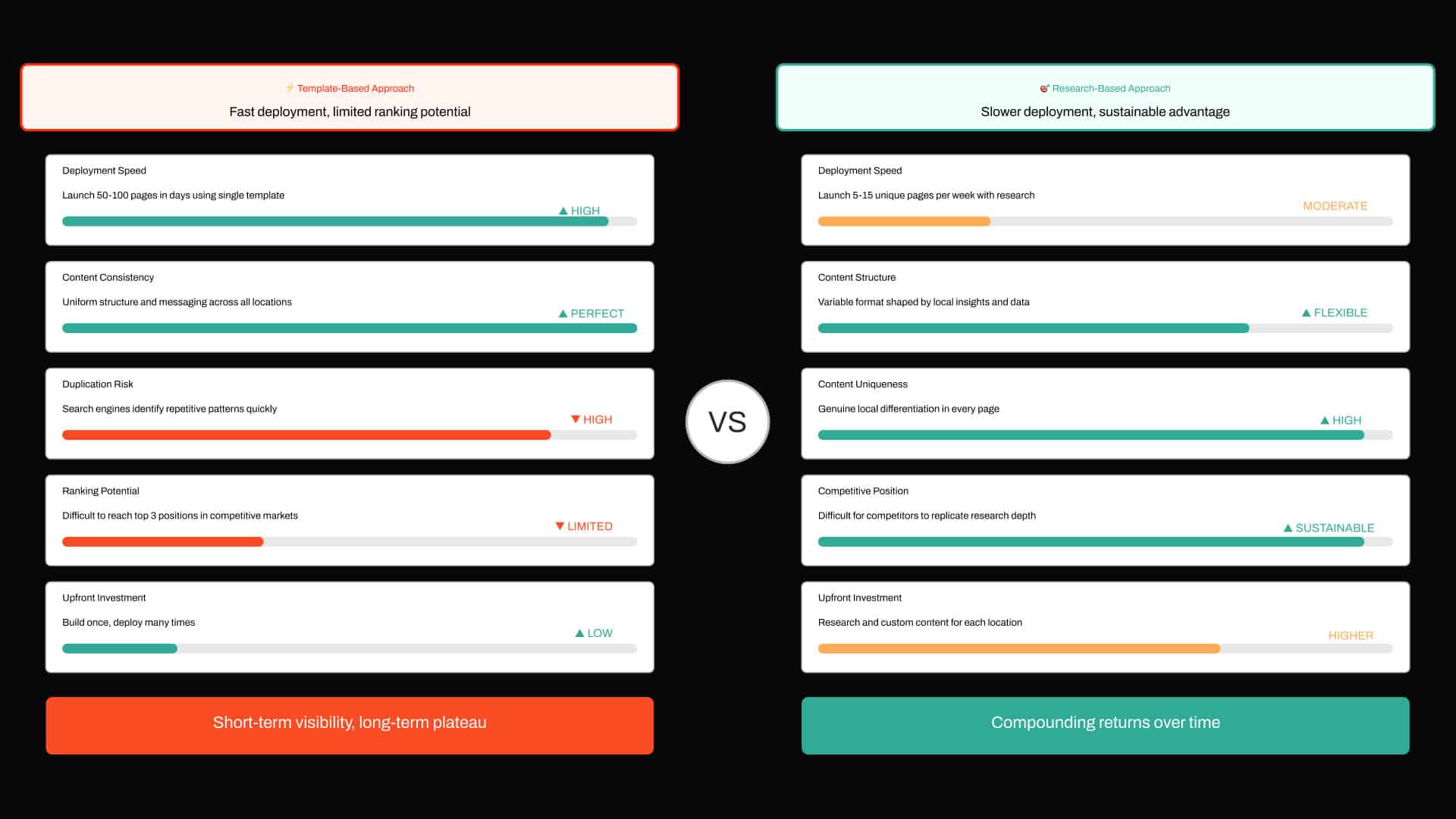
Organizations opening new locations or acquiring facilities in new markets face a decision point about content strategy. The templating approach allows rapid deployment but creates long-term ranking and credibility problems.
The differentiated approach requires more upfront effort but produces assets that remain effective as the market matures.
The strategic question isn’t whether to launch immediately with templates and improve later. Templated content that gets indexed and fails to rank creates baggage that persists even after you improve it.
Search engines develop a pattern recognition for your domain.
A more defensible approach treats each new market as requiring genuine local research before content development. This slows initial deployment but ensures each location launches with content capable of establishing local visibility.
Scaling Through Systems Rather Than Templates
Organizations that successfully operate dozens of location pages do so by building research and content development systems rather than by creating content templates. This might include structured intake processes that capture location-specific information during facility acquisition or partnerships with local staff to document community relationships and referral patterns.
These systems allow consistent content quality without requiring identical content structure. The research process remains similar across locations, but the output reflects genuine differences in how each facility operates within its local context.
Why this matters for treatment centers: This approach scales better than templates because it produces assets that remain valuable over time rather than creating technical debt that requires eventual remediation.

Location Pages as Part of Comprehensive Local Presence
No single page type solves local visibility. Location pages work in concert with Google Business Profiles, local citations, review management, and service pages to create comprehensive local presence.
The location page serves as the owned-media asset where you control messaging and can provide depth that business profiles and citation listings can’t accommodate.
This means location pages shouldn’t try to accomplish everything. They don’t need to explain your entire clinical model, list every staff member, or replace service-specific content.
They need to address geography-specific considerations and connect to other resources that provide additional detail.
What this means in practice: Treatment centers that treat location pages as isolated SEO assets miss how they integrate into broader marketing systems. A strong location page supports paid search campaigns by improving Quality Scores for location-specific ad groups.
It provides a credible destination for local directory listings. It gives families a reason to engage with your brand after discovering you through maps or review sites.
If you’re rebuilding location pages or planning to expand into new markets, we can sit down with your team to map your local SEO architecture and identify which pages will earn rankings versus which need to be rebuilt from scratch.