California has more for-profit treatment operators that accept private insurance than any other state. It also has one of the most detailed sets of state laws on how treatment centers can market, including rules that reach agencies, lead generators, and call lines directly.
We know this market from the inside. Webserv is based in Irvine, in Orange County, which has the highest share of for-profit, privately insured treatment centers of any major U.S. market in our data.
This guide is for owners and marketing directors of California treatment centers. It covers the market, the state laws that shape your marketing, what to ask an agency, and who does this work in California. It’s part of how we approach SEO and paid search for treatment centers.
Key Takeaways
- FindTreatment.gov lists 2,229 California facilities. 43% are for-profit, 63% accept private insurance, and 344 for-profit operators that accept private insurance have their own websites, the most of any state.
- California’s SB 349, in effect since 2023, requires accurate, plain-language marketing and makes some deceptive practices unlawful for any person, not only treatment providers.
- Health and Safety Code 11831.6 bars licensed and certified programs from paying or receiving anything of value for referrals. The Insurance Code separately bans referral fees for insured patients.
- Federal prosecutors have charged a series of Southern California kickback and body brokering cases since 2021, many tied to Orange County.
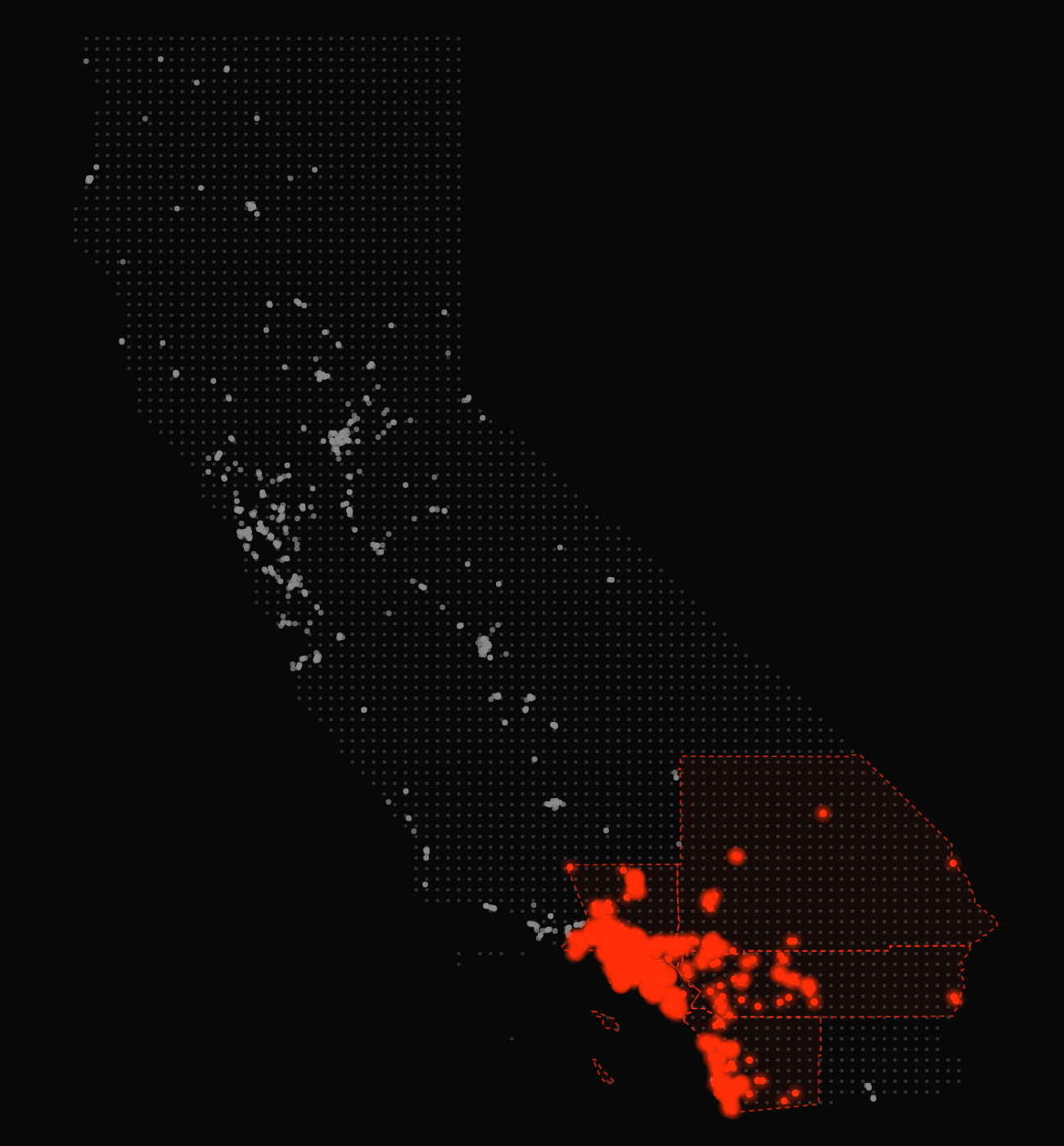
- Los Angeles, Orange County, the Inland Empire, and San Diego have the most commercial operators. Each has its own guide below.
California’s treatment market in numbers
These counts come from SAMHSA’s FindTreatment.gov listings for California.
| California, as listed on FindTreatment.gov | Count |
|---|---|
| Facilities listed | 2,229 |
| Substance use facilities | 1,050 |
| Mental health facilities | 1,031 |
| Opioid treatment programs | 148 |
| Offering residential care | 741 |
| Offering detox | 396 |
| For-profit | 953 |
| Accepting private insurance | 1,404 |
| Accepting Medicaid (Medi-Cal) | 1,052 |
| For-profit operators accepting private insurance, by unique website | 344 |
Source: SAMHSA FindTreatment.gov locator export, pulled November 9, 2026. Counts reflect facilities that list themselves on FindTreatment.gov, so they undercount the full market.
Commercial operators cluster in Southern California. By market, the counts of for-profit operators that accept private insurance are:
| Market | For-profit operators accepting private insurance |
|---|---|
| Los Angeles County | 131 |
| Orange County | 79 |
| Inland Empire | 43 |
| San Diego County | 33 |
| Sacramento | 26 |
| Ventura County | 21 |
At the city level, Los Angeles leads with 47 for-profit facilities that accept private insurance. San Juan Capistrano is second with 37, followed by Newport Beach and Woodland Hills at 29 each and Malibu at 25.
Why California marketing carries extra scrutiny
In 2017, the Orange County Register’s “Rehab Riviera” investigation reported that the state had just 16 inspectors to monitor nearly 2,000 rehab centers. Over the next several years, California passed a series of laws on referrals, inducements, and marketing.
Federal prosecutors followed. In December 2021, the U.S. Attorney’s Office for the Central District of California announced charges against 10 defendants in kickback schemes tied to Orange County treatment facilities.
In October 2026, the same office announced charges in what the Justice Department called the largest substance abuse treatment fraud scheme it has prosecuted. Those charges are allegations.
The FTC has also acted. Its case against Mercury Marketing, whose defendants include Malibu Detox and Aliya Health Group, alleges search ads that impersonated other treatment clinics. Malibu Detox settled under a stipulated order in March 2026, and the case remains pending.
The California laws that shape your marketing
Ethical treatment and marketing, SB 349. The California Ethical Treatment for Persons with Substance Use Disorder Act, in effect since January 1, 2023, requires marketing to give “accurate and complete information, in plain language.” Ads must state the types of services and levels of care offered, plus the provider’s name and brand.
It’s unlawful to make false or misleading statements about the nature, identity, or location of services on a call line or website, or to misstate in-network or out-of-network status.
Rules that reach agencies and lead generators. Some SB 349 provisions apply to any person, not only treatment providers:
- Giving false identity or contact information for a provider.
- Redirecting readers to another site.
- Implying a relationship with a provider without its express, written consent.
A violation is a deceptive act under California’s Unfair Competition Law. Section 11857.5 allows civil penalties of up to $20,000 per violation. The Attorney General, district attorneys, county counsel, and city attorneys can all sue.
Deceptive marketing by providers, HSC 11831.9. Added by SB 434 in 2021, this section bars licensed facilities and certified programs from false or misleading statements about services or “geographical locations,” and from false contact information or links that send readers elsewhere.
Referral payments, HSC 11831.6. Under Section 11831.6, licensed and certified programs, their owners, and their employees may not give or receive anything of value for a referral. The state Department of Health Care Services enforces it through penalties and license actions.
Housing and travel inducements, HSC 11831.65. Section 11831.65 limits how programs can offer housing and transportation. Housing needs its own contract and can’t depend on agreeing to treatment. Ground transport is limited to trips under 125 miles, and air travel must include a return ticket.
Referral fees for insured patients. Insurance Code 754 makes it unlawful for any person to pay or receive a referral fee for services an insurer may reimburse. Section 750 makes some referral payments a crime, with fines up to $50,000.
Status disclosure on your website. HSC 11831.5 requires a disclosure on your website and intake forms telling people they can check the state’s list of programs on probation, suspension, or revocation.
COMMON MISTAKE
Assuming the rules stop at the treatment center. SB 349’s “any person” provisions cover a lead generator that uses a provider’s name without written consent, or a call line that misstates who answers. Your agency’s practices are your exposure too.
Choosing a rehab marketing agency in California
Ask every agency you’re considering:
- How do you handle SB 349? They should know which provisions apply to them directly.
- How are you paid? Any fee tied to admissions needs review under HSC 11831.6, Insurance Code 754, and the federal Eliminating Kickbacks in Recovery Act.
- Do you run call lines or bid on competitor names? Ask how they avoid misstating who answers, and how they handle trademarked names.
- How do you write insurance claims? In-network and out-of-network statements must be accurate under SB 349.
- Is our 11831.5 disclosure on the site? It’s a simple fix many sites still lack.
OPERATOR INSIGHT
Put SB 349 compliance and written consent requirements in the agency contract. If a vendor runs ads or call lines using your name, you want the consent and the review process in writing.
Marketing agencies in California
We list Webserv first because it’s ours. The other agencies show a California office on their own websites. Each market guide lists that market’s healthcare and general agencies. Below are the state’s rehab specialists with verified offices.
1. Webserv
 Homepage screenshot of Webserv.
Webserv is a behavioral health marketing agency based in Irvine, in Orange County. It runs SEO, paid media, creative, and admissions operations work for treatment centers, has served 200+ treatment centers since 2017, and is a Google Premier Partner.
Rehab and behavioral health specialists
Agencies that say they focus on addiction treatment, mental health, or behavioral health providers.
| Agency | Office (per its website) | How it describes its work |
|---|---|---|
| BuzzFactory | Palm Springs | A growth agency for the behavioral health industry |
| Marketing Wind | Newark | A behavioral health marketing agency working only with healthcare |
| Sweet Media Services | Costa Mesa | Behavioral health marketing focused on admissions |
Offices and descriptions verified on each agency’s own website, November 2026. Within each group, agencies are listed alphabetically. We describe them only by what they say about themselves, and we don’t rate them.
Several other California rehab agencies list addresses at shared workspaces or mail centers, or no address at all. We’ll add them once a working office can be confirmed. For a national view, see our ranking of marketing agencies for rehabs.
California markets
- Los Angeles County: Los Angeles, Woodland Hills, Malibu, Long Beach, and Agoura Hills.
- Orange County: San Juan Capistrano, Newport Beach, Orange, Costa Mesa, and Huntington Beach.
- Inland Empire: Riverside and San Bernardino counties, including Palm Springs and Temecula.
- San Diego County: San Diego, Encinitas, Del Mar, and La Mesa.
See all states on our locations page. For how local marketing fits a full program, see our complete guide to behavioral health marketing. If you want a second look at your California marketing, book an intro meeting.
This page summarizes public statutes and enforcement actions. It isn’t legal advice. Talk to healthcare counsel about your specific situation.
Frequently Asked Questions
What does California’s SB 349 require of treatment center marketing?
SB 349, in effect since 2023, requires marketing to give accurate and complete information in plain language, and ads to state the services, levels of care, and provider name.
It bans false statements about the nature, identity, or location of services, and false in-network or out-of-network claims.
Violations can bring civil penalties of up to $20,000 each.
Do California’s treatment marketing laws apply to agencies?
Some do. SB 349 makes it unlawful for any person to give false identity or contact information for a provider or to imply a relationship without written consent.
Most other sections, such as HSC 11831.6 and 11831.9, apply to licensed and certified programs.
Your agency’s practices still create risk for your program.
Is paying for patient referrals legal in California?
No, in most cases. HSC 11831.6 bars licensed and certified programs from giving or receiving anything of value for referrals.
Insurance Code 754 bans referral fees for services an insurer may reimburse, and federal law adds the Eliminating Kickbacks in Recovery Act.
Review any marketing fee tied to admissions with healthcare counsel.
Which California markets have the most treatment centers?
On FindTreatment.gov, Los Angeles County has the most for-profit operators that accept private insurance, with 131.
Orange County has 79, the Inland Empire 43, and San Diego County 33.
Orange County has the highest commercial share: 80% of its listed facilities are for-profit and accept private insurance.