Local SEO for multi-location treatment centers is the specific SEO discipline that sits between general organic SEO and Google Business Profile management, and it lives inside our SEO capability.
It covers what happens when a single facility operator becomes a two-facility or three-facility operator, and when a portfolio operator manages 5 to 25 facilities across multiple states with meaningful geographic overlap.
The specific problem multi-location treatment centers face: the SEO capability has to serve both the corporate brand entity and the individual facility entities, and the two levels of entity signal have to reinforce each other rather than fragment.
Fragmented entity signal is what produces the specific ranking failures multi-location operators see when they expand beyond a single facility.
The pattern I see across portfolio operator SEO audits: individual facility pages compete against each other for the specific geographic queries because each facility carries the same corporate template with facility-specific fields swapped in.
Google’s ranking picks one facility page over the others and the rest sit invisible for the geographic terms they should own.
Or the opposite pattern: individual facility pages carry no corporate entity signal, and the facility pages rank against each other for the corporate brand terms because Google cannot resolve which page owns the brand entity.
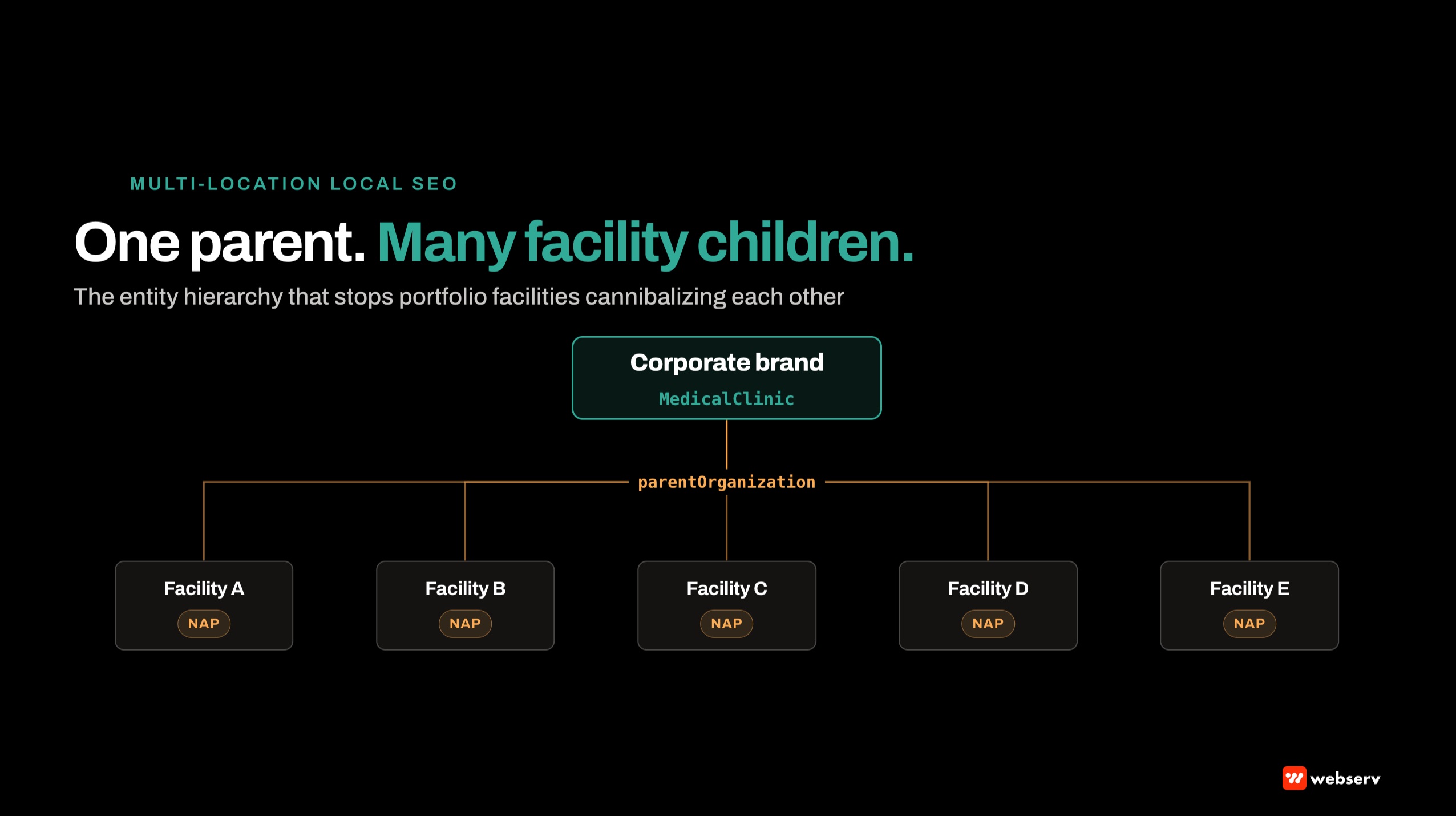
The pattern that works: clear entity hierarchy with the corporate brand as the parent entity, each facility as a distinct child entity with facility-specific NAP data, and cross-linking that reinforces the parent-child relationship rather than treating each facility as a standalone site.
This is a comprehensive guide to multi-location treatment center Local SEO. It sits inside our ultimate guide to behavioral health marketing guide, extends the earlier Local SEO framing in our Local SEO for healthcare piece, and pairs with our sibling attribution guide and landing pages guide as the four Sept 7-14 launch hubs.
It walks the entity hierarchy that produces clean parent-child signal, the URL architecture that supports the hierarchy, and the schema markup that reinforces the entity relationships. It also covers the Google Business Profile management pattern for multi-location operators, the NAP consistency discipline that separates well-managed portfolios from fragmented portfolios, and the specific measurement setup that produces facility-level and portfolio-level attribution simultaneously.
Downstream Local SEO supporting pieces publish over weeks 1-8 and reference this hub for the entity architecture that all Local SEO work has to sit inside.
Key Takeaways
- Multi-location treatment center Local SEO requires clear entity hierarchy: the corporate brand entity as the parent, each facility as a distinct child entity, and cross-linking that reinforces the parent-child relationship. Fragmented entity signal is the specific failure mode that produces the ranking problems most portfolio operators experience.
- URL architecture supports the entity hierarchy: /locations/{facility-slug}/ for facility-level pages, /locations/ for the location index, and consistent internal linking patterns across every facility. Portfolio operators that use inconsistent URL patterns across facilities produce entity signal fragmentation that Google cannot resolve.
- Schema markup reinforces the entity hierarchy: MedicalClinic Organization schema for the corporate brand, MedicalBusiness schema for each facility with the specific NAP and geographic identifiers, and Organization-to-MedicalBusiness relationship linking through the parent-organization property.
- Google Business Profile management for multi-location operators requires the Business Profile API integration for portfolios above 10 locations, category consistency across facilities, and NAP consistency between GBP and website that Google’s ranking specifically evaluates.
- Measurement setup produces facility-level and portfolio-level attribution simultaneously through property-level GA4 configuration, GBP insights integration, and rank tracking segmented by facility location.
DEFINITION
Local SEO for multi-location treatment centers. The SEO discipline that sits between general organic SEO and Google Business Profile management, specifically for treatment center operators managing more than one facility. Runs on a parent-child entity hierarchy (corporate brand as parent, each facility as child), subdirectory URL architecture at /locations/{facility-slug}/, consolidated schema with parentOrganization linking, Business Profile API for portfolios above 10 locations, and unified measurement across GA4 facility segments, GBP insights, and rank tracking segmented by facility location.
Distinct from single-facility Local SEO (no parent-child hierarchy needed), distinct from general organic SEO (which does not address the entity-fragmentation failure mode that hits portfolios), and distinct from standalone GBP management (which handles the map-pack layer but not the website entity signal that ranks on organic Search).
OPERATOR INSIGHT
Fragmented entity signal is what produces the specific ranking failures multi-location operators see when they expand beyond a single facility.
Individual facility pages compete against each other for the specific geographic queries because each facility carries the same corporate template with facility-specific fields swapped in. Google’s ranking picks one facility page over the others and the rest sit invisible for the geographic terms they should own. The fix is a clear parent-child entity hierarchy, not more content.
The entity hierarchy that produces clean signal
Multi-location treatment center Local SEO requires clear entity hierarchy to produce the ranking signal Google’s algorithm evaluates. The specific hierarchy: corporate brand as the parent entity, each facility as a distinct child entity, cross-linking that reinforces the parent-child relationship.
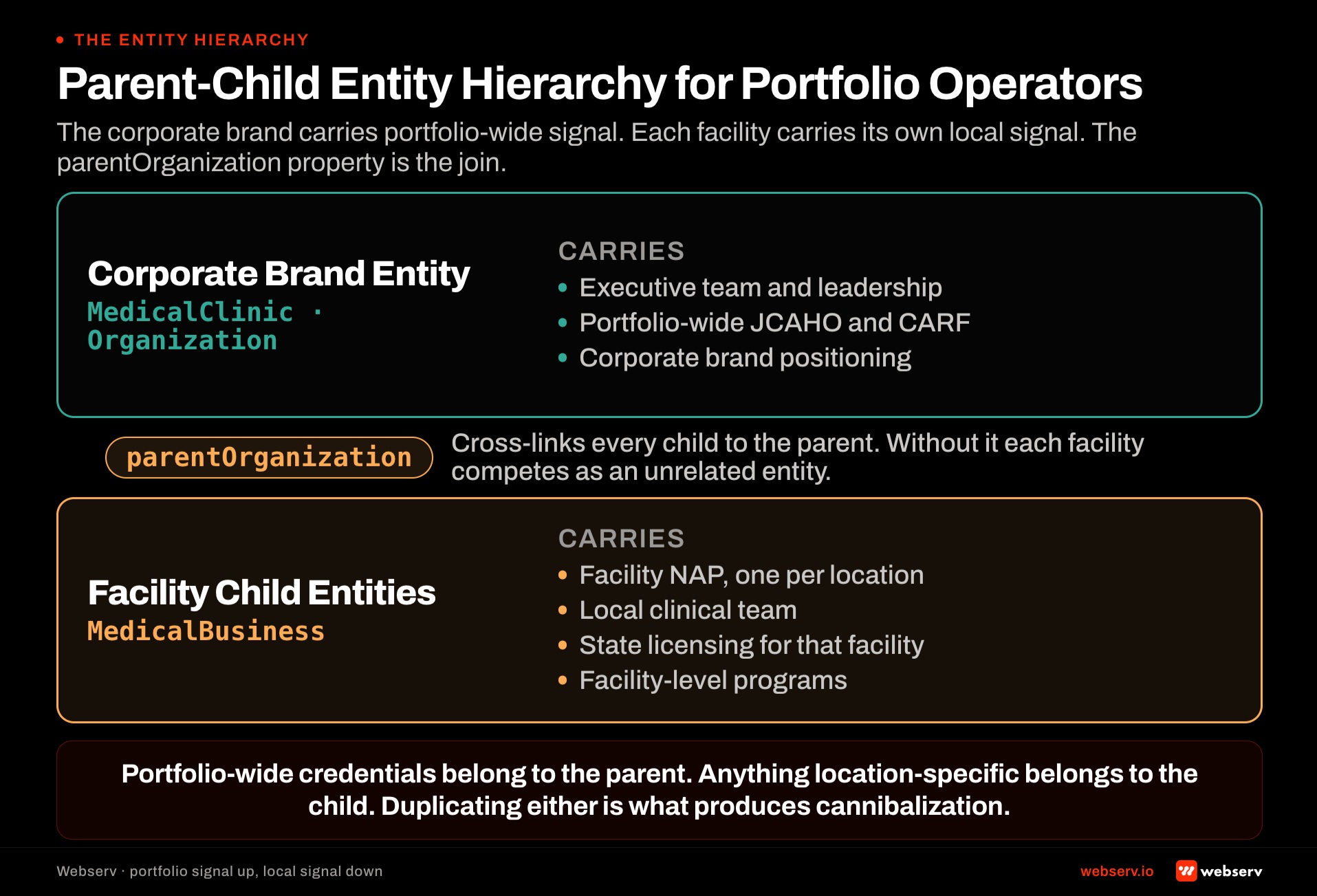
Corporate brand entity. The corporate brand carries the master brand identity, the executive team, the accreditation credentials that apply portfolio-wide (JCAHO, CARF corporate certification), and the specific brand positioning that differentiates the portfolio from competitor portfolios.
The corporate brand page is typically the homepage plus the About and Leadership pages. Corporate schema (Organization or MedicalClinic Organization) sits on the corporate pages.
Facility child entities. Each facility carries its own NAP data, its own local clinical team, its own facility-specific accreditation (state licensing), its own program details, and its own local reviews.
The facility pages are typically the location-specific pages at /locations/{facility-slug}/. Facility schema (MedicalBusiness or MedicalClinic with facility-specific identifiers) sits on the facility pages.
Parent-child cross-linking pattern. Corporate pages link to facility pages through the location index at /locations/ and through inline references in corporate content. Facility pages link to the corporate brand entity through breadcrumbs, header navigation, and inline references to portfolio-wide differentiators.
The pattern that fails: facility pages that duplicate the corporate positioning verbatim (produces near-duplicate content across facilities), or facility pages that carry no corporate entity signal (produces fragmented entity resolution).
The pattern that works: facility pages that reference the corporate brand as their parent entity, carry facility-specific differentiators, and link through the location index for parent-child navigation.
URL architecture for multi-location Local SEO
The URL architecture that supports clean parent-child entity hierarchy: /locations/{facility-slug}/ for facility-level pages, /locations/ for the location index page, and consistent internal linking patterns across every facility.
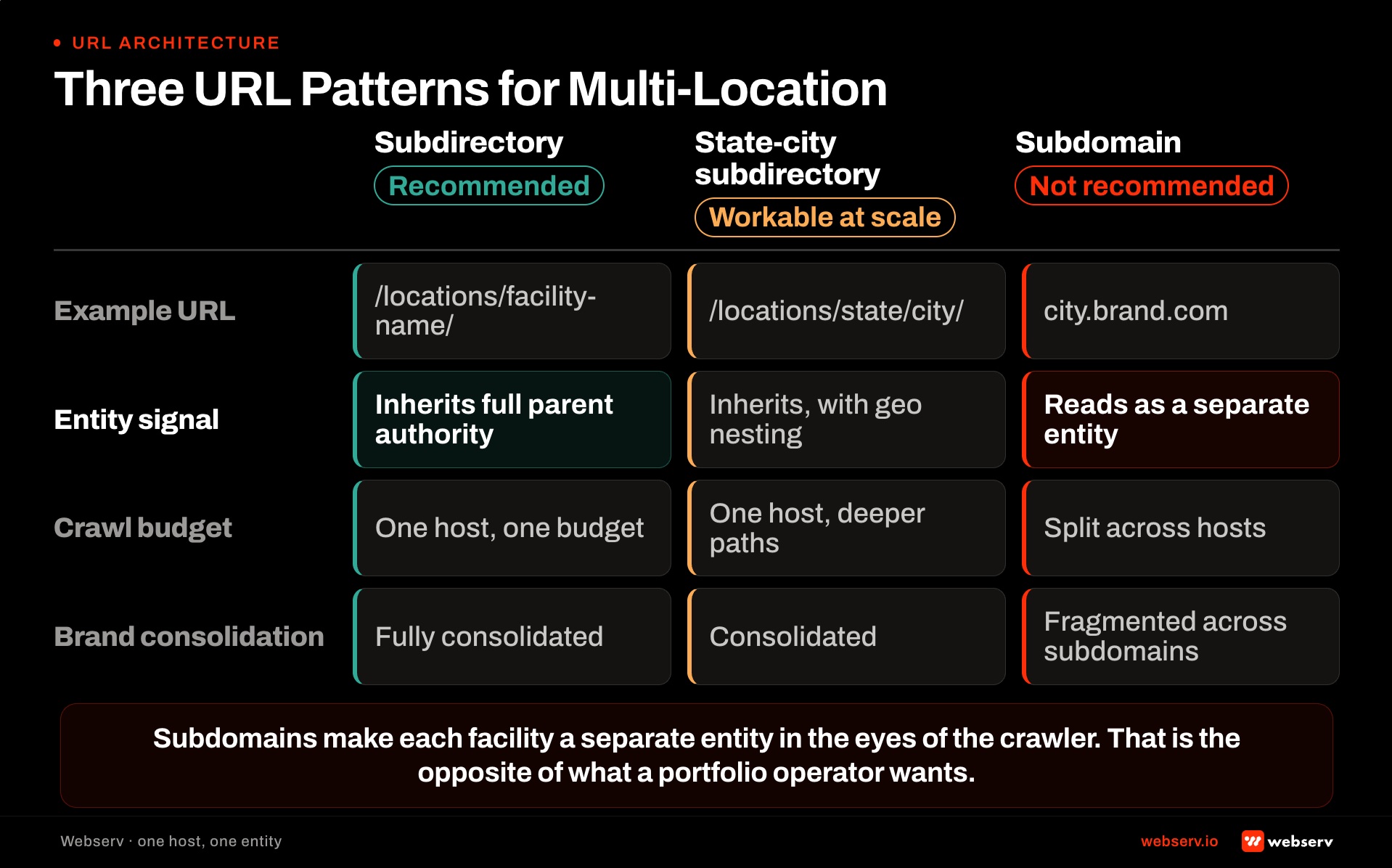
Facility page URL pattern. /locations/scottsdale-arizona/ for a specific facility in Scottsdale. /locations/malibu-california/ for a Malibu facility. Consistent geographic identifier in the slug (city and state, or city only if state is implied by portfolio scope).
Location index URL. /locations/ for the page that lists all facilities with brief facility summaries and links to individual facility pages. Serves as the parent-child navigation anchor for both users and crawlers.
Alternative URL patterns and their tradeoffs. Some portfolio operators use /locations/{state}/{city}/ for two-level geographic hierarchy. This works for portfolios spanning multiple states but produces URL depth that Google’s crawl budget has to accommodate.
Others use subdomain per facility (scottsdale.facility.com) rather than subdirectory pattern. Subdomain approach fragments the entity signal because each subdomain resolves as a distinct entity. Not recommended for portfolio operators optimizing for corporate brand signal.
The pattern that works for most treatment center portfolios: subdirectory /locations/{facility-slug}/ with the geographic identifier in the slug, and consistent internal linking that treats every facility identically in the site architecture.
Schema markup that reinforces entity hierarchy
The schema markup that reinforces multi-location entity hierarchy: MedicalClinic Organization for the corporate brand, MedicalBusiness for each facility, and the parentOrganization property linking each facility to the corporate brand.
Corporate schema (on homepage and corporate pages). MedicalClinic Organization type with corporate name, corporate logo, corporate URL, portfolio-wide accreditation via hasCredential, executive team via employee references, and sameAs identifiers for corporate LinkedIn, Wikidata (if applicable), and other authoritative external sources.
Facility schema (on each facility page). MedicalBusiness type with facility-specific name (typically the corporate brand plus geographic identifier), facility address, facility phone, facility geo coordinates, facility hours, facility-specific accreditation via hasCredential, local clinical team references, and sameAs identifiers for the facility’s Google Business Profile URL and local directory listings.
parentOrganization property. The facility MedicalBusiness schema includes parentOrganization pointing to the corporate MedicalClinic Organization schema entity. This produces the explicit entity relationship that Google’s parser resolves as parent-child hierarchy.
The specific implementation pattern for WordPress with Rank Math: Rank Math handles the base Organization schema on corporate pages. Custom schema for facility MedicalBusiness with parentOrganization property deploys through the webserv_jsonld post meta pattern rather than through inline scripts.
Consolidated @graph on each facility page includes both the corporate Organization and the facility MedicalBusiness in a single JSON-LD block, with explicit @id references between them.
The multi-location Local SEO program at a glance
2
Entity levels: corporate brand parent + facility child, cross-linked
10+
Facility count where Business Profile API integration meaningfully pays off
48-72 hr
Portfolio-wide review response SLA for consistency signal
180-365
Days for portfolio-wide entity signal to fully propagate through index refreshes
Google Business Profile management for multi-location operators
GBP management for multi-location portfolios requires specific patterns that differ from single-facility GBP management.
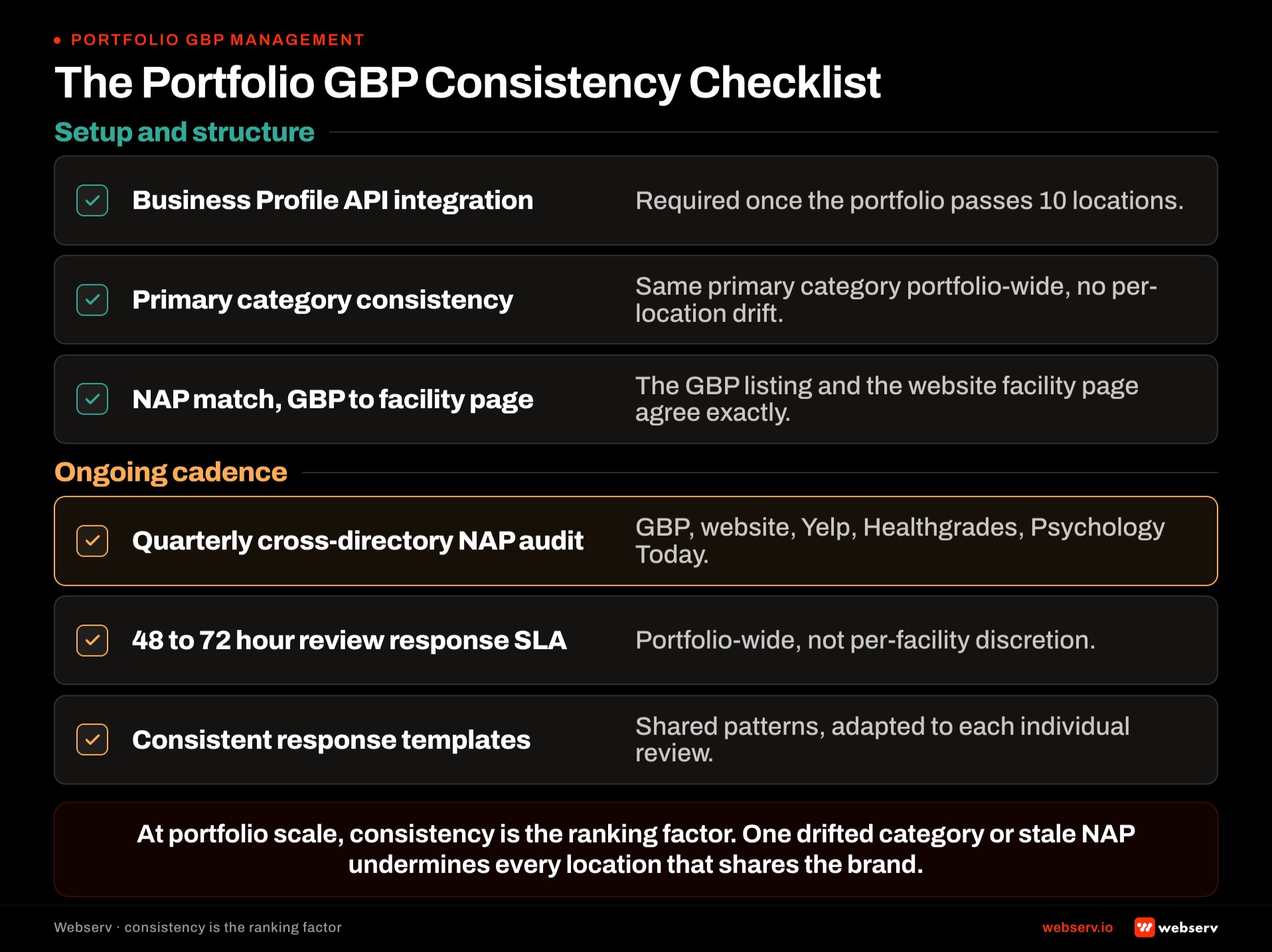
Business Profile API for portfolios above 10 locations. GBP offers the Business Profile API for bulk management of location data. Portfolios with 10+ facilities benefit meaningfully from API integration because manual per-facility updates become impractical at scale.
The specific integrations that work: bulk updates to hours, phone numbers, and descriptions through the API. Bulk review response management through the API. Bulk photo uploads through the API for portfolio-wide brand consistency.
Category consistency across facilities. Every facility in the portfolio should carry the same primary and secondary GBP categories. Inconsistent categorization across facilities produces search visibility variance that has no business reason.
The specific primary category for BH facilities: “Addiction treatment center” for facilities that primarily treat SUD. “Mental health service” for facilities that primarily treat non-SUD BH conditions. Secondary categories add specificity but the primary category should be consistent portfolio-wide.
NAP consistency between GBP and website. The facility name, address, and phone in Google Business Profile must match the facility name, address, and phone on the corresponding website facility page. Mismatched NAP produces the specific ranking failure that Google flags as inconsistent entity signal.
The specific check: quarterly audit of NAP consistency across GBP, facility pages, local directory listings (Yelp, Healthgrades, Psychology Today), and any citation sources. Mismatches get remediated within 30 days of detection.
Review management portfolio-wide. Review response cadence, tone, and content should be consistent across facilities. Portfolios that respond to reviews at some facilities but not others produce inconsistent quality signal that Google factors into local ranking.
The specific pattern that works: portfolio-wide review response SLA (typically 48 to 72 hours for both positive and negative reviews), consistent response template patterns adapted to specific review content, and quarterly review-tone audit to ensure the response quality remains consistent across facilities.
DO
- Use a single website with facility subdirectories at /locations/{facility-slug}/ , separate websites per facility fragment the entity signal.
- Ship facility MedicalBusiness schema with parentOrganization pointing to the corporate MedicalClinic entity , explicit parent-child resolves cleanly for Google’s parser.
- Integrate Business Profile API for portfolios of 10+ facilities so hours, phone, description, review response, and photo updates run in bulk.
- Audit NAP consistency across GBP, facility pages, and citation sources every quarter; remediate mismatches within 30 days of detection.
- Report at facility-level AND portfolio-level in one unified layer that combines GA4 segments, GBP insights, and facility-specific rank tracking.
DON’T
- Run facility subdomains (scottsdale.brand.com) , subdomain approach fragments entity signal because each subdomain resolves as a distinct entity.
- Duplicate corporate positioning verbatim across facility pages , produces near-duplicate content that Google collapses at index time.
- Consolidate all locations into a single portfolio-level GBP listing , Google suspends non-physical-address listings.
- Use single portfolio-wide program pages that reference all facilities collectively , user and search-engine confusion about which facility offers what at which address.
- Judge portfolio-wide Local SEO at 60 days , the entity signal takes multiple Google index refreshes to fully propagate.
Measurement setup for multi-location attribution
The measurement setup that produces facility-level and portfolio-level attribution simultaneously: property-level GA4 configuration with facility segmentation, GBP insights integration for facility-level local search performance, and rank tracking segmented by facility location.
Property-level GA4 with facility segmentation. Single GA4 property covering all facility pages, with facility-level segmentation through custom dimensions or content grouping. Enables facility-level performance reporting without requiring separate GA4 properties per facility.
GBP insights integration. GBP surfaces facility-level local search performance (impressions, calls, direction requests, website clicks) through the Business Profile API. Integration with reporting produces facility-level local visibility data.
Rank tracking segmented by facility location. Rank tracking for geographic queries segmented by facility location. Facility-specific query tracking produces the local ranking signal for each facility’s service area.
The specific pattern that works: unified reporting layer that combines GA4 facility segments, GBP facility insights, and facility-specific rank tracking into a single portfolio-level view with facility drill-down. This layer plugs directly into the five-layer attribution chain in our attribution guide.
Frequently Asked Questions
Should we use one website for all facilities or separate websites per facility?
Single website with facility-specific subdirectories at /locations/{facility-slug}/. Separate websites per facility fragments the entity signal, dilutes domain authority across multiple domains, and produces the specific ranking failures multi-location operators experience when Google cannot resolve which entity owns the brand.
The exceptions: portfolios with meaningfully different brand identities per facility (typically post-acquisition scenarios where facility brands were established pre-acquisition and carry meaningful brand equity locally). Those portfolios sometimes maintain facility-specific websites during a transition period, but the target state is single-website with facility subdirectories.
Portfolios that operate under a single corporate brand across all facilities should always use single-website architecture with facility subdirectories.
How do we handle facilities that offer different levels of care from each other?
Facility-level program pages under each facility subdirectory. /locations/scottsdale-arizona/residential/ for the residential program at the Scottsdale facility. /locations/malibu-california/php/ for the PHP program at the Malibu facility.
The pattern that fails: single portfolio-wide program pages (like /programs/residential/) that reference all facilities collectively. This produces confusion for both users and search engines about which facility offers which program at which specific address.
The pattern that works: facility-level program pages that describe the specific program at the specific facility with facility-specific clinical team references, facility-specific admission workflow, and facility-specific service area coverage.
How do we prevent facility pages from cannibalizing each other for geographic queries?
Distinct geographic targeting per facility. Facility A targets its specific city and metro area. Facility B targets its specific city and metro area. Overlapping geographic coverage between facilities is a specific business decision that requires SEO handling.
For facilities with genuinely overlapping service areas (two Phoenix-area facilities serving the same metro), the SEO handling: distinct positioning per facility (one facility positioned as residential-only, another as outpatient-only), distinct facility-specific content (specific clinical team, specific programs, specific facility characteristics), and internal linking that helps Google understand which facility owns which specific offer.
Facilities in genuinely non-overlapping geographic areas (Phoenix and Denver) rarely produce cannibalization because the geographic terms are non-overlapping. The cannibalization risk sits primarily in same-metro portfolios.
How does portfolio-level Local SEO interact with paid media programs?
Local SEO produces the organic ranking baseline that supports paid media geographic targeting. Paid media programs deliver targeted traffic to facility pages. Local SEO determines whether the facility pages have enough entity signal for paid conversion to make sense.
The specific interaction pattern: paid campaigns geo-target the facility service area, land traffic on the specific facility page (or a landing page mapped to the facility), and the facility page’s Local SEO signal determines whether the paid traffic converts against organic-visible facility trust.
Facilities with strong Local SEO signal typically produce better paid conversion because the paid traffic reinforces the organic entity signal. Facilities with weak Local SEO signal typically produce paid conversion below the portfolio average because the facility entity is not sufficiently established.
How long does multi-location Local SEO take to produce ranking results?
Between 90 and 180 days for the entity hierarchy work to produce visible ranking improvements. Between 180 and 365 days for full portfolio-wide impact as Google’s index refreshes across all facility pages and the entity signals propagate.
Portfolio operators that expect faster results typically produce misleading conclusions about early performance because the Local SEO signal takes multiple index refreshes to fully propagate. The right measurement window: 180 to 365 days of continuous Local SEO work before evaluating portfolio-level ranking impact.
Individual facility ranking can move faster (30 to 90 days) for facilities with existing entity signal that gets tuned. New facility ranking typically takes the full 180 to 365 day window because the entity is being established from scratch.
Do we need separate GBP listings per facility or a single portfolio-level GBP?
Separate GBP per facility. Google Business Profile is inherently facility-level because it maps to a specific physical address. Portfolios with 10+ facilities benefit from Business Profile API integration for bulk management, but each facility maintains its own GBP listing.
Corporate brand GBP does not exist as a separate entity in the way corporate websites do. The corporate brand entity lives on the website, in Wikidata (for portfolios with sufficient notability), and in the aggregate signal across all facility GBP listings that share the corporate brand name.
Facilities that try to run a single portfolio-level GBP typically produce the specific GBP suspension issues that Google flags for non-physical-address listings. The right pattern: separate GBP per facility, managed at scale through the Business Profile API.
How does multi-location Local SEO integrate with our overall SEO strategy?
As a specific specialty inside the broader SEO capability. General SEO covers on-page optimization, content strategy, technical SEO, and link building. Local SEO covers the specific patterns that produce local search visibility for multi-location operators.
The specific integration pattern: general SEO strategy establishes the corporate brand entity signal, content strategy, and technical foundation. Local SEO builds the facility-level entity signal on top of the corporate foundation. Both layers required for multi-location portfolios to produce competitive ranking.
Facilities that treat Local SEO as separate from general SEO typically produce fragmented signal at the corporate-to-facility handoff. Facilities that integrate both layers under a single SEO strategy typically produce meaningfully better portfolio ranking than facilities that separate the two.
Trevor Gage is the Director of Marketing at Webserv, a digital marketing agency for treatment centers.