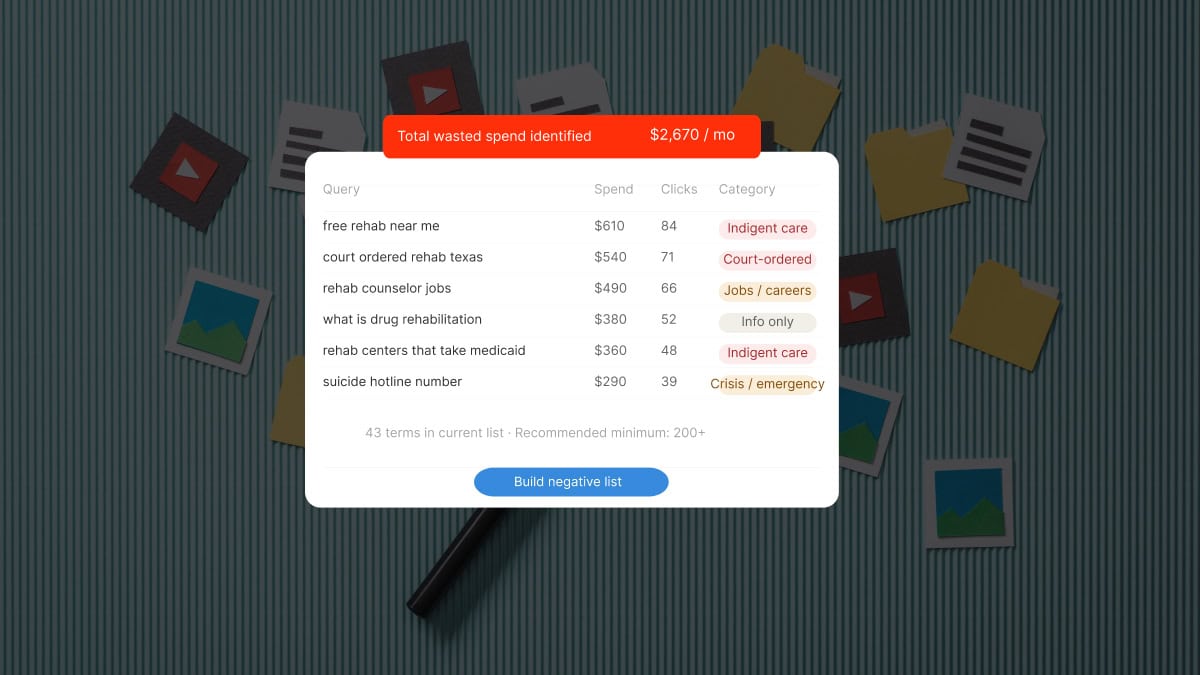
A treatment center we audited last quarter was burning $4,200 a month on clicks from queries like “free rehab near me,” “rehab centers that take Medicaid,” and “court ordered rehab Texas.”
None of those searchers were a fit for the program. The center could not admit on those policies. The clicks converted to phone calls that admissions had to politely turn away.
The center had no negative keyword list. The waste had been compounding for 14 months.
Negative keyword discipline sits on top of the foundational compliance layer. Without LegitScript certification, none of this matters, because the ads never serve in the first place.
Negative keywords are the unglamorous side of PPC management. They get treated as an afterthought by most agencies and as a nuisance by most account managers. In behavioral health, they are the single largest lever for paid search efficiency that operators consistently leave unpulled.
This guide assumes the account is already running, which means the program has cleared the LegitScript certification process that Google Ads, Microsoft Ads, and Meta require for any treatment center advertiser. If certification is not yet in place, that work is the prerequisite and most of what follows here is academic until it is done.
We rebuilt the account’s negative keyword list over a quarter. The list went from 43 terms to 217. Wasted spend dropped 35% in the first month. Roughly 10% of total budget redirected from low-intent traffic to qualified searchers.
A negative keyword list is the difference between paid search that converts admits and paid search that subsidizes Google’s ad inventory.
Mitch Marowitz, Director of Paid Admissions, Webserv
This guide explains why negative keywords matter more in behavioral health than in most verticals, walks through the eight categories of negatives every treatment center should be running, provides a starter seed list, and outlines the ongoing review cadence that keeps the list working.
Key Takeaways
- No negative keyword list means your ad budget is funding calls admissions has to turn away.
- Behavioral health has waste categories most verticals never deal with: free care seekers, court-ordered patients, crisis callers, and job seekers all click your ads.
- A deliberate negative keyword list typically cuts wasted spend by 25 to 40 percent in the first quarter.
- If your paid search partner cannot pull the negative keyword list in five minutes, it is not part of their operating cadence.
Why negative keywords matter more in behavioral health
The keyword “rehab” is one of the most ambiguous terms in advertising. It maps to addiction treatment, physical therapy, vocational rehabilitation, animal rehabilitation, building renovation, and political campaign recovery. Each meaning attracts a different searcher with different intent.
Treatment center campaigns running broad-match or phrase-match keywords against that ambiguous root pick up traffic from all of those meanings. Most of it is non-converting. All of it is costing money.
The same pattern applies to “treatment,” “recovery,” “addiction,” and most of the high-intent root terms a treatment center wants to bid on. Each root carries multiple unrelated meanings, and each unrelated meaning produces clicks that admissions cannot convert.
Behavioral health programs also face vertical-specific waste categories that do not exist in non-regulated industries.
Searches for free or government-funded care from patients the program cannot accept. Searches from court-ordered patients with specific funding requirements. Searches from competitor staff doing market research. Searches from mental health crisis users who need different services.
A negative keyword list is the operational defense against all of those traffic types. The list shapes what queries the campaigns actually serve on, and the shape of that serving determines what fraction of the ad spend reaches qualified prospects.
The eight categories of negatives every treatment center should run
The starter negative keyword list for a behavioral health PPC account organizes around eight categories. Each one targets a different waste pattern.
Category 1: Indigent care and government-funded queries.
Searches for free, low-cost, sliding-scale, or government-funded treatment. The program either does not accept those policies or has a limited number of beds reserved for them. Either way, broad paid search is not the right channel.
Category 2: Mental health crisis terms that imply different services.
Crisis hotline searches, suicide-prevention searches, and emergency mental health searches. These are critical needs but rarely match an admissions-ready prospect for residential or PHP care.
Category 3: Court-ordered and legal-system queries.
Searches for court-ordered rehab, DUI-related treatment, drug court, probation requirements. These patients often have specific funding sources or program requirements that the center may not match.
Category 4: Job seekers and careers traffic.
Searches for jobs at rehab centers, salary information, internships, and career changes into the field. This traffic produces zero conversions and consumes ad budget at full CPC.
Category 5: Information-only queries.
Searches for definitions, statistics, news articles, research papers, and educational content. These users are not in a decision-making moment and rarely convert from a paid search ad.
Category 6: Competitor names and direct comparisons.
This category is more nuanced. Some operators bid on competitor names deliberately. Others exclude them to focus on commercial intent. The decision depends on the program’s positioning strategy. Either way, the negatives need to be conscious choices.
Category 7: News, celebrity, and current events.
Searches related to high-profile addiction news, celebrity rehab stories, or current events. These spike unpredictably and produce zero conversions during the spike period.
Category 8: Foreign-language and wrong-region queries.
Searches in languages the program does not service, or searches from regions the program cannot serve due to licensing limitations.
Each category produces a list of specific negative keywords. The combined list typically runs 200 to 400 terms for a serious treatment center account.
A starter seed list
The seed list below covers the most common waste patterns. Use it as a starting point. Add to it based on the program’s specific service offerings, geographic markets, and search query patterns.
| Indigent and government-funded. | Free, free rehab, low cost, no cost, sliding scale, government, state funded, Medicaid only, Medicare only, public assistance, charity, indigent, homeless, shelter, county program, free detox, free treatment |
| Crisis and emergency. | Suicide hotline, crisis line, emergency, ER, 911, hotline, helpline, immediate help, crisis text, suicide prevention, immediate counseling, walk in clinic |
| Court-ordered and legal. | Court ordered, court mandated, drug court, DUI, probation, parole, judge ordered, jail diversion, criminal justice, custody, mandated treatment, sentenced |
| Jobs and careers. | Jobs, careers, hiring, employment, salary, internship, training program, certification, course, degree, school, university, education program, become a counselor |
| Information-only. | What is, definition of, statistics, research, study, news, article, paper, dissertation, history of, types of, facts about, signs of, symptoms (alone, without local modifier) |
| News and celebrity. | Celebrity name terms (update quarterly), Demi Lovato, news article, story, latest news, breaking, scandal, death, obituary |
| Foreign-language. | Español, gratis, spanish only, french, language-specific terms based on geographic market |
| Wrong region. | Specific cities and states the program does not serve, especially border regions to in-service markets that get accidental traffic |
| Treatment-vertical-specific (apply with judgment). | Animal rehab, dog rehab, physical therapy, sports rehab, building rehab, real estate rehab, political rehab, image rehab, knee rehab, shoulder rehab, post-surgery rehab |
This list is a starting point. Run it through search query reports for 60 days and refine. New negatives surface every quarter as search patterns shift.
How to assemble the full list for a specific program
Building the program-specific list takes a few hours of focused work and produces returns for years.
Sort by spend. The top 50 highest-spend queries that did not convert are the priority candidates for evaluation.
Some queries will not fit cleanly. Those go into a “review” bucket for individual judgment.
Match types depend on the campaign structure. Phrase match negatives are usually the right starting point because they catch variations without blocking exact-match positive keywords.
New negative candidates surface as the campaigns serve on more diverse query patterns. Add them as they appear.
The negative list will continue growing for 6 to 12 months before stabilizing. Once stable, monthly review is sufficient to maintain the list.
The first quarter of running with a deliberate negative keyword list typically produces a 25% to 40% reduction in wasted spend. The savings compound. Ten percent of redirected budget at year-end represents months of high-intent traffic that the campaigns would otherwise have missed.
The match-type decision
Per Google’s negative keyword match type documentation, negative keywords come in three options: broad, phrase, and exact. Each behaves differently and serves a different purpose.
Broad match negative. Blocks any search containing the negative term in any order. Aggressive but can be too broad. A broad match negative on “free” blocks “freedom” and “freeway” along with “free rehab.”
Phrase match negative. Blocks searches that contain the exact phrase in order. More precise than broad match but still flexible. The default match type for most behavioral health negatives.
Exact match negative. Blocks only the exact query. Used for specific high-volume queries that need to be blocked precisely without affecting related variations.
The default pattern for behavioral health is phrase match negatives at the campaign level, with selective broad match negatives for unambiguous waste categories (jobs, careers, free) and selective exact match negatives for high-volume specific queries that surface in the search query report.
Common mistakes that cost programs money
AVOID THIS
Over-aggressive negatives at the wrong match level. Adding “free” as a broad-match negative also blocks “free consultation” and “free assessment” — valid commercial queries for many programs. Applying negatives at ad-group level when they should be account-level lets the same wasted query keep firing on the campaign next door. Fix: run one account-level shared negative list for unambiguous waste (jobs, news, DIY), then layer campaign-level phrase-match negatives for ambiguous terms after checking historical converting queries.
Three patterns surface most often in audits. Watch for these.
| Negative keywords applied at the wrong level. | Negatives applied at the ad group level when they should be at the campaign level, or applied to one campaign when they should be applied across the account. The fix is to consolidate the negative list into a shared negative keyword list applied at the account level for unambiguous waste, with campaign-level negatives layered on top for campaign-specific exclusions. |
| Over-aggressive negatives blocking valid traffic. | A negative on “free” can block “free consultation” or “free assessment,” which are valid commercial queries for some programs. The remediation is to use phrase match instead of broad match for ambiguous terms, and to verify the negative list against the historical converting query data before applying. |
| Stale lists that have not been updated. | Search query patterns shift as Google’s search algorithms update, as new platforms emerge, and as user behavior changes. A negative keyword list from two years ago is missing the queries that have surfaced in the last 24 months. Quarterly updates are the minimum cadence to keep the list current. |
What success looks like at twelve weeks
A treatment center that builds a deliberate negative keyword list should see measurable change inside a quarter.
Week one: pull the 90-day search query report, tag the non-converting queries, apply the seed list above plus the program-specific additions identified in the report.
Weeks two through eight: weekly review of new search query data. Add 5 to 15 new negatives per week as new patterns surface. Watch the wasted-spend metric in the account-level reports.
Weeks nine through twelve: monthly review cadence. The list should be 200 to 400 terms by this point. Wasted spend should be running 25% to 40% lower than the baseline.
The center we worked with started this process with a 43-term list and $4,200 a month in waste. They ended at 217 terms and roughly $2,700 a month in waste. The $1,500 monthly savings redirected to qualified traffic produced an additional 8 to 12 admit calls per month at the same blended cost-per-admit.
What to ask your paid search partner this week
Three questions surface whether a paid search partner is operating with the right negative keyword discipline.
First, ask for the current negative keyword list. If it is fewer than 100 terms for a behavioral health account running meaningful budget, the list is incomplete. If the partner cannot pull it in five minutes, it is not part of the operating cadence.
Second, ask when the list was last updated. If the answer is more than 60 days ago, the list is stale. Search patterns shift faster than that in this vertical.
Third, ask what the wasted-spend percentage looked like in the last 90 days versus the prior 90 days. If the percentage is not trending down, the list is not actively managed.
Negative keywords are the unglamorous discipline that separates a paid search account producing admits from one producing wasted spend. If you want to know exactly where your account stands, book a strategy call and we will run a full ads account audit. The fix is closeable inside a quarter, and if you want to understand what that looks like end to end, see what is included in our paid search service for treatment centers. The savings compound for the lifetime of the account.
Frequently asked questions about negative keywords for addiction treatment
How often should we update our negative keyword list?
Most treatment center accounts benefit from a weekly negative keyword review during the first 90 days of any campaign and a monthly cadence after that. Search terms evolve as the campaign scales, new wasteful patterns emerge with Google’s broad match expansion, and the cost of missed negatives compounds quickly.
The review process is straightforward. Pull the search terms report, sort by spend or impressions, identify queries that do not match treatment readiness or insurance viability, and add them to the appropriate negative list. The first few months produce dozens of additions per week. By month six, the cadence drops to 5 to 10 new negatives per week.
Skipping the review is one of the most common reasons treatment center accounts underperform. We see accounts with 18 months of unmonitored search term data and entire categories of wasted spend (court-ordered queries, free-rehab queries, insurance-mismatched queries) that nobody filtered out. The cleanup usually saves 15 to 30 percent of budget in the first month.
Can we use the same negative keyword list across all campaigns?
Account-level negative keywords work for universal exclusions (free rehab, court-ordered, employment-related, education-related). Campaign-level or ad group level negatives are more appropriate for service-specific exclusions, like keeping detox campaigns from triggering on PHP queries or vice versa.
The best practice is a layered structure. The account-level list catches the obvious universal waste. The campaign-level lists handle level-of-care boundaries. The ad group level lists fine-tune intent matching for specific keyword groups. Each layer adds precision without duplicating work.
The trap is putting everything at the account level. A negative keyword that makes sense for the residential campaign (excluding IOP queries) blocks legitimate traffic when applied account-wide if the program also runs IOP. The layered approach prevents that collision.
What is the risk of being too aggressive with negative keywords?
The main risk is suppressing legitimate query patterns that look like waste at first read but actually convert. Common examples: blocking ‘rehab cost’ queries when low-budget patients sometimes have premium employer plans, blocking ‘family member rehab’ queries when concerned family members are often the actual decision-maker, blocking ‘detox’ modifiers from a residential campaign when many residential admits start with a detox question.
The cleaner approach is to monitor the impact of new negative keywords for 30 days before treating them as permanent. If the negative reduces wasted spend without dropping conversions, keep it. If conversions drop alongside spend, the negative was too aggressive and should be removed or narrowed.
We do not recommend running starter negative lists from generic PPC blogs in a treatment center account without local validation. The lists are usually too broad and block intent patterns that work in behavioral health specifically. Build the list from your own search terms data, not from external templates.
How do we balance broad-match negatives with intent capture?
Negative keyword match types control how aggressively a negative blocks similar queries. Broad-match negatives block any query containing the negative word in any order. Phrase-match negatives block queries containing the negative phrase in order. Exact-match negatives block only the exact query.
Most treatment center accounts get the best results from a mix. Use broad-match negatives sparingly for clearly universal exclusions (free, jobs, careers, court). Use phrase-match negatives for category exclusions (insurance carriers you do not accept, conditions you do not treat). Use exact-match negatives for individual high-cost queries that need to be blocked without affecting related variants.
Defaulting to broad-match for everything tends to over-block legitimate traffic. Defaulting to exact-match for everything leaves too many similar wasteful queries running. The right balance produces a list that is restrictive on universal waste and selective on category-specific exclusions.
Are negative keywords still useful with Performance Max campaigns?
Yes, with reduced control. Performance Max does not expose search term data the way standard search campaigns do, and the negative keyword application is more constrained. Account-level negatives still apply to Performance Max, but the granularity of control is lower than in standard campaigns.
The implication is that treatment centers running both Performance Max and standard search campaigns should not over-rely on Performance Max for primary keyword targeting. Performance Max works best as a supplement to a well-structured standard search account, not as a replacement for it. The negative keyword discipline only applies fully to the standard campaigns.
We typically allocate 70 to 85 percent of treatment center paid search budget to standard campaigns and the rest to Performance Max. That ratio preserves the negative keyword control that drives cost-per-admit efficiency, while still capturing the broad-reach benefits Performance Max offers.
The perspective in this article comes from 9 years working exclusively inside behavioral health.
We are a team built by people in recovery who understand that behind every admission is someone asking for help. If that resonates, get to know us.
Mitch Marowitz is the Director of Paid Admissions at Webserv. Webserv works with behavioral health and addiction treatment centers on paid media, SEO, and full-funnel admissions strategy.