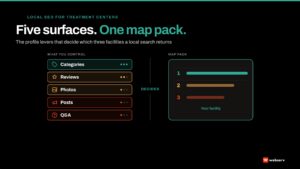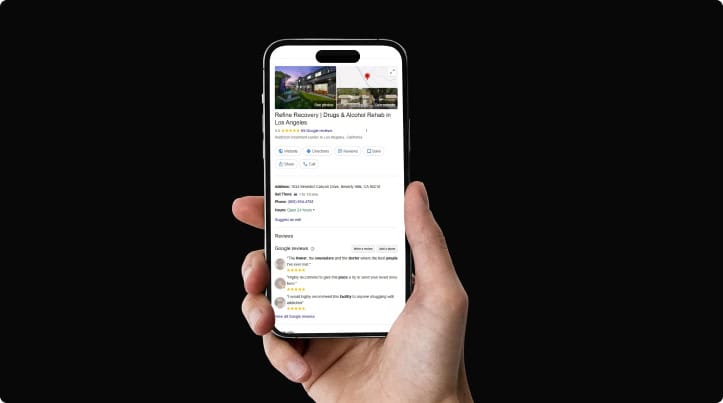
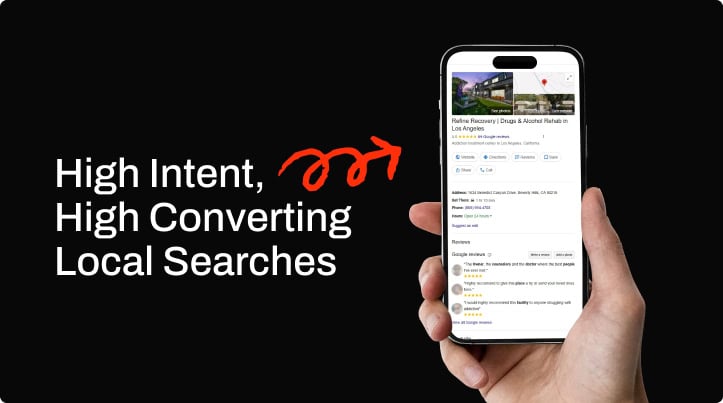
Your Google Business Profile is often the first thing someone sees when they search for treatment. Not your website. Not your paid ads. Your GBP listing in the map pack.
For treatment centers, that matters more than almost any other industry. When someone searches “rehab near me” or “detox available now,” they’re in crisis. They need immediate answers, a phone number they can call right now, and confidence that you’re legitimate.
If your GBP is incomplete, outdated, or poorly optimized, you’re losing high-intent admissions to competitors who simply manage their profiles better.
This guide covers the eight most important GBP optimizations for rehab centers. Not every possible tactic. Just the ones that directly impact whether you show up in local search, whether families trust you, and whether they call.
Quick Overview: The 8 Critical GBP Optimizations for Rehab Centers
| Optimization | What It Does | Why It Matters for Admissions |
| NAP Consistency Across the Web | Ensures your Name, Address, Phone match everywhere online | Inconsistent NAP suppresses map pack rankings and loses calls |
| Correct Primary Category | Determines which searches you’re eligible to appear for | Wrong category = invisible for high-intent searches |
| Unique Phone Number Per Location | Each licensed facility gets its own local number | Reinforces local legitimacy and enables accurate call tracking |
| Service Listings by Level of Care | Lists specific services like detox, IOP, PHP, MAT individually | Matches high-intent searches like “detox near me” or “IOP rehab” |
| Review Strategy (Recency + Engagement) | Drives ongoing reviews and responds to every one | Recent reviews boost rankings and conversion trust |
| GBP Description for Crisis Searchers | Clear, calm language explaining who you help and what you offer | Influences click-through when families compare options quickly |
| High-Trust Photo Strategy | Shows real facility photos, not stock images | Proves legitimacy and increases engagement and calls |
| Regular GBP Posts | Posts about programs, updates, availability, education | Signals active operations and supports rankings |
1. NAP Consistency Across the Entire Web (Non-Negotiable)
What It Means
Your Name, Address, and Phone number must match exactly everywhere they appear online. Not “close enough.” Not “mostly the same.” Exactly the same.
This includes:
- Google Business Profile
- Your website footer and contact pages
- Citation directories like Yelp, Healthgrades, Psychology Today
- Licensing and accreditation listings
- Social media profiles
- Any other online directories
Even small differences cause problems. “Suite 100” versus “Ste 100.” An old phone number on one listing. A slightly different business name. All of these weaken your local authority.
Why It Matters
NAP consistency is a core trust signal for Google’s local algorithm. When Google sees conflicting information about your business across the web, it doesn’t know which version is correct. So it suppresses your rankings.
For treatment centers with multiple locations, inconsistent NAP is even worse. It confuses attribution, making it harder to track which location drove a call. It also dilutes the authority of each individual location.
If your NAP data is wrong or inconsistent, no other GBP optimization will work fully. This is the foundation everything else builds on.
How to Fix It
Audit every place your business information appears online. Use tools like BrightLocal or Semrush to find all your citations. Check your website, Google Business Profile, major directories, and licensing sites.
Create a master document with the exact format you’ll use everywhere:
- Business name (spell it the same way every time)
- Full address with consistent abbreviations
- Primary phone number formatted the same way
Update every listing to match. If you find old citations you can’t edit, try to have them removed or suppressed.
For multi-location centers, create separate NAP data for each facility and maintain it consistently.
2. Correct Primary Category Selection
What It Means
Your primary category is the single most important classification in your Google Business Profile. It tells Google what type of business you are and which searches you should appear for.
For addiction treatment centers, the best primary categories are usually:
- Addiction Treatment Center
- Rehabilitation Center
- Mental Health Clinic (when appropriate for dual diagnosis or behavioral health focus)
You can add secondary categories, but your primary category carries the most ranking weight. Choose carefully.
Why It Matters
The primary category determines search eligibility. If you choose the wrong category, you won’t even be considered for high-intent searches like “rehab near me” or “addiction treatment center.”
Google uses categories to match your listing with search intent. Choose “Rehabilitation Center” instead of “Addiction Treatment Center,” and you might show up for physical therapy searches instead of addiction treatment.
Don’t overthink this or try to stack categories hoping to rank for everything. Focus your primary category on what you actually are.
How to Fix It
Log into your Google Business Profile and review your primary category. If it’s vague, generic, or incorrect, change it to the most specific, accurate option available.
For most treatment centers, “Addiction Treatment Center” is the right choice. If you’re primarily focused on mental health or dual diagnosis, “Mental Health Clinic” might work better.
Add secondary categories that reflect additional services (e.g., “Detoxification Service,” “Counseling Service”), but keep your primary category focused on your core offering.
If you’re not sure which category Google considers primary, check your GBP settings or test different options and monitor your rankings for key searches.
3. Unique Phone Number Per Licensed Location
What It Means
Every physical, licensed treatment facility you operate needs its own Google Business Profile with its own local phone number.
Don’t use a shared 800 number across multiple locations. Don’t use the same local number for two different facilities. Each location gets its own unique, local phone number with an area code that matches the geographic area.
Why It Matters
Unique phone numbers reinforce local legitimacy. Google uses phone numbers as a trust signal to verify that each location is real, distinct, and serving a specific area.
Shared numbers across locations confuse Google and weaken geographic relevance. It also makes call attribution impossible. If three facilities share the same number, you can’t track which location drove the call.
For treatment centers, accurate call tracking by location is critical for understanding which markets perform best and where to invest marketing budget.
How to Fix It
If you’re using shared phone numbers across locations, get dedicated local numbers for each facility. Use area codes that match the city or region where each facility is located.
Update your GBP for each location with the unique number. Then update your website, citations, and any other places that list phone numbers.
Use call tracking software that integrates with your CRM so you can see which location drove each call and how those calls convert to admissions.
4. Service Listings by Level of Care (Not Just “Rehab”)
What It Means
Google Business Profile allows you to list specific services your business offers. Most treatment centers either skip this entirely or list generic services like “Addiction Treatment” or “Rehab.”
That’s a missed opportunity. You should list every level of care and service you provide individually:
- Medical Detox
- Residential Treatment
- Partial Hospitalization Program (PHP)
- Intensive Outpatient Program (IOP)
- Medication-Assisted Treatment (MAT)
- Dual Diagnosis Treatment
- Sober Living
- Aftercare Services
Why It Matters
Services directly influence keyword matching. When someone searches “detox near me” or “IOP rehab that accepts insurance,” Google looks at your service listings to determine if you’re a relevant match.
If you only list “Addiction Treatment,” you’re not signaling to Google that you offer detox, IOP, or other specific services that people are actively searching for.
These are high-intent searches. Someone searching for a specific level of care is ready to verify benefits and admit. Don’t miss these opportunities.
How to Fix It
Log into your Google Business Profile and navigate to the services section. List every level of care and treatment service you offer as a separate service.
Be specific. Don’t just list “Outpatient Treatment.” List “Intensive Outpatient Program (IOP)” and “Partial Hospitalization Program (PHP)” separately.
If you accept specific insurance plans or offer specialized programs (e.g., executive rehab, LGBTQ+ treatment), consider adding those as services or in your business description.
Update your services whenever you add or change programming. Keep this section current.
5. Review Strategy Focused on Recency and Engagement
What It Means
Reviews matter, but it’s not just about volume. What matters more is:
- Review recency (recent reviews carry more weight)
- Review velocity (consistent new reviews over time)
- Response rate and speed (responding to every review quickly)
A profile with 50 reviews but none in the past six months will rank lower than a profile with 30 reviews and five new ones this month.
Why It Matters
Reviews impact both rankings and conversion trust. Google uses review signals to determine which businesses are active, legitimate, and trusted. Families use reviews to decide whether to call you.
For addiction treatment, reviews are especially sensitive. Families are trusting you with someone’s life. They read reviews carefully. If your most recent review is a year old or you have negative reviews with no response, trust drops immediately.
How to Do It Right
Build a system for encouraging reviews ethically. After discharge, follow up with families who had positive experiences and ask if they’d be willing to share feedback on Google. Never incentivize reviews or violate patient privacy.
Respond to every review within 24 hours—positive and negative. Thank people for positive feedback. Address concerns in negative reviews professionally without getting defensive and without including any protected health information (PHI).
Keep responses brief, empathetic, and focused on showing you care about feedback. Don’t argue. Don’t make excuses. Don’t violate HIPAA by acknowledging someone was a patient unless they mentioned it first.
Monitor your reviews daily. Set up alerts so you know immediately when a new review is posted.
6. GBP Description Written for Crisis Searchers
What It Means
Your Google Business Profile description is limited to 750 characters, but most treatment centers waste it on marketing language or vague generalities.
Instead, write your description for someone in crisis who needs immediate clarity:
- Who you help (specific populations or conditions)
- What levels of care you offer
- Where you’re located (mention city/region naturally)
- What makes you accessible (insurance accepted, immediate admission, etc.)
Use calm, reassuring language. Avoid hype or sales copy.
Why It Matters
When someone searches for treatment, they’re comparing multiple options quickly. Your description influences whether they click your listing or call.
Families need to know immediately if you can help them. “Comprehensive addiction treatment services” doesn’t tell them anything. “Medical detox, residential treatment, and IOP for adults struggling with alcohol and opioid addiction in Orange County, accepting most major insurance plans” does.
How to Write It
Start with who you serve: “We provide addiction treatment for adults struggling with alcohol, opioids, and co-occurring mental health conditions.”
List your levels of care: “Services include medical detox, residential treatment, PHP, and IOP.”
Include location naturally: “Located in [city], serving families throughout [region].”
Address accessibility: “We accept most major insurance plans and offer immediate admission when beds are available.”
End with a clear next step: “Call [number] 24/7 to speak with our admissions team.”
Keep it factual, calm, and focused on reducing anxiety for the person reading.
7. High-Trust Photo Strategy (Not Stock Images)
What It Means
Photos in your Google Business Profile should prove legitimacy, not create aesthetic appeal. They should show real images of your facility, staff, and environment.
High-impact photo types:
- Exterior building photos (shows you’re a real place)
- Interior common areas (living spaces, group rooms, dining areas)
- Outdoor spaces (if you have them)
- Staff photos (when appropriate and with permission)
- Amenities relevant to treatment (gym, meditation space, etc.)
Never use stock photos. Google can detect them, and families can spot them instantly.
Why It Matters
Photo volume and freshness correlate strongly with higher engagement and call volume. When families are comparing treatment centers in search results, photos help them visualize where their loved one will be.
Fresh photos also signal that your profile is actively managed and current. Outdated photos suggest the facility might not be operating or might not match what’s shown online.
For treatment centers, photos build trust. Families want to see a real facility with real people, not a generic recovery stock photo.
How to Do It Right
Take professional-quality photos of your facility, but make sure they’re real. Hire a photographer if needed, but photograph your actual facility, not a staged set.
Upload at least 10-15 high-quality photos covering different areas: exterior, common spaces, bedrooms, amenities, outdoor areas.
Update photos every few months. Add new images whenever you renovate, update a space, or add new amenities.
Avoid photos with identifiable patients unless you have explicit written permission and it’s compliant with HIPAA.
8. Regular GBP Posts That Reflect Real Operations
What It Means
Google Business Profile allows you to post updates, similar to social media. Most treatment centers either never post or post sporadically.
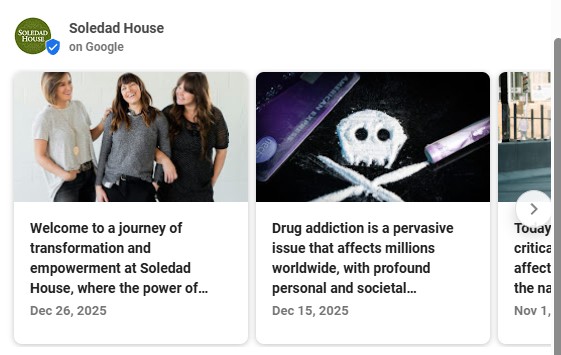
Regular posting signals that your business is active and legitimate. It also gives you additional visibility in search results and on your GBP listing.
Effective post topics for treatment centers:
- Program updates or new services
- Availability updates (beds available, immediate admission)
- Educational content about treatment or recovery
- Staff highlights or new team members
- Community involvement or events
Why It Matters
Active profiles rank better. Google prioritizes businesses that consistently update their information and demonstrate ongoing operations.
Posts also improve engagement. When families are researching treatment options, recent posts show that your facility is operating now, not abandoned or outdated.
For treatment centers, posts can address real-time needs: “Beds available for immediate admission this week” or “Now accepting [insurance plan] for all levels of care.”
How to Do It Right
Post at least once per week. More often is fine, but consistency matters more than frequency.
Keep posts short, clear, and relevant. Include a photo when possible. Add a call-to-action like “Call today” with your phone number.
Use posts strategically to address high-intent search moments: availability, new insurance acceptance, program expansions, or seasonal capacity.
Avoid promotional language. Focus on providing useful information that helps families make decisions.
What the Best Treatment Centers Do Differently
The centers that dominate local search don’t just set up their Google Business Profile and forget it. They treat GBP as an active admissions tool that requires ongoing management.
They respond to reviews within hours. They post updates weekly. They audit NAP consistency quarterly. They monitor GBP Insights to see which search terms trigger their listing and how visibility trends over time.
They understand that local search drives high-intent calls—people in crisis who need help immediately. So they optimize every element of their GBP to reduce friction, build trust, and make it easy to call right now.
They also connect GBP performance to admissions outcomes. They track calls from GBP separately from other sources. They know which locations perform best in local search and invest accordingly.
Scale your Facility with your GBP
GBP optimizations for rehab centers isn’t glamorous. It’s operational work that requires attention and consistency. But for treatment centers, it’s one of the highest-ROI marketing activities you can do.
Most of your competitors have incomplete profiles. They don’t respond to reviews. They use generic descriptions. They ignore service listings. That’s your opportunity.
Start with NAP consistency. If your business information is inconsistent across the web, fix that first. Then move through the other optimizations: correct category, unique phone numbers, detailed services, active review management, crisis-focused descriptions, real photos, and regular posts.
None of these optimizations require a massive budget. They require attention, consistency, and a commitment to managing your profile like the admissions tool it is.
If you’re ready to dominate local search and turn your Google Business Profile into a reliable source of high-intent calls, Webserv works exclusively with treatment centers to build and manage GBP strategies that drive admissions.