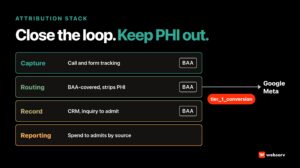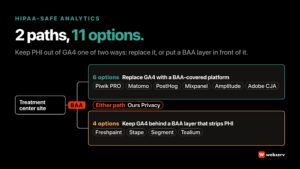
At a glance: This is a Webserv-authored ranking of the drug rehab marketing agencies and behavioral health marketing agencies operators should consider in 2026. Webserv is on this list and at #1. We disclose our methodology below so you can re-rank by the criteria that matter to you. Every agency is scored against the same six factors: behavioral health depth, admissions attribution, clinical and legal review workflow, HIPAA-safe tracking, multi-location capability, and AI search readiness.
Key Takeaways
- Webserv is the only DR-39+ listicle in the top 8 for “rehab marketing agency.” Every other top-8 result is an agency service page selling its own services. Google split the intent. The honest version of this list helps both research and hire intent at once.
- The ranking rewards outcomes an operator can verify. Six weighted factors: behavioral health depth (25%), admissions attribution (20%), clinical and legal review (15%), HIPAA-safe tracking (15%), multi-location capability (15%), and AI search readiness (10%).
- The field cut from 27 agencies to 15. Too many entries dilutes the depth signal both for search engines and for the operators actually reading the list.
- No agency wins every sub-vertical. Single-location boutiques have different needs than PE-backed multi-state networks. The comparison table maps strengths so the right fit surfaces fast.
- Pay-per-lead aggregators excluded by design. They sell distribution arbitrage, not marketing. Real cost per qualified admit on aggregator leads runs $6,000–$11,000 because the same lead is sold to 3–5 competitors.
- AI search readiness is becoming a real differentiator. Answer engine optimization and citation-ready clinical content separate the agencies that survive the next twenty-four months from the ones that don’t.
- The hot take at the bottom. If your rehab marketing agency doesn’t have at least one team member who has worked inside a treatment center, they will break something expensive.
A note before the list
If you run a treatment center, marketing is a different sport than what most agencies are trained for.
The regulatory layer is unforgiving. Insurance credentialing takes longer than the sales cycle. Patient search behavior happens at crisis moments, not on a quarterly content calendar.
The agencies that work for treatment centers are the ones who can speak fluently about ASAM levels, payer mix, BAA scope, and the difference between a click and a verified admit before the contract is signed.
These are the agencies that clear that bar. Some show up on every “best of” roundup; others are smaller shops that rarely make those lists because they don’t buy placement. We’re one of them.
A disclosure up front: we built this list, we score against criteria we built our agency around, and we put Webserv at the top. If you re-rank by years in business or headcount alone, the order shifts. The methodology section tells you how.
A multi-state outpatient brand we worked with last year ran a marketing-agency audit before signing a $180K annual retainer. They evaluated five named agencies.
Three couldn’t provide a Business Associate Agreement. Two didn’t know what ASAM levels were. One thought CARF was a credit card processor.
The audit took 90 minutes. It saved them the retainer mistake.
We cut the field from twenty-seven agencies to fifteen. The agencies that didn’t make the cut weren’t necessarily bad. They just didn’t have the disclosed BH track record or the admissions-attribution depth to belong on a list operators should actually use to evaluate partners.
(One aside on what’s not here: pure pay-per-lead aggregators, lead-broker networks, and any agency that lists “addiction treatment” alongside “personal injury law” and “HVAC” on their vertical menu. Those engagements end the same way every time, and the cleanup costs more than the original retainer.)
A second admission: most behavioral health “AI search” positioning is theater right now. AEO and GEO matter, and a few agencies on this list are doing real work, but the underlying clinical content authority and link profile have to exist first. We get to that in the conclusion.
The order is deliberate. Check the scoring first, then decide whether it fits how your program actually runs.
How we ranked these agencies
We scored every agency on six factors, weighted by what has predicted admit growth in the marketing programs we audit, not by what reads well in a pitch deck.
| Factor | Weight | What we looked for |
|---|---|---|
| Behavioral health depth | 25% | How long the agency has worked only in BH, how much of its revenue comes from BH, and which clients it can name with permission |
| Admissions attribution | 20% | Whether the agency reports verified admits and VOBs, or stops at leads and sessions |
| Clinical & legal review | 15% | Documented SME review pipeline, claims substantiation, state-level compliance awareness |
| HIPAA-safe tracking | 15% | BAA scope, server-side architecture, PHI minimization, breach posture |
| Multi-location capability | 15% | A repeatable location-page framework, GBP management at scale, and a way to prioritize markets |
| AI search readiness | 10% | AEO and GEO methodology that goes beyond schema-only retrofits |
A weighting note. AI search readiness is rated at 10%, not higher, because the AI Overview share of behavioral health queries is still uneven, and the agencies overstating their GEO capabilities outnumber the ones doing real citation work. For an honest look at which agencies are doing real citation work, see our Top 20 AEO Agencies ranking.
Re-weight if your portfolio leans heavier on informational queries where AI Overview interception is already costing clicks.
At a glance: the 15 agencies
| Rank | Agency | Sub-vertical strength | Headquarters |
|---|---|---|---|
| 1 | Webserv | Multi-location behavioral health, admissions-attributable growth | Irvine, CA |
| 2 | Cardinal Digital Marketing | PE-backed and multi-location BH networks, business-intelligence-first measurement | Atlanta, GA |
| 3 | MGMT Digital | BH-only boutique, LegitScript consulting, eating disorder and nonprofit work | Los Angeles + Miami |
| 4 | Healthcare Success | Multi-location hospital systems with BH service lines, omnichannel media | Irvine, CA |
| 5 | Dreamscape Marketing (Unlock Health) | Large BH systems that need governance across several brands | Columbia, MD |
| 6 | Active Marketing | Patient, content-led programs backed by twenty years of BH writing | U.S. |
| 7 | Stodzy Internet Marketing | Single sites that need the basics done well and published steadily | South Florida |
| 8 | Lead to Recovery | Cost-per-admission optimization, direct-response cross-channel | Pompano Beach, FL |
| 9 | Behavioral Health Partners | New programs that also need licensing and growth consulting | Denver, CO |
| 10 | Faebl Studios | Substance-use-only growth accelerator, billing-aware engagements | Los Angeles, CA |
| 11 | Digital Admits | Full-funnel admissions engineering, call-center integration | Orange County, CA |
| 12 | The Digital Intellect | HIPAA-certified infrastructure, AEO/GEO-forward methodology | West Palm Beach, FL |
| 13 | WebFX | Large BH groups that want big-agency reporting | Harrisburg, PA |
| 14 | BuzzFactory | Mission-driven programs that want a team with lived recovery experience | Palm Springs, CA |
| 15 | Luxe Marketing Group | Networks that need one brand to hold together across many locations | U.S. |
What is drug rehab marketing?
Drug rehab marketing is the practice of promoting addiction treatment services to prospective patients, their families, referring clinicians, and payers, subject to the specific regulatory constraints that apply to substance use disorder care. It covers everything a treatment center does to fill census: local SEO for city-specific search queries, paid search for high-intent commercial keywords, paid social to family and prospect audiences, content marketing for the pre-decision research phase, referral partnerships with therapists and physicians, reputation and review management, and the outbound work that keeps case management teams and drug court coordinators aware of the facility.
“Rehab” and “addiction treatment” describe the same work, but operators search both ways. For centers that position as the latter, our companion ranking of addiction treatment marketing agencies applies this same methodology to that terminology.
It differs from general healthcare marketing in three consequential ways. First, HIPAA and 42 CFR Part 2 both apply, and Part 2 is stricter than HIPAA on anything that identifies a person as being in or having been in SUD treatment. That constrains ad platform tracking, custom audience uploads, retargeting, and post-discharge outreach in ways that most agencies outside the category do not understand. Second, the Eliminating Kickbacks in Recovery Act (EKRA) prohibits pay-per-admit lead-purchasing arrangements and has been enforced with real prosecutions. That kills a whole category of paid-referral models that work in other healthcare verticals. Third, the trust threshold for the decision is higher than almost any other consumer purchase, which means content and creative that would perform for a dental practice or a med spa fall flat for a treatment center.
The measurement standard that separates efficient drug rehab marketing programs from wasteful ones is cost per admit, not cost per lead. A $50 aggregator lead that never picks up the phone is expensive at any price. A $2,000 organic search lead that produces a residential admit at $30,000 in collected revenue is a bargain. The programs that consistently outperform the category are the ones that instrument attribution to admits and route marketing budget accordingly, not the ones that optimize for surface-level channel efficiency.
The 15 agencies ranked below are the ones we’ve seen do this work at a level that produces real admissions outcomes for treatment center operators, evaluated across six factors: behavioral health depth, admissions attribution capability, clinical and legal review workflow, HIPAA-safe tracking architecture, multi-location operational capability, and AI search readiness. For a broader operator-side view of the demand for these services, see our rehab lead generation playbook.
How much does drug rehab marketing cost in 2026?
Drug rehab marketing spend typically falls in the 6-12% of revenue range, a higher share than most healthcare categories carry, especially for programs in growth phases. The higher percentage reflects the shorter patient lifetime value in most SUD levels of care, the elevated cost per admit on paid channels, and the compliance overhead that keeps generic marketing tools out of reach.
The channel-level cost pattern is consistent across the operators we work with. Organic search produces blended cost per admit in the $400-$900 range on a mature program, though the 4-9 month payback window prices out operators who need census filled this quarter. Google branded paid search runs $500-$1,400 per admit, Google non-brand commercial paid search runs $1,800-$6,000, and Meta paid social runs $1,500-$4,500 when the compliance architecture is in place. Purchased aggregator leads look cheap at $150-$400 per lead but produce effective cost per admit of $2,500-$8,000 because conversion rates run 3-8% versus 8-15% for organic. Referral partnerships are the outlier: no direct dollar cost but heavy relationship investment, and they produce the highest lead-to-admit rates (25-45%) because the referral source has pre-qualified the caller.
Agency retainer economics in 2026 span an order of magnitude depending on scope and firm. Solo operators and small boutique agencies charge $2,500-$8,000/month for single-facility clients. Mid-tier specialist agencies with behavioral health depth (Webserv sits in this tier for single-facility engagements) charge $8,000-$20,000/month depending on the mix of SEO, paid, content, and analytics work. Multi-location engagements at facility networks with 3-10 sites typically run $20,000-$60,000/month. Enterprise engagements at national treatment center brands run $60,000-$200,000/month when the scope includes national paid media, content authority, and technical platform work.
The pricing question worth asking every prospective agency: what percentage of the retainer is retained as agency margin versus deployed as media spend, and how does that ratio change as spend scales. Retainers where 70%+ is agency margin are structural money losers for operators, regardless of the agency’s category depth. Retainers where the ratio flips as media spend grows are the ones that align long-term.
In-house vs agency vs offshore: the drug rehab marketing model decision
The right marketing operating model for a treatment center depends on scale, growth stage, and internal capability. There is no default answer, and operators who default to “we should build in-house” or “we should outsource everything” without running the math usually pick wrong.
In-house marketing works best for national multi-facility operators with the scale to justify $500K+ in annual marketing salary and infrastructure, and for organizations where marketing is core enough to strategic differentiation that outsourcing feels like a governance risk. The advantages are internal knowledge accumulation, tighter admissions integration, and long-term cost efficiency at scale. The disadvantages are recruiting difficulty in the behavioral health category, replacement cost when key hires leave, and the tendency of small in-house teams to over-generalize because there is no depth to specialize behind.
Agency partnership works best for single-facility operators and small regional networks (2-5 locations) that need immediate access to behavioral health category depth, compliance-hardened operational infrastructure, and cross-client benchmarks without the fixed cost of building it internally. The advantages are access to specialists (SEO, paid, creative, compliance) at fractional cost, faster iteration on tactical execution, and pattern recognition across similar operators. The disadvantages are agency-margin overhead on the media dollar and the risk of picking an agency that doesn’t have real behavioral health depth, which is the entire reason to hire one in this category. Our ranking of behavioral health SEO companies covers the SEO specialists.
Offshore or generalist marketing outsourcing almost never works in drug rehab marketing. Behavioral health compliance carries seven-figure legal risk when done poorly, EKRA prohibits pay-per-admit arrangements that offshore vendors typically default to, and the trust threshold for treatment center prospects punishes generic content produced without category expertise. Operators who have tried offshore report the same three failure patterns: HIPAA-exposed tracking configurations, lead quality collapse from generic ad creative, and reputation damage from tone-deaf copy that clinical stakeholders had to unwind.
The hybrid model that outperforms both extremes: an internal marketing lead or director who owns strategy, admissions integration, and vendor management, paired with a category-specialist agency that owns tactical execution across SEO, paid media, content, and compliance. That structure keeps the operator in control of the strategic decisions that matter most while accessing the deep-category expertise that is genuinely hard to replicate in-house. See our lead generation playbook for how the operational integration between in-house and agency should be structured.
The 15 agencies
1. Webserv
Best for: Multi-location rehabs and BH networks that judge marketing on verified admits and payor mix
Headquarters: Irvine, California
Years BH-exclusive: ~10
Notable clients: SoCal Sunrise, Grata House, Profound Treatment, Resilience Recovery, The Last Resort, Silver Lining, Tennessee MH
In 2025, Webserv attributed 2,000+ verified admissions across the client portfolio. The model is built around one number: admits, not sessions.
Reporting connects paid and organic spend to approved VOBs and to the admissions each client’s CRM reports back.
Why we rank ourselves here: Webserv works only in behavioral health and adjacent regulated categories. Our writers are used to YMYL constraints, every analytics setup ships with BAA-ready server-side tracking, and clinical content never goes live without a named subject-matter reviewer.
The capability set covers behavioral health SEO, authority content, digital PR, paid media, conversion-rate optimization, admissions ops, and answer engine optimization under one team. The full AEO methodology we run on client work is documented in our guide to getting cited in Google AI Overviews and ChatGPT. No outsourcing of clinical review.
Where we’d lose this scoring exercise: Put more weight on team size or broad healthcare experience and Cardinal or Healthcare Success comes out ahead. Make years in business the deciding factor and Active Marketing or Stodzy wins.
“If your rehab marketing agency doesn’t have at least one team member who has worked inside a treatment center, they will eventually break something expensive. There’s no substitute for operating experience in this vertical.”
Preston Powell, CEO, Webserv
What clients get: Marketing reports built around admits, payor mix, lifetime value, and channel attribution; a clinical-review process that keeps content clear of YMYL problems and state regulator scrutiny; multi-location frameworks that scale without degrading at volume; and AEO work aimed at the AI answers that now sit in front of top-of-funnel rehab searches. We apply the same six-factor scoring in our ranking of the top AEO agencies for behavioral health.
If what you need to know is whether paid and organic spend turn into verified admissions in your CRM, book an intro meeting. If the goal is a traffic chart for the board, any agency below can produce one.
2. Cardinal Digital Marketing
Best for: PE-backed BH groups and multi-location operators with an in-house CMO and demanding measurement needs
Headquarters: Atlanta, Georgia
Notable clients: LifeStance Health (500+ locations), multi-location ABA brand (per published case study)
Cardinal recently joined Power Digital as the dedicated healthcare division. The RevRx business intelligence layer applies media mix modeling across paid search, programmatic, Meta, and TikTok.
Reported case studies include an 82% lift in new traffic for the 500+ location BH network and a 41% lift in qualified leads for a multi-location ABA provider.
What we found: Spend planning tied to provider capacity, so budgets flex with availability. An AI-optimized search layer (internally called AISO) on top of conventional SEO. A HIPAA-compliant martech stack included as standard scope.
Skip if your retainer can’t support six-figure annual spend, or you don’t have an internal marketing leader to absorb the BI surface area.
3. MGMT Digital
Best for: Behavioral health nonprofits, boutique programs, eating disorder and ABA providers
Headquarters: Los Angeles and Miami
Founded: 2017
Notable clients: Disclosed selectively under client agreements
MGMT’s service page outranks our listicle on adjacent BH terms. Their URL has 22 referring domains and a 25 URL Rating, and that link equity tells you what the agency invests in.
What we found: Clients get the whole team, not one account manager in the middle, and LegitScript consulting comes built into the engagement. The agency reports 80 to 100% growth in organic keyword footprint within three to six months on new accounts.
Skip if you’re rolling out across more than four facilities; the boutique model trades scale for depth.
4. Healthcare Success
Best for: Hospital systems with BH service lines, multi-location health networks, organizations with broad media budgets
Headquarters: Irvine, California
Founded: 2006
Notable clients: 1,000+ healthcare clients served (composite, per agency disclosure)
A 40+ person team that integrates traditional media (TV, radio, programmatic display) with digital. Multicultural marketing and B2B physician-referral outreach are core service lines, and HIPAA-protected call tracking is standard.
What we found: Integrated media philosophy rather than digital-only. Brand, paid, and SEO under one roof. Multicultural marketing capability that few competitors match.
Skip if you’re hiring purely for organic. The integrated model is most efficient when you’re spending across three or more channels.
5. Dreamscape Marketing (Unlock Health)
Best for: Enterprise behavioral health systems, multi-brand networks, large psychiatric organizations
Headquarters: Columbia, Maryland
Founded: ~18 years ago
Notable clients: Promises Behavioral Health, San Antonio Recovery Center, Brightview (per published research)
Dreamscape was acquired into Unlock Health and continues to support enterprise BH systems with workflow governance, dashboards, and multi-brand SEO architecture. Their addiction treatment service page sits at #1 on several head terms.
What we found: Editorial teams focused on behavioral health with real workflow governance, dashboards that hold up under audit, and architecture built for multi-brand, multi-location organizations with dozens of facilities.
Skip if you’re a single-location operator. The infrastructure is built for scale that single facilities don’t need.
6. Active Marketing
Best for: Centers willing to invest for the long term in content, digital PR, and editorial link building
Headquarters: U.S.
Founded: 2004
Notable clients: Disclosed under NDA
Among the agencies here, Active has the longest track record in addiction treatment specifically, with more than twenty years of editorial work across several algorithm cycles. Its strategy is research-led and content-heavy rather than built around paid media.
What we found: Earned-media placement for treatment centers, conversion rate optimization run alongside content, and B2B healthcare and health-tech clients as a second line of business.
Skip if you need paid campaigns that produce admits within weeks; this approach pays off slowly.
7. Stodzy Internet Marketing
Best for: Boutique and single-location rehabs early in their growth
Headquarters: South Florida
Notable clients: Disclosed under client agreement
A long-running rehab-specific agency whose core work is steady content and service-page expansion across substance, modality, and symptom searches.
What we found: Local search work tuned to competitive regional markets, turnkey site improvements, and a publishing cadence that holds up over long retainers.
Skip if you run more than two facilities or need enterprise attribution.
8. Lead to Recovery
Best for: Programs focused on cost-per-admission optimization across both digital and traditional channels
Headquarters: Pompano Beach, Florida
Notable clients: Disclosed selectively
A direct-response shop that buys well past digital: cable and network TV, streaming, satellite radio, podcasts, and print, with ongoing CPA optimization on the digital side.
What we found: Reporting tied to admissions rather than clicks, cost worked down over the life of each campaign, and cross-channel buying most digital-only agencies don’t offer.
Skip if your team can’t yet read direct-response results next to digital data, or absorb the call volume that follows.
9. Behavioral Health Partners
Best for: New or fast-growing programs that want launch marketing and licensing or regulatory help from one partner
Headquarters: Denver, Colorado
Notable clients: Disclosed under engagement agreement
BHP is part marketing agency, part treatment consulting firm. Alongside SEO, PPC, and web design, it handles feasibility studies, business plans, state licensing, and Joint Commission and CARF prep, and its team includes a licensed psychologist who has helped open more than 80 centers.
What we found: One partner reportedly grew from 3 active patients to 30 within five months. The agency also cites CRM setup and Google Ads management with documented 25.6% conversion rates (per agency disclosure).
Skip if you already run multiple established locations; the consulting layer pays off most for new programs and fast-growing single sites.
10. Faebl Studios

Best for: Detox, residential, PHP/IOP, and sober living programs in their early or growth stage
Headquarters: Los Angeles, California
Notable clients: Portfolio is selective and undisclosed publicly
Faebl is the one agency here that positions itself purely as a “growth accelerator” for substance use treatment, working from a curated portfolio of clients who share performance learnings. It reports 10,000+ admissions and $300M in billing value at a 7x average ROI across that portfolio (per agency disclosure).
What we found: One engagement that covers SEO, PPC, content, web, admissions consulting, and billing optimization, with a substance-use-only focus that goes deeper than broad BH coverage.
Skip if you run only mental health or eating disorder programs; adjacent verticals get less attention than substance use.
11. Digital Admits
Best for: Programs that want marketing, the call center, and admissions handled by one vendor
Headquarters: Orange County, California
Notable clients: Lighthouse Treatment (case study reports 2,723 admits and 3,345% lead growth since inception)
An admissions-first agency citing roughly two decades in digital marketing and more than 10,000 claimed admission placements. Its scope reaches into call center consulting, lead attribution, and VOB strategy, on month-to-month terms.
What we found: Paid search built around insurance payors and VOB conversion, SEO aimed at AI, voice, and ChatGPT visibility, and call-center systems, scripting, and staffing inside the same engagement.
Skip if you want to keep your admissions team in-house and outside the agency’s view.
12. The Digital Intellect

Best for: Programs that want a HIPAA-certified partner with an AI-search-first approach
Headquarters: West Palm Beach, Florida
Notable clients: Residential programs in Missouri and New Jersey (per published case studies)
TDI is a HIPAA-certified, Inc. 5000-recognized Google Partner. Its stack pairs technical SEO with Answer Engine and Generative Engine Optimization, running featured snippets, voice search, structured data, and conversational intent as named workstreams.
What we found: Multi-location local pack work alongside national SEO, and a genuine AEO/GEO method rather than the schema-only retrofits common in the category.
Skip if you can’t produce content. AEO and GEO depend on authoritative clinical content, and TDI’s approach assumes you already have that engine.
13. WebFX
Best for: Large BH organizations that need big-agency reporting and AI-driven campaign optimization
Headquarters: Harrisburg, Pennsylvania
Notable clients: $10B+ in client revenue driven over five years (composite, per agency disclosure)
WebFX is one of the largest performance marketing agencies in the U.S., and its proprietary RevenueCloudFX platform ties marketing analytics to CRM and revenue data. Healthcare is one vertical among many.
What we found: Enterprise scale and technology, AI-driven optimization across multi-channel campaigns, and measurement breadth few competitors can match.
Skip if you need clinical context specific to addiction treatment; the breadth is real, but the BH specialization is thinner than the niche agencies here.
14. BuzzFactory

Best for: Mission-driven programs that want a partner who knows recovery from the inside
Headquarters: Palm Springs, California
Notable clients: Disclosed under client agreement
Everyone on the BuzzFactory team is in recovery, and that shapes the agency’s tone, brand messaging, and read on how patients and families judge a program. It has fifteen years of BH-only work and offers month-to-month contracts.
What we found: Full-service digital plus podcast production and alumni relations strategy, StoryBrand messaging applied to behavioral health, and one client that reportedly went from one admit a month to more than five.
Skip if you run a clinical-academic program that wants an arm’s-length agency; BuzzFactory works embedded.
15. Luxe Marketing Group
Best for: Multi-facility networks that need a consistent brand and strong performance at each location
Headquarters: U.S.
Notable clients: 150+ facilities served, 300+ websites built (composite, per agency disclosure)
Luxe is a boutique behavioral healthcare agency with more than 25 years of combined industry experience, offering custom WordPress builds, branding, and PPC with LegitScript support. Multi-location strategy is its strongest area.
What we found: Location-hub architecture that scales, unified tracking, and market-specific content plans, with documented drops in cost per VOB and stronger map-pack rankings on multi-location accounts.
Skip if you need a single-location boutique engagement; Luxe’s value grows with facility count.
What competitors miss
HOW WE READ THIS LIST
Most “best rehab marketing agency” rankings rank by loudest brand or paid placement. They don't publish scoring criteria, don't say which sub-vertical the agency is actually strongest in, and pad the list to 25+ entries so every paid slot looks organic. We score every agency here against the same six factors (behavioral health depth, admit attribution, clinical and legal review workflow, HIPAA-safe tracking, multi-location capability, and AI search readiness) and disclose the methodology so you can re-rank by the criteria that matter to your operation.
From Webserv’s vantage point auditing competing “best rehab marketing agency” rankings, the pattern is consistent: most lists rank by who has the loudest brand or who pays for placement. They don’t disclose how they scored, they don’t say which sub-vertical the agency is actually strongest in, and they include 25+ entries because every paid-placement slot has to look organic.
The criteria that matter to a treatment center operator are harder to score from the outside: verified admit attribution, BAA scope and PHI minimization, the clinical review pipeline, and whether the agency has ever sat in a state regulator audit conversation on a client’s behalf.
Most roundups skip these because they mean asking agencies hard questions and checking the answers. Our methodology has gaps too, as every methodology does, which is why we publish it so operators can re-weight it.
What rehab marketing agencies actually do
Effective rehab marketing is full-funnel work that has to align with clinical accuracy, compliance, and patient intent. Webserv’s operator framework breaks the work into five workstreams that matter most.
Organic search and SEO. Treatment center SEO is still the most durable lead generation channel. Organic admits compound where paid ones reset every month, and the 2026 wrinkle is that AI Overviews are intercepting top-of-funnel informational queries.
Paid search and paid social. Paid media connects facilities with high-intent searchers in the moment they’re ready. The cost per click in this category is high because the lifetime value justifies it. On the execution side it splits into two disciplines with different playbooks: Google Ads agencies for treatment centers and paid social agencies for rehab.
Content authority and editorial depth. Authority content for treatment centers needs clinical accuracy, named SME review, and original data points. A 3,000-word evidence-backed guide outperforms ten 700-word posts in this category.
Local SEO and multi-location work. Local SEO is where the highest-intent treatment seekers actually search. Multi-location operators need programmatic frameworks that scale without degrading.
Admissions ops integration. The lead-handling layer is where most centers leak admits. Admissions ops infrastructure is what makes the marketing program actually pay off.
Each agency here handles these workstreams its own way, and that variation is the point: pick the one that matches how your program operates.
How to choose a rehab marketing agency
TOP REJECTION TRIGGER
“We can't share specific admit numbers because of client confidentiality.” Real admit attribution is shareable in anonymized form. Reluctance means it does not exist and the engagement will drift toward lead and session reporting regardless of contract language. Second red flag: “fast content turnaround” without a clinical or legal review step. That produces content that ranks for a quarter and then draws a state regulator letter twelve months in.
Five questions Webserv uses when an operator asks us to vet another agency, in this order.
1. Can the agency document admit attribution?
Ask for a case study that reports results as verified admits, not leads or sessions. An agency that can’t produce one will drift toward vanity metrics no matter what the contract says.
Red flag: “We can’t share specific admit numbers because of client confidentiality.” Real admit attribution is shareable in anonymized form. Reluctance signals it doesn’t exist.
2. How do clinical and legal review actually work?
Ask who signs off, who substantiates claims, and how edits are version-controlled. State compliance rules vary, and an agency that doesn’t track them will eventually publish something that draws a regulator letter.
Red flag: “Fast content turnaround” with no named SME on the workflow.
3. What does the BAA cover, and how is tracking built?
Expect BAAs with every vendor in the tracking and analytics chain, server-side tracking as the default rather than an upsell, and a documented data flow as a deliverable.
Red flag: Reluctance to discuss data security protocols, or a default tracking stack that uses client-side pixels for conversion events on patient-facing pages.
4. How does the agency report?
Ask to see a real client report. Does it open with sessions or verified admits, combine paid and organic in one view, and break results out by payor mix? The report shows what the agency really optimizes for.
Red flag: Traffic, impressions, and rankings on the first three slides. That’s what the agency optimizes for.
5. What is the multi-location capability?
Ask for a programmatic location framework, how geo-clusters get prioritized, and the largest multi-location engagement the agency has run. Marketing at treatment-center scale across many locations is far harder than single-site work.
Red flag: Duplicate location pages with city names swapped, or shared phone numbers across GBPs for different facilities.
The expensive truth most operators learn 12 months in
The cheapest marketing retainer in this category will cost you more than the most expensive one. Webserv has watched this play out repeatedly in operator audits when treatment centers come to us after a budget agency engagement.
Clinical content published without review gets suppressed by Google’s YMYL systems or flagged by a state regulator. A tracking pixel that captures PHI turns into a HIPAA breach. A badly built multi-location setup costs established locations visibility every time a new one launches.
All of these can be fixed, but the bill comes in lost admits and legal-review hours.
HIPAA penalty amounts are adjusted for inflation every year, and the numbers most marketing vendors quote are the 2009 statutory figures. HHS published the current schedule in its January 2026 civil monetary penalty adjustment: the top tier now runs from $73,011 per violation to a $2,190,294 calendar-year cap.
The lowest tier, where the covered entity did not know and could not reasonably have known, still starts at $145 per violation. Behavioral health operators carry a second exposure on top of that: the 2026 HHS penalty adjustment sets separate 42 CFR Part 2 penalties, currently $103 to $51,299 per violation with a $1,538,970 calendar-year cap.
The fine is the smaller problem. The HHS Office for Civil Rights breach portal is public, indefinite, and searchable. A breach stays a referral-relationship problem long after the penalty is paid.
Every agency on this list, ranked or not, is more expensive than the lowest-bid generalist. That gap is the product. Pay for the review workflow and BAA-ready tracking, or pay for the rebuild later.
Pricing for rehab marketing services in 2026
Behavioral health marketing costs more than standard local-business marketing because of the clinical review, BAA-ready systems, legal oversight, and multi-location scaling baked in. The pricing ranges below reflect Webserv’s analysis of behavioral health agency engagements in the current market. The rehab SEO cost guide has the long version on the SEO side specifically.
| Engagement type | Typical investment | What’s included |
|---|---|---|
| Single-location centers | $6,000–$12,000 / month | Full-service marketing including SEO, paid media, content, and reporting |
| Regional multi-location operators | $10,000–$30,000 / month | Above plus geo-cluster prioritization, GBP scaling, multi-location attribution |
| Enterprise BH groups | $30,000+ / month | Everything in the tier above, plus governance across brands, deeper attribution, and a dedicated team |
| Technical migration | $10,000–$50,000 one-time | Merging domains, mapping redirects, moving CMS platforms, and rebuilding site structure |
| Full website rebuild | $30,000–$150,000 one-time | Custom design, a repeatable location-page system, and EHR or CRM integration |
| AEO/GEO build-out | $5,000–$20,000 one-time | Structured data, content templates built to be cited, and an AI Overview review |
The biggest cost drivers: facility count, levels of care offered, clinical review depth, technical debt baseline, market competition, and EHR/CRM integration scope.
Frequently asked questions about choosing a rehab marketing agency
What is the difference between a rehab marketing agency and a healthcare marketing agency?
A rehab marketing agency operates exclusively or primarily in behavioral health and addiction treatment. A healthcare marketing agency operates across the broader healthcare vertical, which can include hospitals, ASCs, dental, dermatology, primary care, and behavioral health as one of many service lines. The difference is depth versus breadth.
For most treatment center operators, depth matters more than breadth. Behavioral health has compliance constraints (LegitScript, EKRA, 42 CFR Part 2, Meta health restrictions), patient acquisition realities (insurance-driven decisions, crisis-state search behavior), and clinical vocabulary (ASAM levels, dual diagnosis, MAT) that do not transfer cleanly from other healthcare verticals.
A generalist healthcare agency can serve a behavioral health client well, but typically requires the operator to teach them what is different about the category. A specialist agency starts from a baseline of fluency. For programs measuring against admissions and census, that fluency tends to produce better results.
How big does our marketing budget need to be to hire an agency?
Most specialist agency engagements start at $5,000 to $15,000 per month for organic work and $10,000 to $40,000 per month for paid media management. Total programs (organic, paid, creative, web) commonly run $25,000 to $100,000+ per month for established programs. For most facilities, the break-even point is around $20,000 monthly in combined agency-managed spend.
Below that level, the agency overhead is large relative to the program, and operators often get better results with a part-time in-house marketer plus targeted contractor support. Above that level, agencies typically produce better economics through specialization and process discipline that in-house teams cannot match.
The harder number to pin down is the right marketing-to-revenue ratio. Most treatment centers spend 6 to 12 percent of revenue on marketing. Newer programs or programs in scaling mode spend toward the high end of that range. Mature programs with strong word-of-mouth spend toward the low end.
Can we hire an agency if we’re not yet running paid ads?
Yes. Many treatment centers start with an agency on the organic side (SEO, content, web design, GBP) and add paid media later. Organic-first engagements are common for facilities that need to build long-term admission flow before they invest in higher-cost-per-admit paid channels.
The right sequencing depends on census stability. If a facility has consistent admission flow and needs more, organic-first makes sense because the cost-per-admit is lower over time. If a facility has census gaps and needs immediate volume, paid-first makes more sense because organic takes months to ramp.
We will tell you upfront whether your situation calls for organic-first, paid-first, or simultaneous. The wrong sequencing wastes 6 months of marketing spend and prolongs the census ramp.
How long does a typical agency engagement last?
Most agency engagements run 12 to 24 months as the baseline working horizon. Year-one builds the foundation (technical SEO, paid campaigns, creative, website conversion). Year-two compounds the work into a defensible competitive position. Most operators that rotate agencies inside 12 months lose the year-one investment and start over.
The friction points that drive early agency turnover are usually about reporting clarity and account team continuity, not work quality. Agencies that report against admission attribution and maintain consistent senior strategist involvement keep clients longer.
At Webserv, our average client tenure is approximately 3.5 years. That is not because we offer the cheapest contracts. It is because the work compounds and operators see the compounding effect in admit volume, cost-per-admit, and payer mix improvements that they would lose by switching.
What happens if we outgrow our current marketing agency?
Operators outgrow agencies when their program scales beyond the agency’s senior capacity, when their channel mix expands beyond the agency’s specialty, or when the strategic conversation shifts from execution to commercial growth strategy. The signs are usually clear: senior strategists become unreachable, reporting stays at the same depth as it was at $30K monthly spend, and strategic discussions repeat without progress.
The transition options are to upsize within the existing agency (if they have the senior capacity), to add a second specialist agency, or to migrate to a different agency that fits the new size. Each path carries trade-offs and 60 to 90 days of friction.
The right time to evaluate is when the gap between what the agency delivers and what the program needs starts compounding. The wrong time is in reaction to a single bad month. Marketing programs have variance, and switching during a normal down quarter usually multiplies the problem.
What does a drug rehab marketing agency actually do?
A drug rehab marketing agency runs the full acquisition system for an addiction treatment center: local SEO for city-specific searches, paid search for high-intent commercial keywords, paid social to prospect and family audiences, content marketing for the pre-decision research phase, referral partnership development with therapists and physicians, reputation management across review sites, and analytics infrastructure that ties every lead back to admits.
The work that separates category-specialist drug rehab marketing agencies from generalist healthcare agencies is compliance-hardened operational infrastructure: HIPAA and 42 CFR Part 2 compliant lead forms, server-side conversion tracking that keeps PHI out of ad platforms, EKRA-compliant contract structures that avoid pay-per-admit arrangements, and clinical review workflows for every published claim.
The measurement standard that matters is cost per admit, not cost per lead. Agencies that report lead volume without reporting attributed admits are measuring the wrong thing. The best drug rehab marketing agencies instrument admit attribution and route budget based on which channels produce efficient volume at the operator’s payer-mix and clinical-fit standards.