Key Takeaways
- Opening a rehab in California requires DHCS licensing, local zoning approval, staff credentialing, and Medi-Cal enrollment (if billing state programs), each with distinct timelines and evidence requirements.
- Choose the level of care before anything else. Outpatient, IOP, residential, and MAT each carry different facility, staffing, and licensing paths.
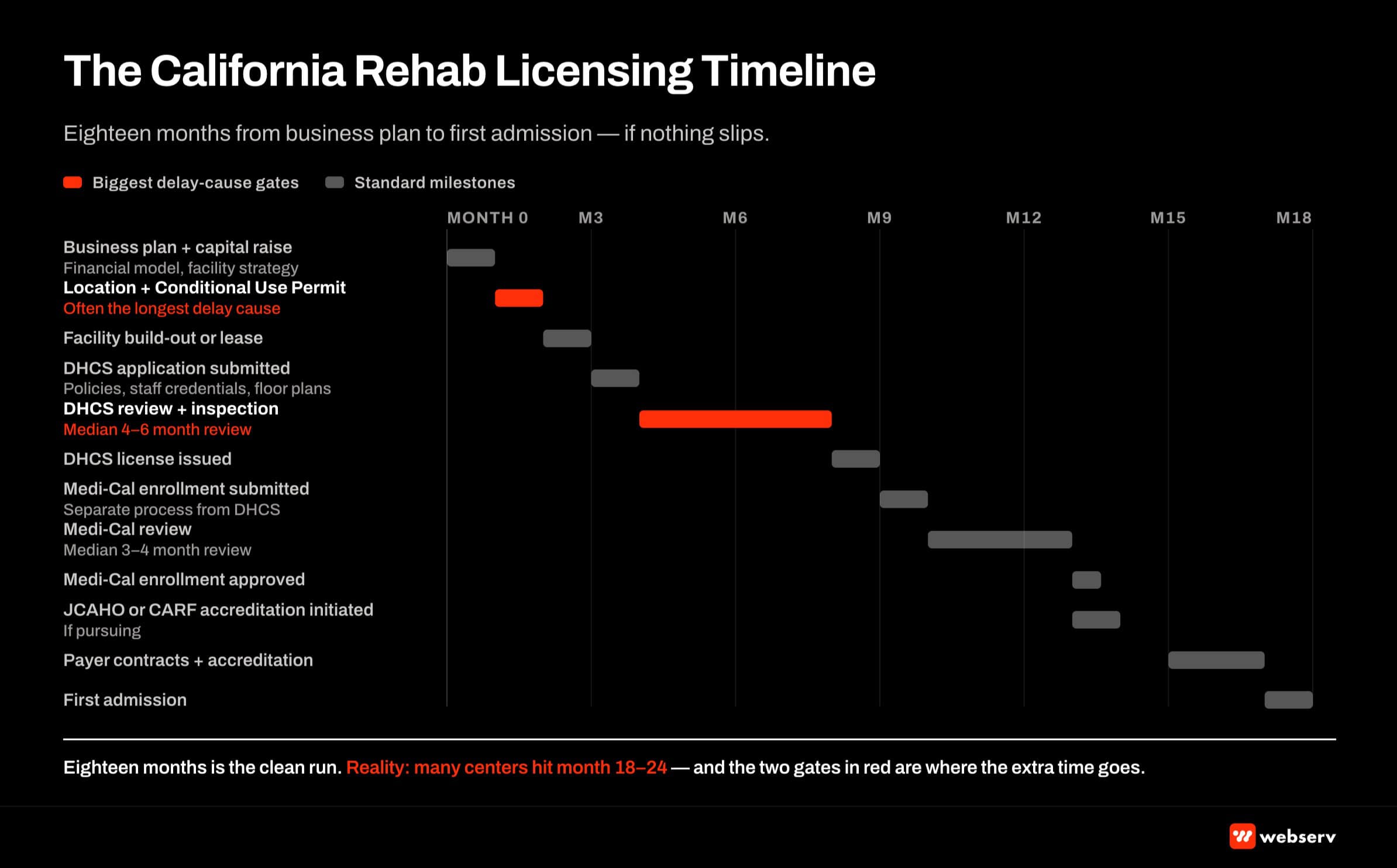
- Local zoning and Conditional Use Permits are often the biggest launch delay. Confirm allowed uses with planning staff in writing before signing a lease.
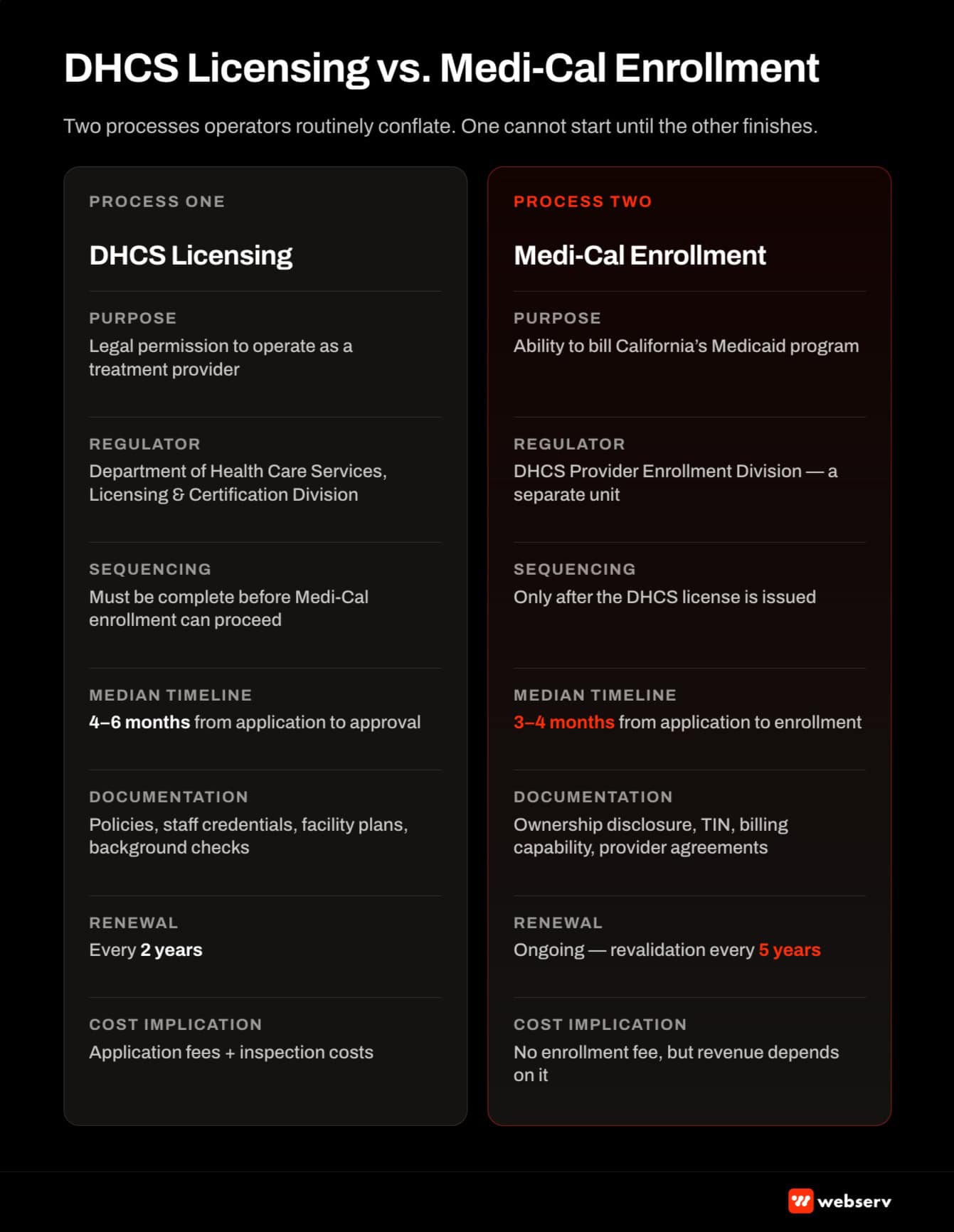
- DHCS licensing is separate from Medi-Cal enrollment. Both are required to bill state programs; sequencing matters for cash flow.
- Accreditation (The Joint Commission, CARF) is optional for licensing but usually required by commercial payers for contracts.
1. Licensing and State Certification (DHCS)
Most addiction treatment and behavioral health programs in California need a license or certification from the Department of Health Care Services (DHCS).
Licensing covers outpatient, intensive outpatient, residential, and narcotic treatment programs. Medi-Cal enrollment, which allows you to bill for services, is a separate process that starts only after DHCS approval.
- Policies and procedures for admission, discharge, and client rights
- Clinical protocols and proof of staff credentials
- Facility floor plans and safety compliance
- Background check results
- Evidence of local zoning and occupancy approvals
Once licensed, programs must maintain written standards for infection control, documentation, and quality assurance. These shape your day-to-day operations.
2. Choosing a Program Type
Your level of care determines your licensing path, staffing model, and facility needs:- Outpatient programs : require clinic licensing and credentialed staff
- Residential programs : must meet fire, building, and residential facility codes
- Medication-Assisted Treatment (MAT) : adds pharmacy and medical oversight rules
3. Local Approvals, Zoning & Permits
Even with DHCS approval, you can’t open your doors until local agencies sign off. Expect to work with your city or county planning, building, and fire departments for:- Business license
- Conditional Use Permit (CUP) if required for group care
- Building permits and inspections
- Certificate of Occupancy
- Fire safety and accessibility clearances
4. Residential Rehab in Single-Family Homes
Running a residential program from a converted home is possible but complex. Some cities allow it with a CUP; others restrict it entirely. Common local concerns include parking, density, and neighborhood impact. Always check both city and county zoning codes before purchasing or renovating property. Your local planning office can confirm whether a home-based facility fits their residential care definition. That answer can make or break your timeline and renovation budget.5. Facility Safety & Compliance Standards
Facilities must meet:- Building, fire, and life-safety codes
- ADA accessibility requirements
- Infection control and sanitation standards
6. Staffing & Credentialing
Your staffing model depends on your level of care and payer mix. Typical core roles include:- Clinical Director (LCSW, LMFT, LPCC, psychologist, or psychiatrist)
- Licensed clinicians and certified counselors
- Nurses (for residential or MAT programs)
- Case managers and support staff
7. Clinical Supervision & Counselor Certification
DHCS expects licensed clinicians to supervise counselors. Common certifications include CCAPP and CADTP , which are recognized by DHCS and most county behavioral health plans. Structured supervision and ongoing CE training keep the program compliant and improve clinical outcomes.8. Accreditation & Payer Contracting
While not legally required, national accreditation (CARF or The Joint Commission) adds credibility and opens doors to payer contracts. Accreditation focuses on clinical pathways, outcome tracking, and client safety, all of which improve your readiness for Medi-Cal and commercial audits. If you’re developing your online presence during accreditation prep, consider how a solid healthcare SEO strategy can strengthen credibility with both patients and payers. Many insurers prefer or require accreditation before contracting.9. Medi-Cal Enrollment & Billing
Medi-Cal reimbursement requires:- DHCS certification and provider enrollment
- Documented medical necessity for each client
- Full ASAM-based assessments and level-of-care placement
- Individualized treatment plans with measurable goals
- Progress notes and discharge summaries
10. Telehealth, Privacy & Remote Services
California allows telehealth for most behavioral health services when:- Providers are licensed in California
- Clients give informed consent
- Sessions use secure, HIPAA-compliant platforms
11. Peer Support & Volunteer Roles
Peer support specialists bring lived experience to recovery programs. Rehab statistics suggest that compassionate, experienced alumni outreach may be key. California’s Peer Support Specialist Certification allows certain peer services to be billable under defined Medi-Cal codes. Volunteers can assist with outreach or groups but cannot deliver reimbursable clinical care.12. Startup & Operating Costs
$50K-$300K
Outpatient startup range in California. Covers lease, EHR, licensing, and initial marketing spend.
$500K-$2M+
Residential startup range. Property acquisition or lease, renovations, staffing runway, and operating reserves.
8-18 months
Typical timeline from property secured to first admit. Zoning and DHCS licensing dominate the critical path.
Ongoing
Payroll, insurance, utilities, accreditation, and compliance systems compound monthly. Conservative revenue forecasts protect cash flow in months 1 to 12.
| Program Type | Typical Range | Key Costs |
| Outpatient | $50K–$300K | Lease, EHR, licensing, marketing |
| Residential | $500K–$2M+ | Property, renovations, staffing, reserves |
13. Timelines & Milestones
Opening a rehab center often takes 8–18 months depending on location and scope. Typical phases:- Secure property and confirm zoning
- Complete renovations and safety inspections
- Hire and credential staff
- Submit DHCS applications
- Enroll with Medi-Cal and payers
14. Insurance & Risk Management
You’ll need:- Workers’ compensation (required by law)
- General and professional liability insurance
- Property and cyber liability coverage
- Directors & Officers (D&O) insurance
15. Renewals, Audits & Inspections
Licenses and certifications must be renewed on DHCS’s schedule, often annually. Expect:- DHCS and payer audits (scheduled or unannounced)
- Fire and building inspections
- Reviews of medical necessity and documentation
16. Common Licensing Pitfalls (and How to Avoid Them)
Frequent issues:- Incomplete applications or missing credentials
- Unverified staff background checks
- Unsafe or noncompliant facilities
- Poor recordkeeping or billing errors
- Lack of supervision or QA programs
17. Marketing & Referral Rules Before You Launch
Your first marketing contract is a compliance document. California’s SB 1228 made it illegal for licensed or certified treatment programs to pay or receive anything of value for patient referrals, so the payment terms in every lead-vendor or call-center contract fall under it. Federal law adds a second layer. Under 18 U.S.C. §220 (EKRA), paying for referrals to a recovery home or clinical treatment facility carries up to $200,000 and 10 years per occurrence, and it reaches commercial payers, not just federal programs. The practical rule: pay marketing partners a flat fee or retainer, never per admit or per lead. Our breakdown of how body brokering works covers the arrangements that get new operators in trouble, and the pre-admission eligibility verification playbook covers the intake side once calls start.Frequently Asked Questions
Do I need a business license to run a rehab center in California?
Yes. Most cities and counties require a business license, zoning clearance, and a certificate of occupancy before opening a rehab in California.
Can I operate a residential rehab from a house?
Sometimes. Rules vary by jurisdiction. Many California cities require a Conditional Use Permit plus fire and building compliance before a residential rehab can open in a single-family structure.
How long does DHCS licensing take?
Typically several months. Residential programs often take longer than outpatient programs due to facility renovations, staffing verification, and physical-plant inspections.
Does Medi-Cal cover residential treatment?
Yes, if services meet medical necessity and documentation standards. Programs must be enrolled Medi-Cal providers and follow county DMC-ODS or Medi-Cal fee-for-service billing rules.
Can peers or volunteers provide billable therapy?
No. Only licensed or certified clinicians can bill for therapy. Peer support specialists can be billable in California only if certified under state peer support rules and supervised appropriately.
Is telehealth allowed for rehab services?
Yes, with client consent and secure, HIPAA-compliant platforms. Follow DHCS and Medi-Cal telehealth billing rules and document consent for each session.
Can I start outpatient first and add residential later?
Yes. Many California providers expand in phases: launching outpatient or IOP first, then adding residential once staffing and payer relationships are established.
What insurance coverage is required to open a rehab in California?
Workers compensation is mandatory. General liability and professional liability are highly recommended and are often required by commercial payers before contracting.
How often does DHCS inspect a licensed rehab?
Usually annually, plus as-needed follow-ups. Unannounced visits may occur after a complaint or an incident report.
What causes DHCS license denials?
Incomplete applications, missing documentation, unsafe facility conditions, or non-compliance with staffing and supervision standards are the most common causes of DHCS license denials.