We did a competitive audit for a prospective client and identified a local competitor dominating their market. First position across the board. Every major local and organic term in the city. We explained why going head-to-head would be a losing fight, then laid out a strategy targeting less obvious long-tail terms with lower difficulty that were a better fit for their specific program.
Not high volume. Dead on for their clinical model.
Later, that client mentioned they knew the owner of the dominant treatment center. Turns out the market leader was frustrated. His site performed well. He ranked for everything but he was getting hounded by calls from people with state-funded insurance he couldn’t accept.
The city had a large lower-income population, and showing up first for the broadest addiction treatment terms meant he was the first call for anyone looking for help. Not the right audience for a dual diagnosis, trauma-informed luxury program.
Ranking first for the most obvious keyword in your market is not always the win it looks like on a dashboard. Keyword strategy in behavioral health is about finding the searches that match your actual program. Not the searches with the highest volume.
In 2026, that calculation got more complicated. AI Overviews now appear in the majority of healthcare searches, changing the ROI equation for informational queries entirely.
Some keywords drive admissions calls. Some build citation authority in AI systems for patients who won’t call until they’ve done six more searches. The criteria for evaluating which is which now include: does this query generate an AI Overview, or does it deliver traditional results where a page-one ranking produces real click volume?
This guide covers both tracks. If you’d rather have this built for your market than do it yourself, see our premium SEO for treatment centers.
Key Takeaways
- AI Overviews now appear in 51% of healthcare searches, double the all-industry average. For informational behavioral health queries, the median zero-click rate is 83%. Clicks are no longer the right metric for informational keyword targeting.
- Geo-modification is the strongest lever for protecting click traffic in 2026. But ranking first for the broadest terms in your market can mean fielding calls you cannot convert if the keyword does not match the program.
- Long-tail keywords represent 91.8% of all searches and convert at 2.5x the rate of short-tail terms. The specificity is a feature, not a limitation.
- Topic clusters drive 30% more organic traffic than standalone keyword-targeted pages. Content organized around clinical clusters compounds authority faster than an ad-hoc publishing calendar.
- Insurance and payer keywords are the most underused, highest-converting category in behavioral health SEO. Low KD, moderate volume, and patients who have already decided they want treatment.
- If the top three results for your target keyword are WebMD and Healthline, you are investing in rankings you cannot realistically achieve. Start where the competitive gap is closable.
DEFINITION
Intent Tier
The behavioral health keyword classification that separates terms by where the searcher sits in the admit funnel. High-intent terms (“detox near me,” “insurance for residential”) signal active admissions inquiry. Mid-intent terms (“how to choose a rehab”) signal evaluation. Low-intent terms (“what is addiction”) signal awareness. The right keyword strategy targets each tier with the right content type.
Why behavioral health keywords don’t work like other industries
Keyword research in behavioral health operates under constraints that don’t apply to most other industries. Understanding them prevents the most common mistake: chasing volume metrics that don’t correlate with admissions outcomes.
Low volume, maximum intent
Most behavioral health keywords have search volumes that would look unimpressive in a conventional evaluation. “Detox center Austin” might pull 200 searches per month. “Residential treatment near me” might pull 300.
In e-commerce or B2B SaaS, those numbers would be below the consideration threshold. In behavioral health, they represent a patient or family member in a genuine decision moment.
The intent concentration in behavioral health keyword volume is unlike almost any other vertical. Volume is not the primary evaluation criterion. Intent alignment and keyword difficulty relative to your domain authority are.
A 200-volume treatment center keyword is not comparable to a 200-volume keyword for a home goods blog. The person behind that search is often in crisis.
Patient language vs clinical language: bridging the gap
Patients and families don’t always use the same terminology clinicians use. They don’t always use the terminology providers use in their marketing either.
A patient researching fentanyl treatment may search “fentanyl addiction help” or “I can’t stop taking fentanyl” before they search “medication-assisted treatment for opioid use disorder.” A family member may search “how to get my son into rehab” before they search “addiction treatment centers for young adults.”
Effective keyword research maps both registers: the clinical terminology used in academic and professional sources, and the plain language used by the actual population you’re trying to reach.
Both belong in your keyword map. Pages that capture plain-language searches build early-stage trust. Pages targeting clinical terms capture patients further along the research journey.
The YMYL evaluation layer
Behavioral health content is evaluated under Google’s YMYL standard. That is the highest quality bar in the evaluation framework. This has a direct keyword implication. Not all keywords are equally rankable regardless of SEO effort.
A treatment center with a DA (domain authority) of 15 publishing a condition page about opioid use disorder will not outrank NIDA, WebMD, Healthline, and Mayo Clinic for that query, no matter how well the page is optimized.
The YMYL standard means Google systematically favors the most credentialed, authoritative sources for high-stakes health queries. The practical consequence: keyword strategy must be filtered through a domain authority reality check.
The highest-volume behavioral health keywords are often not the right starting point. They are dominated by national health publishers and aggregators with DA 70–90+ that a typical treatment center cannot displace.
The right starting keywords are those where your DA is within 10–15 points of the competition. That is where content quality and topical authority can actually tip the balance.
AI Overviews and what they mean
This is the section that didn’t exist in any behavioral health keyword strategy guide written before 2025.
Which means most pre-2025 guidance on keyword strategy is incomplete.
| 51% of healthcare searches now trigger an AI Overview, double the all-industry rate. Source: WebFX analysis of 130,000+ health queries, 2025 |
| 83% median zero-click rate for queries that trigger AI Overviews. Source: Similarweb aggregated data, 2025 |
| ~40% average CTR decline on informational keywords when AI Overviews appear. Source: Ars Technica, 2024 |
What this means in practice: a treatment center that publishes a high-quality educational blog post about opioid withdrawal symptoms may rank on page one for that query and receive far fewer clicks than the same ranking would have generated two years ago.
Google summarizes the answer in an AI Overview at the top of the page. Most users get what they need without clicking through to any site. Per Google’s documentation on AI Overviews, summaries are drawn from indexed content that meets quality and authoritativeness standards, which makes earning a citation a function of how parseable and verifiable the source content is to AI systems.
This does not mean stop publishing educational content. It means the value equation has shifted:
| Informational keywords that trigger AI Overviews | The primary value is brand citation inside the AI Overview. Appearing as a cited source signals authority to AI systems and builds brand recognition among the 17% of users who do click. The secondary value is AEO positioning: a page cited in AI Overviews today is building the entity and topical authority that compounds in AI search systems over time |
| Commercial and navigational keywords (less AI Overview exposure) | These remain high click-through opportunities. “Drug rehab Austin,” “IOP near me,” “does Cigna cover rehab”. Queries with local, transactional, or navigational intent are less likely to trigger AI Overviews. This is where organic rankings still drive direct admissions traffic. |
| Geo-modified keywords (most protected) | Adding a city, county, or state modifier to a keyword is the single most effective way to reduce AI Overview exposure. Google understands that a searcher who adds a location wants to find a specific provider in that area, not a generalized answer. Local results and map packs handle these queries, not AI summaries. |
| Long-tail question queries (8+ words) | These trigger AI Overviews at a much higher rate. “What is the difference between PHP and IOP for alcohol treatment?” is almost certain to generate an AI Overview. The page ranking for it should be optimized for AEO citation, not raw click-through volume. |
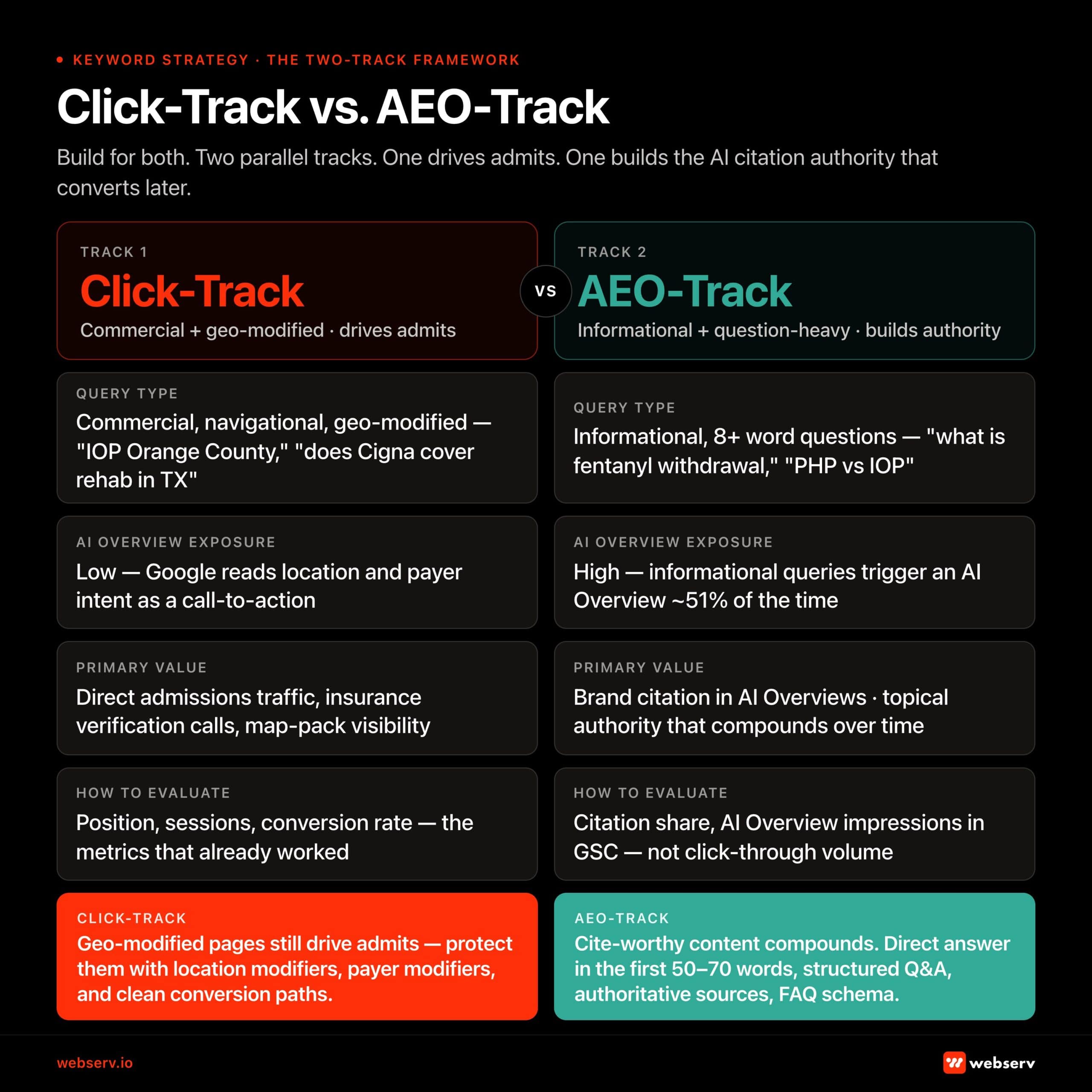
The strategic conclusion: build your keyword strategy with two parallel tracks. Track 1 is commercial and geo-modified keywords that drive click traffic and admissions. Track 2 is informational and AEO-targeted keywords that build citation authority in AI systems.
Don’t evaluate Track 2 keywords by the same click-volume metrics as Track 1. For the full AEO implementation, see the answer engine optimization guide for behavioral health.
The treatment center keyword funnel
Behavioral health keyword strategy organizes around a patient decision journey with three stages. Each stage has different keyword characteristics, different competitive landscapes, and different AI Overview exposure profiles in 2026.
| Stage | Keyword examples / AI Overview exposure | Primary goal in 2026 |
|---|---|---|
| Tier 1: Awareness (Education) | How long does alcohol detox take? | Fentanyl withdrawal symptoms | Signs of opioid addiction. ⚠ HIGH AI Overview exposure. Optimize for citation, not click volume | AEO citation authority; brand visibility in AI systems; topical trust-building for patients in early research |
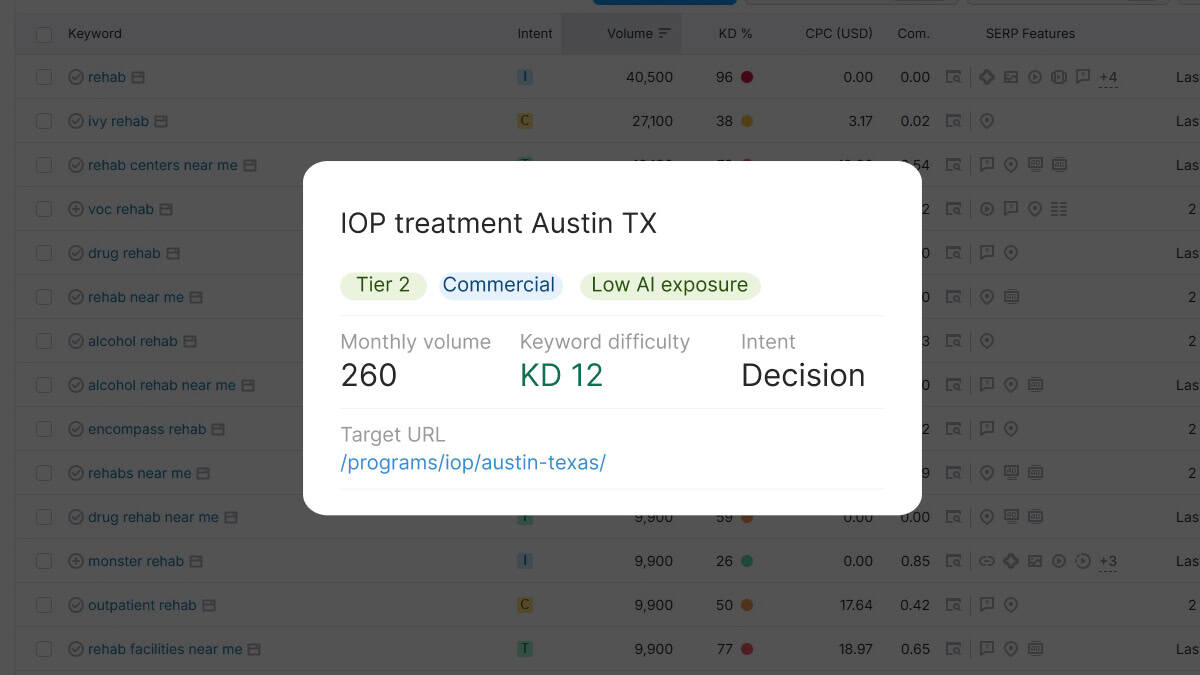
| Tier 2: Evaluation (Comparison) | Drug rehab Austin TX | PHP treatment Los Angeles | IOP vs PHP treatment ⚠ MODERATE AI Overview exposure. Geo-modified versions are protected | Map pack visibility + organic rankings for geo-modified terms; page-one placement before the admission call |
| Tier 3: Decision (Conversion) | Does Cigna cover residential rehab? | Detox center same-day admission | Drug rehab that accepts Medicaid ✓ LOW AI Overview exposure when geo-modified. Highest click-through rate | Direct admissions traffic; insurance verification calls; geo-modified payer pages are the highest-conversion keyword category |
The 2026 adjustment to this framework: Tier 1 content (informational/educational) still matters, but the ROI calculation is fundamentally different.
You’re not building Tier 1 pages to generate click traffic.
You’re building them to establish topical authority that makes your Tier 2 and Tier 3 pages more rankable, and to earn citation visibility in AI Overviews for the brand-awareness value that comes from being a cited source at the moment of early patient research.
The six keyword categories for treatment centers
Treatment center keyword strategy organizes around six distinct categories, each with its own search behavior, competitive landscape, and AI Overview exposure profile. A complete program covers all six, with prioritization informed by the two-track framework above.
Category 1: Levels-of-care keywords
Level-of-care keywords target the specific programs a center offers: detox, residential, PHP, IOP, and outpatient. These are Tier 2 keywords, the evaluation-stage searches where the patient or family is comparing options and looking for a specific program in a specific place.
Geo-modification is essential: “IOP Orange County” targets the map pack and drives call traffic. “IOP treatment” without a modifier competes against national directories and health publishers.
The keyword formula: [level of care] + [location]. The simplest version typically has the highest search volume. “Detox center Austin” outperforms “medically supervised detoxification Austin Texas” in volume. though both belong in the content.
Levels-of-care keyword examples:
| Example | Intent | Vol range | KD range | AI exposure | Notes |
|---|---|---|---|---|---|
| IOP [city] | Commercial | 50–400 | 5–20 | Low (geo) | One page per LOC + city combination |
| PHP treatment [city] | Commercial | 50–300 | 5–20 | Low (geo) | Clarify PHP vs IOP, patients often confused |
| residential treatment [state] | Commercial | 100–800 | 15–35 | Low (geo) | State level for residential; city for outpatient |
| drug detox [city] | Commercial | 50–600 | 5–25 | Low (geo) | High-conversion; Tier 3 in urgency |
| medically supervised detox | Commercial | 50–200 | 8–18 | Medium | Differentiator; appends “near me” or city |
| outpatient rehab near me | Navigational | 100–500 | 3–15 | Low (map) | Map pack captures this. GBP optimization, not page |
Category 2: Condition and substance-specific keywords
These keywords intercept patients at the awareness and evaluation stages.
“Alcohol rehab Austin” is Tier 2: the patient knows the problem and the location, and is looking for a specific provider. “Signs of alcohol addiction” is Tier 1: educational, with high AI Overview exposure, AEO value rather than direct click value.
The substance landscape changes. As new substances become clinically significant, the keyword opportunity ahead of the competition is real. Fentanyl-specific content has grown roughly fivefold in search volume in recent years, and xylazine-specific content is now emerging.
Centers that publish clinically accurate, reviewed content on emerging substance categories before the national health publishers have fully covered them can establish AI Overview citation authority in those categories before the competition arrives.
Condition and substance keyword examples:
| Example | Intent | Vol range | KD range | AI exposure | Notes |
|---|---|---|---|---|---|
| alcohol rehab [city/state] | Commercial | 50–1,000 | 10–30 | Low (geo) | Highest-volume substance category in most markets |
| fentanyl treatment centers | Commercial | 50–300 | 5–15 | Medium | Growing rapidly; geo-modify to protect click traffic |
| dual diagnosis treatment [city] | Commercial | 50–300 | 8–22 | Low (geo) | High value, indicates complex clinical need |
| opioid addiction treatment | Commercial | 50–400 | 10–25 | Medium | Broad; use with geo-modifier for click value |
| meth addiction treatment [state] | Commercial | 50–300 | 8–20 | Low (geo) | Regional variation, higher in West/Midwest |
| what is fentanyl withdrawal | Informational | 100–500 | 5–15 | High (AI) | AEO track, optimize for citation, not click |
Category 3: Geographic and local keywords
Geographic keywords are the core of the commercial, click-generating keyword strategy in 2026.
They have the lowest AI Overview exposure of any keyword category because Google understands local intent as a call-to-action signal. They also have lower KD than their non-geographic counterparts. They compete against local providers rather than national health publishers.
But geography is not always the right axis.
We worked with a treatment center in a mid-sized city in a rural area of the Southwest. Location-based targeting would have been a light lift with a low ceiling. The local population could not sustain their program, and the geographic keyword volume wasn’t there to support growth.
They had something more interesting: a men’s program built around fellowship, with an out-of-the-way location that leaned into experiential therapy. White water rafting, hiking, camping, time in nature.
We targeted wilderness rehab terms instead of city plus rehab or state plus rehab. That framing gave them a national audience of young men looking to escape their surroundings who were willing to travel for the experience. Geography became a differentiator, not a constraint.
The lesson: geo-modification is the default for most programs. It is not the only frame. When a program has something genuinely distinctive, the keyword strategy should reflect the program. Not the zip code.
A critical nuance from the California market: city and county both generate significant, separate search volume.
“Mental health Orange County” and “mental health Anaheim” are different searches with different competitive landscapes. In major metros, county-level terms often outperform city-level terms in volume because the county encompasses a larger searchable population.
Near-me keywords: “Rehab near me” and “detox near me” are dominated by the Google map pack, not organic website rankings. Your GBP optimization captures these. Your website doesn’t.
Do not build pages targeting near-me keywords; optimize your GBP. See the local SEO playbook for the complete map pack strategy. The expansion strategy failure mode.
When centers need to grow beyond their primary keyword and can’t rank for it yet, most agencies default to two uninspired moves: targeting surrounding cities with thin location pages that have no chance of ranking, or pursuing keywords that are technically related to the program but disconnected from what patients are actually searching.
A treatment center that offers equine therapy should not be optimizing a page for “equine therapy Culver City.” That page targets nobody. The keyword that actually drives qualified patients is “equine therapy for addiction treatment.” That phrase matches the clinical modality to the service context. Specificity beats proximity when the program has something genuinely differentiated to offer.
Category 4: Insurance and payer keywords
Insurance keywords are the most underused, highest-converting category in treatment center keyword strategy. A patient searching “does Blue Cross cover residential rehab in Texas” has already decided they want residential treatment. The only remaining question is financial viability.
That’s a Tier 3 keyword in the clearest sense, and it has remarkably low KD because most treatment centers haven’t systematically built this content.
The 2026 AI Overview note: insurance keywords without geographic modifiers (“does insurance cover rehab”) frequently trigger AI Overviews that provide general guidance.
The geo-modified version (“does Blue Cross cover residential rehab in Texas”) is far less likely to generate an AI Overview because Google recognizes the need for a specific, localized answer. Always geo-modify insurance keywords to protect click-through traffic and conversion.
Insurance and payer keyword examples:
| Example | Intent | Vol range | KD range | AI exposure | Notes |
|---|---|---|---|---|---|
| does Blue Cross cover rehab in [state] | Commercial | 50–300 | 5–15 | Low (geo) | Geo-modified payer pages are highest-conversion asset |
| Cigna addiction treatment [state] | Commercial | 50–200 | 5–15 | Low (geo) | Build one per major payer × state combination |
| does Medicaid cover drug rehab [state] | Commercial | 50–300 | 5–12 | Low (geo) | Critical for centers accepting Medicaid |
| rehab that accepts Aetna [city] | Commercial | 50–200 | 5–12 | Low (geo) | Broad; use with Payer + city = highest specificity, lowest competition |
| does insurance cover detox | Informational | 100–500 | 5–15 | High (AI) | AEO track without geo; add state for click value |
| free drug rehab [state] | Commercial | 50–400 | 8–20 | Low (geo) | Addresses cost barrier directly; Medicaid programs |
Category 5: Demographic and modality keywords
Demographic keywords target specific patient populations: young adults, women, veterans, LGBTQ+, professionals, first responders. Modality keywords target specific treatment approaches: CBT, DBT, EMDR, trauma-informed care, MAT. These are typically lower-volume but attract a highly specific audience and carry meaningful differentiation value in competitive markets.
Only build demographic pages for populations you genuinely serve with a differentiated program. Thin demographic pages that swap in a population name without clinical specificity are duplicate content risks and don’t rank.
Demographic and modality keyword examples:
| Example | Intent | Vol range | KD range | AI exposure | Notes |
|---|---|---|---|---|---|
| young adult rehab | Commercial | 100–400 | 10–20 | Medium | Parents search on behalf of 18–25 year olds |
| trauma-informed addiction treatment [state] | Commercial | 50–200 | 5–15 | Low (geo) | Differentiator for clinical sophistication |
| MAT program [city] | Commercial | 50–300 | 8–20 | Low (geo) | Medication-assisted treatment has growing search volume |
| veterans drug rehab | Commercial | 50–300 | 8–18 | Low (geo) | VA benefits angle creates insurance page opportunity |
| LGBTQ rehab centers [state] | Commercial | 50–200 | 8–15 | Low (geo) | Low KD; underserved in most markets |
| women’s addiction treatment [city] | Commercial | 100–500 | 10–22 | Low (geo) | Gender-specific programs command differentiated positioning |
Category 6: Informational and AEO keywords
Informational keywords are the educational questions patients and families ask before they’re ready to search for a specific treatment center.
In 2026, the primary value of these keywords is AEO positioning: they are the content that AI systems cite when answering behavioral health questions. The secondary value is first-touch traffic and topical authority building.
The shift in how to write these pages: the 2026 research shows that content structured for AI extraction, answering the core question in the first 50–70 words, then expanding with depth, both earns AI Overview citations and performs better in traditional rankings.
The “curiosity gap” approach (posing a question but burying the answer) has been explicitly penalized in healthcare content by Google’s 2026 updates. Answer first, then provide context.
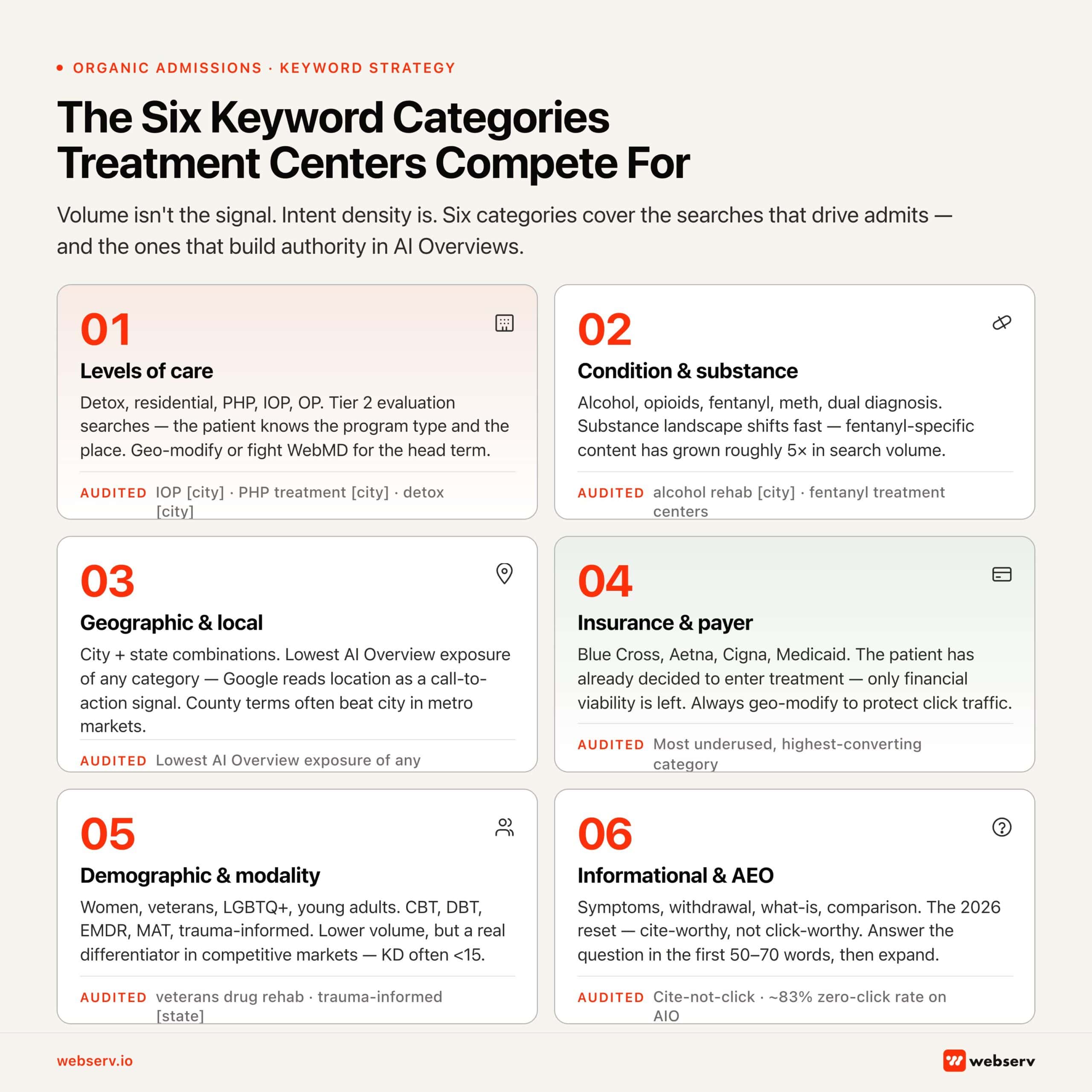 Infographic titled ‘The Six Keyword Categories Treatment Centers Compete For.’ Intro: ‘Volume isn’t the signal. Intent density is. Six categories cover the searches that drive admits — and the ones that build authority in AI Overviews.’ Six-tile grid. 01 Levels of care: detox, residential, PHP, IOP, OP. Tier 2 evaluation searches — the patient knows the program type and the place. Geo-modify or fight WebMD for the head term. Audited examples: IOP [city], PHP treatment [city], detox [city]. 02 Condition & substance: alcohol, opioids, fentanyl, meth, dual diagnosis. Substance landscape shifts fast — fentanyl-specific content has grown roughly 5x in search volume. Audited examples: alcohol rehab [city], fentanyl treatment centers. 03 Geographic & local: city plus state combinations. Lowest AI Overview exposure of any category — Google reads location as a call-to-action signal. County terms often beat city in metro markets. Audited: lowest AI Overview exposure of any. 04 Insurance & payer: Blue Cross, Aetna, Cigna, Medicaid. The patient has already decided to enter treatment — only financial viability is left. Always geo-modify to protect click traffic. Audited: most underused, highest-converting category. 05 Demographic & modality: women, veterans, LGBTQ+, young adults. CBT, DBT, EMDR, MAT, trauma-informed. Lower volume, but a real differentiator in competitive markets — keyword difficulty often under 15. Audited examples: veterans drug rehab, trauma-informed [state]. 06 Informational & AEO: symptoms, withdrawal, what-is, comparison. The 2026 reset — cite-worthy, not click-worthy. Answer the question in the first 50 to 70 words, then expand. Audited: cite-not-click, approximately 83% zero-click rate on AIO.
Why scattered keywords lose to organized content programs
Publishing individual pages targeting individual keywords, without a coherent content architecture, produces weaker results than organizing content into topic clusters.
Research indicates that topic clusters drive approximately 30% more organic traffic than standalone keyword-targeted pages, because they signal topical authority across an entire subject area rather than relevance for a single query.
A topic cluster has three components: a pillar page that comprehensively covers a broad topic (e.g., “Alcohol Addiction Treatment. The Complete Guide”), supporting cluster pages that cover subtopics in depth (one per level of care, one per payer, one per demographic, one per condition variation), and internal links that connect cluster pages to the pillar and to each other.
The internal linking is what tells Google the pages are related and that the site has genuine depth on the topic.
The behavioral health content cluster architecture
| Levels-of-care cluster | Pillar: “Complete Guide to Addiction Treatment Programs” → Supporting: one page per LOC (Detox, Residential, PHP, IOP, OP, MAT) → Each supported by insurance pages and condition-specific variations |
| Substance-specific cluster | Pillar: “Addiction Treatment by Substance” → Supporting: one page per substance (alcohol, opioids, fentanyl, meth, benzos, co-occurring) → Each linked back to relevant LOC pages |
| Insurance cluster | Pillar: “Does Insurance Cover Addiction Treatment?” → Supporting: one page per major payer × state combination → Each linked to relevant LOC pages |
| Local/geographic cluster | Pillar: Location hub page → Supporting: one page per facility with local program and payer specifics → GBP profile reinforcing each page |
| Informational/AEO cluster | Pillar: Condition guide (e.g., “Opioid Addiction: Signs, Symptoms, and Treatment”) → Supporting: symptom pages, FAQ pages, “what to expect” guides → Optimized for AEO citation with structured Q&A format |
The cluster architecture serves a second purpose: it maps to the patient journey.
A patient who finds a symptom article through an AI Overview citation clicks through, reads the article, finds an internal link to their nearest program page, and calls. The cluster creates the pathway from Tier 1 traffic to Tier 3 conversion.
Standalone pages never build that pathway.
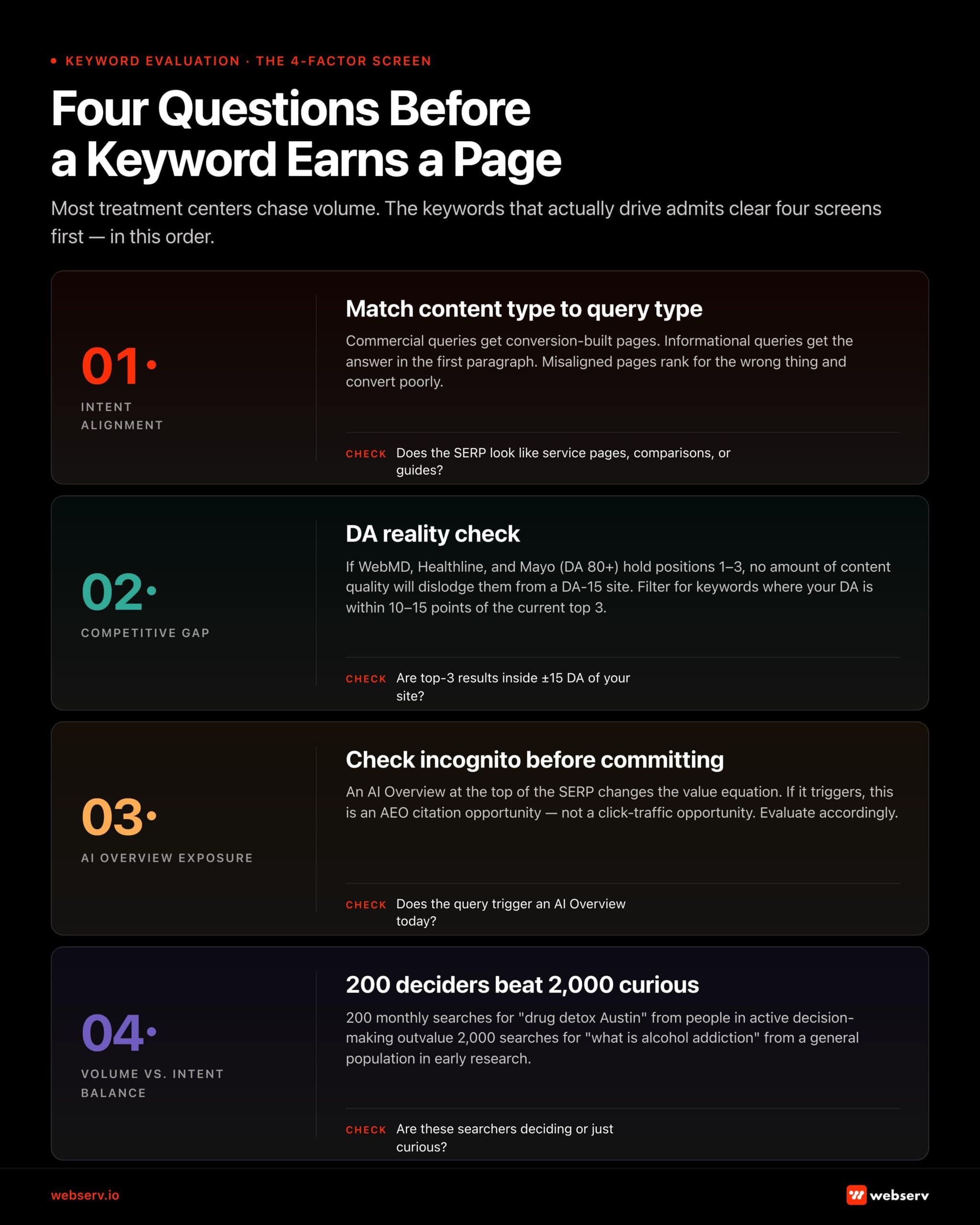 Infographic titled ‘Four Questions Before a Keyword Earns a Page.’ Subtitle: ‘Most treatment centers chase volume. The keywords that actually drive admits clear four screens first — in this order.’ Four-row layout, each row numbered with a screen name and a check question. 01 Intent Alignment — Match content type to query type: commercial queries get conversion-built pages. Informational queries get the answer in the first paragraph. Misaligned pages rank for the wrong thing and convert poorly. Check: does the SERP look like service pages, comparisons, or guides? 02 Competitive Gap — DA reality check: if WebMD, Healthline, and Mayo (DA 80+) hold positions 1 through 3, no amount of content quality will dislodge them from a DA-15 site. Filter for keywords where your DA is within 10 to 15 points of the current top 3. Check: are top-3 results inside plus or minus 15 DA of your site? 03 AI Overview Exposure — Check incognito before committing: an AI Overview at the top of the SERP changes the value equation. If it triggers, this is an AEO citation opportunity — not a click-traffic opportunity. Evaluate accordingly. Check: does the query trigger an AI Overview today? 04 Volume vs. Intent Balance — 200 deciders beat 2,000 curious: 200 monthly searches for ‘drug detox Austin’ from people in active decision-making outvalue 2,000 searches for ‘what is alcohol addiction’ from a general population in early research. Check: are these searchers deciding or just curious?
Evaluating keywords: the four-factor screen
Most treatment center owners and admissions directors think they already know which keywords they should be ranking for. Sometimes they’re right. More often they’re searching a low-volume or zero-volume variation of the obvious term and don’t know it.
But the more common problem is underestimating what it actually takes to rank. You can pursue best practices for a target keyword for months and still be stuck on page two.
That’s not failure. That’s a normal outcome in a YMYL vertical where competitors have years of domain authority you cannot compress.
This is why a multi-horizon keyword strategy targets short, medium, and long-term goals simultaneously. Don’t put all your eggs in one basket waiting for a breakthrough on the flagship term. Build the program so there’s measurable movement at every horizon.
Before committing a page to a keyword, run every candidate through four evaluation criteria. The criteria are listed in order of importance:
Does this keyword reflect the type of query your page is built to answer? A page optimized for a commercial keyword should be structured for conversion. A page targeting an informational keyword should answer the question directly in the first paragraph. Misaligned pages rank for the wrong thing and convert poorly.
What are the DA scores of sites currently ranking in positions 1–3 for this keyword? If the top three results are WebMD, Healthline, and SAMHSA (DA 70–90), this keyword is not a near-term organic opportunity regardless of your content quality. Filter for keywords where your DA is within 10–15 points of the current top 3.
Does this query currently trigger an AI Overview? Check by searching the keyword in an incognito browser. If an AI Overview appears, recalibrate your expectations: this is an AEO citation opportunity, not a click-traffic opportunity. Evaluate accordingly is the brand visibility from AI citation worth the content investment?
Absolute volume matters less than the ratio of volume to intent density. 200 monthly searches for “drug detox Austin” from a population in active decision-making is more valuable than 2,000 searches for “what is alcohol addiction” from a general population in early research. Prioritize terms that concentrate intent over terms that concentrate curiosity.
How SoCal Sunrise generated 85 admissions and 2,297% ROI from SEO in 6 months
A ground-up SEO rebuild using the Pathfinder Parents Methodology turned an invisible online presence into a top-ranking admissions engine.
Read the case study →85 admits and 3,152 leads attributed to organic
The keyword research workflow
Keyword research for a new or existing client follows four sequential steps. The tools are SEMrush and Google Search Console.
The output is a categorized, evaluated keyword map that feeds position tracking setup and content prioritization.
1 Domain Overview:
Start with what already ranks. In SEMrush Domain Overview, enter the site URL and pull all organic keywords ranking in the top 100. Filter by commercial intent to surface high-priority terms first. Export to your keyword research spreadsheet. This baseline establishes what’s working. You don’t want to rebuild what isn’t broken. It also surfaces keywords the site is ranking for in positions 8-20 that are strong optimization opportunities with existing authority.
2 Keyword Magic Tool:
Discover unranked opportunities. In the Keyword Magic Tool, enter seed terms for each service, condition, and geographic combination the center offers. Sort results by KD first (filter below 30), then by volume. For each qualifying term, run a quick AI Overview check before adding it to the list. If it consistently triggers AI Overviews, flag it as AEO-track rather than click-track. Add qualifying terms to the keyword list with their category tag.
3 Competitive gap analysis:
Find what competitors rank for that you don’t. In SEMrush’s Keyword Gap tool, compare the site against 3–5 direct competitors with comparable DA. Filter for keywords where competitors rank in positions 1–20 and your site doesn’t rank at all. These have proven demand (competitors rank for them) and a demonstrated competitive baseline. Check each gap keyword for AI Overview presence before prioritizing. Commercial and geo-modified gaps without AI Overview coverage are the highest-value additions to the list.
4 Evaluate, categorize, map
Apply the four-factor screen to every candidate. Score each keyword by intent alignment, DA competitive gap, AI Overview exposure, and volume-intent balance. Assign each surviving keyword to exactly one page, no shared targets. Tag by the six keyword categories and by funnel tier. This output is the keyword map that drives all subsequent content work and the position tracking setup.
Breaking down keyword mapping
Keyword mapping is the process of assigning exactly one primary target keyword to each page on the site.
It is not optional. It prevents keyword cannibalization (two pages competing for the same term and splitting ranking signals) and ensures every page has a clear purpose in the overall architecture.
The most common mapping mistake
There is a real difference between creating complementary content that supports a page and creating cannibalization that decreases your likelihood of ranking. Most agencies get this wrong by treating them as the same thing.
Complementary content targets related but distinct search intents. A page for “alcohol detox Austin” and a blog post on “what to expect during alcohol detox” are not competing. They serve different moments in the patient journey and support each other through internal links.
Cannibalization is when you try different takes on the same intent to chase the same keyword.
An “IOP Austin” service page and an “intensive outpatient Austin” blog post are targeting the same searcher in the same decision moment. Google can’t determine which page to rank, so it may rank both weakly rather than one strongly.
The distinction is search intent. Understand what each query is actually asking, match your content and content category to that intent, and assign each distinct intent to exactly one URL. Don’t create variations on a theme hoping one will break through.
The most common treatment center example: a “drug rehab Austin” service page and an “Austin drug rehab” blog post. Same intent. Different URL. Google splits the signals.
Fix: consolidate the weaker page into the stronger one and 301-redirect.
URL-level keyword mapping for treatment centers
| /programs/detox/ | drug detox [state] or medical detox [city]. Most geographically specific term with sufficient volume |
| /programs/residential/ | residential treatment [state] or inpatient rehab [city] or state-level for residential (wider geographic draw) |
| /programs/php/ | PHP treatment [city] or partial hospitalization program [city]. Use the term your patients actually search |
| /programs/iop/ | IOP [city] or intensive outpatient program [city] (same principle as PHP) |
| /what-we-treat/alcohol-addiction/ | alcohol rehab [city] or alcohol addiction treatment [state] |
| /insurance/blue-cross/ | does Blue Cross cover rehab in [state]. Payer + state, geo-modified for click value |
| /locations/austin-texas/ | drug rehab Austin Texas or addiction treatment Austin TX. Primary geo term for that location |
Keyword strategy for mental health vs addiction treatment
Mental health and addiction treatment share the same general keyword framework, but meaningful differences in search behavior require strategic adjustments:
| Topic | Mental health | Addiction treatment |
|---|---|---|
| Search volume | Higher volume, higher KD. “Mental health therapist near me” pulls 1,300 to 3,500 searches per month. | Lower volume, lower KD. “Addiction treatment near me” pulls 100 to 500 per month. |
| Consideration cycle | Contemplative. Patients evaluate for weeks or months. Content should assume a longer research window. | Often crisis-driven. Shorter windows, faster decisions. Admissions CTAs belong near the top of the page. |
| AI Overview exposure | High. Mental health queries trigger AI Overviews at least as frequently as addiction queries, arguably more. Geo-modification is essential. | High for informational queries. Geo-modification is the primary defense for maintaining click traffic. |
| Geographic scale | Local. City-level geo-targeting reflects where outpatient patients are actually searching from. | Regional. Residential programs draw from a wider radius. State and regional targeting alongside city-level. |
| Insurance keywords | Payer-first. Mental health parity laws have shifted searches toward in-network queries. “Therapists that accept Aetna in Austin” converts. | Condition-first. Patients search by substance or level of care, then layer in payer. Payer pages still convert but follow program pages. |
| Stigma language | Splits by demographic. Younger users search with clinical terms. Older users and families search descriptively. Build content for both. | More uniform. Patients and families use similar language across demographics. Plain language plus clinical terminology both belong. |
The mental health keywords every treatment center should target
Mental health keywords break into a few core groups, each with its own search behavior and conversion profile:
- Condition-specific mental health keywords like anxiety treatment, depression treatment, PTSD therapy, OCD treatment. Highest intent when paired with city or insurance modifiers.
- Therapy modality keywords like CBT, DBT, EMDR, ketamine therapy. Strong conversion when geo-modified and matched to provider credentials.
- Demographic mental health keywords like adolescent mental health treatment, mental health treatment for veterans, LGBTQ+ mental health support. Lower volume but higher fit-quality.
- Crisis-state mental health keywords like “do I need therapy,” “am I depressed,” “panic attack help.” Heavy AI Overview saturation; informational plays rather than direct conversion.
- Telehealth mental health keywords like virtual therapy, online mental health treatment, telehealth therapy near me. Surged post-2020 and continues to grow as parity laws expand reimbursement.
When mapped against treatment center service pages, these mental health keywords almost always need their own content surface separate from addiction treatment keywords. The audiences overlap but the search behavior differs enough that combining them dilutes intent signals.
Measuring whether keyword strategy is working
Keyword research sets the strategy. Position tracking tells you whether it’s working and what to do next.
The tracking setup happens before new content is published. That ensures a measurable baseline against which every optimization is evaluated.
SEMrush position tracking setup
- Create a project for the center in SEMrush → Position Tracking. Set target device (mobile and desktop), target location (city, county, or state, matching the geographic level from your keyword strategy), and upload the curated keyword list.
- Use SEMrush’s tagging function to categorize keywords by the six categories from your research sheet. Tags make it possible to see how each category performs in aggregate, not just individual terms. You can see, for instance, that your insurance keyword rankings are moving while your condition page rankings are stagnant.
- Review on a monthly cadence. Identify keywords that have entered positions 10–20 (optimization opportunity on the existing page). Identify keywords that have dropped 5 or more positions (investigate cause: content update needed, competitor improvement, or technical issue).
- Identify keywords where you’ve entered the top 3 and extend to related terms in the same cluster.
Google Search Console as your source of truth
Google Search Console provides real impression and click data. What your pages actually receive for specific queries, not estimates.
For keywords where you’re tracking position in SEMrush, compare against GSC data for the same terms. GSC often surfaces additional keyword opportunities: queries you’re ranking in positions 10–30 that you weren’t actively targeting. Add those to your keyword map and optimize the relevant pages.
GSC’s AI Overview impressions report (under Search Appearance) is now essential. It shows which queries are surfacing your content in AI Overviews, helping you identify AEO wins that wouldn’t appear in traditional click data.
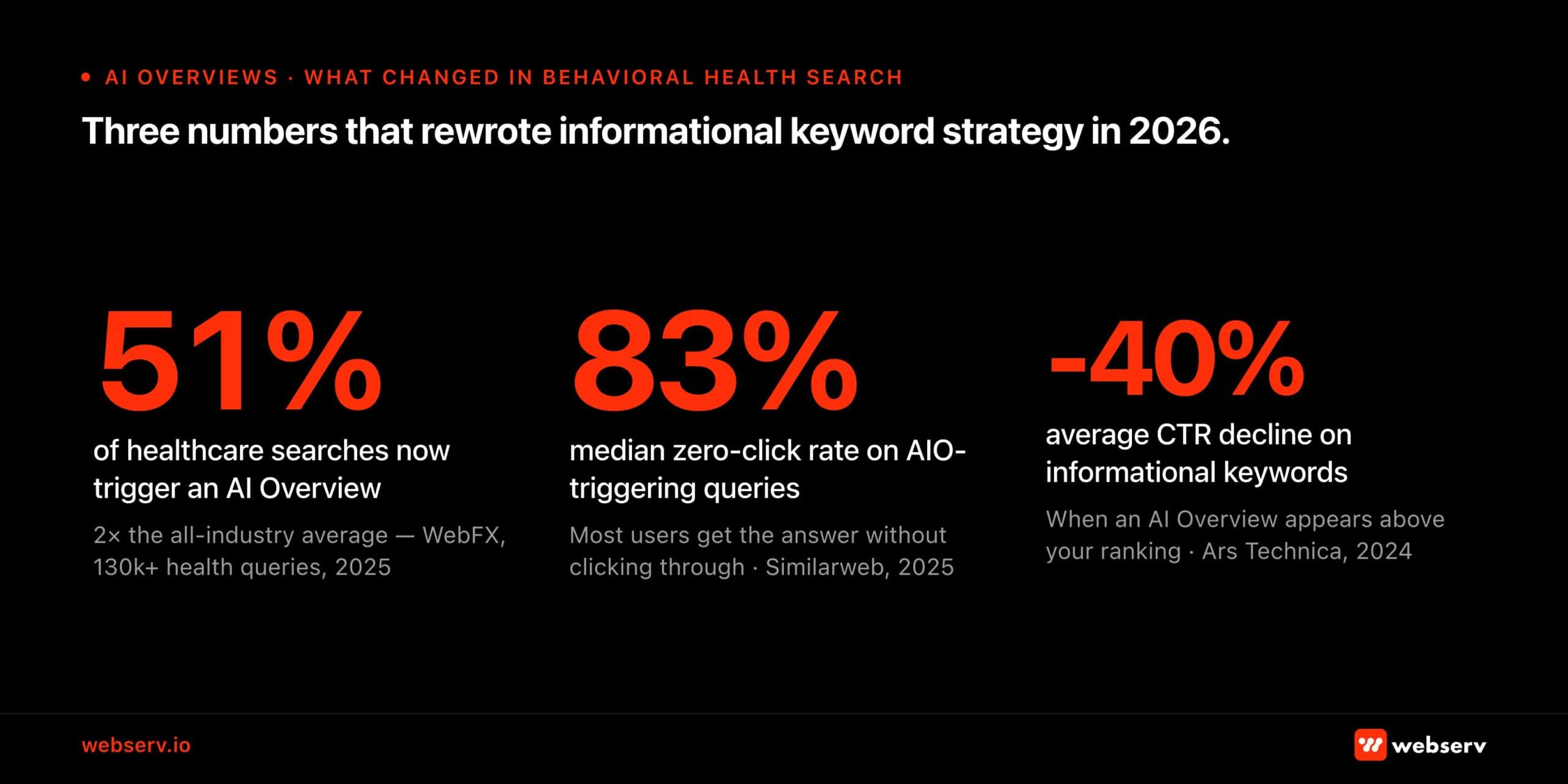 Infographic titled ‘Three numbers that rewrote informational keyword strategy in 2026.’ Header: ‘AI Overviews — What Changed in Behavioral Health Search.’ Three statistics shown in large red type. 51%: of healthcare searches now trigger an AI Overview — 2x the all-industry average. Source: WebFX, 130k+ health queries, 2025. 83%: median zero-click rate on AIO-triggering queries — most users get the answer without clicking through. Source: Similarweb, 2025. -40%: average CTR decline on informational keywords when an AI Overview appears above your ranking. Source: Ars Technica, 2024.
Most in-house teams hit a wall not because they lack knowledge, but because they lack bandwidth.
When you are ready to hand it off, Webserv has spent 9 years executing exactly this for treatment centers nationwide.
Frequently Asked Questions
Should I still target informational keywords if AI Overviews reduce clicks?
Yes, but with recalibrated expectations.
The value of informational keyword targeting has shifted from click traffic to citation authority and topical depth. A treatment center whose educational content is consistently cited in AI Overviews is building brand authority in the AI systems that are increasingly serving as the first touchpoint for patients in early research.
That citation visibility converts to brand recall and direct searches later in the decision journey. Build informational content with the explicit goal of earning AI Overview citation: direct answers in the first paragraph, structured Q&A, authoritative external sources, and FAQ schema.
How many keywords should a treatment center maintain in active tracking?
There’s no correct total. It depends on the size of the site and the breadth of services. A single-location IOP center might have a meaningful tracking set of 50–100 terms. A multi-location center might track 300–500.
The more important principle is coverage across all six keyword categories and both funnel tracks. A well-organized, tagged keyword set produces more actionable insight than a large, untagged list.
Do near-me keywords belong in the keyword strategy?
“Near me” searches are captured by the Google map pack based on GBP profile and physical proximity. Your website content doesn’t rank for them.
Build your GBP, optimize your local citations, and develop your review velocity. That’s what captures near-me traffic. Organic keyword strategy should focus on terms where page content is what Google serves, not map pack results.
How frequently should keyword research be updated?
The initial research establishes the foundation for 6–12 months of execution. Revisit quarterly.
Add keywords as site DA grows and previously out-of-reach terms become attainable. Add keywords for new services or locations. Run a fresh competitive gap analysis.
And audit which previously targeted informational terms are now consistently triggering AI Overviews. Recalibrate those pages toward AEO optimization rather than click-traffic optimization. That is new in 2026 and most keyword programs aren’t accounting for it yet.
What’s the best way to handle keywords where WebMD or Healthline dominate?
Two approaches work in parallel.
First, don’t target the head term directly. Target the geo-modified version. “Opioid addiction treatment” is dominated by national publishers. “Opioid addiction treatment Austin” is not. The geo-modifier creates a different competitive landscape with regional treatment centers as your actual competitors.
Second, target the head term for AEO positioning. Publish the best, most structured content for that query, not to rank #1 in traditional results, but to be cited in AI Overviews alongside WebMD.
Being cited alongside those publishers is its own form of credibility signal.
What are the best SEO keywords for mental health practices?
The best SEO keywords for mental health practices are condition-modified, geo-modified, and insurance-modified, usually all three at once. “Anxiety therapist Austin,” “depression treatment that takes Aetna,” and “trauma therapy near me” outperform generic mental health SEO keywords because they capture intent and qualification in the query itself.
National head terms like “mental health treatment” are dominated by WebMD, Healthline, and crisis hotlines. Not winnable for most practices. Geo-modification is the most reliable path to mental health SEO keywords that actually convert.
How do rehab SEO keywords differ from mental health SEO keywords?
Rehab SEO keywords cluster around substance, level of care, and insurance: “alcohol detox PHP Austin,” “opioid treatment that takes Medicaid.” The crisis cycle is shorter, so admissions CTAs work earlier in the funnel.
Mental health SEO keywords cluster around condition, modality, and demographic: “CBT for adolescent anxiety,” “EMDR therapy for veterans.” The decision cycle is longer, so educational content carries more weight.
Same six-category framework applies to both, but the volume distribution and conversion timing are different enough that a combined keyword strategy almost always underperforms a split one.
Should treatment centers track addiction treatment keywords separately from mental health keywords?
Yes, for any center that offers both. The reporting categories should split addiction treatment keywords (substance, level of care, payer) from mental health keywords (condition, modality, demographic) and from co-occurring keywords (“dual diagnosis,” “co-occurring disorders”).
Combining them in the same tracking bucket hides which side of the service line is actually driving admissions, and makes it impossible to tell when one category is winning AI Overview citations while the other is losing organic clicks.
Keyword strategy is not a one-time decision
The single biggest mistake in behavioral health keyword strategy is treating it as a setup task. Pick the obvious terms, build the pages, wait for the rankings. That approach worked in 2022. It does not work in 2026.
The center ranking first for the most obvious term in their market might be getting calls they cannot convert. The center targeting a less obvious modality keyword might be flying under the radar of bigger competitors while filling beds with exactly the right patients.
The center that builds for short, medium, and long-term keyword goals simultaneously is the one still growing at month twelve when the flagship term is still stuck on page two.
Some keywords drive admissions calls. Some build citation authority in AI systems that generates brand recognition for patients who will not call until they have done six more searches. Both tracks matter. If you want to understand how the AI citation track works end to end, see our answer engine optimization service for behavioral health.
The keyword map that comes out of systematic research is the operating blueprint for a treatment center content program. It is also the foundation for the position tracking that tells you whether the investment is working. To see what a full organic program built around this framework looks like, see what is included in our SEO service for treatment centers.
If you want to see what that keyword map looks like for your specific market, book an intro call and we will run a full SEO audit. We build keyword maps as part of every onboarding sprint and use them to drive every subsequent content and optimization decision.