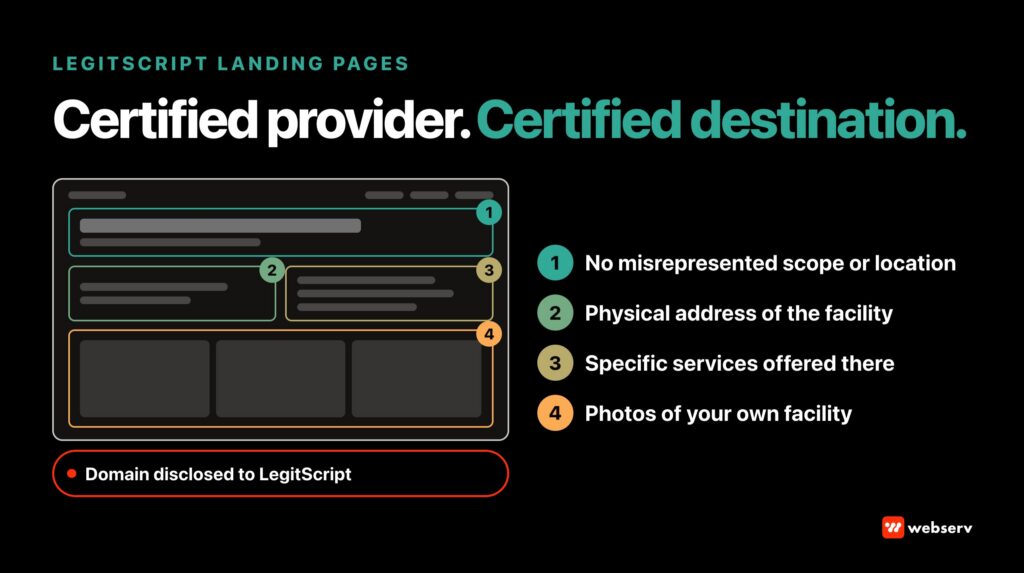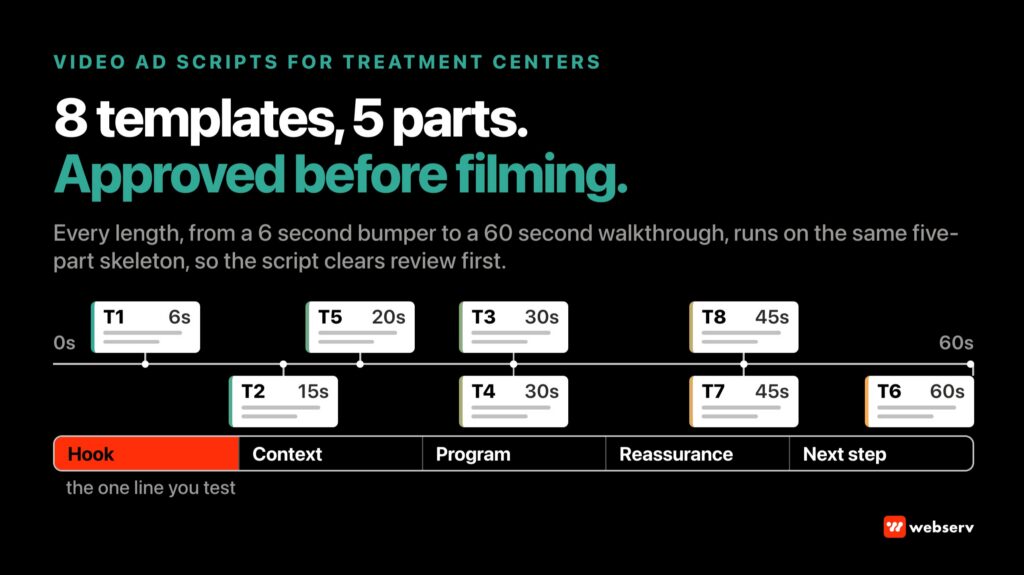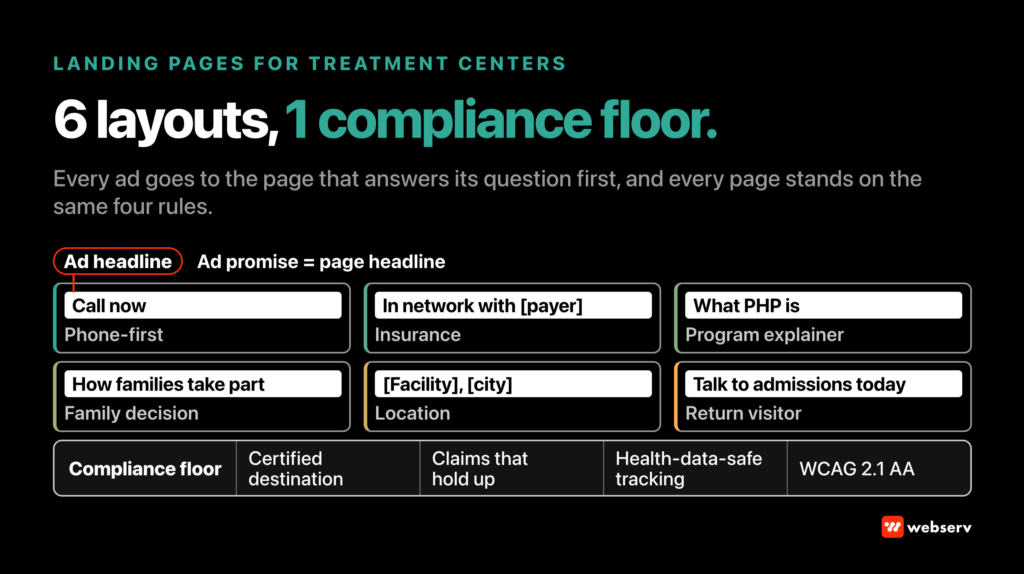
If you are running a treatment center and investing in paid search, there is a good chance someone has mentioned LegitScript to you at some point. Maybe you know exactly what it is, maybe you have only heard the name in passing. Either way, if your program is not certified, Google, Bing, and Meta will not let you advertise on them, full stop.
Once certified, the operational discipline is what keeps the program running. The most common post-cert failures fall into two buckets: compliance-language errors in ad copy that trigger Healthcare and Medicines review, and budget waste from broad-match queries that should have been on a negative keyword list. Both are easier to prevent than to fix after the suspension letter arrives.
This guide was written for owners and operators who want to understand what LegitScript actually is, how the certification process works from start to finish, and how to avoid the documentation pitfalls that send most programs through multiple rejection cycles before they ever run a single ad.
Key Takeaways
- First-attempt certification takes 2–4 weeks; rejection cycles can stretch to 16 weeks.
- Treat LegitScript as a clinical audit, not a forms exercise.
- Marketing claim substantiation triggers more rejections than any other category.
- Undisclosed mid-cycle changes are the most expensive failure mode.
- At $1,595 to apply and $3,095 a year per facility, certification is the cheapest insurance policy in your paid media stack.
A treatment center we work with submitted their LegitScript application three times before getting certified. The third attempt took 11 weeks to resolve. They lost a full quarter of paid search admit volume during the wait.
The program was not non-compliant. The clinical operation was strong, the licensing was current, the staffing was credentialed correctly. The rejections came from documentation requirements that were not obvious from the public-facing application form.
That is the most expensive thing about LegitScript certification. Treating it as a forms exercise is the posture that produces multiple rejection cycles and lost quarters of paid search.
The programs that get certified on first attempt treat it differently. They run the certification as a clinical and operational audit before they ever submit the application. By the time the form is filed, the program has already passed the audit it knows it is going to be evaluated against.
A clean first-attempt certification can complete in 2 to 4 weeks. A program that has to iterate through rejections often takes 8 to 12 weeks. Sometimes 16.
The difference is a quarter of paid search.
This guide walks through what LegitScript certification actually is, why it is required for treatment center advertising, and the full step-by-step certification process.
It also covers the documentation requirements that catch most applicants by surprise, the most common rejection reasons, and what the annual renewal cycle looks like once a program is certified.
The cost of getting this right is real. The cost of getting it wrong is the difference between a paid search operation that produces admits every week and one that sits suspended for a quarter while a six-figure marketing budget evaporates.
What LegitScript certification actually is
LegitScript is a third-party verification program that certifies addiction treatment providers as compliant with a published set of standards covering clinical operations, marketing claims, ownership, and patient outcomes.
DEFINITION
LegitScript Certification
The third-party certification that gates paid advertising for addiction treatment on Google, Microsoft, and Meta. Without certification, treatment center operators cannot run ads on those platforms at all. The program runs a documentation-heavy review of state licensing, accreditation, clinical leadership, ownership disclosure, and marketing claims before issuing the cert.
The certification was developed in response to advertising platform concerns about addiction treatment advertising. The fraud was real.
Google, Bing, and Meta all require LegitScript certification for treatment center advertising in the United States. Without it, an addiction treatment program cannot run paid ads on those platforms in any meaningful way.
LegitScript reviews each applicant against a multi-category standard. The standards include state licensing alignment, clinical staff credentialing, ownership disclosures, marketing claim substantiation, patient referral practices, and a behavioral expectation that the program does not engage in patient brokering, illegal kickbacks, or misleading outcome representations.
A program that meets the standard receives a certification valid for one year. The certification is publicly searchable on the LegitScript directory. Advertising platforms verify the certification status when serving treatment center ads.
Programs that fail to meet the standard receive a rejection with specific feedback on which categories triggered the failure. Most rejections are remediable. Some are not.
The certification requirement exists because the addiction treatment vertical has a documented history of advertising fraud. Programs misrepresenting clinical staffing, fabricating success rates, engaging in patient brokering, and using paid media to acquire patients into programs that did not deliver clinical care.
Advertising platforms responded by requiring third-party verification before allowing treatment center ads. LegitScript became the standard verification provider in 2018 when Google made it a hard requirement.
The current state of the requirement spans most major platforms.
Google Ads. LegitScript certification is required for any advertiser running ads on substance use disorder treatment, mental health treatment, or behavioral health services in the United States. Without certification, the account cannot run those ad categories and any attempts to do so trigger account-level enforcement.
Bing Ads. Microsoft adopted the same requirement, which means LegitScript is the gating criterion across both major search platforms.
Meta (Facebook and Instagram). Meta requires LegitScript certification for substance use disorder treatment advertising on both platforms. Mental health advertising on Meta has its own additional layer of approvals, but LegitScript is the foundation.
Third-party publisher networks. Many treatment center directories and referral networks require LegitScript certification as a baseline for inclusion.
PLATFORM GATING
Google, Microsoft (Bing), and Meta all require LegitScript certification before running any addiction treatment ads. Third-party publisher networks (directories, referral networks) increasingly require it too. One certification clears all four channels. No certification means no paid acquisition at all in the BH category.
The practical consequence: a treatment center without LegitScript certification cannot reliably run paid acquisition. The investment in the certification process pays back the first month the program runs paid ads against an addressable patient market.
The five-stage certification process
LegitScript certification follows a structured five-stage process. Programs that understand the stages and prepare for each one in advance complete certification 60% to 80% faster than programs that submit reactively.
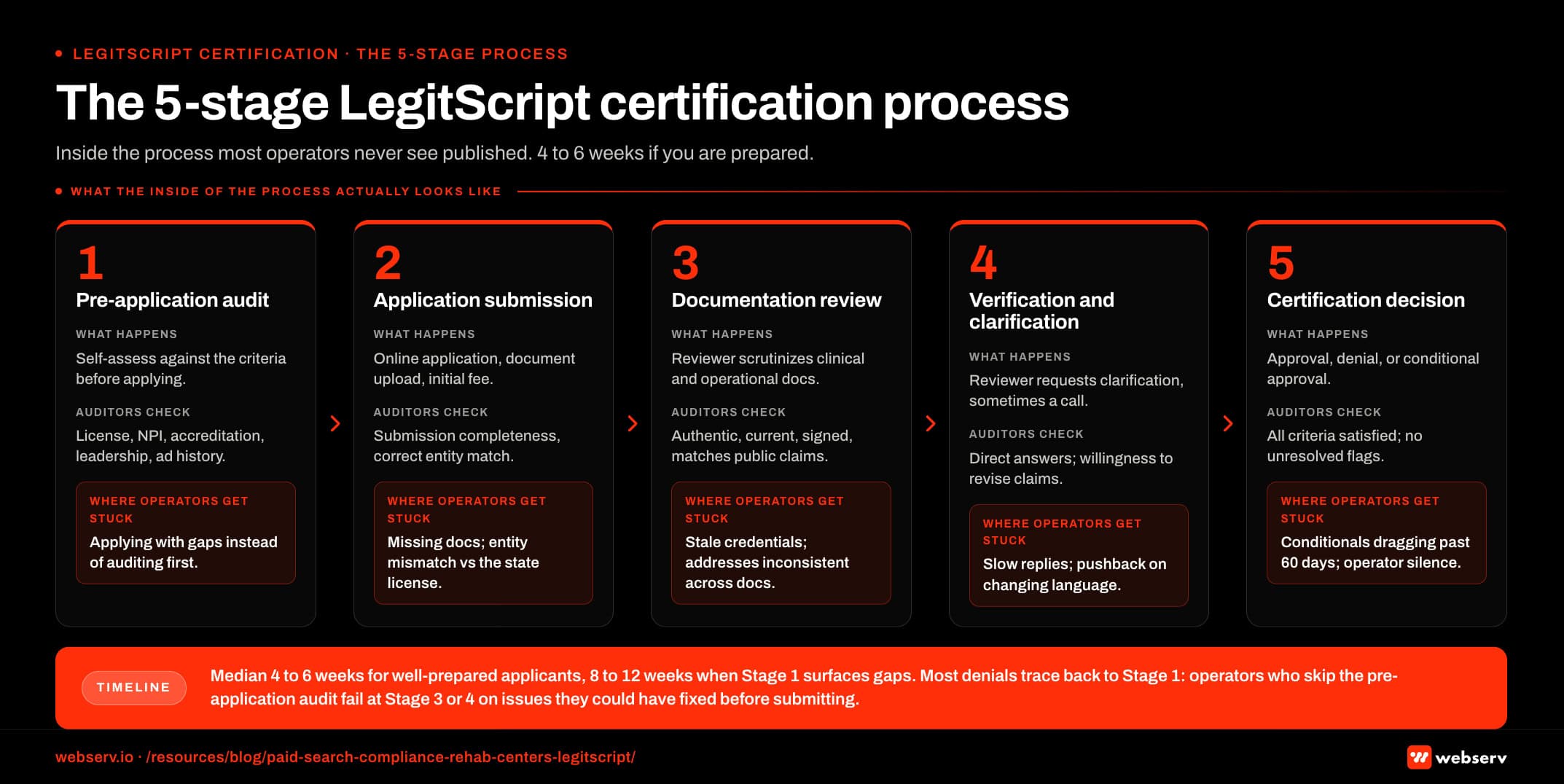 Infographic titled ‘The 5-stage LegitScript certification process’.
Stage 1: Pre-application audit
The pre-application audit is the work the operator does before opening the LegitScript application form. Programs that skip this stage are the ones that go through multiple rejection cycles.
The pre-application audit covers six areas.
State licensing review. Confirm the program’s state license is current, that it covers every level of care the program intends to bill and advertise, and that the license addresses match the physical addresses where treatment is delivered.
Joint Commission or CARF accreditation status. Most LegitScript-certified programs hold accreditation from one of the major behavioral health accreditors. The accreditation should be current, the addresses on file should match the program’s operating addresses, and any accreditation conditions or pending reviews should be documented.
Clinical staff credentialing. Pull the licenses of every clinical staff member who will be named on the application. Confirm each license is current, in the correct state, at the correct level (LCSW, LPC, MD, RN, etc.), and matches the role the staff member is performing at the program.
Medical director designation. The medical director’s credentials need to align with the level of care being provided. DEA registration should be current. The MD should be on-site or remotely available at the level the program advertises.
Ownership and corporate structure documentation. LegitScript requires disclosure of beneficial owners, parent organizations, and any related entities. Programs with complex corporate structures should have this documentation organized before applying.
Marketing claim audit. Review every public-facing claim the program makes about success rates, clinical approach, accreditation, or patient outcomes. Each claim needs documentation that substantiates it. Generic, unsourced claims will trigger rejections.
The pre-application audit takes 2 to 4 weeks for a program that has not previously aligned to LegitScript standards. For a program that has been operating with accreditation discipline already, it takes a few days.
Stage 2: Application submission
The LegitScript application is a multi-section online form that collects program information, attaches the documentation gathered in Stage 1, and pays the application fee.
LegitScript’s addiction treatment FAQ lists a $1,595 application fee and a $3,095 annual certification fee per facility for providers with one to nine facilities, and directs larger organizations to its Enterprise certification. The fees are non-refundable, which is part of why the pre-application audit matters.
Common application errors that delay processing include incomplete clinical staff lists, missing medical director documentation, addresses that do not match between the application and the licensing documents, and marketing claim attestations that contradict what is published on the program’s website.
A program that has done the Stage 1 audit submits an application that goes directly to documentation review. A program that has not often submits an incomplete application that triggers a request for additional information before review even begins.
Stage 3: Documentation review
LegitScript reviewers compare the submitted application against each of LegitScript’s 16 certification standards. The review takes 1 to 3 weeks depending on application volume and the completeness of the submission.
The reviewer is looking for specific matches between the documentation and the published standards. The standards are deliberately specific to prevent ambiguous interpretation in the reviewer’s favor.
Programs that submit clean applications with complete documentation often receive certification at this stage without further interaction. Programs that submit applications with gaps receive a request for additional information, which restarts the review clock for the items being requested.
Multiple back-and-forth cycles at this stage are the most common cause of long certification timelines. Each cycle adds 1 to 3 weeks.
Stage 4: Verification and clarification
For programs whose applications pass documentation review without question, this stage is bypassed. For programs with documentation that requires clarification, LegitScript may schedule a verification call with the medical director, the program operator, or both.
The verification call is not adversarial. The reviewer is confirming that the documentation submitted accurately represents the program’s actual operations. The questions tend to focus on level-of-care delivery, clinical staff coverage patterns, marketing claim substantiation, and any patterns the reviewer has identified that need confirmation.
A program that has been operating consistently with the documentation it submitted will pass this stage in a single call. A program where the documentation does not fully match operations will receive follow-up requests.
Stage 5: Certification decision
The certification decision is binary. Either the program is certified for one year, or the application is denied with specific feedback on which categories failed.
Certification produces a unique LegitScript certification ID. The ID is what advertising platforms verify against. The directory listing on legitscript.com goes live shortly after certification.
Denial decisions are appealable, but the appeal process adds weeks and rarely succeeds without remediation of the underlying issues. Most programs that are denied apply again after addressing the specific issues identified in the rejection.
The full process from initial application submission to certification decision runs 2 to 16 weeks. The variance is almost entirely about how prepared the program was at submission.
Documentation that catches most applicants by surprise
Five categories of documentation produce the most surprise rejections in our experience.
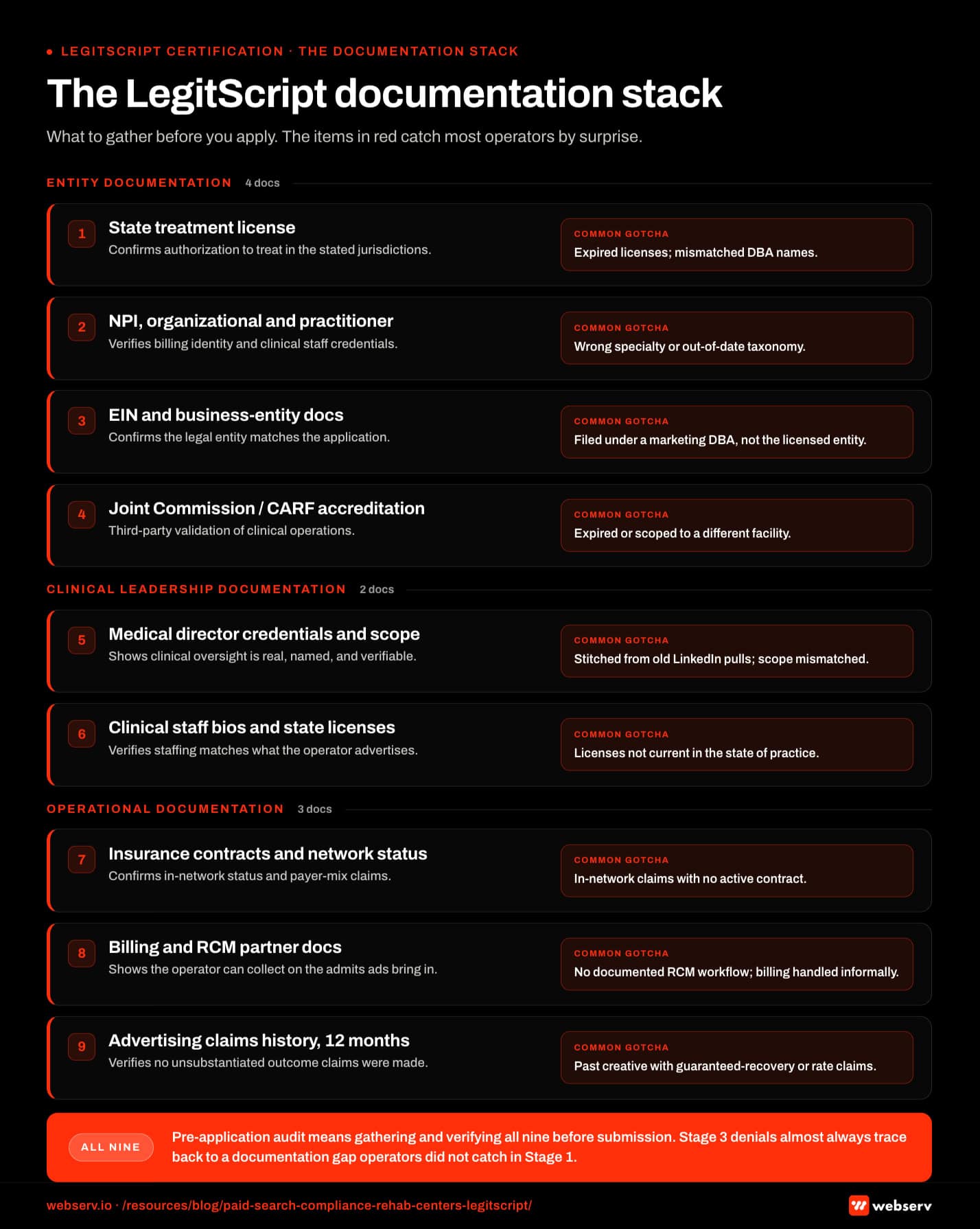 Infographic titled ‘The LegitScript documentation stack’.
Address consistency across licensing, accreditation, and corporate filings. A program that operates at one address but has the licensing on file at the previous corporate office address will trigger a documentation mismatch. LegitScript expects all addresses to align.
Medical director coverage documentation. It is not enough to name a medical director.
The documentation needs to show how the MD is engaged, what their on-site or remote availability looks like, and how their oversight is documented in the clinical record. Programs that operate with a part-time or consulting MD often need to provide engagement letters and oversight documentation.
Outcomes claim substantiation. Any success rate, completion rate, or outcome statistic on the program’s website needs documentation showing how the number was calculated.
Internal data needs to come with methodology. Third-party data needs to come with a citation. Generic claims like “high success rate” or “industry-leading outcomes” without substantiation get pulled.
Patient referral relationship disclosures. LegitScript requires disclosure of any financial relationships with referral sources. Programs that have referral fees, kickback arrangements, or anti-kickback exposure need to disclose proactively.
Failure to disclose these relationships and having LegitScript discover them through other channels is the most serious certification issue a program can face.
Marketing relationship disclosures. Programs that work with marketing agencies or call centers need to disclose those relationships and confirm that the agencies are operating in compliance with relevant advertising regulations.
The pattern across all five categories is the same. LegitScript treats documentation gaps as compliance gaps. A program that has the right operations but cannot document them will receive the same rejection as a program that does not have the right operations at all.
TOP REJECTION TRIGGERS
The application patterns that most often trigger LegitScript rejection or extended review: unverified physical address on the primary landing page, guarantees or specific outcome claims in any marketing asset, missing physician-supervised language on medical detox program pages, marketing materials that show insurance carrier logos without written permission, and any cost-per-lead affiliate arrangement disclosed in the application. Any one of these can put the application into extended review and delay certification.
The most common rejection reasons
Five rejection patterns surface across most LegitScript certification cycles. Watch for these.
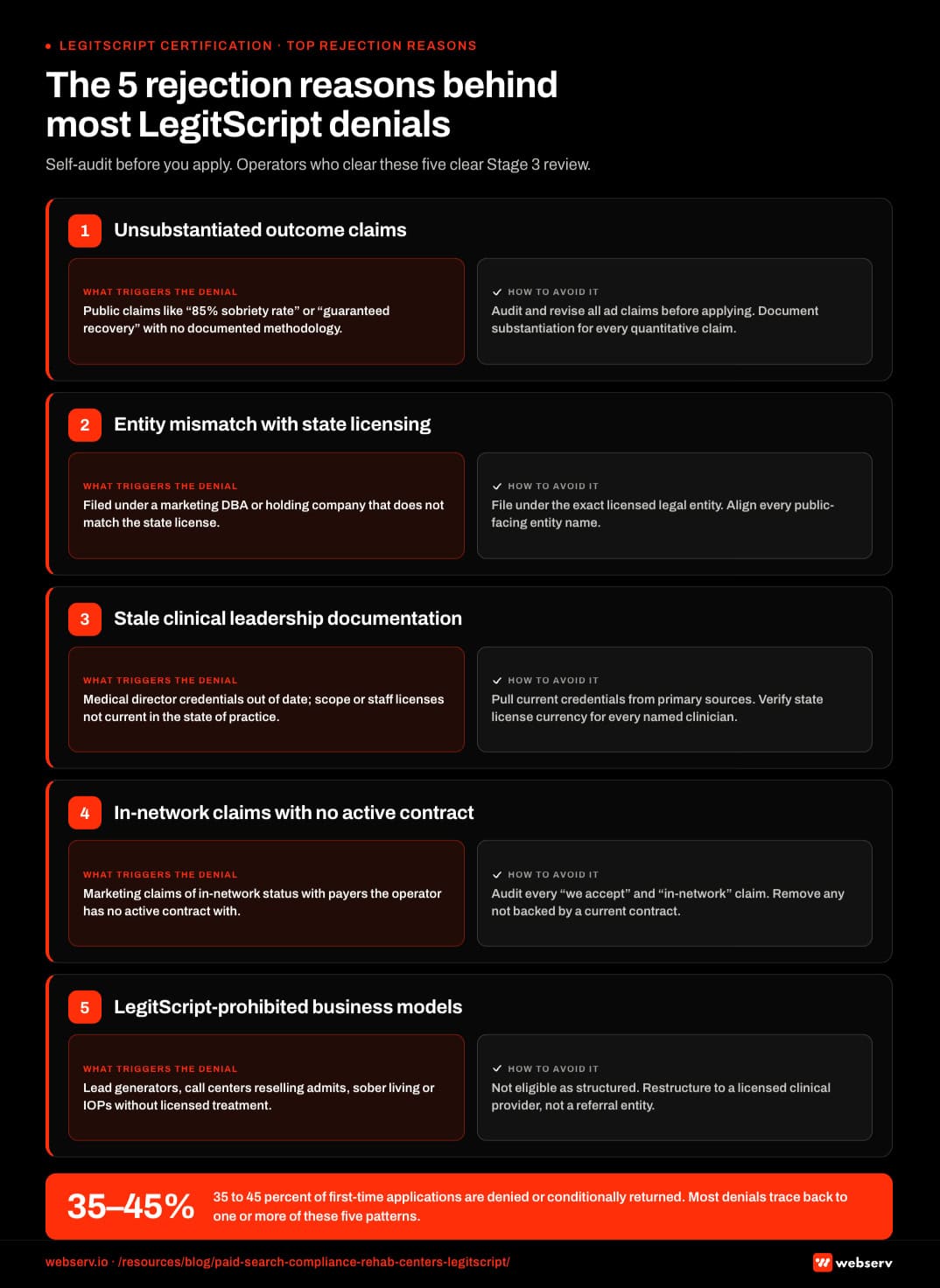 Infographic titled ‘The 5 rejection reasons that account for most LegitScript denials’.
License mismatch with services. The state license does not cover every level of care the program is advertising or billing. Common variant: a program licensed for outpatient substance use disorder services advertising residential treatment.
Clinical staff licensing gaps. A staff member listed on the application has an expired, suspended, or wrong-state license. Variant: the credentialing documentation shows a license at a level that does not match the service being delivered.
Medical director engagement insufficient. The MD is named on the application but the documentation does not show meaningful clinical oversight. This rejection is more common at smaller programs and at programs operating across multiple sites with a single MD.
Marketing claim substantiation gaps. The website publishes claims that the application cannot substantiate, or the application substantiates claims that are not consistent with what the website says. This category catches more applicants than any other.
Ownership disclosure incomplete. The application does not disclose all beneficial owners, parent organizations, or related entities. LegitScript identifies the gap through corporate filings or other public sources, which triggers an immediate rejection.
A rejection in any of these categories is remediable. The remediation work usually takes 2 to 6 weeks depending on what needs to be fixed. The application can be resubmitted after remediation, with a new fee for the resubmission cycle.
WHAT PASSING APPLICATIONS DO
- License covers every LOC the program will advertise
- Medical director engagement documented at the right hours
- Ownership and corporate structure disclosed in full
- Marketing claims pre-audited against LegitScript standards
- Address consistency across licensing, accreditation, and corporate filings
WHAT REJECTED APPLICATIONS SKIP
- License doesn’t list the level of care being advertised
- Medical director listed without time commitment evidence
- Ownership disclosure missing parent entities or affiliates
- Outcome claims (success rate, cure language) in active ad copy
- Mismatched addresses between license, accreditation, and Secretary of State
The annual renewal cycle
LegitScript certification is an annual obligation, not a one-time event. The certification is valid for 12 months, after which a renewal application is required.
The renewal process is shorter than the initial certification when the program has maintained alignment to the standards throughout the year. The renewal application reviews changes to licensing, staffing, ownership, marketing claims, and any compliance issues that surfaced during the certification year.
LegitScript also runs ongoing monitoring during the certification year. The monitoring includes website crawls for marketing claim changes, public records reviews for licensing and ownership changes, and periodic outreach for clarifying questions.
A program that experiences a meaningful change during the certification year, such as adding a new level of care, changing the medical director, or restructuring ownership, should notify LegitScript proactively. Failure to do so can trigger a mid-cycle review and, in some cases, certification revocation.
Mid-cycle revocations are the most expensive failure mode. A program that loses certification mid-year typically does not realize it until Google or Meta suspends advertising. By the time the suspension is identified and the certification status is investigated, several weeks have passed.
The annual renewal process should be calendared 90 days in advance. The renewal application is straightforward when the program has been operating cleanly. It becomes complex when the program has had material changes that were not proactively disclosed.
What certification costs and what the fee actually buys
LegitScript charges a $1,595 application fee and a $3,095 annual certification fee per facility for providers with one to nine facilities. The annual fee is the larger recurring cost, so budget for it every year, not only at application. Fees change, so confirm current pricing with LegitScript before you budget.
The fee structure is published, but program-specific pricing requires direct conversation with LegitScript.
The fee buys three things.
Verification of compliance. LegitScript verifies the program’s documentation against the published standards and issues certification when the verification is complete.
Listing in the LegitScript directory. The directory is publicly searchable and is the primary database that advertising platforms verify against.
Ongoing monitoring during the certification year. LegitScript actively monitors certified programs for changes that affect compliance. The monitoring is part of why advertising platforms trust the certification.
The fee feels meaningful, especially for smaller programs. The actual cost to evaluate is the lost advertising revenue from operating without certification, plus the lost time from going through multiple rejection cycles before achieving certification. The fee is a fraction of either.
A program that plans to spend $20,000 a month on paid search loses a full quarter of that spend, and the admissions it would have produced, during a one-quarter delay. The certification fees, $1,595 to apply and $3,095 a year per facility, are small against that opportunity cost.
How Profound Treatment drove 31 admits and a 42% drop in cost per viable in one quarter
Broad match pivot, negative keyword management, and intake-level conversion tracking turned a fragmented paid strategy into a predictable admissions engine.
Read the case study →68 viable VOBs at $4,529 cost per viable
What this means for the program operationally
LegitScript certification is the gating criterion for treatment center paid media. It is not optional for any program planning to acquire patients through Google, Bing, or Meta in the United States.
The programs that handle certification well treat it as an operational discipline rather than a paperwork submission.
The discipline has four parts.
Quarterly compliance reviews that cover licensing alignment, clinical staff credentialing, medical director documentation, ownership accuracy, and marketing claim substantiation. These reviews catch the issues that would otherwise trigger mid-cycle revocations or rejection on annual renewal.
A 90-day pre-renewal audit that simulates the renewal application before submission. The audit identifies any gaps that need remediation before the formal renewal goes in.
Proactive disclosure of material changes during the certification year. Adding a level of care, changing the medical director, modifying ownership, or making meaningful changes to the website all trigger a notification to LegitScript outside the normal renewal cycle.
A defined response protocol for any LegitScript outreach. The response window for clarification requests is typically 14 to 30 days. Programs that have an internal process for responding within that window do not lose certification to administrative gaps.
The first-time certification process is the one that gets most operator attention. The renewal cycle and the ongoing monitoring are what determine whether the certification stays in place once it has been earned.
Why certification is closer to a clinical audit than a marketing decision
The framing that produces successful certifications is treating the application as a clinical and operational audit rather than as a marketing function.
HOW TO THINK ABOUT THIS
LegitScript is not a marketing checkbox. It is a clinical-and-compliance audit dressed up as a certification. The reviewers are looking at the same evidence that state licensing boards and Joint Commission reviewers look at, applied to how the treatment center presents itself in advertising. Programs that treat certification as an SEO task rather than a clinical-ops task usually fail the first application and spend twice as long on renewal.
The standards LegitScript evaluates against are clinical standards. The licensing, the credentialing, the medical director engagement, the outcomes documentation, the ownership disclosure. None of those are marketing decisions. They are operational decisions that have to be in place before the program can advertise compliantly.
A program where marketing leads the certification process tends to treat the application as a forms problem. The team gathers what is available, fills in what they have, and submits. Rejections trigger panic and a scramble to find documentation that the operations team should have organized in the first place.
A program where compliance, operations, and marketing share ownership of the certification produces clean first-attempt applications. The work happens before the application is opened. The application is the closing step of an audit that the program has already passed internally.
That is the operating posture that produces 2-week certifications instead of 12-week certifications. The cost difference is a quarter of paid search admit volume, which on most treatment center budgets exceeds the lifetime cost of the certification process across multiple years.
What to do if your application is denied
A denial decision is not a permanent outcome. Most denials are remediable, and most remediated programs achieve certification on the second or third attempt.
The first step after a denial is to read the rejection feedback in detail. LegitScript provides specific feedback on which categories failed and why. The feedback is the roadmap for remediation.
The second step is to convene the operations, clinical, and compliance teams to address each rejection point. Remediation often requires changes to operations or documentation that take weeks to complete. Trying to resubmit before the underlying issues are fully remediated produces another rejection.
The third step is the resubmission. The resubmission requires a new application fee, which is one of the reasons it makes sense to remediate fully before resubmitting. A program that resubmits prematurely pays the fee twice and absorbs another delay cycle.
For programs with complex rejection patterns, consider engaging a healthcare compliance consultant or attorney with LegitScript-specific experience. The consultant fee is meaningful but is usually less than the cost of another failed resubmission cycle.
A program that has been denied twice should treat the third application as a project with executive ownership. The cost of a third denial is high enough that the project deserves the same operational rigor as a contract negotiation or an audit defense.
What success looks like at twelve months
A treatment center that handles LegitScript certification well has the following operational profile at the 12-month mark.
The certification was achieved on the first attempt within 4 weeks of application submission. The certification has been continuously valid since then. Mid-cycle changes were proactively disclosed to LegitScript and processed without issue.
The renewal application was submitted 60 days before expiration and was approved within 2 weeks. The annual monitoring fee was paid on schedule. No advertising platform has flagged the program for certification issues during the year.
The marketing operation has continued running paid search and paid social campaigns without interruption. Conversion volume has been consistent. The compliance posture has not been a constraint on the marketing strategy.
The cost of operating this way is the disciplined attention to certification that the entire team contributes throughout the year. The cost of operating any other way is suspension, lost admit volume, and the recovery work that comes after.
The certification is the cheapest insurance policy a treatment center can buy on its paid media operation. The fee is real. The cost of not having it is roughly 100x higher.
If the current paid search operation does not have a quarterly compliance review built in or a 90-day pre-renewal audit on the calendar, the certification is being treated as a paperwork item rather than as the operational discipline it actually requires. Operators who want a head-start on identifying paid social agencies that handle Meta LegitScript end to end can work from our scored shortlist of firms running the certification cadence as operational discipline.
That gap is closeable inside a quarter, and the foundation it builds is what every other paid media optimization gets to stand on.
That includes the work we cover in our guides to Quality Score in rehab Google Ads, building a negative keyword list for addiction treatment PPC, HIPAA-compliant conversion tracking setup, ad group structure for residential treatment Google Ads, and writing compliant ad headlines. Each of those depends on a certified, in-good-standing account to function. For how paid search fits the rest of the program, see our behavioral health marketing guide.
If you’d rather have a partner walk you through compliance, certification prep, and the paid search build that follows, book an intro call with Webserv.
Most in-house teams hit a wall not because they lack knowledge, but because they lack bandwidth.
When you are ready to hand it off, Webserv has spent 9 years executing exactly this for treatment centers nationwide.
Frequently asked questions about LegitScript certification
Which paid ad platforms actually require LegitScript certification?
Google Ads, Microsoft Ads (Bing), and Meta (Facebook and Instagram) all require LegitScript certification before a treatment center account can serve ads. That covers approximately 90 percent of the paid media inventory most treatment centers use. TikTok, LinkedIn, and programmatic display platforms have their own healthcare advertiser approval processes that overlap but are not identical to LegitScript.
The result is that without LegitScript, the major demand-generation channels are off-limits. Programs that try to run Google Ads without certification get accounts suspended within hours of campaign launch. Meta will reject ad creative at the moment of submission. The shutdown is automated and immediate.
We have seen treatment centers attempt to work around this with consumer-segment ad accounts or by using third-party platforms that obscure the advertiser identity. Both routes end the same way: the account gets flagged and access to the platform is permanently revoked.
Should we hire a consultant to manage the LegitScript application?
Most treatment centers benefit from outside help with their first LegitScript application, then handle renewals in-house. The application is detailed enough that small documentation gaps cause rejections. Renewals are simpler because the foundational documentation is already in place and you are demonstrating continued compliance rather than building it from scratch.
The right outside support is operational, not just legal. Compliance consultants who understand treatment center workflows can prevent rejection by anticipating the documentation LegitScript will ask for and helping you build it before submission. Lawyers without behavioral health experience tend to over-engineer the application.
At Webserv, we do not manage LegitScript applications directly, but we coordinate with compliance partners who do. The marketing side cannot launch until the certification is in place, so the application timeline is tracked alongside campaign readiness.
How does LegitScript certification work for telehealth-only treatment programs?
Telehealth-only treatment programs (no physical facility) need LegitScript certification the same way brick-and-mortar facilities do, but the documentation requirements differ. Instead of state licensing and facility inspection records, telehealth applicants must demonstrate state-by-state clinician licensing for every state they treat patients in, plus HIPAA-compliant technology and prescriber DEA registration for any MAT services.
The trap most telehealth applicants fall into is incomplete state-by-state clinician licensing. LegitScript wants documentation that every clinician on the panel is licensed in every state where they see patients. Programs running ads nationally without comprehensive multi-state licensing get rejected for scope of practice.
The cleaner approach for new telehealth programs is to limit advertising to states where clinician licensing is complete, then expand as the licensing footprint grows. Trying to certify for all 50 states without the underlying licensing is a fast path to denial.
What is the actual timeline from application submission to running ads?
Most treatment centers see LegitScript certification approved within 90 to 120 days of submission when the documentation is complete on first pass. Applications that need follow-up requests for additional documentation typically extend to 5 or 6 months. Applications with significant documentation gaps can run 6 to 9 months or be denied outright.
After certification, Google Ads and Meta require their own healthcare advertiser approval, which is faster (typically 1 to 2 weeks for Google Healthcare Advertiser certification) but still adds time before ads can serve. Plan for 4 to 6 months from application start to first ad live.
For new programs planning a marketing launch, the LegitScript application should be one of the first projects after licensure, not one of the last. Treating it as a marketing prerequisite that runs in parallel with all other launch work prevents the campaign-ready-but-cannot-advertise problem that kills early census ramps.
Do we need separate LegitScript certifications for each treatment location?
Most multi-location treatment center operators run one LegitScript certification that covers all of their locations under a single legal entity. LegitScript certifies the operating entity, not the individual facility. The locations are listed within that certification with their own state licensing documentation, but the certification itself is unified.
The exception is when locations operate under different legal entities (separate LLCs, separate parent companies, or franchise structures). In those cases each entity needs its own certification. This catches some operators by surprise when they acquire a new facility through a separate corporate structure and discover the certification does not transfer automatically.
When acquiring or opening a new location under an existing certified entity, the new location can be added to the existing certification through a documentation update rather than a fresh application. The process is faster but still requires LegitScript review, and the new location cannot be advertised until that update is approved.