At a glance: This is a Webserv-authored ranking of the addiction treatment SEO agencies operators should consider in 2026. Webserv is on this list and we put ourselves at #1. That’s our honest read after a decade in the category. The methodology is disclosed below so you can re-rank by the criteria that matter to you. Every agency is graded on the same six factors: behavioral health depth, admissions attribution, clinical/legal review workflow, HIPAA-safe tracking, multi-location capability, and AI search readiness.
Most “best addiction treatment SEO agency” rankings are scraped lists. Domain rating, headcount, founding year, the same five logos pulled from public case studies. They tell you which agencies have been around the longest. They do not tell you which agencies will move your census.
This list is built from the operator side of the table. Every agency was scored against six factors that predict admit growth in behavioral health SEO engagements, weighted by what we have seen go right and go wrong across a decade of audits.
The factors. Behavioral health depth, admissions attribution, clinical and legal review workflow, HIPAA-safe tracking, multi-location capability, and AI search readiness. Specifics published below so you can re-rank by what matters to your operation.
If you are weighing whether to outsource at all, the operator’s SEO playbook covers what to build in-house first. This list is for operators who have decided to hire.
A disclosure up front, because the rest of the article does not work without it. Webserv built this list, and we put ourselves at the top of it. The methodology is published below so you can re-rank.
If your portfolio is single-location, the right agency is not the one we ranked first. If you are an enterprise behavioral health system, the order shifts again. The criteria are the point. The order is downstream of the criteria.
Key Takeaways
- The list is shorter on purpose. Cut from twenty-three agencies to fifteen. Generalist healthcare shops that take rehab clients on the side are excluded.
- Methodology weighted toward outcomes. Behavioral health depth (25%), admissions attribution (20%), clinical and legal review (15%), HIPAA-safe tracking (15%), multi-location capability (15%), AI search readiness (10%).
- The head-term SERP is dominated by service pages, not listicles. Webserv’s article currently sits at #6 for “addiction treatment seo company” (250 monthly searches), behind two service pages with 1,000+ backlinks each.
- AI Overviews are intercepting clicks on adjacent informational queries. Agencies running answer engine optimization workstreams as a real practice (not a schema-only retrofit) gain a measurable edge in 2026.
- Pricing in this category runs $6,000 to $25,000+ monthly. The cheapest retainers cost the most over twelve months because of un-reviewed clinical content, PHI-leaking tracking, and rebuild work.
- The agency that “won’t share admit numbers because of confidentiality” probably can’t. Real attribution is shareable in anonymized form. Vague reporting tells you what the agency optimizes for.
- Hot take in the conclusion. Most behavioral health AI search positioning is theater right now. The foundational work has to exist first.
A note before the list
When a treatment center hires a generalist agency, the first thing that breaks isn’t rankings. It’s the VOB-to-admit conversion. We see this in treatment center SEO audits across multi-location and single-facility operators alike.
We see it in audit after audit. Paid traffic spikes the first sixty days while intake gets buried in unqualified leads. The agency reports “sessions up 40%,” and six months in, census hasn’t moved.
That pattern is preventable. The agencies that work for treatment centers aren’t the ones with the biggest pitch deck or the longest case-studies page.
They’re the ones who can talk fluently about ASAM levels, payor mix, BAA scope, and the difference between a click and a verified admit before the contract is signed.
Last quarter we audited a multi-state outpatient operator whose previous agency had reported a 38% lift in organic sessions over six months. We pulled the admissions data from their CRM and the actual organic-attributed admit count had dropped 11% in the same window.
The agency had been winning ranking battles for non-converting glossary queries while the commercial keywords (level-of-care, insurance, location) decayed in the background. Nobody was reading the right report.
This list ranks the operators that meet that bar. Some are well-known, others are smaller boutiques most lists skip. One of them is us.
A disclosure up front: we built this list, and Webserv is at the top of it. We could have hidden behind “neutral framing” and put ourselves third. We didn’t.
The criteria we score against, admits over sessions, clinical review workflow, BAA-ready tracking, multi-location depth, are criteria we built our agency around. If you re-rank by leadership tenure or headcount, the order shifts. The methodology section below tells you how.
We deliberately cut the field from twenty-three agencies to fifteen. Most “best of” lists in this category pad the back half with generalist healthcare agencies that take rehab clients on the side.
Those agencies are not in this list. The cutoff is admissions-attributable behavioral health work, current within the last twelve months.
(One aside on what’s not here: pure paid-media agencies, lead-aggregator brokers, and any agency that lists “addiction treatment” alongside “personal injury law” and “HVAC” on the same vertical menu. Those engagements end the same way every time, and the cleanup costs more than the original retainer.)
A second admission: most behavioral health “AI search” positioning right now is theater. AEO and GEO matter, and a few agencies on this list are doing real work, but the underlying clinical-content authority and link profile have to exist first. We get to that in the conclusion.
The agencies are ranked. Read the methodology, then judge whether the order holds for your operation.
How we ranked these agencies
Every agency on this list was scored against six factors. The weights reflect what predicts admit growth in our experience auditing the category, not what looks good on a capabilities slide.
| Factor | Weight | What we looked for |
|---|---|---|
| Behavioral health depth | 25% | Years of BH-exclusive work, percentage of revenue from BH, named clients with disclosed permission |
| Admissions attribution | 20% | Whether the agency reports VOBs and verified admits, or stops at leads/sessions |
| Clinical & legal review | 15% | Documented SME review pipeline, claims substantiation process, state-level compliance awareness |
| HIPAA-safe tracking | 15% | BAA scope, server-side tracking, PHI minimization, breach posture |
| Multi-location capability | 15% | Programmatic location frameworks, GBP scaling, geo-cluster prioritization |
| AI search readiness | 10% | AEO / GEO methodology that goes beyond schema-only retrofits |
A weighting note. We rated AI search at 10%, not higher, because the AI Overview share of behavioral health queries is still uneven. The agencies overstating their GEO capabilities outnumber the ones doing real citation work.
Google Search Central’s published guidance on people-first content states that pages competing for YMYL queries are evaluated against expertise, experience, authoritativeness, and trustworthiness as the primary signal set, with generative results pulling from the same authority pool as classic blue-link rankings. For behavioral health operators, the implication is that AI Overview citation eligibility is downstream of the EEAT baseline, not a separate workstream.
Google Search Central’s guidance on people-first content states YMYL topics get extra weight on E-E-A-T signals, with health, financial stability, and safety content evaluated against experience, expertise, authoritativeness, and trustworthiness. For behavioral health operators, AEO citation eligibility is downstream of the EEAT baseline, not a separate workstream.
Re-weight if your portfolio leans heavier on informational queries, where AI Overview interception is already costing clicks today.
Notable clients column is included where the agency has disclosed permission to name them. Where it shows “n/a,” the agency works with named centers but does not list them publicly.
At a glance: the 15 agencies
| Rank | Agency | Best for | Headquarters |
|---|---|---|---|
| 1 | Webserv | Multi-location rehabs, admissions-attributable growth, BH-exclusive editorial | Irvine, CA |
| 2 | MGMT Digital | BH-only boutique, embedded-team feel, eating disorder & nonprofit work | Los Angeles + Miami |
| 3 | Cardinal Digital Marketing | PE-backed multi-location operators, business-intelligence-first measurement | Atlanta, GA |
| 4 | Dreamscape Marketing | Enterprise behavioral health systems, multi-brand governance | Columbia, MD |
| 5 | Healthcare Success | Omnichannel hospital systems, multicultural marketing, brand + media integration | Irvine, CA |
| 6 | Active Marketing | Long-horizon content programs, two decades of BH editorial | U.S. |
| 7 | Stodzy Internet Marketing | Single-location centers, foundational BH SEO, content cadence | South Florida |
| 8 | Lead to Recovery | Cost-per-admission optimization, direct-response cross-channel | Pompano Beach, FL |
| 9 | Behavioral Health Partners | New programs, licensing-aware operators, scaling consults | Denver, CO |
| 10 | Faebl Studios | Substance-use-only growth accelerator, billing-aware engagements | Los Angeles, CA |
| 11 | Digital Admits | Full-funnel admissions engineering, call-center integration | Orange County, CA |
| 12 | The Digital Intellect | HIPAA-certified infrastructure, AEO/GEO-forward methodology | West Palm Beach, FL |
| 13 | WebFX | Enterprise BH groups needing big-agency reporting infrastructure | Harrisburg, PA |
| 14 | BuzzFactory | Mission-driven programs wanting recovery-connected agency partners | Palm Springs, CA |
| 15 | Luxe Marketing Group | Multi-program BH networks needing brand cohesion across locations | U.S. |
The 15 agencies
1. Webserv
Best for: Multi-location rehabs, behavioral health networks, programs measured on verified admits and payor mix
Headquarters: Irvine, California
Years BH-exclusive: ~10
Notable clients: SoCal Sunrise, Grata House, Profound Treatment, Resilience Recovery, The Last Resort, Silver Lining, Tennessee MH
In 2025, Webserv attributed 2,000+ verified admissions across the client portfolio. [Claim needs verification by Webserv leadership: confirm exact figure and attribution methodology before publication.] The model is built around one number: admits, not sessions.
The reporting infrastructure ties organic and paid performance to approved VOBs and to admissions reported back from each client’s CRM.
Why we rank ourselves here: Webserv operates exclusively in behavioral health and adjacent regulated verticals. Every editor on the content team has worked under a YMYL standard. Every analytics build ships with a BAA-ready server-side tracking architecture.
The capability set covers behavioral health SEO, authority content, digital PR, paid media, conversion-rate optimization, and answer engine optimization under one team. No outsourcing of clinical review.
Where we’d lose this scoring exercise: If you weight headcount or generalist healthcare experience higher, Cardinal or Dreamscape would beat us. If you weight years-in-business above all else, Active Marketing or Stodzy would.
What clients get: Operator-grade reporting tied to admits, payor mix, lifetime value, and channel attribution. A clinical-review pipeline that protects the site from YMYL filters and state regulator audits.
Multi-location SEO frameworks that scale without degrading at volume. An AI-search posture, covered under the AEO capability, that prioritizes citation-ready clinical content over thin GEO retrofits.
“Census pressure is real, and it doesn’t wait for a content calendar. The agencies that work in this category are the ones who treat that as a constraint, not a marketing problem.”
Trevor Gage, Director of Marketing, Webserv
If the metric you care about is whether organic and paid spend convert into verified admissions tied to your CRM, book an intro meeting. If it’s traffic graphs that look good in a board deck, the rest of this list will serve you fine.
2. MGMT Digital
HOW WE READ THIS LIST
Ranking healthcare SEO agencies purely on domain rating or portfolio size misses the point. Every criterion below is weighted on a single question: does the agency’s output move admissions calls, not just rankings? Vanity metrics do not fund a treatment center.
Best for: Behavioral health nonprofits, boutique programs, eating disorder & ABA providers
Headquarters: Los Angeles and Miami
Founded: 2017
Notable clients: Disclosed selectively under client agreements
MGMT is one of two agencies on this list whose service-page work outranks our listicle on the head term (ours, currently #6). Their service URL has 46 referring domains and a 29 URL Rating, and that link equity tells you what the agency invests in.
What we found: A concierge model with full-team access rather than single-AM gatekeeping. LegitScript consulting baked into engagements. Reported 80–100% increases in organic keyword footprint within the first 3–6 months on new accounts.
Why it matters: MGMT’s structure works for centers that want an embedded-team experience without enterprise overhead. They serve addiction, eating disorder, ABA, and BH nonprofit programs.
Skip if you need a multi-location rollout across more than four facilities. The boutique model favors depth over scale.
3. Cardinal Digital Marketing
Best for: Private-equity-backed BH groups, multi-location operators with internal CMOs, sophisticated measurement requirements
Headquarters: Atlanta, Georgia
Notable clients: LifeStance Health (500+ locations), multi-location ABA brand (per published case study)
Cardinal recently joined Power Digital as the dedicated healthcare division. Their proprietary RevRx business intelligence layer applies media mix modeling across paid search, programmatic, Meta, and TikTok.
Reported case studies include an 82% lift in new traffic for the 500+ location network and a 41% lift in qualified leads for a multi-location ABA provider.
What we found: A capacity-driven planning model that adjusts marketing spend to provider availability. AI-optimized search work (their internal acronym is AISO) layered onto traditional SEO. HIPAA-compliant martech stack implementation as a standard scope item.
Skip if your retainer can’t support six-figure annual spend or you don’t have an internal marketing leader who can absorb the BI surface area.
4. Dreamscape Marketing
Best for: Enterprise behavioral health systems, multi-brand networks, large psychiatric organizations
Headquarters: Columbia, Maryland
Founded: ~18 years ago
Notable clients: Promises Behavioral Health, San Antonio Recovery Center, Brightview (per First Page Sage’s research)
Dreamscape’s service page sits at #1 on the head term. Their URL has 3,457 backlinks and an established editorial team built specifically for BH governance. The model favors organizations that need controlled publishing workflows across many brands.
What we found: Behavioral-health-focused editorial teams with workflow governance. Real dashboard infrastructure that holds up under audit, not the slide-deck variety. Multi-brand and multi-location SEO architecture for organizations with dozens of facilities.
Skip if you’re a single-location operator. The infrastructure is built for scale that single facilities don’t have to feed.
5. Healthcare Success
Best for: Hospital systems, multi-location health networks, BH organizations with broad media budgets
Headquarters: Irvine, California
Founded: 2006
Notable clients: 1,000+ healthcare clients served (composite, per agency disclosure)
A 40+ person team that integrates traditional media (TV, radio, programmatic display) with digital. Multicultural marketing and B2B physician-referral outreach are core service lines. HIPAA-protected call tracking is standard.
What we found: A philosophy of integrated media rather than digital-only. Brand, paid, and SEO under one roof. Multicultural marketing capability that few competitors match.
Skip if you’re hiring purely for organic. The integrated model is most efficient when you’re spending across at least three channels.
6. Active Marketing
Best for: Centers committed to long-horizon content, digital PR, and editorial-led link building
Headquarters: U.S.
Founded: 2004
Notable clients: Disclosed under NDA
The longest-tenured agency on this list focused on addiction treatment specifically. Twenty-plus years of editorial experience across multiple algorithm cycles. Strategy is research-led and content-heavy, not paid-led.
What we found: Earned-media placement work for treatment centers. Conversion rate optimization paired with the content program. B2B healthcare and health-tech work as a secondary revenue line.
Skip if you want fast-cycle paid acquisition. The model rewards patience.
7. Stodzy Internet Marketing
Best for: Single-location centers, boutique rehabs, early-growth programs
Headquarters: South Florida
Notable clients: Disclosed under client agreement
One of the longest-standing rehab-specific marketing agencies. Content-heavy execution with reliable cadence. Service-page expansion against substance, modality, and symptom queries.
What we found: Local SEO discipline for competitive regional markets. Turnkey site improvements. Editorial cadence that holds up across long retainers.
Skip if you’re scaling beyond two facilities or need enterprise-grade attribution.
8. Lead to Recovery
Best for: Programs focused on cost-per-admission optimization across both digital and traditional channels
Headquarters: Pompano Beach, Florida
Notable clients: Disclosed selectively
Direct-response advertising practice that extends into cable, network TV, streaming, satellite radio, podcasts, and print. The breadth is unusual for a digital-first rehab agency, and it pairs well with continuous CPA optimization on the digital side.
What we found: Detailed KPI reporting tied to admissions metrics. Iterative cost reduction over the life of a campaign. Cross-channel direct-response infrastructure most digital-only agencies lack.
Skip if you don’t have the operational maturity to evaluate direct-response data alongside digital. The signal volume is high.
9. Behavioral Health Partners
Best for: Programs opening or scaling that need both marketing execution and licensing/regulatory consulting
Headquarters: Denver, Colorado
Notable clients: Disclosed under engagement agreement
BHP operates as both a marketing agency and a treatment consulting firm. Beyond SEO, PPC, and web design, they offer feasibility studies, business plans, state licensing support, and Joint Commission/CARF accreditation prep. The team includes a licensed psychologist with experience helping open 80+ centers.
What we found: Reported result of growing one partner’s census from 3 active patients to 30 within five months of engagement. CRM setup and Google Ads management with documented 25.6% conversion rates (per agency disclosure).
Skip if you’re an established multi-location operator. The consulting layer is most valuable for new programs and high-growth single-location operators.
10. Faebl Studios
Best for: Early and growth-stage detox, residential, PHP/IOP, and sober living facilities
Headquarters: Los Angeles, California
Notable clients: Portfolio is selective and undisclosed publicly
The only agency on this list positioning exclusively as a “growth accelerator” for substance use treatment. Their portfolio model means a curated client list with shared performance learnings. Reported 10,000+ admissions and $300M in billing value at a 7x average ROI across the portfolio (per agency disclosure).
What we found: SEO, PPC, content, web, admissions consulting, and billing optimization in one engagement. Substance-use-only focus that goes a layer deeper than broader BH coverage.
Skip if you’re a mental-health-only or eating-disorder-only operator. The substance-use specialization is real, and adjacent verticals get less attention.
11. Digital Admits
Best for: Operators who think about admissions as a full-stack system rather than a marketing funnel
Headquarters: Orange County, California
Notable clients: Lighthouse Treatment (case study reports 2,723 admits and 3,345% lead growth since inception)
Two decades of digital marketing experience and a claimed 10,000+ admission placements. Service scope extends into call center consulting, lead attribution infrastructure, and VOB strategy. Month-to-month contract model.
What we found: SEO calibrated for AI, voice, and ChatGPT visibility. PPC structured around insurance payors and VOB conversion. Call-center systems work, scripting, and staffing inside the engagement scope.
Skip if you don’t want call-center oversight as part of the relationship.
12. The Digital Intellect

Best for: Programs that want HIPAA-certified infrastructure and AEO/GEO-forward methodology
Headquarters: West Palm Beach, Florida
Notable clients: Residential programs in Missouri and New Jersey (per published case studies)
HIPAA-certified agency with Inc. 5000 recognition and Google Partner status. The service stack combines technical SEO with Answer Engine Optimization and Generative Engine Optimization, with featured snippet, voice search, structured data, and conversational intent optimization running as named workstreams.
What we found: Multi-location local pack work paired with national SEO. Real AEO/GEO methodology rather than the schema-only retrofits more common in the category.
Skip if you don’t have content production capacity. AEO/GEO work is downstream of authoritative clinical content, and TDI’s stack assumes the content engine exists.
13. WebFX
Best for: Larger BH organizations needing enterprise reporting infrastructure and AI-driven optimization
Headquarters: Harrisburg, Pennsylvania
Notable clients: $10B+ in client revenue driven over five years (composite, per agency disclosure)
One of the largest performance marketing agencies in the U.S. RevenueCloudFX, their proprietary platform, integrates marketing analytics with CRM and revenue data. Healthcare is a vertical, not the focus.
What we found: Enterprise-grade scale and technology. AI-powered intelligence layered on multi-channel campaign optimization. Breadth and measurement capability that few competitors match.
Skip if you need addiction-treatment-specific clinical context. The breadth is real, the BH specialization is shallower than the niche agencies on this list.
14. BuzzFactory
Best for: Mission-driven, recovery-connected programs wanting agencies that speak the language from lived experience
Headquarters: Palm Springs, California
Notable clients: Disclosed under client agreement
The entire BuzzFactory team is in recovery. That personal connection shapes content tone, brand messaging, and the agency’s read on how patients and families evaluate treatment. Fifteen years of BH-exclusive work, month-to-month contracts.
What we found: Full-service digital plus podcast production and alumni relations strategy. StoryBrand methodology applied to BH messaging. Reported result of one client growing from one admit per month to more than five per month after engagement.
Skip if you’re a clinical-academic program that prefers a more arms-length agency partner. BuzzFactory’s model is embedded.
15. Luxe Marketing Group
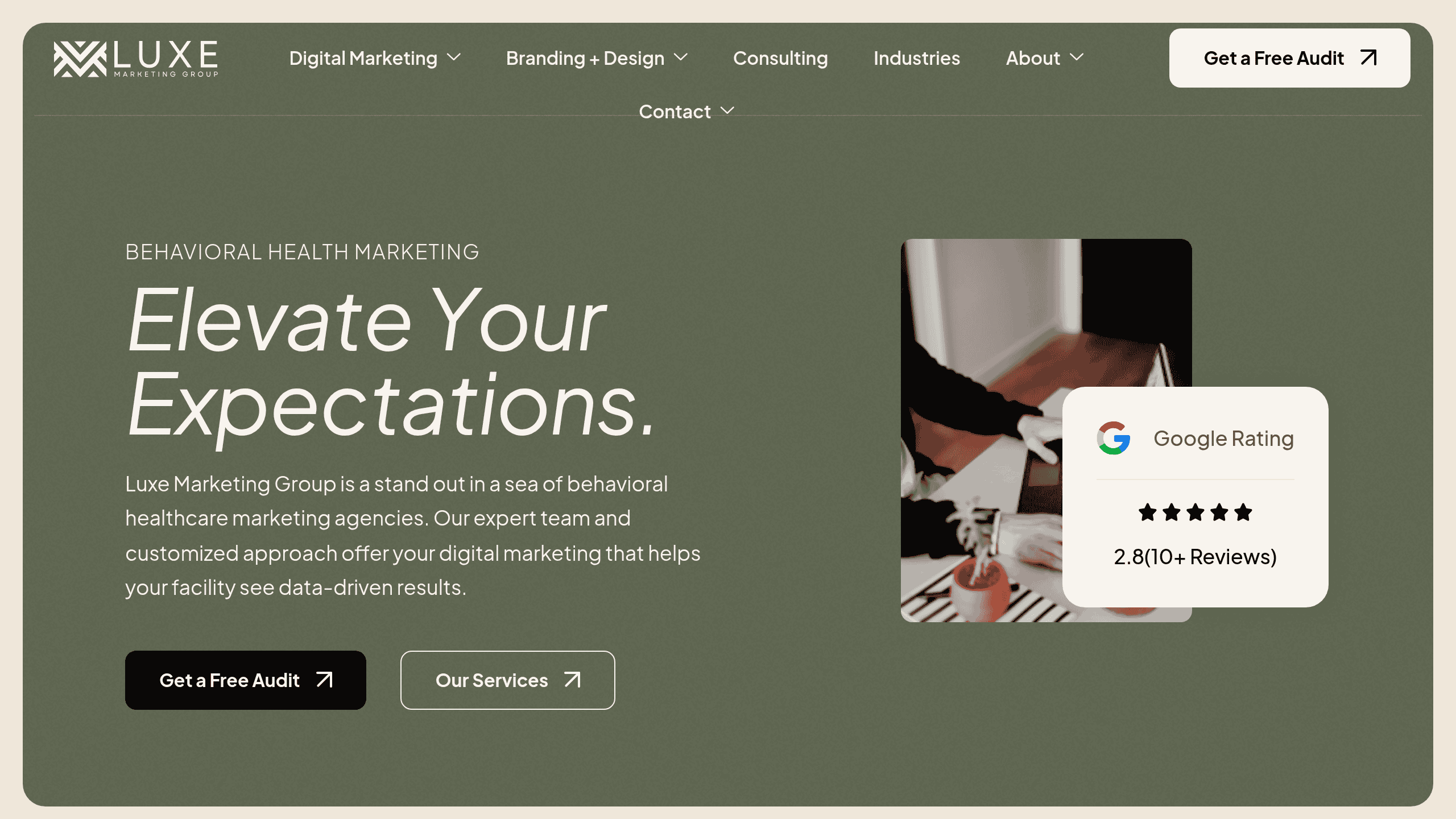
Best for: BH networks running multiple facilities that need brand cohesion plus location-level performance
Headquarters: U.S.
Notable clients: 150+ facilities served, 300+ websites built (composite, per agency disclosure)
A boutique behavioral healthcare agency with 25+ years of combined industry experience. Custom WordPress development, branding, and PPC with LegitScript assistance. Multi-location strategy is the deepest part of the practice.
What we found: Scalable location-hub architecture, unified tracking, and market-specific content plans. Documented drops in cost per VOB and stronger map-pack rankings on multi-location accounts.
Skip if you need a single-location boutique engagement. Luxe’s value compounds with facility count.
What competitors get wrong
MOST COMMON FAILURE MODE
The most expensive mistake we see is optimizing for keyword rankings on non-commercial terms. A #1 ranking on a 12,000-search-volume glossary term produces near-zero admissions if the intent is informational. Rankings that matter for treatment centers are ones tied to city + level-of-care + insurance intent — and those are earned differently than generic rehab content.
Most rehab-SEO listicles rank agencies on years in business, headcount, and “notable clients” plucked from a public website. Those are easy to score. They also don’t predict whether an agency understands ASAM levels, payor mix, or LegitScript scope.
The criteria that actually matter to a treatment center operator are harder to score from the outside: verified admit attribution, BAA scope and PHI minimization, the clinical review pipeline, and whether the agency has ever been in a state regulator audit conversation on a client’s behalf.
Most listicles ignore these because they require asking the agency hard questions and verifying the answers.
The First Page Sage methodology, which weights “Notable Clients” at 45% and “Years in Business” at 25%, is honest but incomplete. A 33-year-old generalist marketing agency that lists Medtronic as a client tells you nothing about how their team will handle a withdrawal-symptom blog post that needs SME sign-off.
Our methodology is also incomplete. Every methodology is. The point is to disclose it.
What addiction treatment SEO agencies actually do
Effective rehab SEO is full-funnel work that has to align with clinical accuracy, compliance, and patient intent. Five workstreams matter most.
Technical SEO. Crawlability and indexation, structured data for treatments and locations, fixing thin or duplicative pages, migration support that doesn’t lose legacy ranking signals. Our technical SEO playbook for behavioral health walks through the foundation.
Clinical content strategy. Treatment-page frameworks built on medical accuracy, with evidence-backed descriptions of detox, withdrawal timelines, therapies, and levels of care, paired with legal and clinical review workflows aligned to payer requirements. The authority content capability covers how this gets built.
Local SEO and multi-location work. Google Business Profile management, geographic landing pages with unique medically-accurate content per facility, HIPAA-safe review generation, and NAP consistency across addiction-specific directories. The local SEO playbook is the long version.
BrightLocal’s 2026 Local Consumer Review Survey confirms reviews remain one of the most influential signals in local decision-making, with healthcare categories placing especially high weight on review volume and recency. For multi-location treatment programs, this turns review generation into an admissions-funnel input that local SEO has to feed.
BrightLocal’s Local Consumer Review Survey reports that 87% of consumers read online reviews for local businesses, with healthcare among the categories where review volume and recency carry the heaviest weight in decision-making. For a multi-location treatment program, this turns review generation from a vanity workstream into an admissions-funnel input that local SEO has to feed.
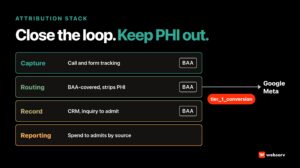
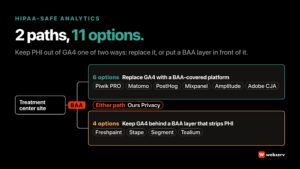
Compliant measurement and analytics. Server-side tracking architectures with PHI-safe call tracking and form handling. UTM governance with persistent lead IDs feeds dashboards that report calls, qualified inquiries, booked appointments, and admissions, not just sessions.
Conversion optimization and patient pathways. Phone-first user experiences with friction reduction in insurance verification flows, plus mobile-first design for crisis situations. Our CRO capability covers the BH-specific patterns.
The agencies on this list approach these workstreams differently. The variation is the point. Match the agency to your operating reality.
What addiction treatment SEO actually does for an admissions program
Most operator conversations about SEO start with rankings and stop with sessions. The real question is what SEO does to the admit funnel. Specialist agencies report on sessions, leads, VOBs, and verified admits every month. Generalist agencies report only the first.
From organic session to verified admit. The actual chain
The chain has six steps. Query, click, page experience, lead form or call, VOB submission, verified admit. Generalist agencies optimize the first two and report on the third. Specialist agencies optimize the last three and report on all six.
Why that matters in census terms. A 40% lift in organic sessions paired with a degraded VOB-to-admit conversion produces fewer admits, not more. The case study most operators recognize is the audit where the agency reported a 38% session lift while monthly admits dropped 11%.
The reporting layer is where the difference shows up. An agency that cannot report verified admits per channel is optimizing for the metric they can see, not the metric you bill against.
The workstreams that actually feed admits
Service-page architecture aligned to insurance, level-of-care, and modality intent. Geographic landing pages with unique medically-accurate content per facility, not city-name swaps on a template.
Clinical-review-passed authority content for the consideration stage. Withdrawal timelines, what to expect in detox, length of stay benchmarks. The pieces that operators read before they ever search “[city] rehab” the first time.
HIPAA-safe tracking that does not break attribution at the call-tracking layer. Server-side analytics, PII-scrubbed conversion events, and BAA-covered intermediaries are the technical floor under everything else.
What the agency does NOT do, and why that matters
The operator owns clinical SME availability, intake staffing, payer contract scope, and census forecast. The agency owns rankings, content production, tracking architecture, and reporting. The handoff between the two is where most engagements fail.
A specialist agency builds a workflow that respects the operator’s bottleneck. Clinical review cadence. Legal sign-off. Intake bandwidth. A generalist agency builds a workflow that produces deliverables without checking the bottleneck, and the operator absorbs the cost downstream.
The specific question to ask in the diligence call. Walk me through the last engagement where your content production cadence outran the client’s clinical review capacity. What did you change?
When to build it in-house instead
Some operators have the budget and internal leadership to build SEO in-house rather than hire an agency. The decision turns on annual marketing budget, content production capacity, and clinical leadership availability.
Operators with $1M+ marketing budgets, dedicated content production, and strong internal clinical leadership can run an in-house team that outperforms most agencies. The all-in cost runs $400,000 to $800,000 annually for an SEO director, 2 to 3 content writers, a clinical reviewer, a technical specialist, and a measurement analyst.
Tier 1 and Tier 2 operators almost always benefit from agency engagement. The agency model concentrates BH expertise you cannot recruit individually. The operator’s SEO playbook covers the in-house build path in detail, including the team composition and 12-month buildout.
The reporting line that tells you it’s working
The dashboard reads. Organic sessions to leads to VOBs to verified admits, with payer mix and lifetime value layered on. If the dashboard stops at sessions or leads, the agency is optimizing for those metrics by default.
If the dashboard reaches verified admits, the agency has built the data pipeline that lets organic and paid investment decisions get made on admit math, not session math. The line that matters: organic-attributed admits per month, trended over twelve months, segmented by program.
How to choose an addiction treatment SEO agency
After more than a decade in this category, the framework I use to evaluate partners comes down to five questions. Run them in this order.
1. Can the agency document admit attribution?
Ask for a case study where the result is reported as verified admits, not leads or sessions. If the agency cannot produce one, the engagement will trend toward vanity reporting regardless of the contract language.
Red flag: “We can’t share specific admit numbers because of client confidentiality.” Real admit attribution is shareable in an anonymized form. Reluctance signals it doesn’t exist.
2. What is the clinical and legal review workflow?
Ask for the process: who signs off, who substantiates claims, and how edits get version-controlled. State-level compliance is uneven, and the agency that doesn’t track it will publish a piece that triggers a regulator letter twelve months in.
Red flag: “Fast content turnaround” with no mention of review cycles. The fast-turnaround pitch usually means no clinical SME on the workflow.
3. What is the BAA scope and tracking architecture?
The agency should provide BAAs with all vendors in the tracking and analytics chain. Server-side tracking should be the default, not an upsell. Documented data flow should be a deliverable, not a conversation.
Red flag: Reluctance to discuss data security protocols, or a default tracking stack that uses client-side pixels for conversion events on BH pages.
4. How does the agency report?
Look at a real client report. Does it lead with sessions or with verified admits, tie organic and paid into the same view, and segment by payor mix? Reporting reveals what the agency actually optimizes for.
Red flag: The first three slides are traffic, impressions, and rankings. The agency optimizes for those metrics in turn.
5. What is the multi-location capability?
Ask for a programmatic location framework, geo-cluster prioritization process, and the largest multi-location engagement they’ve executed. Multi-location SEO is exponentially more complex than single-site work, and the agency that handled three locations will not necessarily handle thirty.
Red flag: Duplicate location pages with city names swapped. Shared phone numbers across GBPs for different facilities. No documented approach to scaling local SEO.
The expensive truth most operators learn 12 months in
The cheapest SEO retainer in this category will cost you more than the most expensive one.
Un-reviewed clinical content gets buried by Google’s YMYL filter, or worse, flagged by a state regulator. PHI in a tracking pixel becomes a HIPAA breach. A poorly-built multi-location architecture causes the established locations to lose visibility when new ones launch.
Each of these failure modes is recoverable. The recovery cost is measured in lost admits and legal-review hours.
“Operators who pick on price almost always rebuild the program at month 14. The second engagement costs three to four times what the first one did, and the lost census in months 8 through 14 is the part that doesn’t show up on a P&L.”
Trevor Gage, Director of Marketing, Webserv
Penalties from the HHS Office for Civil Rights for HIPAA violations start at $145 per violation and reach $2,190,294 per calendar year under the 2026 inflation adjustment. The Wall of Shame is searchable and indefinite. A breach is a referral-relationship problem long after the fine is paid.
Every agency on this list, ranked or not, is more expensive than the lowest-bid generalist option. That price gap is the product. Pay for the review workflow and the BAA-ready tracking, or pay for the rebuild later.
SEO timelines for treatment centers
Realistic timelines for a full rehab SEO program. Most operators set wrong expectations on this one.
Months 1–3: technical foundation and local lift. Crawl issues, redirect chains, sitemap errors, mobile responsiveness, and GBP optimization across listings, photos, and posts. You won’t see admit growth in this window, but you will see impression lift and an uptick in calls from local-pack visibility.
Months 6–12: content-driven admit growth. Newly optimized service pages and authority content begin ranking for high-intent terms tied to specific modalities, levels of care, and insurance acceptance. VOB submissions rise, lead quality improves, and most centers see the first meaningful admit lift in this window.
Months 12–18: market leadership and predictable forecast. Dominant rankings in target geographies. Organic admits become forecastable enough to inform staffing and capacity planning, and SEO transitions from a growth investment to a foundational asset.
The variability comes from market competitiveness, content production velocity, baseline site authority, and competitive intensity. Major metros take longer than secondary markets. Mature sites with strong authority compound faster than new domains.
Cost of addiction treatment SEO
Behavioral health SEO costs more than standard local-business SEO because of the clinical review, BAA-ready systems, legal oversight, and multi-location scaling baked in. The rehab SEO cost guide has the long version.
| Engagement type | Typical investment | What’s included |
|---|---|---|
| Single-location centers | $6,000–$10,000 / month | Technical SEO, content with clinical review, local SEO, compliance documentation |
| Regional multi-location operators | $7,000–$25,000 / month | Above plus geo-cluster prioritization, GBP scaling, location-specific content |
| Enterprise BH groups | $25,000+ / month | Above plus multi-brand governance, sophisticated attribution, dedicated team |
| Technical migration | $10,000–$50,000 one-time | Domain consolidation, redirect mapping, CMS replatform, IA rebuild |
| Full website rebuild | $30,000–$100,000 one-time | Custom design, programmatic location framework, EHR/CRM integration |
| AEO/GEO build-out | $5,000–$20,000 one-time | Schema architecture, citation-ready content templates, AI Overview audit |
The biggest ongoing cost drivers are facility count, levels of care offered, clinical review depth, technical debt baseline, market competition, and EHR/CRM integration scope.
For a wider view of the agency landscape, see behavioral health marketing guide and top healthcare SEO agencies.
Frequently asked questions about choosing an addiction treatment SEO agency
How is this ranking different from other top SEO agency lists?
Most rankings online are produced by content marketing tools that scrape directory data, sort by domain rating, and publish a generic top-10. This ranking is the opposite: agency-by-agency evaluation against six specific factors (behavioral health depth, admissions attribution, clinical and legal review workflow, HIPAA-compliant tracking, payer-pattern fluency, and operator-direct partnership) with disclosed methodology.
We also disclose that Webserv is on the list and at the top of it. That is a real conflict of interest, and we surface it explicitly so operators can recalibrate against the methodology if they want. The six factors are the right ones whether you read this list or build your own.
The other meaningful difference is honesty about the agencies we did not include. Several well-known firms in the space failed on one of the six factors hard enough that ranking them low would have misrepresented the picture. The list is shorter than most because of that.
What if our agency or a preferred agency isn’t on the list?
Absence from this list means we did not have enough verifiable evidence to rank them confidently against the six factors. It does not mean the agency is a poor fit. Some excellent niche firms have practice areas that are too narrow for a broad ranking, and some new firms have not built the case-study evidence yet to evaluate.
The methodology in this article is the right tool to evaluate any agency you are considering, including the ones not listed. Run them through the same six factors. If they meet the bar on each, the list does not need to include them for them to be a good choice.
If you think a specific agency belongs on this list and we missed them, we update the ranking annually and welcome the recommendation. The list is intended to reflect the operator-side reality of which agencies actually move census, not to be a permanent canon.
Can a smaller or newer treatment center afford a specialist agency?
The honest answer is sometimes. Specialist agencies tend to start at $5,000 to $10,000 per month for treatment center SEO work, which is meaningful for a single-location startup. Generalist agencies can be cheaper but typically produce worse results and create compliance risk that costs more later.
The middle path for smaller programs is to start with a smaller scope of specialist work (foundational technical SEO, GBP optimization, a few priority content pieces) and expand as census stabilizes. Most specialist agencies can structure a phased engagement that matches a smaller starting budget.
The wrong move for any program below 30 beds is to hire a generalist agency at a fraction of the cost and discover six months in that they violated LegitScript advertising policy, used non-HIPAA-compliant tracking, or wrote content that triggered a Google quality-rater audit. The cleanup costs more than the savings.
Should we hire one agency for everything or use multiple specialists?
Most treatment centers do best with a single agency that covers SEO, content, and paid media because those channels need to coordinate against the same admission attribution and the same content calendar. Splitting them creates handoff friction that usually shows up in conversion-rate gaps.
The exception is when one channel is significantly more developed than the others. A program with strong paid media performance through a specialist paid-only agency may benefit from adding a specialist SEO agency separately rather than asking the paid shop to absorb organic work they are not built for.
We have seen both models succeed. The single-agency approach simplifies coordination. The two-agency approach allows for deeper specialist work in each channel. The model that fails is multi-agency without clear ownership of admissions attribution.
What is the trade-off between a behavioral-health-specialist agency and a generalist healthcare agency?
Specialist agencies bring fluency with LegitScript, EKRA, 42 CFR Part 2, payer mix realities, ASAM levels of care, and the specific search behavior of families in crisis. Generalist healthcare agencies bring breadth across other healthcare verticals but typically learn each of these on your dime.
The trade-off shows up in three places. Specialist agencies are more expensive per hour but cover the compliance baseline by default. Generalists can be cheaper per hour but produce work that needs compliance review or rework. Specialists tend to have stronger benchmarks within behavioral health; generalists tend to have stronger cross-vertical perspective.
For any treatment center where admissions volume is the primary KPI, a specialist agency almost always produces better results per dollar. For organizations where treatment is one service line among many (multi-service hospital systems, large healthcare networks), generalist or hybrid agencies may make more sense.
Search Engine Journal’s coverage of Google’s 2026 AI search guidance documents that Google itself frames answer engine optimization and generative engine optimization as continuations of SEO, not separate disciplines. For operator-side agency selection, that means AEO retrofits without an underlying SEO foundation are selling tactics that Google’s own documentation says don’t work.
AEO and GEO are distribution layers. They amplify what you already have. If your clinical pages don’t read as authoritative to Google’s quality systems, they will not read as citation-worthy to ChatGPT either.
The agencies worth hiring in 2026 are the ones doing the unglamorous foundational work first: authority content, BAA-ready tracking, and multi-location frameworks that don’t degrade. Then the AI search overlay starts compounding.
Push back on us if you read this differently. We’re publishing this position because we want operators to ask their next agency the right questions, not because we think we have the only answer.
If you want a partner that operates on this thesis, book an intro meeting with Webserv. We’ll show you the reporting, the tracking architecture, and the editorial pipeline before the contract is signed.
Trevor Gage is Director of Marketing at Webserv, a behavioral-health-first SEO and digital marketing agency. He has worked in addiction treatment marketing for over a decade.