Anchor text is the clickable words in a hyperlink that help search engines understand the linked page’s topic and relevance, making it an important element of search engine optimization. Optimizing anchor text with relevant, natural keywords strengthens internal linking structure and improves rankings through strategic SEO practices.
What Is Anchor Text?
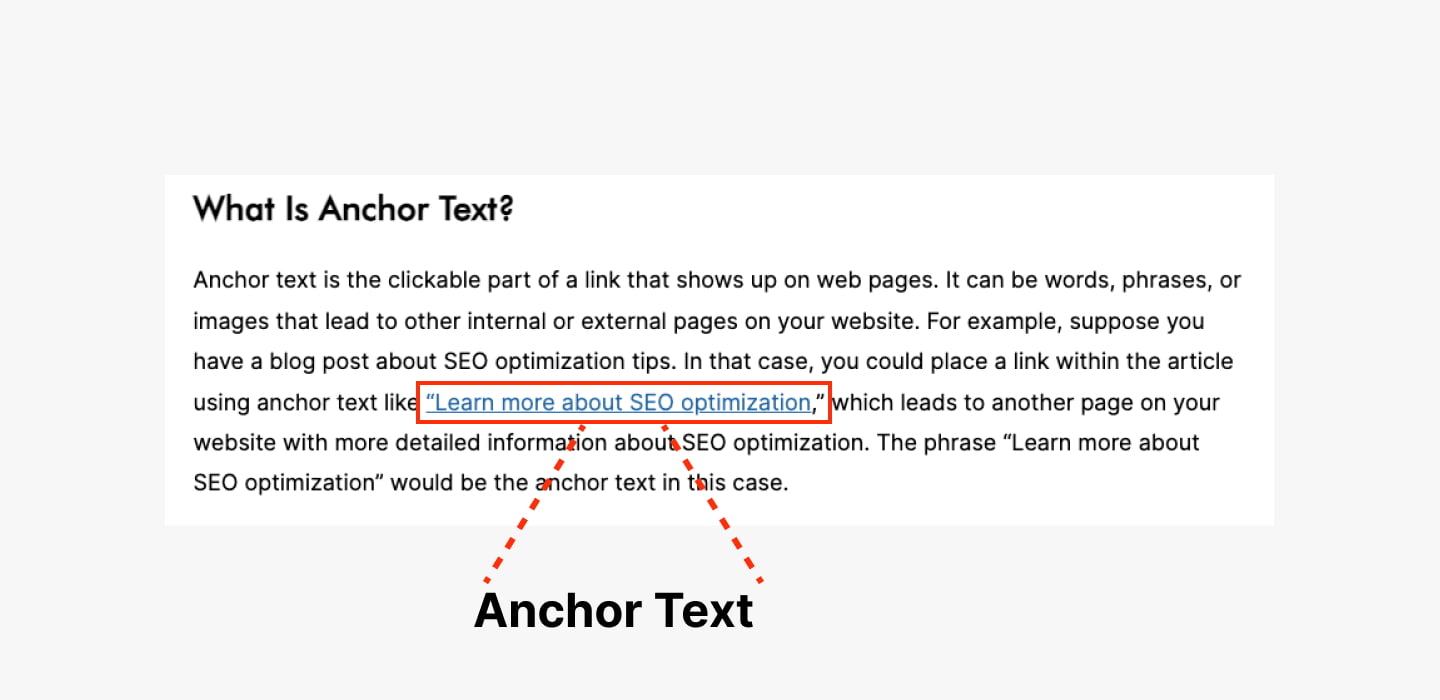
Anchor text is the clickable part of a link that shows up on web pages. It can be words, phrases, or images that lead to other internal or external pages on your website. For example, suppose you have a blog post about SEO optimization tips. In that case, you could place a link within the article using anchor text like “Learn more about SEO optimization,” which leads to another page on your website with more detailed information about SEO optimization. The phrase “Learn more about SEO optimization” would be the anchor text in this case.
How Does Anchor Text Help With SEO?
Anchor texts are important for two reasons when it comes to SEO: relevancy and indexing. Relevancy means that the words used in the anchor text should accurately reflect what the webpage linked to is about. This helps search engine algorithms understand what kind of content they can expect from each page and therefore where they should position it in their rankings list.
Indexing refers to getting pages indexed by Google so they can appear in searches; when someone uses anchor text with appropriate keywords included as part of a link pointing back to another page on your site, it signals Google that these two pages are related. This helps Google index them both faster, increasing their chances of showing up on SERPs (search engine results pages).
How To Add Anchor Text?
Adding anchor text involves editing HTML code, but there are plenty of tools available online (like WordPress plugins) that make this process much simpler for non-coders, too; most CMS platforms like WordPress allow you to simply highlight existing words in your content and turn them into clickable links using just point-and-click actions without having to edit any code at all!
Make sure you always use relevant keywords when creating anchors so that users and search engines know exactly where each link will take them before clicking on it!
Anchor Text Example
Say you have an eCommerce website selling shoes online, and you want more visitors coming directly to your product page instead of your homepage first. You can include links with anchors like “shop now” or “buy shoes here” pointing directly at the product page from various other places around your website; adding these links will help Google better understand what those product pages are actually about so they get higher rankings in SERPs when people search for specific kinds of shoes like running shoes or leather boots etc.
In addition, it also provides users with an easier way to navigate around your site and get them quickly where they need to go without having to manually search for what they need first through menus or navigation bars, etc.
Anchor Text FAQ
What is anchor text in SEO?
Anchor text is the visible, clickable text of a hyperlink. In the link Webserv, the word “Webserv” is the anchor text. Search engines use anchor text as a signal about the destination page’s topic and relevance.
Anchor text works on both inbound links (from other sites to yours) and internal links (from one page on your site to another). Both types influence how Google understands what a linked page is about.
What are the main types of anchor text?
Exact-match anchor text uses the exact keyword you want the target page to rank for (“drug rehab marketing”). Partial-match uses a variation (“marketing services for drug rehabs”). Branded uses your brand name (“Webserv”). Naked URLs are just the URL itself. Generic anchors are non-descriptive (“click here,” “learn more”). Image alt text serves as anchor text for image links.
A natural link profile mixes all six types. Over-reliance on exact-match anchor text on inbound links is a well-documented spam signal that can trigger algorithmic penalties.
How do I write good anchor text for internal links?
For internal links, prefer descriptive anchor text that tells both users and search engines what the linked page covers. “Read our lead generation playbook” is stronger than “click here.”
Use exact-match keywords more freely in internal links than in inbound links (you control internal links, so there’s no natural-profile concern). Keep anchor text under 10 words. Ensure the anchor text and destination page topic clearly match; misleading anchors damage user trust and Google’s page understanding.
How does anchor text affect SEO rankings?
Anchor text is one of Google’s oldest and most stable ranking signals. Links to your page with anchor text like “drug rehab marketing” reinforce that the page should rank for that query. This is why over-optimizing anchor text was a common early SEO tactic and why Google’s Penguin algorithm updates specifically targeted unnatural anchor text distributions.
Modern anchor text strategy: build inbound links naturally through genuinely useful content and outreach, control internal anchor text to reflect the true topic of the destination page, and never buy links or coordinate anchor text campaigns designed to manipulate rankings.
Further reading
Authoritative sources: Google Search Central documentation. Related glossary entries: canonical tag, click-through rate.