Mental health and addiction treatment center SEO is the strategic process of improving a healthcare facility’s online visibility so people actively seeking help can find accurate, trustworthy, and compliant information at the exact moment they’re ready to take the next step toward care.
Search engine optimization for treatment centers is no longer optional—it’s the foundation of predictable admissions growth. When patients and families search for help, they rely on local results, authoritative content, and trustworthy signals to choose where to call.
This treatment center SEO guide walks through every pillar of a modern, compliance-aware treatment center SEO program so you can improve visibility, increase calls, and build a reliable admissions pipeline.
What is Treatment Center SEO?
Treatment center SEO is the practice of optimizing a mental health or addiction treatment provider’s website, content, and local presence so it appears prominently when people search for services like “inpatient rehab,” “IOP near me,” or “dual diagnosis treatment.” It includes building service and location pages, publishing clinically accurate educational content, optimizing Google Business Profiles, improving site speed and structure, and earning credible backlinks.
You might perform treatment center SEO in-house or hire an addiction treatment SEO agency to do the work on your behalf.
6 Benefits of Treatment Center SEO in 2026
Treatment center SEO helps mental health and addiction providers reach the right people at the right time—when they’re actively searching for care and support.
- Higher-Intent Patient Traffic: SEO targets people already searching for treatment options, leading to more qualified calls, form fills, and admissions.
- Increased Trust & Credibility: Educational, clinically accurate content and strong search visibility position your center as a legitimate, trustworthy provider.
- Lower Long-Term Acquisition Costs: Unlike paid ads, organic rankings continue to drive leads over time without rising cost per click.
- Stronger Local Visibility: Optimized location pages and Google Business Profiles help your center appear in “near me” and map-based searches.
- Better Conversion Rates: SEO-driven users are typically further along in the decision process, making them more likely to take action.
- Sustainable, Scalable Growth: A strong SEO foundation supports consistent admissions growth while reducing reliance on volatile ad platforms.
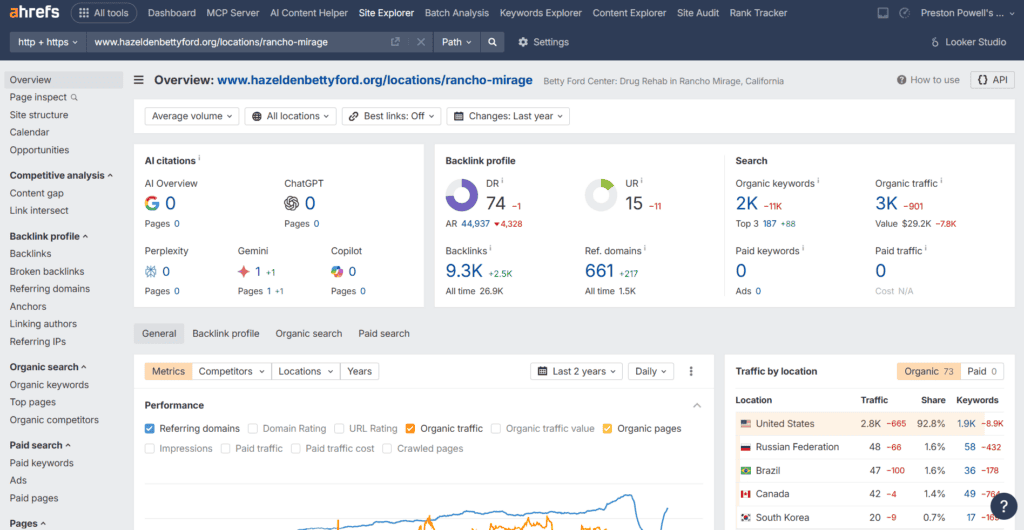
SEO Strategy #1: Content Strategy for Treatment Center SEO
Effective content strategy builds trust, answers patient concerns, and signals clinical credibility — all while supporting rankings for intent-driven searches. High-quality treatment center content should guide readers from early research to taking action, helping them feel informed and supported throughout the decision-making process.
Build High-Intent Pages That Convert
- Location pages with localized content, FAQs, maps, and staff credentials
- Treatment program pages for detox, residential, PHP, IOP, MAT, and outpatient care
- Insurance & admissions pages that clarify expectations
- Resource and blog content that answers clinically relevant, search-driven questions
- Patient stories (only with written consent)
Develop Authority and Search Visibility
Every page should build topical relevance. Many treatment operators start with a services + locations architecture, then supplement with high-value educational content. If you need structured support, our content SEO team can help you build a scalable roadmap.
When your content communicates clarity, clinical expertise, and empathy, it becomes a competitive advantage in both search rankings and referral trust.
SEO Strategy #2: Local SEO and Google Business Profile
There are ~21,205 eligible substance use + mental health treatment facilities in the U.S., according to a 2024 survey. That’s the top-level indicator of how crowded the provider landscape is, especially once you narrow by state, level of care, and payer mix.
Local SEO sits at the center of treatment center discoverability, and getting it right means pairing accurate business data with a well-optimized Google Business Profile (GBP) and localized content that reinforces your service area. Together, these elements signal to Google that your center is credible, relevant, and active in your local community.
Build a Strong GBP Foundation
- Maintain strict NAP consistency across your website, GBP, and directories
- Select the exact primary category (Addiction Treatment Center)
- Add detailed service descriptions and compliant business information
- Enable messaging or appointment links that align with HIPAA workflows
- Upload current, privacy-safe photos
- Publish GBP posts weekly to maintain relevance
Strengthen Local Ranking Signals
Local performance is influenced by proximity, listing accuracy, reviews, user interactions, and relevance. These small factors compound into major gains over time. To go deeper on local tactics, review our guide on Local SEO for rehab centers.
A strong GBP establishes your center as a trustworthy option in the Map Pack — and when paired with local content and citation accuracy, it becomes one of the most reliable drivers of admissions.
SEO Strategy #3: Technical SEO and Site Architecture
Technical SEO ensures your site loads quickly, is secure, and allows search engines to fully understand and index your content. A well-structured site doesn’t just improve rankings — it directly improves patient experience and makes it easier for people to get help.
Prioritize Technical Foundations
- Optimize for mobile first
- Use HTTPS and maintain secure hosting
- Compress imagery and implement CDN support
- Maintain clean URLs and strong internal linking
- Update XML sitemaps and robots.txt
- Implement canonical tags to prevent duplication
Support Crawlability and Conversion
Technical structure influences how your pages appear in search and how easy it is for patients to navigate your site. Improving these foundations also enhances tracking accuracy, structured data visibility, and overall conversion performance.
A healthy technical foundation ensures search engines index your most important content — and that patients can reach your admissions team without friction.
SEO Strategy #4: Citations, Directories, and Data Aggregators
Accurate citations reinforce the legitimacy of your treatment center across the web. They act as validation points for your NAP data and are essential for maintaining strong local search performance over time.
Claim and Optimize High-Value Directories
- Google Business Profile
- Bing Places
- Apple Maps
- SAMHSA treatment locator
- Psychology Today (when applicable)
- AddictionCenter, Rehab.com, Healthgrades
Tip: Ensure listing consistency. Citation consistency reduces ranking volatility and supports a reliable patient discovery experience. When your directory ecosystem stays clean and consistent, your local SEO becomes more stable and scalable.
SEO Strategy #5: Reputation Management and Online Reviews
Reviews carry enormous influence for patients and families considering care. Strong reputation management supports local rankings and builds trust at a deeply emotional moment in someone’s decision journey.
Create a Compliant Review Workflow
- Request reviews after non-sensitive interactions
- Use neutral, privacy-safe language
- Provide direct links to GBP and other platforms
- Respond empathetically without revealing PHI
- Escalate sensitive issues offline
Strengthen Trust Over Time
Responded-to reviews signal credibility to both Google and prospective patients. For additional support, see our guide on healthcare reputation management.
A steady flow of real, positive feedback becomes one of the strongest trust signals your center can maintain.
SEO Strategy #6: Content Cadence and Editorial Priorities
Consistency drives SEO momentum—especially in healthcare, where authority and freshness play major roles in ranking. A strategic cadence ensures your content stays aligned with patient intent and regulatory requirements.
Recommended Publishing Rhythm
- 1 in-depth blog or resource per week
- Regular updates to location and service pages
- Weekly GBP posts
- Quarterly editorial planning based on analytics
Prioritize High-Impact Content First
Start with service and location pages, then layer topical blogs and FAQs. This structure helps search engines understand your expertise and strengthens your site’s natural authority.
Publishing consistently (not constantly) ensures you grow without overwhelming your clinical or compliance teams.
SEO Strategy #7: Tracking, Attribution, and Measurement
Accurate tracking turns SEO from a traffic metric into an admissions engine. You need end-to-end reporting and insights into how searchers become callers, and how callers become admitted patients.
Implement a Full-Funnel Tracking Stack
- GA4 with enhanced measurement
- Google Search Console
- UTM parameters on every campaign
- Call tracking that preserves source data
- GCLID/UTM capture on forms
- CRM → analytics integration for offline admissions
Measure What Truly Matters
This setup lets you calculate cost per admission, compare channels, and prioritize what produces the best clinical and financial outcomes. When tracking is aligned with admissions, SEO becomes a predictable and measurable growth channel.
SEO Strategy #8: Conversion Rate Optimization for Calls and Forms
Conversion rate optimization (CRO) ensures patients can reach you quickly and easily — especially during moments of urgency. Even small improvements significantly increase admissions without requiring more traffic.
Make Conversion Paths Clear
- Persistent click-to-call buttons
- Highly visible admissions hours
- Short, intuitive intake forms
- Clear expectations for what happens next
- Tailored landing pages for high-intent searches
Explore deeper CRO improvements through our conversion optimization services. Strong CRO ensures your SEO efforts translate into real admissions rather than unconverted traffic.
SEO Strategy #9: Structured Data and Trust Signals
Structured data helps search engines understand your services, locations, and credibility. It plays a vital role in both rankings and AI-generated summaries.
Essential Schema Types
- LocalBusiness / MedicalOrganization
- Service (detox, residential, PHP, etc.)
- FAQPage
- Review / AggregateRating
- BreadcrumbList
- WebPage / Article
Reinforce Trust and Indexability
Schema helps your content stand out in SERPs and provides machine-readable clarity to AI systems. Properly implemented structured data supports richer search results and strengthens overall visibility.
SEO Strategy #10: AI Overviews and Generative Engine Optimization (GEO)
AI-generated answer summaries (like Google’s AI Overviews) are reshaping search visibility. Preparing now ensures your content is consistently selected and cited.
Structure Content for AI Readability
- Add concise summaries at the top of key pages
- Use structured question-and-answer blocks
- Strengthen E-E-A-T signals
- Add schema (FAQ, Service, LocalBusiness, etc.)
- Provide clear, fact-based claims
Content that is clean, factual, and well-structured is more likely to be referenced by AI systems. By preparing for generative search now, you future-proof your admissions pipeline.
SEO Pro Tip: Compliance and Privacy for Healthcare
Compliance underpins every aspect of marketing in behavioral healthcare. SEO content and review responses must follow strict privacy standards to protect both patients and your organization. Compliance failures can damage rankings, reputation, and licensure. Maintaining documented guardrails ensures stable, low-risk SEO performance.
When compliance is embedded into your processes, your marketing remains durable and trustworthy.
Uphold HIPAA-Safe Marketing Standards
- Never disclose PHI publicly
- Avoid promises or guaranteed outcomes
- Document clinical claims
- Use secure, HIPAA-compliant forms
- Maintain defined review-response workflows
SEO Pro Tip: Ongoing SEO vs One-Time Projects
SEO isn’t a one-time checklist; it’s an ongoing program aligned with how people search and how treatment markets change.
Why SEO Must Be Continuous
- Competitors evolve
- Search behavior shifts
- Algorithms update
- Clinical programs expand
- New locations require new pages
Foundational fixes create stability, but momentum comes from continuous content, reputation management, and technical health. Ongoing SEO ensures your admissions pipeline stays strong even as the digital landscape shifts.
SEO Pro Tip: Link SEO to Admissions and ROI
SEO success must be measured in admissions, not just rankings. Align your KPIs with meaningful patient acquisition outcomes.
Admissions-Focused KPIs to track:
- Organic sessions to high-intent pages
- Calls and forms attributed to SEO
- Organic conversion rates
- Cost per admission
- Payer mix
- Lifetime value
This approach lets you confidently allocate budget and forecast admissions volume. When SEO ties directly to patient outcomes, it becomes one of the most accountable and scalable acquisition channels available.
Can a drug rehab SEO company guarantee a #1 ranking in Google?
No reputable SEO company can guarantee a number one ranking in Google because rankings depend on many variables outside an agency’s control, including competitor actions, algorithm updates, domain authority, and local relevance. Responsible vendors can guarantee deliverables like technical fixes, content production, and improvements in visibility or traffic.
How long before we start seeing phone calls and admissions from SEO?
Time to impact varies by market competitiveness, site baseline, and effort. Local GBP optimizations and citation corrections can produce increased phone calls within a few weeks, while organic traffic and consistent admissions often emerge in a 3-6 month window for faster markets and 6-12 months for more competitive areas.
Which directories and citation sources matter most for rehab centers?
Claim and maintain profiles on Google Business Profile, Bing Places, and Apple Maps, and list on specialty directories like SAMHSA treatment locator, Rehab.com, AddictionCenter, Psychology Today, and Healthgrades. Local chamber of commerce pages and state provider registries also help visibility with referral partners.
How much does healthcare SEO cost?
Healthcare SEO typically costs between $4,000 and $8,000+ per month, depending on competition, location, and scope of services. Larger treatment centers in competitive markets often require higher investment due to compliance, content depth, and authority needs.
Is paying someone to do SEO worth it?
Yes—when done correctly, SEO delivers long-term, high-intent patient leads at a lower cost than paid advertising. Professional SEO also reduces compliance risks and accelerates results compared to trial-and-error approaches.
What is SEO in healthcare?
SEO in healthcare is the practice of optimizing medical and behavioral health websites to rank for patient-driven searches like “mental health treatment near me” or “addiction rehab.” It combines technical optimization, compliant content, and local SEO to attract and convert patients ethically.
What does SEO stand for?
SEO stands for Search Engine Optimization. It is the process of improving a website’s visibility in search engines to drive relevant, organic traffic.
Ready to Increase Admissions With a Proven Treatment Center SEO Strategy?
If you’re ready to strengthen your visibility, attract more qualified inquiries, and build a predictable admissions pipeline, our team can help. Request a free SEO & local visibility audit.
You’ll receive a prioritized roadmap covering your GBP, citations, content gaps, tracking issues, and the quickest opportunities to increase admissions.