Key Takeaways
- SEO and PPC serve different roles but work best together.
- SEO builds sustainable authority and organic growth.
- PPC drives immediate traffic and precise audience targeting.
- A blended strategy produces the best ROI.
- Data should flow between both strategies to optimize faster.
What Is SEO? (Search Engine Optimization)
Search engine optimization (SEO) is the process of increasing your website’s visibility in organic search results by improving both what users see and what search engines evaluate.
Modern SEO combines technical performance, user experience, and content relevance to help your site earn higher rankings and attract qualified traffic that converts. Here is a breakdown of the parts of SEO management:
Keyword Optimization
Keyword optimization is about matching your content to what real users are searching for. This includes:
- Researching high-intent and long-tail keywords
- Optimizing page titles, meta descriptions, headings (H1–H3), and URLs
- Using natural, semantic keyword variations
- Structuring content so search engines can understand topical relevance
Successful keyword optimization focuses less on “stuffing” and more on search intent, creating pages that actually answer the question the user is asking.
Technical SEO
Technical SEO ensures that your website is accessible, indexable, and fast. If Google can’t crawl or load your site efficiently, your rankings will suffer regardless of how good your content is.
Core technical SEO components include:
- Page speed optimization
- Mobile-first indexing
- XML sitemaps and proper site architecture
- Clean URLs and structured navigation
- Secure HTTPS setup
- Fixing crawl errors and broken links
- Implementing structured data/schema markup
Think of technical SEO as your site’s foundation. Without it, content cannot perform.
Content Creation
Content is what ultimately earns traffic, but it must be written for people first and search engines second. SEO content should:
- Solve a problem or answer a question
- Demonstrate expertise and authority
- Include keywords naturally
- Provide structure using headings and lists
- Be updated regularly to maintain accuracy
High-performing content types include:
- Blog articles
- Service pages
- Location pages
- Guides and tutorials
- Case studies and FAQs
The better your content satisfies user intent, the longer users stay, the more they engage—and the better you rank.
Backlink Acquisition
Backlinks are incoming links from other websites, and they act as “trust signals” to search engines. The more reputable sites that link to you, the more authority your site gains.
Effective backlink strategies include:
- Publishing valuable content others want to reference
- Digital PR and press features
- Guest posting on relevant industry sites
- Earning links through partnerships and mentions
- Fixing broken backlinks and reclaiming lost links
Not all links are equal. Quality matters far more than quantity.
UX and Core Web Vitals
User experience (UX) and site performance are direct ranking factors. Google measures site quality using Core Web Vitals, which track:
- Loading speed
- Visual stability
- Interactivity
- Mobile usability
- Page structure
A great SEO strategy ensures:
- Pages load quickly
- Content is easy to read
- Navigation is intuitive
- Design is mobile-friendly
If users stay longer, interact more, and bounce less, rankings improve.
Local SEO Optimization
Local SEO is essential for businesses that serve a geographic area. It helps your site appear in local search results and Google Maps.
Local SEO includes:
- Optimizing your Google Business Profile
- NAP consistency (Name, Address, Phone)
- Collecting and responding to reviews
- Creating location-specific pages
- Local backlinks and citations
- Geo-targeted keyword optimization
For service-based businesses, local SEO often drives some of the highest-converting traffic.
| Pros of SEO | Cons of SEO |
| Builds long-term authorityDrives free, sustained trafficHigh trust and credibilityCost-efficient over timeSupports e-commerce and lead generation | Takes time to show impactHighly competitive marketsAlgorithm changes require strategy shiftsRequires consistent output |
What Is PPC? (Pay-Per-Click Advertising)
Pay-Per-Click advertising (PPC) is a digital marketing model in which businesses pay a fee each time a user clicks on an ad.
Instead of earning traffic organically over time, PPC allows brands to instantly appear at the top of search engines and across digital properties to capture high-intent users at the moment they’re ready to act.
Purpose of PPC
PPC is designed to drive immediate, targeted traffic through paid platforms such as:
- Google Ads
- Meta (Facebook & Instagram) Ads
- Microsoft Advertising (Bing)
- YouTube
- Display networks and mobile apps
The primary advantage of PPC is speed—you can launch a campaign and begin generating traffic the same day.
Types of PPC Campaigns
1. Search Ads
Search ads appear at the top of search engine results when users actively search for a keyword. These ads are intent-based, meaning the user is already looking for a solution.
Search ads are ideal for:
- Lead generation
- Service-based businesses
- High-intent queries like “near me” or “hire” searches
- E-commerce product discovery
They operate on keyword bidding and relevance, with success driven by:
- Keyword targeting
- Ad copy quality
- Quality Score
- Landing page relevance
Display Network
Display ads appear visually across websites, apps, and email platforms through graphic or dynamic placements.
Display advertising is best for:
- Brand awareness
- Retargeting campaigns
- Prospecting new audiences
- Upper-funnel audiences
Google’s Display Network reaches millions of websites and apps, allowing your brand to stay visible even when users aren’t actively searching.
Shopping Ads
Shopping ads display products directly in search results with:
- Price
- Image
- Seller name
- Reviews
These ads are powered through Google Merchant Center and are performance-driven.
Shopping ads work best for:
- E-commerce brands
- Product comparisons
- Price-sensitive consumers
- High-volume SKUs
They combine automation and bidding strategies to maximize ROAS (Return on Ad Spend).
YouTube Ads
YouTube ads allow brands to advertise through video across the world’s second-largest search engine.
YouTube ad formats include:
- Skippable and non-skippable videos
- In-stream ads
- Discovery ads
- Short-form video placements
Use cases:
- Product education
- Brand storytelling
- Retargeting
- Awareness campaigns
Video is especially effective for nurture campaigns and visual learning.
Retargeting / Remarketing
Remarketing targets users who have already interacted with your website, ads, or content.
This strategy increases:
- Conversion rates
- Brand recall
- Sales velocity
Retargeting works by serving ads to:
- Site visitors
- Cart abandoners
- Past converters
- Video viewers
- Email subscribers
Because these users already know your brand, remarketing typically produces the highest ROI of any PPC campaign type.
| Pros of PPC | Cons of PPC |
| Immediate trafficHyper-targeting by intent and behaviorFast testing of landing pages and messagingRapid audience feedbackExcellent for time-sensitive promotions | Costs scale with competitionTraffic stops if budget stopsPoor execution burns money quicklyRequires constant optimization |
SEO vs PPC: Side-by-Side Comparison Chart
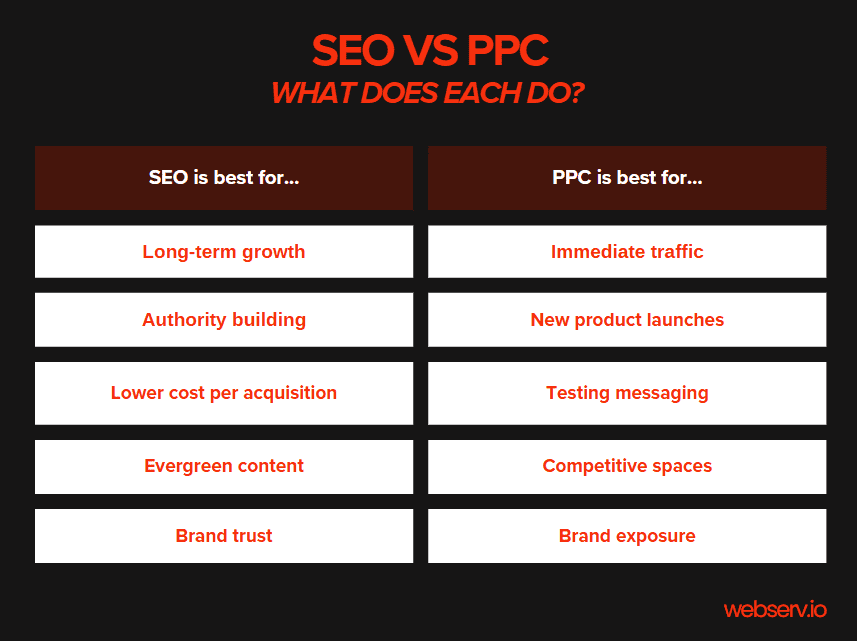
Should You Invest in SEO or PPC?
The answer: Use both SEO and PPC management, in stages. And when integrated, they outperform standalone strategies.
If you need:
- Leads now: Start PPC
- Authority later: Build SEO
- Scalable growth: Blend both
How to Integrate SEO and PPC Management for Maximum Results
SEO and PPC perform best when they operate as a unified system—not separate campaigns. When organic search and paid advertising share data and strategy, businesses gain faster insights, stronger visibility, and higher returns across the funnel.
Here’s how to effectively use SEO and PPC together as part of your digital marketing and sales strategy:
Target Competitive Keywords with PPC While SEO Builds Authority
Highly competitive keywords can take months (or years) to rank organically. PPC allows you to generate traffic immediately, while SEO works behind the scenes to build authority and long-term positioning.
Retarget Organic Traffic with PPC
Not every visitor converts on the first visit. PPC retargeting allows you to re-engage users who previously visited your site through organic search—helping recover lost opportunities and increase conversion rates.
Use PPC Ads to Test SEO Content Performance
Instead of guessing what content will perform, PPC ads give you fast feedback. Use paid campaigns to test:
- Headlines
- Calls-to-action (CTAs)
- Keyword performance
Then apply high-converting insight to your organic content strategy.
Establish SERP Dominance
Appearing in both paid and organic results increases visibility, credibility, and click-through rate. Owning multiple positions on the search results page builds brand authority and improves total traffic capture.
Build PPC Audiences Using SEO Traffic
SEO brings consistent traffic. PPC converts it into smart audience targeting. Use organic visitors to build:
- Remarketing lists
- Engagement audiences
- Conversion pools
This improves targeting efficiency and lowers acquisition cost.
Collect Keyword Conversion Intelligence
Let PPC identify which keywords:
- Generate leads
- Drive revenue
- Convert at the highest rate
Then use that intelligence to guide your long-term SEO content priorities.
Optimize SEO Web Design Using PPC Data
PPC performance highlights what converts. Apply those insights to improve:
- Page structure
- CTA placement
- Trust elements
- Form design
Better UX supports both organic rankings and paid conversion rates.
Launch New Products Using PPC Before SEO Matures
SEO takes time. PPC accelerates visibility for new services or product launches by driving traffic instantly, giving your SEO strategy time to mature in parallel.
Use SEO to Lower PPC Costs
Well-optimized landing pages improve Quality Score, which lowers CPC (cost-per-click). In short: Strong SEO infrastructure makes PPC cheaper and more efficient.
6 Best Practices for Integrating SEO and PPC Management at Scale
Running SEO and PPC together successfully requires more than strategy—it requires operational alignment. These best practices ensure that your organic and paid campaigns work toward the same business goals rather than operating in silos.
1. Use Shared Dashboards
Using a shared analytics dashboard allows both teams to view performance in one place. When SEO and PPC stakeholders work from the same data, decisions move faster and production improves.
A shared dashboard should track:
- Traffic and conversions from both channels
- Keyword performance
- Cost-per-lead and ROI
- Landing page engagement metrics
Centralized visibility prevents misalignment and eliminates guesswork.
2. Employ Unified Reporting
SEO and PPC reporting should be combined, not separated. A unified report lets teams see how both channels contribute to revenue across the entire funnel.
Reporting should focus on:
- Total channel contribution
- Assisted conversions
- Customer journey touchpoints
- Growth trends across search visibility
This approach shifts reporting from vanity metrics to performance metrics.
3. Do Funnel Mapping
SEO and PPC often operate at different stages of the funnel—but both need visibility into the full journey.
Mapping your funnel ensures:
- PPC captures bottom-funnel demand
- SEO nurtures mid- and top-funnel traffic
- Retargeting happens strategically
- Leads are handled appropriately
Without funnel clarity, traffic increases without revenue gains.
4. Use ROI-Based Keyword Prioritization
Not all keywords deserve equal attention.
Use PPC data to identify:
- Keywords that convert
- Keywords that drive revenue
- Keywords with high buyer intent
Then prioritize those keywords in SEO content planning. This ensures organic traffic isn’t just high-volume—but high-value.
5. Always Think Conversion-First Design
Traffic means nothing without conversion.
Every landing page should be designed for:
- Clear messaging
- Strong calls-to-action
- Trust signals
- Fast load speed
- Mobile usability
When SEO and PPC both drive to optimized pages, cost-per-acquisition decreases and ROI increases.
SEO and PPC Management FAQs
Here are some questions people also ask me about SEO and PPC management:
How do I find the right keywords to target for SEO and PPC?
You find the right keywords by identifying the search terms your ideal customers use and targeting the ones most likely to drive traffic, leads, and revenue.
Effective keyword research identifies the right search terms people use in Google Search and maps them to commercial intent across the Google SERP.
Strong keyword strategy directly influences search rankings and ensures your content aligns with how users actually search before they ever convert.
Why isn’t my website ranking on Google even though I have content?
Publishing content alone isn’t enough—rankings depend on authority, technical health, and how your site is structured.
Website ranking is influenced by a combination of domain authority, backlink diversity, Link Building, and how well your site architecture optimization supports crawlability and indexation.
Smart use of internal links and a strategic internal link structure help distribute authority across key pages, while regular website audits surface technical issues that negatively affect long-term visibility in search rankings.
How do I know if my website content is actually working?
Your content is working if it attracts traffic, keeps people engaged, and drives conversions.
High-performing website content is built on strategic content marketing and designed around strong landing page experience signals that reduce bounce rate. When content aligns with keyword demand and closes known content gaps, users stay longer and engage more.
Proper optimization ensures your pages not only rank but also convert, blending search visibility with UX performance.
What does PPC management actually include?
PPC management covers everything from launch and optimization to testing and performance reporting.
A full-service Pay-per-click management approach includes campaign setup, advanced bid management, creative testing, and ongoing optimization across platforms like Microsoft Ads, Amazon Ads, and the Google Display Network.
Teams monitor impression share, manage your bidding system, and refine ad creative while ensuring your ad campaign consistently produces measurable paid results.
Should SEO and Google Ads work together or separately?
SEO and PPC perform best when they’re integrated into one strategy instead of run separately.
When SEO and paid media operate inside a single marketing strategy, performance compounds. Aligning market positioning with data synergy ensures campaigns reinforce each other rather than compete. Businesses in professional services see better lead quality and faster scalability when organic and paid visibility grow together instead of in silos.
Does SEO & PPC work differently for certain industries?
Yes, each industry requires a different approach to keyword strategy, messaging, and conversion paths.
Something like addiction and rehab services requires different keyword targeting, conversion strategies, and attribution logic than local shops or real estate services. Campaign structure, bidding strategy, and content formats all shift based on how buyers search and convert within each vertical, making industry-specific execution critical for ROI.
Can technical issues hurt my Google rankings?
Yes, technical problems can block crawling, indexing, and performance, which harms rankings.
SEO agencies often use a RACI chart to define accountability across SEO strategists, PPC managers, creatives, and data teams. This model ensures visibility, ownership, and execution clarity, preventing delays and miscommunication while improving delivery consistency.
Scale Smarter with an Integrated SEO + PPC Management Strategy
Stop running paid ads and SEO in silos. Give us 15 minutes, and we’ll show you how search and paid media work together to produce predictable outcomes for your facility. Book an intro call with Webserv now.