Lead generation for treatment centers is the strategic process of attracting and nurturing potential patients through targeted digital marketing that connects individuals seeking help with appropriate care.
Lead generation is important because it creates a predictable system for connecting people in crisis with treatment while maintaining the census levels facilities need to remain viable.
This article provides a comprehensive roadmap for building effective lead generation systems that balance patient acquisition with ethical practices, covering digital strategy, compliance, and ROI optimization.
Stop wasting budget on the wrong leads. Learn how Webserv’s performance-driven marketing solutions increased one treatment center’s mobile conversion rates while reducing ad spend by 61%.
What is Rehab Lead Generation?
Lead generation for treatment centers is the strategic process of attracting, identifying, and nurturing potential patients who may benefit from addiction treatment or mental health services.
This process encompasses various digital marketing tactics designed to connect with individuals actively seeking help, their concerned family members, or healthcare professionals making referrals.
8 Benefits of Rehab Lead Generation You Can’t Afford to Ignore
Implementing a comprehensive lead generation strategy delivers measurable advantages that extend beyond simply filling beds:
- Predictable Patient Flow: A well-structured lead generation system creates consistent inquiry volume, allowing treatment centers to forecast admissions and maintain optimal census levels throughout seasonal fluctuations.
- Improved Patient-Facility Matching: Targeted marketing efforts help connect individuals with programs specifically designed for their needs, increasing treatment success rates and reducing early discharge rates.
- Enhanced Market Positioning: Strategic lead generation establishes your facility as a trusted authority in specific treatment modalities, demographics, or insurance networks, differentiating you from competitors.
- Reduced Cost Per Admission: Data-driven optimization of marketing channels and messaging progressively lowers acquisition costs while improving lead quality over time.
- Greater Insurance Mix Control: Targeted campaigns can be calibrated to attract patients with preferred insurance coverage, improving revenue per admission and reducing administrative burden.
- Measurable Marketing ROI: Unlike traditional awareness campaigns, digital lead generation provides clear attribution from marketing investment to patient admissions and revenue generated.
- Competitive Intelligence: Lead generation systems provide valuable data about market trends, competitor positioning, and evolving patient needs that inform broader business strategy.
- Scalable Growth Infrastructure: A proven lead generation framework can be replicated across multiple locations or expanded to new service lines, supporting sustainable organizational growth.
13 Strategies for Rehab Lead Generation
Here are 13 digital marketing strategies to use for treatment center lead generation.
Learn how Webserv helps treatment centers implement these strategies.
1. Website Development and Optimization
Your treatment center website is the hub for all digital marketing and often the first interaction potential patients have with your facility.
Step A: Organize for Patient Decisions
- Prioritize treatment approaches, insurance acceptance, and program details over administrative content
- Make key pages accessible within two clicks
- Include multiple contact options: phone, forms, and chat
Step B: Optimize Technical Performance
- Keep page load times under 3 seconds (delays cause 50%+ abandonment)
- Optimize images and code efficiency
- Use content delivery networks for consistent performance
Step C: Ensure Accessibility
- Write at appropriate reading levels for diverse backgrounds
- Offer multilingual content where needed
- Enable assistive technology compatibility
2. Building & Using Landing Pages for Conversions
Did you know: Companies with 31-40 landing pages generate 7x more leads than those with fewer landing pages.
Landing pages focus visitor attention on single conversion goals by eliminating distractions and precisely matching ad messaging—including visual design, terminology, and direct response to search intent.
Core Components:
- Compelling headline addressing visitor’s primary concern
- Concise explanation of how your program helps
- Trust indicators (accreditation, testimonials)
- Prominent calls-to-action above the fold
- Secondary content addressing objections (insurance, duration, approach)
- Callout of unique, niche, or luxury rehab amenities
Systematic Testing Strategies:
- A/B test headlines, form lengths, images, and CTA copy
- Small changes (button color, field order) can significantly impact conversions
- Compound improvements over time through continuous testing
3. Search Engine Optimization (SEO)
Search engine optimization represents the most sustainable lead generation investment for treatment centers, delivering compounding returns as organic visibility improves over time.
On-Page SEO Fundamentals
On-page optimization ensures every page clearly communicates its topic and value to search engines and visitors. Strategic keyword selection targets high-volume general terms, mid-volume treatment modalities, and long-tail patient questions based on search volume, intent, and competition.
Content quality fundamentally determines ranking potential. Search algorithms prioritize content demonstrating genuine expertise, addressing search intent comprehensively, and providing unique value.
Pro Tips:
- Target keyword mix: Combine 20% high-volume general terms, 50% mid-volume treatment-specific keywords, and 30% long-tail patient questions for balanced visibility
- Optimize titles for clicks: Keep title tags under 60 characters and include your primary keyword plus a compelling benefit or differentiator
- Write for humans first: Create comprehensive, helpful content that answers real patient questions—search engines reward genuine expertise over keyword-stuffed pages
Technical SEO Fundamentals
Technical SEO ensures search engines efficiently discover, crawl, and index your content. Site architecture should follow logical hierarchies with services organized under parent categories and clean, descriptive URLs avoiding unnecessary parameters.
Pro Tips:
- Fix technical issues first: Run a free technical audit using Screaming Frog or SEMrush to identify and prioritize crawl errors, broken links, and indexing problems before investing in content
- Optimize for mobile speed: Aim for page load times under 3 seconds on mobile (test at https://pagespeed.web.dev) since mobile users abandon 50%+ of pages that load slowly
- Use structured data: Implement Schema markup for organization, location, and service information to enhance search result visibility with rich snippets
Local Search Optimization Strategies
Local search connects treatment centers with nearby individuals seeking immediate help. Optimization focuses on consistent NAP (Name, Address, Phone) information across directories, location-specific content, and locally-focused link building.
Pro Tips:
- Claim and optimize your Google Business Profile: Complete every section (services, hours, photos, attributes), post weekly updates, and respond to all reviews within 24-48 hours for maximum local visibility
- Build citations strategically: Use BrightLocal or Yext to ensure consistent NAP across the top 50 healthcare directories—inconsistent information can drop your rankings by 30%+
- Create city-specific landing pages: Build dedicated pages for each service area you target (e.g., “Drug Rehab in [City]”) with unique local content, not duplicate templates
Business Profile Optimization for Search Visibility
Google Business Profiles appear prominently in map results and knowledge panels. Comprehensive optimization includes detailed descriptions, complete service listings, regular photo updates, and consistent review management.
Pro Tips:
- Post weekly updates: Google prioritizes active profiles—share program updates, staff spotlights, or recovery tips weekly to improve local pack rankings by up to 20%
- Respond to every review within 48 hours: Timely, personalized responses (not templates) signal active management and can increase conversion rates by 15-25% according to BrightLocal research
- Add photos monthly: Profiles with 100+ photos receive 520% more calls than average—prioritize facility tours, outdoor spaces, and amenity photos that reduce anxiety about treatment
Content Marketing and Blogging for Organic Reach
Content marketing builds organic visibility while establishing your facility as a trusted information source. Effective blog content addresses patient questions, explains treatment concepts, and nurtures prospects through their decision journey.
Content depth outperforms frequency. Comprehensive resources exploring treatment modalities, evidence-based approaches, and practical guides addressing logistical questions perform better than numerous shallow posts.
Pro Tips:
- Target “best of” and comparison keywords: Create comprehensive guides like “Inpatient vs. Outpatient Treatment” or “Best Dual Diagnosis Programs in [State]” which rank well and convert 3-5x higher than general awareness content
- Publish 2-3 deep articles monthly over 10 shallow ones: One 3,000-word comprehensive guide generates 220% more leads than shorter content according to HubSpot—focus on quality over quantity
- Answer real patient questions: Mine Google’s “People Also Ask” sections and forums like Reddit’s r/addiction for actual questions people ask, then create detailed answers that demonstrate genuine expertise
4. Pay-Per-Click (PPC) Advertising
Paid search advertising delivers immediate visibility for high-intent keywords, connecting your facility with individuals actively seeking treatment.
A. Paid Search Campaign Strategies
Effective PPC campaigns balance coverage with control through single keyword or single theme ad groups, providing maximum relevance between queries, ad copy, and landing pages. This granular approach improves quality scores, reduces CPC, and increases conversions.
Pro Tips:
- Start with exact match keywords: Begin campaigns with exact match on high-intent terms like “[insurance name] drug rehab [city]” to control costs—CPCs average $25-$185, so broad match wastes budget quickly
- Build negative keyword lists immediately: Exclude “jobs,” “career,” “salary,” “DIY,” “free,” and competitor names from day one—this typically reduces wasted spend by 30-40% in addiction treatment campaigns
- Use ad scheduling strategically: Weight 60-70% of budget to business hours (9am-6pm) when admissions teams can answer calls—conversion rates drop 40%+ for after-hours inquiries according to CallRail data
B. Targeting and Audience Segmentation
Strategic audience segmentation remains possible within healthcare advertising restrictions. Geographic targeting focuses spending on serviceable areas with bid adjustments reflecting travel distance, competition, and admission probability.
Remarketing re-engages website visitors during extended decision cycles. However, sensitivity around behavioral health privacy requires strict frequency caps and thoughtful messaging to avoid harmful or intrusive experiences.
Pro Tips:
- Use radius targeting with bid modifiers: Set base campaigns for 25-mile radius, then add +30% bid adjustments for high-intent ZIP codes within 10 miles where admission rates are highest
- Layer “in-market” audiences cautiously: Google’s “Healthcare & Medical Services” audiences can reduce CPA by 20-30%, but avoid anything labeled “substance abuse” which violates most platform policies
- Cap remarketing at 3-5 impressions per week: Treatment seekers need breathing room—aggressive remarketing (10+ ads/week) can feel predatory and violates ethical standards, while 3-5 maintains awareness without pressure
C. Budget Optimization Techniques
Effective budget management balances coverage with concentration on highest-performing terms. Portfolio bidding optimizes automatically across campaigns, but treatment centers should maintain guardrails preventing excessive spending on unproven keywords.
Seasonal adjustments accommodate predictable inquiry spikes during early year (insurance resets), summer (family interventions), and fall (academic pressures), allowing proactive budget increases during high-value periods.
Pro Tips:
- Allocate 70% to proven keywords, 30% to testing: Protect most of your budget for terms with proven cost-per-admission under $10K, while dedicating remaining budget to test new keywords and ad variations
- Front-load budget to Monday-Thursday 8am-5pm: Treatment center data shows 60% of qualified calls occur during these hours—shift 65-70% of daily budget here, then scale back 50% for evenings/weekends
- Increase budgets 40% in January and September: These months consistently show 35-50% higher inquiry volume due to insurance resets and back-to-school timing—plan budget increases 2-3 weeks before these spikes
5. Social Media Marketing
Social media serves multiple functions from awareness building to direct lead capture. Platform selection should align with target demographics, with different networks serving distinct purposes in your strategy.
Social media advertising requires careful navigation of behavioral health policies. Platforms restrict health-condition targeting, requiring creative approaches focusing on solution-seeking audiences.
Pro Tips:
- Use Facebook/Instagram for awareness, not direct response: CPL averages $15-40 (vs. $50-150 for Google), but conversion rates are 60% lower—use social for brand building and remarketing, not primary lead generation
- Post recovery success stories strategically: Video testimonials (with HIPAA-compliant releases) generate 1200% more engagement than text posts and build trust during the research phase before prospects search Google
- Target “life events” and interests, not conditions: Facebook allows targeting around “recently moved,” “new job,” or interests like “wellness” and “self-improvement”—avoid anything mentioning addiction or substance abuse which violates platform policies
6. Email Marketing
Email marketing nurtures leads through extended decision cycles, maintains referral source engagement, and supports alumni community building. Effective programs segment audiences by relationship type, engagement level, and decision journey position.
Lead nurturing sequences begin with educational value before facility-specific promotion. Initial emails address treatment approaches or insurance questions, with subsequent messages introducing programs, testimonials, and facility tours.
Pro Tips:
- Deploy 5-7 email nurture sequences over 30 days: Start with “What to Expect in Treatment” (Day 1), then “Insurance Verification Guide” (Day 3), building to “Meet Our Team” (Day 7) and “Schedule a Tour” (Day 14)—this cadence converts 25-30% better than weekly emails
- Segment by engagement level immediately: Create “hot” (opened 3+ emails), “warm” (opened 1-2), and “cold” (no opens) segments after first week, then send daily emails to hot leads while reducing cold leads to weekly
- Use HIPAA-compliant platforms only: Mailchimp and Constant Contact are NOT HIPAA-compliant—use Paubox, LuxSci, or healthcare-specific CRMs like Kipu or Dazos to avoid $50K+ violation penalties
7. Conversion Rate Optimization
Conversion rate optimization (CRO) systematically improves the percentage of visitors completing desired actions, multiplying the value of all marketing investments. Even modest improvements compound into substantial lead volume increases and cost reductions over time.
Pro Tips:
- Start with Hotjar or Microsoft Clarity (free): Install session recording and heatmaps immediately—you’ll discover 5-10 quick wins within the first 100 recordings (common issues: broken mobile forms, confusing navigation, missing trust signals)
- Focus on high-traffic, low-converting pages first: A 2% improvement on a page with 1,000 monthly visitors generates 20 extra leads—prioritize your top 5 entry pages for maximum ROI
- Test one element at a time: Changing headlines, CTAs, and forms simultaneously makes it impossible to know what worked—run focused A/B tests for 2-4 weeks minimum to reach statistical significance
8. Testing and Improvement Methodologies
A/B testing compares variations systematically to identify optimal approaches. Valuable tests for treatment centers include headline variations, form length comparisons balancing information gathering against completion, and call-to-action testing between phone versus form contact.
Pro Tips:
- Run tests for minimum 2-4 weeks or 1,000 conversions: Treatment center traffic is typically lower volume—premature decisions based on 50-100 conversions lead to false positives 40% of the time according to Optimizely data
- Test high-impact elements first: Start with headlines (can improve conversions 20-40%), then CTAs (10-30% lift), then form fields (15-50% lift)—save button colors and minor design tweaks for later
- Use 95% confidence threshold minimum: Don’t implement changes until your testing tool shows 95%+ confidence and at least 7 days of data—weekend vs. weekday behavior differs significantly in addiction treatment searches
9. Call-to-Action Optimization
CTA effectiveness directly impacts lead generation. Optimal CTAs balance visibility, clarity, and motivation while addressing the emotional complexity of seeking treatment. Button copy should focus on outcomes—”Start Your Recovery” outperforms generic “Submit” language.
Pro Tips:
- Use outcome-focused CTA copy: “Verify My Insurance in 60 Seconds,” “Start My Recovery Journey,” or “Speak to an Admissions Specialist Now” convert 30-50% better than “Submit,” “Click Here,” or “Learn More”
- Place CTAs every 2-3 scrolls (600-900 pixels): Add CTAs after key benefit sections, testimonials, and insurance information—pages with 3-5 CTAs convert 25% better than single CTA pages according to Unbounce data
- Make CTAs stand out with contrasting colors: Use high-contrast colors (orange/green on blue backgrounds) and make buttons 44×44 pixels minimum for mobile—CTAs should be instantly visible without competing with surrounding content
10. Form and Intake Process Refinement
Form design significantly impacts completion rates, with each field creating abandonment opportunities. Multi-step forms often outperform single long forms by creating commitment through progressive disclosure.
Pro Tips:
- Limit initial forms to 3-5 fields maximum: Each additional field reduces conversion by 10-15%—capture name, phone, email, and optionally “best time to call” or “insurance provider,” then gather clinical details by phone
- Use multi-step forms for 6+ fields: Break longer forms into 2-3 steps (Step 1: Contact info, Step 2: Insurance, Step 3: Treatment needs)—this approach increases completion rates by 30-50% according to Unbounce research
- Add trust signals near forms: Place “HIPAA Secure,” “Confidential,” or “We Accept Your Insurance” badges directly above or beside forms—this increases submission rates 15-25% by reducing privacy concerns
11. Automation and Efficiency Tools
AI applications enhance treatment center marketing efficiency through machine learning algorithms that optimize ad delivery, predict lead quality, and personalize content at scale.
Marketing automation platforms coordinate multi-channel communication based on prospect behavior. Automated workflows ensure timely follow-up when visitors download resources, submit forms, or abandon applications mid-completion, maintaining engagement during critical hours when response speed impacts conversion probability.
Pro Tips:
- Implement AI chatbots for after-hours coverage (5pm-9am): Tools like Drift or Intercom with healthcare compliance capture 20-30% more leads during off-hours when 40% of crisis-driven searches occur—set up to collect contact info and escalate urgent cases
- Use predictive lead scoring to prioritize follow-up: Platforms like HubSpot or Salesforce Einstein score leads based on 20+ factors (pages viewed, time on site, form completions)—focus admissions team on leads scoring 70+ for 3x higher conversion rates
- Automate immediate response emails: Set up workflows that send personalized confirmation emails within 60 seconds of form submission—this simple automation increases answer rates by 35% and reduces lead drop-off during the critical first hour
12. Predictive Analytics for Lead Quality
Predictive models evaluate leads against historical admission patterns, identifying insurance verification success, clinical appropriateness, and admission probability. High-probability leads receive immediate attention while lower-quality prospects enter longer-term nurturing.
Lifetime value prediction extends analysis beyond initial admission to consider readmission probability, alumni engagement, and referral generation, justifying higher investment for leads demonstrating sustained recovery and facility advocacy characteristics.
Pro Tips:
- Build a simple lead scoring model with 5 key factors: Assign points for insurance type (PPO=10, Medicaid=3), referral source (clinical=10, web=5), response speed (under 1 hour=8), geography (local=7), and engagement (multiple page views=6)—leads scoring 30+ convert 5x better
- Use multi-touch attribution over last-click: Platforms like HubSpot or Google Analytics 4 show that treatment seekers average 7-12 touchpoints before admission—giving credit only to the final click undervalues SEO, content, and awareness campaigns by 40-60%
- Calculate lifetime value by insurance type: Track which insurance providers generate highest LTV through longer stays, better reimbursement rates, and referral likelihood—then weight marketing spend toward attracting those payor types for 20-30% better ROI
13. Personalization at Scale
Dynamic content delivery adapts website messaging based on visitor characteristics including location, referral source, and engagement history. First-time visitors see general overviews while returning visitors receive content addressing specific concerns they previously explored.
Pro Tips:
- Personalize landing pages by traffic source: Show “Verify Your [Insurance Name] Coverage” headlines to visitors from insurance-specific PPC ads, while organic visitors see general “Get Confidential Treatment Help”—this simple personalization increases conversions 15-25%
- Use behavioral email triggers for abandoned forms: Send automated follow-up within 1 hour if someone starts but doesn’t complete a form—these emails recover 10-15% of abandoned leads with subject lines like “We’re Here to Help—Let’s Continue Your Conversation”
- Retarget competitor website visitors with comparison content: Use Google Display or Facebook ads showing “Why Choose [Your Center]” messaging to people who visited competitor sites—focus on unique differentiators like specialized programs, better insurance networks, or superior outcomes data
Lead Management and Qualification for Treatment Centers
Not all inquiries represent equally viable admission opportunities. Systematic qualification processes allow efficient resource allocation toward prospects most likely to admit while maintaining respectful engagement with all inquiries regardless of immediate conversion potential.
Identifying High-Quality Prospects
Initial qualification assesses insurance coverage, clinical appropriateness, and geographic accessibility through automated systems or brief intake conversations, identifying leads requiring deeper engagement versus referral.
Insurance verification determines financial viability and reimbursement rates, with many centers prioritizing PPO insurance given reimbursement differentials. Advanced verification confirms coverage for intended care levels and duration.
Scoring and Prioritization Systems
Lead scoring assigns numerical values based on demographics, insurance type, clinical acuity, support system, and urgency, creating composite scores guiding response prioritization.
Behavioral scoring supplements demographics with engagement signals. Leads researching multiple pages, downloading resources, or returning multiple times demonstrate higher intent than single-page visitors. Email engagement provides additional indicators of genuine interest.
Maximizing Return on Investment
Treatment centers should track complete attribution from marketing investment through admission revenue, identifying profitable channels versus those requiring adjustment.
Cost per lead reveals channel efficiency, but must be evaluated alongside lead quality—lower-cost sources often yield less qualified prospects converting at lower rates.
Lifetime value analysis extends beyond initial admission to consider readmission patterns, length of stay, and reimbursement rates, justifying elevated acquisition costs when total revenue substantially exceeds initial investment.
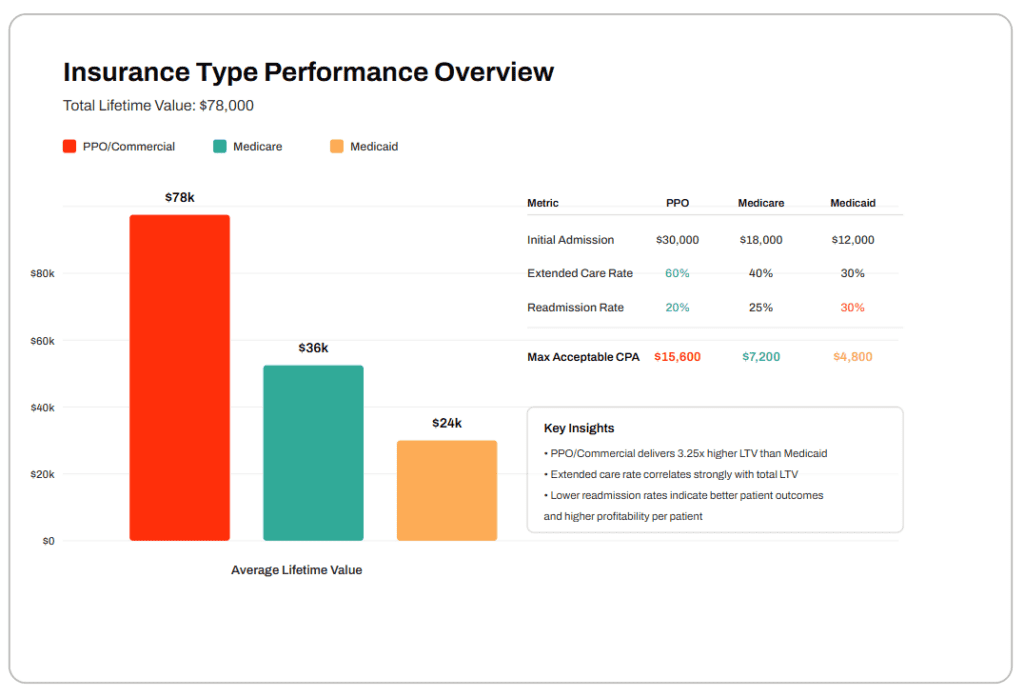
Sample Lifetime Value (LTV) Calculation for Treatment Centers
Example Patient Profile: 30-Day Residential Treatment
Initial Admission Revenue:
- 30-day residential treatment: $30,000
- Insurance reimbursement rate (PPO): $24,000
- Patient responsibility: $6,000
- Total initial admission revenue: $30,000
Extended Care Revenue:
- 60-day PHP (Partial Hospitalization): $18,000
- 90-day IOP (Intensive Outpatient): $9,000
- Total extended care: $27,000
Readmission Revenue (within 3 years):
- 20% probability × $30,000 = $6,000
Alumni Referrals:
- Average 0.5 referrals per alumni × $30,000 = $15,000
Total Lifetime Value: $78,000
Lead Nurturing and Follow-Up for Treatment Centers
Treatment seeking rarely follows linear timelines, with decision cycles ranging from weeks to months as individuals cycle through readiness stages.
Communication Cadence Strategies
Initial response within five minutes of inquiry yields dramatically higher connection rates, reflecting crisis-driven treatment seeking and competitive dynamics.
Subsequent follow-up should balance persistence with respect using varied methods (phone, email, text) while avoiding outreach to explicitly disengaged prospects.
Long-term nurturing with monthly educational content and program updates maintains relationships with leads not ready for admission, with many conversions occurring months after initial inquiry.
Multi-Touch Engagement Approaches
Different individuals prefer different channels—phone for personal connection, email for detailed information, and text for brief mobile communication. Integrated campaigns employ all three strategically.
Content variety—educational posts, videos, testimonials, and insurance guidance—maintains engagement across extended timeframes while preventing repetitive communication.
Relationship Building Throughout the Decision Cycle
Trust development establishes your facility as credible and compassionate through consistent demonstration of expertise, empathy, and ethical practice.
Educational content explaining treatment approaches, evidence-based modalities, and recovery guidance builds credibility while serving genuine informational needs independent of facility selection.
Compliance and Best Practices for Rehab Lead Generation
Treatment center marketing must navigate complex regulatory requirements while maintaining ethical standards that protect vulnerable populations and build lasting trust.
HIPAA Compliance in Marketing and Lead Generation
HIPAA regulations require careful privacy protection throughout prospect interactions. While marketing to prospective patients generally falls outside HIPAA constraints, the transition to patient status creates compliance obligations requiring systematic processes.
Protected Health Information (PHI) includes health status, treatment, or payment information linked to individuals. Marketing systems must prevent PHI exposure through secure transmission, encrypted databases, and access controls.
Privacy Regulations and Data Protection
Beyond HIPAA, treatment centers must navigate evolving privacy regulations, including state consumer protection laws and GDPR for international patients, establishing requirements around data transparency, purpose limitations, and individual access rights.
Cookie consent and tracking disclosure require clear notification of website analytics and tracking technologies, providing visitors meaningful choices about acceptance rather than merely notifying them of data collection.
Ethical Marketing Standards for Treatment Services
Legal compliance establishes minimum standards, while ethical marketing prioritizes appropriate treatment alignment over admission volume, even when limiting revenue opportunities.
Targeting practices should avoid exploiting vulnerable moments. Ethical practice avoids aggressive remarketing that pressures hasty decisions or targets individuals in acute distress with repetitive advertising.
Measuring Success for Rehab Lead Generation
Comprehensive measurement systems track performance across the marketing funnel from initial impression through completed admission. Different metrics reveal distinct insights about strategy effectiveness and optimization opportunities.
Key Performance Indicators and Metrics
Top-of-funnel metrics (impressions, clicks, traffic) indicate visibility and initial interest but provide limited insight into lead quality or conversion effectiveness.
Mid-funnel engagement metrics (page views, time on site, content consumption) reveal how effectively your website engages visitors. High bounce rates suggest messaging misalignment requiring optimization.
Conversion metrics (form submissions, calls, chat interactions) measure lead generation effectiveness and should be tracked by source for channel-level optimization.
Qualification metrics assess lead quality through insurance verification rates, clinical appropriateness, and admission eligibility. High inquiry volume with low qualification suggests targeting problems.
Admission metrics connect marketing to business outcomes. Admission volume by source, cost per admission, and revenue per admission enable data-driven budget allocation.
Sample KPIs for Treatment Center Lead Generation
Traffic & Visibility Metrics:
- Monthly website sessions: [Target: 5,000-10,000]
- Organic search impressions: [Target: 50,000-100,000]
- Branded search volume: [Target: 500-1,000/month]
- Google Business Profile views: [Target: 2,000-5,000/month]
Engagement Metrics:
- Average session duration: [Target: 3-5 minutes]
- Pages per session: [Target: 4-6 pages]
- Bounce rate: [Target: <50%]
- Return visitor rate: [Target: 25-35%]
Lead Generation Metrics:
- Total monthly inquiries: [Target: 50-150]
- Form conversion rate: [Target: 3-5%]
- Phone call conversion rate: [Target: 2-4%]
- Cost per lead (CPL): [Target: $50-$300]
Lead Quality Metrics:
- Insurance verification rate: [Target: 60-80%]
- Clinical appropriateness rate: [Target: 70-85%]
- Lead-to-admission conversion rate: [Target: 15-30%]
- Average lead response time: [Target: <5 minutes]
Revenue Metrics:
- Cost per admission (CPA): [Target: $1,500-$8,000]
- Admission volume by channel: [Track: SEO, PPC, Referral, Social]
- Average revenue per admission: [Target: $15,000-$40,000]
- Marketing ROI: [Target: 3:1 to 5:1 revenue-to-spend ratio]
- Patient lifetime value (LTV): [Target: $40,000-$80,000]
Channel Performance:
- SEO: CPA [Target: $1,500-$4,000]
- PPC: CPA [Target: $3,000-$10,000]
- Referrals: CPA [Target: $500-$2,000]
- Social Media: CPA [Target: $2,000-$6,000]
ROI Tracking and Attribution
Multi-touch attribution acknowledges that admissions rarely result from single interactions. Attribution models should credit all influential touchpoints rather than oversimplifying to first-touch or last-touch attribution.
Channel-specific ROI analysis reveals which tactics generate profitable patient acquisition. Calculate cost per admission by channel, comparing against average revenue per admission to identify positive ROI channels.
Continuous Improvement Strategies
Lead generation optimization is an ongoing process requiring regular strategy reassessment as market dynamics, competitive landscapes, and platform capabilities evolve continuously.
Regular performance reviews should occur monthly minimum, with weekly analysis during active optimization. Reviews should assess performance against targets, identify underperforming elements, and recognize successful tactics worthy of expansion.
What Next?
Ready to turn your lead generation strategy into predictable patient admissions? Book a free intro call with Webserv to discover how our Predictable Patients™ methodology delivers measurable VOBs and admissions for 200+ treatment centers.